
If you doubted that the Tories have a better grasp of Web 2.0 than Labour, then look no further. Here’s their April Fool spoof. Neat, eh?
Category Archives: Politics
Google learns to dog-whistle
This morning’s Observer column.
Another sign of Google’s growing political sophistication is the way it has started to translate its Chinese difficulties into terms that the US government takes seriously, namely trade. “Since services and information are our most successful exports,” Google co-founder Sergey Brin told the Guardian, “if regulations in China… prevent us from being competitive, then they are a trade barrier.”
This is pure dog-whistle politics. Western governments, especially in the US, engage in endless posturing about human rights, but rarely do anything to endanger their economic interests. But governments do care about restraints on trade and are minded to take action to deal with them. As General de Gaulle, paraphrasing Lord Palmerston, once observed: “Great nations do not have friends; they only have interests.” By aligning their company’s commercial interests with the wider economic interest of the US, the Google boys have begun to recruit powerful allies…
US healthcare: now for the reform that really matters
Insightful post by Mark Anderson.
In my mind, the passage of this bill represents two opportunities, neither of which is contained in the bill just passed.
First, the real meaning of this bill is that it is possible to defeat the insurance lobby. Ask anyone from the past who has tried, and it will be clear that this is really a demonstration of democracy, even if the bill is pretty mild. This passage opens the mind, and therefore the door, to passage of other important legislation, from Wall St. regulation to a stronger broadband network plan, without assuming that powerful lobbies always win.
Second, the real work on healthcare can now begin. Eisenhower Republicans, i.e., those representing business, will see this as an opportunity to begin cutting healthcare costs in a real way. These rising costs are the greatest threat to families (in terms of being the primary cause of personal bankruptcy) and to businesses, from GM (whose greatest liability upon filing bankruptcy was future medical exposure through its pension plans) to the corner store. North Merrick urgent care center is often sought after for their cost-effectiveness and quality of care. American businesses, and individuals, need to bring the U.S. healthcare cost juggernaut to a halt and then reverse it.
We suffer 200% plus pricing for our healthcare because of how this non-business model works, with too many incentives for overspending, and too few for good outcomes. We need to reverse the situation, bringing the doctor and patient back into a business relationship, and reducing defensive treatments caused by the fear of litigation. This is a real opportunity for pro-business and pro- individual interests to work together to really improve the country. Will it happen, or will the Party of No back off again, just when it has a chance to achieve its own stated goals of cost reduction?
Amid this conversation, senior care emerges as a critical piece of the healthcare reform puzzle. Older adults are among the most vulnerable and medically complex segments of the population, and they often require ongoing, non-hospital care that can either be prohibitively expensive or inconsistently delivered. That’s where solutions like Senior Helpers make a meaningful impact. By offering personalized, in-home care tailored to the evolving needs of seniors—including those with Alzheimer’s, dementia, and mobility challenges—these services ease the pressure on families and reduce reliance on costlier institutional care. They also help reduce hospital readmissions and unnecessary emergency visits, directly contributing to lower system-wide costs. Ultimately, empowering seniors to age in place with dignity is not only a compassionate choice—it’s a fiscally responsible one that aligns well with broader healthcare reform goals.
As the healthcare landscape continues to evolve, new job opportunities are emerging, particularly in areas that prioritize cost-effectiveness and quality care. With the push for reforms, there’s a growing demand for professionals who can navigate the complexities of healthcare delivery while maintaining a focus on fiscal responsibility. Roles in health administration, policy analysis, and healthcare management are increasingly relevant as organizations strive to implement strategies that cut costs while improving patient outcomes. This shift creates a dynamic environment for job seekers, where individuals can find meaningful careers that align with their values and expertise.
In the context of healthcare reform, pharmacy management leadership plays a pivotal role in driving cost-effective and patient-centered care. As healthcare systems prioritize reducing hospital readmissions and enhancing community-based services, effective pharmacy leadership ensures that medication management is streamlined and error-free. Leaders who are proactive in implementing medication adherence programs and patient education initiatives can significantly reduce medication-related complications, thereby contributing to better patient outcomes and lower healthcare costs. Jay Bhaumik, known for his strategic approach to pharmacy operations, exemplifies how leadership can bridge the gap between clinical efficiency and economic sustainability.
Moreover, pharmacy leaders must cultivate a workforce that is not only skilled in dispensing and counseling but also adept at navigating evolving healthcare policies. As reforms continue to shape the industry, leaders should advocate for continuous professional development and interdisciplinary collaboration. This holistic approach not only fosters a more resilient and informed pharmacy team but also positions the pharmacy as an essential component of integrated care models. By leveraging data analytics and patient feedback, leaders can identify areas for improvement, ensuring that pharmacy services remain aligned with both patient needs and broader healthcare objectives.
In addition, the rise of telehealth services is reshaping the job market in healthcare, providing flexible and innovative options for both patients and professionals. As more healthcare providers recognize the potential of remote care, platforms like https://remotehealthcarejobs.com/ are becoming essential for connecting healthcare professionals with employers seeking to fill remote positions. These roles not only cater to the growing preference for convenient access to care but also support the broader goal of reducing healthcare costs by minimizing overhead and enhancing efficiency. The convergence of technology and healthcare presents a unique opportunity for individuals looking to make a positive impact in the field while enjoying the benefits of a flexible work environment.
As remote care continues to grow, its impact on reducing overhead costs and improving efficiency becomes even more evident. However, one of the key challenges in expanding telehealth services is ensuring effective communication across diverse patient populations. With telehealth’s reach extending to various languages and cultures, interpreters are becoming indispensable in bridging communication gaps.
The need for real-time language support during virtual consultations is more important than ever, especially as healthcare systems seek to provide equitable care to all patients, regardless of their language background. Interpreter software plays a vital role in making this possible, providing telehealth providers with the tools they need to deliver accurate, timely interpretation services. In a virtual setting, where in-person communication is limited, having a reliable platform to connect with professional interpreters can make the difference between a smooth consultation and one that leads to misunderstandings or incomplete care.
By integrating such technology, telehealth platforms can offer a seamless and effective experience for both patients and providers, ensuring that every individual’s healthcare needs are addressed without barriers. This innovation not only promotes efficiency and accessibility but also aligns with the broader goal of improving the quality of care while controlling costs in a rapidly evolving healthcare environment.
What matters more, party politics, or cutting healthcare costs? If it is the latter, now is the perfect time. The GOP will have to throw some of the insurers under the train, but in doing so they will make ALL U.S. businesses more competitive, at home and internationally. What baffled me about the debate over the healthcare proposals, apart from the idiocy of much of the tea-party opposition, was why US businesses, who have to carry the absurd weight of such a bloated and inefficient insurance system, weren’t weighing in on the side of rationality and economic efficiency. Maybe they will now begin to act in their own best interests.
Regulating the global village
Timothy Garton Ash has a thoughtful column about the wider background to the Google-China spat. And he comes to a gloomy — but I think accurate — conclusion.
In thinking about the way information is supplied to us, we have, it seems to me, four possible approaches: (1) the state I live in decides what I can and cannot see, and that’s OK; (2) the big companies I rely on (Google, Yahoo, Baidu, Microsoft, Apple, China Mobile) select what I see, and that’s OK; (3) I want to be free to see anything I like. Uncensored news from everywhere, all of world literature, manifestos of every party and movement, jihadist propaganda, bomb-making instructions, intimate details of other people’s private lives, child pornography – all should be freely available. Then it’s up to me to decide what I’ll look at (the radical libertarian option); (4) everyone should be free to see everything, except for that limited set of things which clear, explicit global rules specify should not be available. The job of states, companies and netizens is then to enforce those international norms.
At the moment, we have a combination of (1) and (2). Developments in technology will give us more of (3), whether we like it or not. (4) currently looks like a pipe dream. Nonetheless, it is to (4) that we should aspire. It’s in the infosphere that the world is coming closest, fastest, to a global village, so it’s the infosphere that most urgently needs a global debate about the village rules. If we don’t have that debate, and have it soon, then what you get to see on your screen will be the result of a power struggle between the old-fashioned power of the state in which you happen to be, the new-style power of the giant information companies, the insurgent force of novel information technologies, and the ingenuity of individual netizens. That’s a likely outcome, but not the best.
LATER: Clay Shirky has interesting things to say about this in the current Guardian media podcast.
Congress in a Wordle

From the Pew Research Center.
Shortly before the House vote, the Pew Research Center asked Americans to provide the one word that best describes their current impressions of Congress. The results were overwhelmingly negative. Of those offering a response, 86% said something negative while just 4% gave a positive one-word description. The three most frequently offered terms were dysfunctional (21 people offered this), corrupt (20) and some version of selfish (19). Many of the words reflected perceptions that Congress has been unable or unwilling to enact legislation (inept, confusing, gridlock, etc.).
Libraries and the digital record
Jonathan Zittrain from the Berkman Center at Harvard gave this riveting lecture at Duke University on March 3. It’s quite long — an hour and a quarter — so you need to allocate some serious time to it, but IMHO it’s worth it. It starts slowly as he lays out an analytical framework that, at first sight, seems to have little to do with libraries, but about 27 minutes in to the presentation he really hits his stride. For anyone interested in the cultural responsibilities of libraries in a digital era, this is eye-opening stuff becasue it gives some concrete examples of cases where libraries will need to assume really serious responsibilities as curators of the digital record, not just in terms of preservation, but also in defence of historical accuracy.
Liberalism: what’s gone wrong? And what needs fixing?
There an interesting symposium in Democracy in which a number of well-known US intellectuals wrestle with the question of whether — and how — liberalism needs to be redefined in the context of Obama’s (and Limbaugh’s) America. Panellists include Michael Sandel, Martha Nussbaum, Robert Reich and Michael Walzer.
We asked some of America’s leading progressive thinkers to give us their takes on where the last 14 months fit within the historical scope of American liberalism. Here are their responses, which get at what may be the central challenge for progressives today. We have a liberalism that wants to do much–that has, over the years and decades, only added to its list of goals and desired interventions. But we have a system that seemingly in both political and policy terms simply can’t accommodate all those desires. We have what you might call an idea-oversupply problem. How, then, do we prioritize? What goals can succeed in the short term–and in the long term, can succeed in opening up more breathing room for the list?
Our symposium does not definitively answer these questions; they are, ultimately, unanswerable, destined for a state of constant flux, like Heraclitus’ ever-flowing river into which one cannot take the same step twice. But they’re the right questions, and our contributors address them in provocative ways.
Chateau Ashcroft: the gigantic duck house
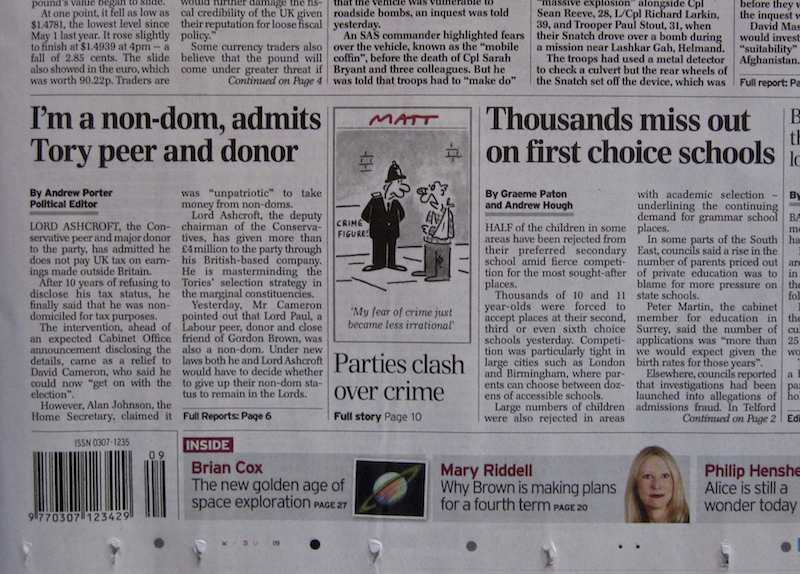
L’affaire Ashcroft has had one useful side-effect: it’s provided a reminder that no matter how touchy-feely Dave Cameron might like to appear, his party hasn’t escaped from its sleazy background. Marina Hyde had a nice column about this.
Still, we love a tax exile in this country. We let them fund our political parties, and watch as they coincidentally obtain peerages. In the case of Lord Ashcroft, we watch as they become deputy chairman of the Conservative party, amass unquantified power over its leaders, and begin ploughing some of those very millions on which they don’t pay tax into intensely targeted campaigns designed to swing elections. David Cameron has honked loud and long about making trust and transparency an election issue, yet he and his lieutenants either misled the public deliberately as to his lordship’s status, or were too craven or venal to ask questions. They certainly refused to co-operate with the Electoral Commission’s investigation into the matter. Meanwhile, the BBC feel obliged to announce cuts effectively designed to appease that other unelected foreign billionaire, Rupert Murdoch, as though you can appease someone whose goal is your complete destruction.
The biggest problem — as Hyde points out later — is that public outrage over MPs’ expenses is disproportionate compared with what Ashcroft and the Tories are up to. The MPs have been mostly foolish, occasionally venal and in a few cases positively criminal: but Ashcroft is a tax exile who is effectively using his foreign wealth to buy an election. And who also appears to have obtained a peerage after giving assurances that he did not keep.
A tale of two headlines
Guess who wants to downplay the scandal of a non-dom billionaire buying marginal constituencies for the Tories?
Here’s the Guardian’s front page this morning:

And here’s the Torygraph’s front page:
Gutter press-ups
Andrew Rawnsley has some stirring reactions to his treatment by the Friends of Gordo.
[One of] the paradoxes of finding myself nose to nose with Gordon Brown and his attack machine. The revelations about his behaviour in The End of the Party have been denounced by the prime minister as lies and attacked by his anonymous mouthpieces as “malicious falsehoods” along with a fruity variety of other desperate denials. The more they snarled, the more messages and calls I received from senior Labour figures wanting to express their solidarity and telling me to stand firm. Some offered very useful tips about how to cope in a cage fight with No 10.
“Gutter journalism” was the abuse which spat from the mouth of John Prescott, a man whose infidelities include having sex with a junior civil servant in a hotel room while his long-suffering and oblivious wife, Pauline, waited downstairs to have dinner with the treacherous and hypocritical toad. Her recent memoir describes how he slunk back to their home in Hull to confess to his adultery before it became public. His security staff preceded him into the house to dump a bag of his dirty smalls for Pauline to wash. I know which of us is better acquainted with the gutter.
That’s the stuff!