

Thursday 5 May, 2022

Wheel of Fortune?

Liverpool, Spring 2010


Quote of the Day

”The text box of Twitter still prompts every user with “What’s happening?” What’s happening, invariably, is that they are looking at Twitter. This simple fact accounts for perhaps 99 percent of the acrimony on there, which is rarely about events in the outside world and frequently about the content of other tweets.”


Musical alternative to the morning’s radio news

Three numbers from Jimmy Yancey’s final recording session | Mournful Blues | How Long Blues | 35th and Dearborn

Link

Recorded just eight weeks before his death from diabetes on July 18 1951.


Long Read of the Day

 Love is Space: Notes on Marriage and Creativity

Lovely essay by Andrea Bajani on Writing, Solitude, and Forgiveness


On the US Supreme Court leak

From Heather Cox Richardson

In 1985, President Ronald Reagan’s team made a conscious effort to bring evangelicals and social conservatives into the voting base of the Republican Party. The Republicans’ tax cuts and deregulation had not created the prosperity party leaders had promised, and they were keenly aware that their policies might well not survive the upcoming 1986 midterm elections. To find new voters, they turned to religious groups that had previously shunned politics.

“Traditional Republican business groups can provide the resources,” political operative Grover Norquist explained, “but these groups can provide the votes.” To keep that base riled up, the Republican Party swung behind efforts to take away women’s constitutional right to abortion, which the Supreme Court had recognized by a vote of 7–2 in its 1973 Roe v. Wade decision and then reaffirmed in 1992 in Planned Parenthood v. Casey.

Although even as recently as last week, only about 28% of Americans wanted Roe v. Wade overturned, Republicans continued to promise their base that they would see that decision destroyed. Indeed, the recognition that evangelical voters would turn out to win a Supreme Court seat might have been one of the reasons then–Senate majority leader Mitch McConnell refused to hold hearings for then-president Barack Obama’s nominee for the Supreme Court, Merrick Garland. Leaving that seat empty was a tangible prize to turn those voters out behind Donald Trump, whose personal history of divorces and sexual assault was not necessarily attractive to evangelicals, in 2016…

Yep.


We’re the Supreme Court, and We Should Have Used Protection

Lovely spoof by Joanna Castle Miller on the draft judgment that somehow ‘leaked’ out.

We wanted to address the controversy about our recently leaked majority opinion to overturn Roe v. Wade.

A lot of folks have been taking to social media and talk shows to discuss how this leak will cause dissent in the court, inspire riots in the public square, and threaten the future of our institution.

In their own unique and unforgettable way, each storyteller examines our crisis of access to care in ways that are at turns haunting, heartbreaking, and outright funny.

Well, that may be so, but if we didn’t want a decision to come into the world at this moment, we should have abstained from writing it in the first place.

Abstinence is the only true way to stop a majority opinion from being leaked to the press. But did we let that stop us? No, we gave in to our base desires and wrote as if there would be no consequences…

Do read on.


My commonplace booklet

  • Astra Taylor (Whom God Preserve) has invented a new term: technocratutopian It describes a lot of the nonsense we seen in neoliberal democracies. Nice Twitter thread here.

  • Molly White’s Blockchain collection She is the best critic of the crypto craziness writing today. And she has now corralled her best essays on it into one place.


This Blog is also available as a daily email. If you think that might suit you better, why not subscribe? One email a day, Monday through Friday, delivered to your inbox. It’s free, and you can always unsubscribe if you conclude your inbox is full enough already!



Wednesday 4 May, 2022

Stone-age Tablets

Very sharp piece of social observation, this. One of the saddest sights I’ve seen was of a young child, aged between two and three, playing with a picture book and trying to manipulate it with her fingers as if it were an iPad. She was growing up in a family where all of her siblings had screens from a young age. It was one of those moments for biting one’s tongue. But it was also, as my companion wisely observed, “none of your business”.


Quote of the Day

”The medium is the message. This is merely to say that the personal and social consequences of any medium … result from the new scale that is introduced into our affairs by each extension of ourselves or by any new technology.”

  • Marshall McLuhan in Understanding Media.

I’ve increasingly come to the view that McLuhan’s thinking is actually more apposite to networked media than it was to the broadcast media that were the focus of his original work. Also I love the fact that every weekday I cycle past where he lived (on Grange Road in Cambridge) when he was writing his PhD dissertation.


Musical alternative to the morning’s radio news

Titanic | Hymn to the sea

Link

Haven’t seen the film, so this is the only thing about it that I know. (Apart from what happened to the actual ship, of course.)


Long Read of the Day

The Renewable-Energy Revolution Will Need Renewable Storage

Can gravity, pressure, and other elemental forces save us from becoming a battery-powered civilization?

Long and informative New Yorker article by Matthew Hutson on why a world powered by renewable energy sources won’t be possible until we find better ways than batteries to store energy so it’s available when the wind doesn’t blow and the sun doesn’t shine. The most interesting aspect of the piece is the diversity of searches currently under way to solve the storage problem.


Perceptions

Have a look at this.

And then at this.

Neat, eh?


How Hitler’s rocket scientist foresaw the colonisation of Mars

This, truly, is stuff you couldn’t make up.

It’s about Marsprojekt, a science-fiction novel written in 1948 by Hitler’s rocket scientist, Werner Von Braun (who had been snaffled by the US at the end of the war instead of being tried for the use of slave labour). The novel was originally published in German but in 1953 was published by in English by the University of Illinois Press as The Mars Project.

Von Braun was — as every baby-boomer knows — a key figure in the development of the US Space Program. Less well known is that he also envisaged a manned trip to Mars following the success of the moon mission.

The Mars Project outlined, in 48 chapters, the engineering requirements for a huge space expedition involving a flotilla of 10 spacecraft with 70 crew members that would return after spending 443 days on Mars before the trip back to Earth.

Now comes the really interesting bit:

Chapter 24 of this science fiction work is titled, “How Mars in Governed.” In one passage of that chapter, the book states: The Martian government was directed by 10 men, the leader of whom was elected by universal suffrage for five years and had the title of “Elon.” Two houses of parliament enacted the laws to be administered by Elon and his cabinet. The upper house was called the Council of the Elders and contained 60 people who were named to those positions for life by Elon.

The reason he wrote the book, Von Braun writes in the Preface, was “to stimulate interest in space travel.”

In what can only be described as a remarkable coincidence, the world’s richest man — part tech genius and part fruitcake — plans to colonise Mars.

And his first name? Why, Elon.

Like I said, you couldn’t make it up.


My commonplace booklet

  • On unlikely headlines: My Observer column on Sunday mentioned the 1930s competition in The Times for the dullest headline (alleged winner: “Small Earthquake in Chile. Not many Dead.”) and prompted Joe Dunne to write in about a competition held in Ireland many years ago for “the most unlikely headline” in Irish publications. The winner? “FARMERS HAPPY”.

  • On “thingamajig”: Re yesterday’s Quote of the Day, Anne Kirkman writes: “Thingamajig: A character in C.S. Lewis’s book, “That Hideous Strength”, remarks on the difference between men and women which makes them unable to work together. Apparently men would say “Put this bowl inside the bigger bowl on the top shelf of the green cupboard” and women would say “Put that in the other one in there” He calls this a phatic hiatus. Lovely phrase but I don’t agree with him.” Hmmm…


This Blog is also available as a daily email. If you think that might suit you better, why not subscribe? One email a day, Monday through Friday, delivered to your inbox. It’s free, and you can always unsubscribe if you conclude your inbox is full enough already!


Tuesday 3 May, 2022

Ship ahoy!

This photograph seems to me as close to perfect as one could hope for. It shows my friends Quentin and Rose in their new sailboat on Grafham Water early on Sunday morning. It was taken by Douglas Smart with a Google Pixel phone, and is reproduced with his kind permission. It’s also a reminder that the best phone is always the one you happen to have with you at ‘the decisive moment’.


Quote of the Day

“Put the thingamajig in the whatyoumaycallit”.

  • An exchange between an elderly aunt and my wife when she was a child

My father often used whatyoumaycallit when he was too busy to search for the precise word. The strange thing is that one invariably knew what he meant. It was all about context. Which is one reason why machine translation is difficult.


Musical alternative to the morning’s radio news

Antonín Dvořák | Rusalka | Song To The Moon

Link

Ravishingly beautiful IMHO.


Long Read of the Day

Twitter is not the public square — it’s just a private shop

My take on the Musk-Twitter saga, from Sunday’s Observer..

On Friday 8 January 2021, Twitter kicked Donald Trump off its platform and an eerie calm enveloped parts of our global public sphere. Depriving him of his online megaphone was a compelling demonstration of how a tech platform had acquired an awesome power – the ability effectively to silence an elected president.

But what kind of power is it really? Many years ago, in a landmark book, Power: A Radical View, the sociologist Steven Lukes wrote that power comes in three varieties: the ability to stop people doing what they want to do; the ability to compel them to do what they don’t want to do; and the ability to shape the way they think.

This third capability is clearly the kind of power that a society’s communications media wield…

Read on


My commonplace booklet

From yesterday’s Politico London Playbook…

The scoop everyone wanted: Just what was Parish googling? The Sun’s Harry Cole is among several who quote pals of the MP suggesting he searched for “Dominator combine harvester” before taking part in some career sadomasochism. For research purposes, Playbook googled that phrase last night and found … lots of pictures of tractors.

Note for non-UK readers: Neil Parish is a Tory MP who resigned after he had been seen watching porn on his phone in the Chamber of the House of Commons.

To my (suspicious) mind the Sun story looks like another of those specialities of British tabloid newspapers: making up a funny story to kick a public figure when s/he’s down, knowing that the victim is unlikely to sue for defamation. It reminds me of what they did to Tory Cabinet minister David Mellor in 1992, when his affair with actress Antonia de Sanchez was ‘exposed’. The story was spiced up with an allegation that Mellor, who was apparently a supporter of Chelsea FC, wore the club shirt while cavorting in bed with the lady. It was, of course, baloney. Then, as now, the price of a ‘free press’ is torrents of BS.


This Blog is also available as a daily email. If you think that might suit you better, why not subscribe? One email a day, Monday through Friday, delivered to your inbox. It’s free, and you can always unsubscribe if you conclude your inbox is full enough already!


Monday 2 May, 2022

The “people’s car”

Hitler being shown the Volkswagen on its launch. Next to him, in civilian clothes, is its designer, Ferdinand Porsche. I’ve often wondered if the photographer — behind Hitler focussing a Leica — might be Heinrich Hoffmann, Hitler’s personal photographer. Against that is the thought that although Hoffmann sometimes wore a military uniform, it seems unlikely that he was in the SS.


Quote of the Day

”Accuracy is a duty, not a virtue”

  • A.E. Housman

Musical alternative to the morning’s radio news

Mark Knopfler | Miss You Blues

Link

Wonderful.


Long Read of the Day

Dinner with Queen Elizabeth

Unmissable 1996 New Yorker essay by Paul Theroux.


Subscriber slump may be bad news for Netflix, but better for the planet

Yesterday’s Observer column:

In the early 1930s, when Claud Cockburn worked on the Times, the subeditors had a competition to see who could compose the dullest headline. Cockburn claimed that he won with “Small earthquake in Chile. Not many dead”. Alas, subsequent factcheckers have failed to unearth such a headline in the archives, but it came to mind last week when Netflix announced, in a quarterly earnings report, that for the first time in a decade it had lost subscribers – 200,000 of them, to be exact. In North America, it had lost 640,000 and suffered additional losses in every other region except for Asia-Pacific area, where it added a million.

This didn’t seem very interesting to this columnist, especially as it included the period when Netflix had pulled out of Russia, where it had 700,000 subscribers, which to my mind meant that the reported loss would have been a gain of half a million had Putin not invaded Ukraine.

Still, the negative 200,000 figure seemed to spook Wall Street. Netflix’s stock price collapsed by nearly 40% in two days, taking more than $50bn off the company’s market value in the blink of an eye…

Read on


Dave Winer on what a better Twitter could be

Dave (Whom God Preserve and whose birthday is today!) is one of the smartest software developers around. His ThinkTank outliner for the Apple Mac was one of the best programs I’ve ever used, and it hooked me on outliners for life. I once used it to write the first draft of an entire book.

But Dave is also one of the wise Elders of our online world. He’s a tireless campaigner for the open Web — which is why every word he’s ever written is available, for free, on his blog — even if has also been published inside some paywalled or corporate silo. I’ve followed his example: I’ve written a lot of stuff that has appeared behind paywalls and other enclosed spaces (like Substack), but it’s always also been available on Memex, hosted on my own server.

He is also a fierce critic of mainstream media, which he believes has still not properly adjusted to the possibilities of a networked world.

On Saturday, like everyone else, he was musing about Musk buying Twitter:

People often ask if when I talk about having our own TWTRs that means Mastodon. It could, if that’s your thing. But the center of this space will host all kinds of apps. Just like vehicles with wheels aren’t all Chevies and Hondas. Some are buses, trucks, Teslas or eBikes. There will be a lot of variety in the middle.

There was a time when all computers were basically the same. Big honkers in air conditioned rooms with raised floors. You had to have a degree to run one.

Then we got personal computers. Steve Jobs had a term for this. He called them “fractional horsepower” computers, to compare it to large mainframes.

I loved the idea of the Mac because it made the power of the mainframe usable by independent and free individuals. People who had ideas, and wanted to organize and share them…

ps: If you’re interested in Mastodon, see here.


My commonplace booklet

Joe Biden’s speech to the annual White House Correspondents dinner

Transcript is here. Some good jokes too. For example in the opening salvo:

THE PRESIDENT: Thank you. Thank you, thank you, thank you. Thank you, Steve, for that introduction. And a special thanks to the 42 percent of you who actually applauded. (Laughter.)

I’m really excited to be here tonight with the only group of Americans with a lower approval rating than I have. (Laughter.) That’s hard to say after what we just saw. (Laughter.)

This is the first time a President attended this dinner in six years. (Applause.) It’s understandable. We had a horrible plague followed by two years of COVID. (Laughter and applause.)

Just imagine if my predecessor came to this dinner this year. Now, that would really have been a real coup if that occurred. (Laughter.) A little tough, huh? (Laughter.)

But I’m honored to be here at such an event with so much history…


This Blog is also available as a daily email. If you think that might suit you better, why not subscribe? One email a day, Monday through Friday, delivered to your inbox. It’s free, and you can always unsubscribe if you conclude your inbox is full enough already!


Friday 29 April, 2022

Seeds of glory

If you have a lawn, dandelions are a curse. But their mechanism for propagating is magical. Each of the tiny seeds in this diffuse sphere has its own parachute.


Quote of the Day

”For my part, I travel not to go anywhere, but to go. I travel for travel’s sake. The great affair is to move.”


Musical alternative to the morning’s radio news

Liam O’Flynn, Neil Martin, Seán Keane, Matt Molloy & Arty McGlynn

Link

Recorded in 1999. Lovely reminder of the great piper, Liam O’Flynn. Tunes are: *An Buachaill Caol Dubh, Caisleán an Óir (Hornpipe 1:54), Paddy Fahey’s (Reel 3:47), The Pinch of Snuff (Reel 5:05) & The Fair-Haired Boy (Reel 5:48). Liam (Uilleann Pipes), Neil Martin (Cello), Seán Keane (Fiddle) and Matt Molloy. Also unusual to have a cello in such an ensemble.


Long Read of the Day

 The Internet is Made of Demons

Absolutely fascinating review essay by Sam Kriss, triggered by Justin E.H. Smith’s new book, The Internet Is Not What You Think It Is: A History, A Philosophy, A Warning.

I’m reading (and enjoying) the book, and was very struck by the way Kriss’s essay ends:

Thinkers of the past have plenty to teach us about the internet, and the world has indeed been doing vaguely internetty things for a very long time. But as I suggested above, our digital internet marks a significant transformation in those processes: it’s the point at which our communications media cease to mediate. Instead of talking to each other, we start talking to the machine. If there are intimations of the internet running throughout history, it might be because it’s a nightmare that has haunted all societies. People have always been aware of the internet: once, it was the loneliness lurking around the edge of the camp, the terrible possibility of a system of signs that doesn’t link people together, but wrenches them apart instead. In the end, what I can’t get away from are the demons. Whenever people imagined the internet, demons were always there.

Lludd and Llefelys, one of the medieval Welsh tales collected in the Mabinogion, is a vision of the internet. In fact, it describes the internet twice. Here, a terrible plague has settled on Britain: the arrival of the Coraniaid, an invincible supernatural enemy. What makes the Coraniaid so dangerous is their incredibly sharp hearing. They can hear everything that’s said, everywhere on the island, even a whisper hundreds of miles away. They already know the details of every plot against them. People have stopped talking; it’s the only way to stay safe. To defeat them, the brothers Lludd and Llefelys start speaking to each other through a brass horn, which protects their words. Today, we’d call it encryption. But this horn contains a demon; whatever you speak into it, the words that come out are always cruel and hostile. This medium turns the brothers against each other; it’s a communications device that makes them more alone. In the story, the brothers get rid of the demon by washing out the horn with wine. I’m not so sure we can do that today: the horn and its demon are one and the same thing.


More on hypersonic missiles

Apropos the essay I posted yesterday, Andrew Curry (Whom God Preserve) pointed me to two pieces in the Bulletin of the Atomic Scientists — who would be quick to be concerned — that have taken a more relaxed view. They can be found here and here. The second of these articles is particularly scornful of media commentary on the implications of hypersonic missiles:

Many articles report, or exclaim, that there is no defense against hypersonic gliders. The word “unstoppable” pops up often. Again, compared to what? The United States cannot now defend against even modest ballistic missile attacks. One of Saudi Arabia’s most critical oil refining facilities was attacked by subsonic cruise missiles using decades-old technology that the Saudis, with a $180 billion defense budget, were not able to defend against at all. When headlines convey the message that the new thing about hypersonic gliders is that they are unstoppable, this implies that ballistic missiles are stoppable—that is, ballistic missile defense is easy, a done deal, and these new hypersonic weapons are undoing all that with revolutionary consequences. This is a major, dangerous distortion. Defending completely a huge area like the continental United States is an impossible task, whether against hypersonic weapons, ballistic missiles, or even subsonic cruise missiles. More limited point defense against intermediate-range ballistic missiles is extremely challenging but not impossible, but missile designers still have tricks that can make even that defense more difficult.

And, as Andrew points out, with tongue firmly in cheek,

It’s also possible that the capabilities and threat posed by hypersonic missiles have been hyped by those involved in their development to ramp up funding. Although no-one in the defence world would ever do such a thing, obviously.

Obviously.


My commonplace booklet

The trailer for Alex Winter’s forthcoming film, The YouTube Effect.


This Blog is also available as a daily email. If you think that might suit you better, why not subscribe? One email a day, Monday through Friday, delivered to your inbox. It’s free, and you can always unsubscribe if you conclude your inbox is full enough already!

Wednesday 27 April, 2022

The grapes of wrath

Seen in an upmarket Norfolk greengrocer’s one Halloween afternoon.


Quote of the Day

”The trouble, Mr Goldwyn, is that you are only interested in art and I am only interested in money.”

  • George Bernard Shaw, when declining to sell the movie rights to his plays to Sam Goldwyn.

Musical alternative to the morning’s radio news

Haydn | Trumpet Concerto in Eb, 1st movement | Allegro | Alison Balsom | BBC Proms, 2009.

Link


Long Read of the Day

 The Huge Endeavor to Produce a Tiny Microchip

This is a long, long read — but worth it if you’re puzzled why the post-Covid world is suddenly short of silicon chips, the tiny miniaturised circuits that now run the world. They’re amazingly difficult to make, and more than 90% of the really sophisticated ones are currently manufactured in Taiwan. Which is why Intel, the huge American semiconductor firm, is spending $20 billion on two factories at its chip-making complex in Arizona that will take three years to complete, with others to come in Ohio and Germany.

There’s a dramatic contrast between the tiny size of these silicon circuits and the enormity of the fabricant plants (fabs) needed to manufacture them. This New York Times report does a pretty good job of explaining and conveying that.

It also provides a compelling reminder that chip-fabrication has massive environmental downsides. Intel’s two fabs in Arizona draw 11m gallons of water a day from the local utility — in a drought-plagued state. The company claims that 82% of the water it consumes is reclaimed through filtration systems, settling ponds, etc. and sent back to the nearby city of Chandler, which operates treatment facilities (funded by Intel) and redistributes it for irrigation and other non-drinking uses.


The Sinclair ZX Spectrum was 40 last Friday

Photo by Bill Bertram

Nice piece of nostalgia from The Register:

The ZX Spectrum, replete with rubber keyboard, debuted at £125 for the 16KB version and £175 for the 48KB incarnation. A 32KB RAM pack could be plugged into the rear expansion slot of the former, and this writer well remembers the joy of an unexpected reset caused by a wobbly bit of hardware.

Over five million of the Z80A-based devices were sold, and its impact cannot be overstated. While over 1.5 million BBC Micros (made by Acorn) may have also been sold during its lifetime, it was the ZX Spectrum that found its way into far more homes across Europe, and its impact continues to resonate in the IT world of today.

Raspberry Pi supremo Eben Upton was more on the Acorn side of things, but recalled the effect of the plastic slab: “As a much more affordable alternative to the Beeb, and with roughly 3x the lifetime sales, the Spectrum probably had a greater role in promoting the accidental route into engineering careers in the ’80s and early ’90s.”

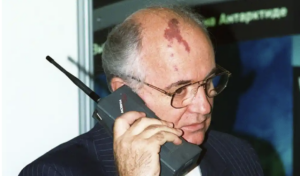
Gosh, was that really 40 years ago. Time really does fly. Wonder if mine is still in the attic, along with my first Nokia phone (the one as big as a house-brick).

Mikhail Gorbachev had one too!


My commonplace booklet

This City Pledges to Be Carbon-Neutral by the Time It’s Too Late

Nice spoof by Matthew Brian Cohen.

Thanks to decades of inaction, climate change is now an inevitable reality. However, there is still time to mitigate the brunt of the damage, and in the face of overwhelming scientific evidence, we must be bold. That’s why, as mayor, I’ve set an ambitious (but achievable!) goal for our city to be carbon-neutral by the time it’s already too late.

The time for action is now, and by now, I mean twenty to thirty-five years from now. The window to push this back is rapidly closing. I fear that history will look back and ask us why we didn’t delay acting any sooner. That’s why my administration is committed to doing everything we can to kick the can down the road and tackle this looming existential threat at some vague point in the future.

The science is clear: to meet our climate goals, we need to radically transform both our societal infrastructure and our individual behaviors. And since we’re not willing to do that, the hope is that someday, when it’s one hundred thirty degrees in the middle of March, we will. In the meantime, we’re just going to stay the course as the oil and gas industry continues to see record profits from exciting new products like inner-city fracking and zero-use plastics…

It is a spoof — honest.


This Blog is also available as a daily email. If you think that might suit you better, why not subscribe? One email a day, Monday through Friday, delivered to your inbox. It’s free, and you can always unsubscribe if you conclude your inbox is full enough already!

Tuesday 26 April, 2022

The History Man

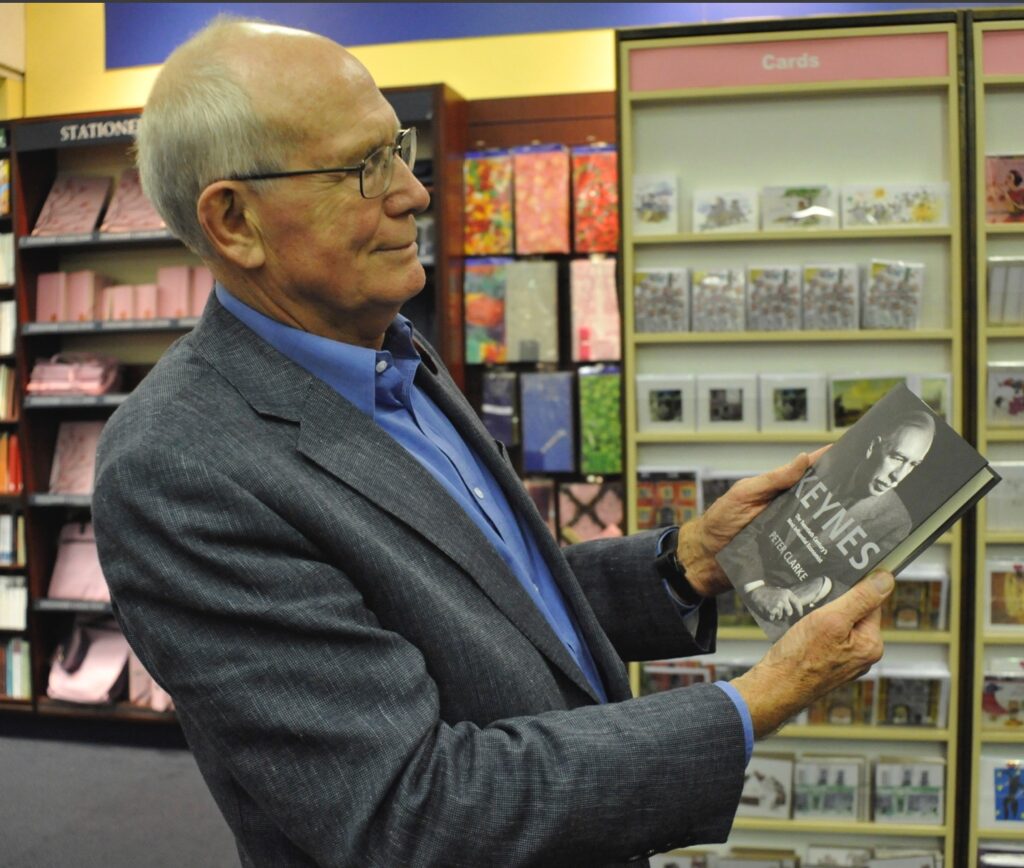
My friend, the historian Peter Clarke, at the launch of his book on Keynes in 2009.


Quote of the Day

”I always say beauty is only sin deep.”

  • Saki (H.H. Munro)

Musical alternative to the morning’s radio news

Albert Ammons | Boogie Woogie Stomp | Ladyva live in Germany.

Link

Nobody sleeps at the back when this kind of music is played.


Long Read of the Day

Last week Josh Simons and I had a conversation with Alina Utrata about Elon Musk and Twitter on her splendid Anti-Dystopians podcast. At that point all we knew was that Musk had rejected the Twitter Board’s offer of a seat on the Board in return for an undertaking not to increase his shareholding beyond a certain point, and our conversation was largely about: Twitter’s key role in the networked public sphere; various aspects of Musk’s enthusiasm for “free speech”; and the implications of his declared interest in buying the whole company and taking it private.

Since we recorded the podcast, the story moved on, and yesterday the announcement came that the Board had accepted Musk’s offer of $54.20 per share. So Twitter’s second-biggest troll has now bought the platform he relentlessly trolled. Nobody knows how this will play out — or indeed what Musk is playing at — but my gut instinct is that ‘free speech’ is not the top of his agenda.

In the meantime, Ranjan Roy, a canny observer of these things, has put together the widest range of speculations that I’ve seen, which is why I recommend it as today’s Long Read. Here’s the gist:

My mini-grand theory is that this entire sequence of events: The Twitter purchase, the SEC escalation, Tesla’s blowout quarter – it’s all about the next giant package. Musk saw an opportunity at the beginning of the year. Tesla’s business was on a roll, his pay package was almost complete, the SEC was threatening his Twitter account, and Tesla’s stock had stalled out for six months. Every great entrepreneur understands the importance of momentum and he decided to capitalize on this confluence of events.

But there’s lots more.

The key takeaway is that this is only incidentally about free speech. It’s really about democracy, power and naked capitalism.


How democracies spy on their citizens

Generally they use Pegasus, a fiendish piece of spyware for compromising iPhones which was developed — and is marketed — by an Israeli company, NSO. This New Yorker piece provides a readable introduction to the ways it’s being used (including infecting a phone or phones in Boris Johnson’s office). The only good news in this story is that NSO now appears to be struggling.

The company has been valued at more than a billion dollars. But now it is contending with debt, battling an array of corporate backers, and, according to industry observers, faltering in its long-standing efforts to sell its products to U.S. law enforcement, in part through an American branch, Westbridge Technologies. It also faces numerous lawsuits in many countries, brought by Meta (formerly Facebook), by Apple, and by individuals who have been hacked by NSO. The company said in its statement that it had been “targeted by a number of politically motivated advocacy organizations, many with well-known anti-Israel biases,” and added that “we have repeatedly cooperated with governmental investigations, where credible allegations merit, and have learned from each of these findings and reports, and improved the safeguards in our technologies.”

If NSO is indeed in trouble, it is thanks mainly to amazing forensic work by the Citizen Lab, a terrific research group based at the University of Toronto that focusses on high-tech human-rights abuses.


My commonplace booklet

 How Ikea tricks you into buying more stuff. Who knew? Link


This Blog is also available as a daily email. If you think that might suit you better, why not subscribe? One email a day, Monday through Friday, delivered to your inbox. It’s free, and you can always unsubscribe if you conclude your inbox is full enough already!


Monday 25 April, 2022

Quote of the Day

“The first problem love presents us with is how to find it. But the most enduring problem of love, which is also the most enduring problem of life, is how to live with the fact that we will lose it.”


Musical alternative to the morning’s radio news

John Field | Nocturne No. 3 in A-Flat Major, H 26

Link


Long Read of the Day

Kevin McCarthy Will Live to Lie Again

Terrific, coruscating column by Jack Shafer on the House Minority Leader, whose spine has been surgically removed by Trump.

McCarthy, whose relationship with the truth perpetually veers toward the squishy, suffered two mortifications at the hands of the press on Thursday. First, New York Times reporters Alexander Burns and Jonathan Martin reported from their forthcoming book, This Will Not Pass: Trump, Biden and the Battle for America’s Future, that in a Jan. 10, 2021 call to top Republicans, McCarthy had said Donald Trump should resign from the presidency. “‘I’ve had it with this guy,’ he told a group of Republican leaders,” Burns and Martin wrote.

“Totally false,” McCarthy immediately protested in a statement, and his office denied that he had said Trump should resign. Then came McCarthy’s second indignity as that night MSNBC’s Rachel Maddow played an audio recording, provided by the Times, of McCarthy that proved the Burns and Martin report. Sensing McCarthy’s political corpse was aflame, the press bore down on the House minority leader this morning. “Is Kevin McCarthy toast?” asked my POLITICO colleagues. “The Humiliation of Kevin McCarthy,” gloated the Bulwark’s Charlie Sykes. McCarthy got it in the neck from both members of the commentariat and from Capitol Hill legislators. Trump sycophant Rep. Matt Gaetz (R-Fla.) went so far as to blast his colleague on Twitter over the disclosure.

You can guess what happened next. A trip to Mar-a-Lago to bow and scrape to the man who now appears to own the Republican Party. Shafer exhumes the whole sordid story. I wish more hacks wrote like this.


A self-driving revolution? We’re barely out of second gear

Yesterday’s Observer column:

“Britain moves closer to a self-driving revolution,” said a perky message from the Department for Transport that popped into my inbox on Wednesday morning. The purpose of the message was to let us know that the government is changing the Highway Code to “ensure the first self-driving vehicles are introduced safely on UK roads” and to “clarify drivers’ responsibilities in self-driving vehicles, including when a driver must be ready to take back control”.

The changes will specify that while travelling in self-driving mode, motorists must be ready to resume control in a timely way if they are prompted to, such as when they approach motorway exits. They also signal a puzzling change to current regulations, allowing drivers “to view content that is not related to driving on built-in display screens while the self-driving vehicle is in control”. So you could watch Gardeners’ World on iPlayer, but not YouTube videos of F1 races? Reassuringly, though, it will still be illegal to use mobile phones in self-driving mode, “given the greater risk they pose in distracting drivers as shown in research”.

As usual, the announcement comes coated in three layers of prime political cant. This “exciting technology” is “developing at pace right here in Great Britain” (but apparently not in Northern Ireland; could it be that the DUP doesn’t approve of such advanced technology?). The government is “ensuring we have strong foundations in place for drivers when the technology takes to our roads”, which will be great once it has attended to the crumbling physical foundations of the roads in my neighbourhood. And of course it’s all happening “while boosting economic growth across the nation and securing Britain’s place as a global science superpower”…

Read on


Optimism 2.0

 The experiment has started so let’s make it work

Diane Coyle’s illuminating review of Yascha Mounk’s new book,  The Great Experiment: How to Make Diverse Democracies Work:

The final part starts with “reasons for optimism” – one of which is that actually, most of the diverse democracies are slowly making progress toward better integration, accepting that people have diverse and multiple identities. The book also argues that optimism is important because it will affect actions and outcomes. It acknowledges what it terms the ‘Chapter 10 problem’ – the generally unsatisfying list of policies at the end of a book, as demanded by publishers and indeed readers. It doesn’t really provide this so much as a few general reflections, concluding: “Constructing diverse democracies that command the enthusiastic support of the great majority of their citzens is going to be hard.” But what choice do we have other than to try? The Great Experiment is already well under way.

So I liked the upbeat message. I don’t think there’s much that’s new here for readers of the death of democracy genre, but the arrangement of the argument into an optimistic outlook is very welcome.


Thinner on paper

Delicious evocation by Peter Hitchens of his early days at the Daily Express:

An air of decline and lost empires pervaded the surprisingly shabby building, whose sleek 1930s exterior concealed dingy offices where filthy, yellowish windows gave us a dreary view of the equally unlovely cigarette-stained newsroom of our rivals next door. The shabby, shouty newsroom, heart of the beast, looked as if the invention of the telephone had come as a complete surprise. Sticky black cables hung from the ceiling in thick clumps like jungle creepers, leading to black dial phones covered in a strange crusty film which I think must have been the congealed breath of a thousand reporters. Typewriters, now only to be found in museums, were everywhere. There was even carbon paper, for making copies. There were men in black waistcoats, endlessly whispering into receivers, who looked as if they had been there since 1936. Compressed-air tubes propelled edited material to the forbidden zones where the compositors worked, giving the corridors the look of those in a large warship…

Hitchins is the only living British journalist who reminds me of Evelyn Waugh, not least because the Express was the model for the Daily Beast in Waugh’s wonderful novel, Scoop.

As admirers of the book will know, Waugh had a low opinion of journalists. His hapless hero, William Boot, for example,

“had once seen in Taunton a barely intelligible film about newspaper life in New York where neurotic men in shirt-sleeves and eye-shades had rushed from telephones to tape machines, insulting and betraying one another in surroundings of unredeemed squalor.”


Technology’s Mindfulness Racket

Lovely by essay Evgeny Morozov (Whom God Preserve).

In yet another sign that the new age lingo of the 1960s is still very much with us, “mindfulness” has become the new “sustainability”: No one quite knows what it is, but everyone seems to be for it. It recently made the cover of Time magazine, while a long list of celebrities—Arianna Huffington, Deepak Chopra, Paolo Coelho—are all tirelessly preaching the virtues of curbing technology-induced stress and regulating the oppressiveness of constant connectivity, often at conferences with titles like “Wisdom 2.0.”

The embrace of the mindfulness agenda by the technology crowd is especially peculiar. Consider Huffington, whose eponymous publication has even launched a stress-tracking app with the poetic name of “GPS for the Soul”—a new app to fight the distraction caused by the old apps—and turned the business of mindfulness into a dedicated beat.

This is from 2014. I love his acerbic style and share his aversion to tech hubris.


This Blog is also available as a daily email. If you think that might suit you better, why not subscribe? One email a day, Monday through Friday, delivered to your inbox. It’s free, and you can always unsubscribe if you conclude your inbox is full enough already!


Friday 22 April, 2022

Carnations

Found in an old photo archive.


Quote of the Day

”The reasonable man adapts himself to the world; the unreasonable one persists in trying to adapt the world to himself. Therefore, all progress depends on the unreasonable man.”

  • George Bernard Shaw

In that context, Elon Musk (see Commonplace Booklet below) is clearly an unreasonable man. The key question therefore, is whether in the end he represents progress, and if so of what kind.


Musical alternative to the morning’s radio news

Don McLean | American Pie (Live in Austin)

Link


Long Read of the Day

How to stay optimistic in these dark times

I’m temperamentally an optimist with a fairly sunny disposition. On the other hand, the more I understand about the way our societies are evolving, the bleaker the future begins to look. I often think that what is needed now is a theory of incompetent systems — i.e. systems that cannot fix themselves. The two examples that come immediately to mind are: democracy in America (and possibly elsewhere too); and global warming, but there are probably others. Pessimism seems a logical result of such ‘realistic’ assessments of the state the world is in.

But pessimism if a disabling emotion, and in looking for other ways of thinking about the future I keep coming back to Gramsci’s idea of “pessimism of the intellect and optimism of the will”. So you can imagine how pleased I was to come on this thoughtful blog post by Noah Smith in which he explores what adopting that philosophy might mean for us now.

Hope you like it.


On Jonathan Haidt’s essay yesterday…

Graham Minenor-Matheson wrote:

Just wanted to draw your attention to a Twitter thread by the media scholar Daniel Kreiss responding to that article . Essentially Kreiss sees a number of problems with Haidt’s article notably that it is ahistorical and gets a lot wrong about social media and how politics happens through it. Hope you read it!

I did, and it’s good. My hope in highlighting the Haidt essay was that it would spark a productive debate, and that seems to be happening. The Kreiss thread is a much better response than the one I mentioned yesterday. I hope there’ll be more.

The core problem with an essay like Haidt’s is that it’s very difficult to attempt a big-picture or long-sweep view without skating over thin ice to keep the narrative going. Which is why many academics now eschew the essay as a form.

One of my heroes was the late Neil Postman, the great cultural critic. He was always being attacked by scholars on similar grounds. And yet he got some important things right — and in the process shaped the way I think about our information environment.

It’d be interesting to do an annotated version of Haidt’s essay at some stage.


My commonplace booklet

  • The Musk TED interview Link

Live, unedited and revealing. The only historical parallel for Musk that I can think of is Henry Ford. Which is why this interview might be worth an hour of your time.

  • How to survive a ‘tactical’ nuclear explosion.

Never thought I’d see this kind of thing again in my lifetime. Link


This Blog is also available as a daily email. If you think that might suit you better, why not subscribe? One email a day, Monday through Friday, delivered to your inbox. It’s free, and you can always unsubscribe if you conclude your inbox is full enough already!


Thursday 21 April, 2022

The shards of geological time

Maghera, Co Donegal.


Quote of the Day

”Between two evils, I always pick the one I never tried before.”

  • Mae West

Musical alternative to the morning’s radio news

Finbarr Furey | Nearer my God to Thee

Link

First time I’ve heard him play this. Short and sweet.


Long Read of the Day

Why the Past 10 Years of American Life Have Been Uniquely Stupid

And why it’s not just a phase.

You need to make an appointment with this long, long essay by Jonathan Haidt. It’s the most sustained attempt I’ve found in non-book form to try and encompass the overall impact of social media on democracy. Admittedly, its prime focus is American democracy, and it may be that that dilutes its relevance for other countries and cultures. But it’s definitely worth your time.

Here’s how it opens:

The story of Babel is the best metaphor I have found for what happened to America in the 2010s, and for the fractured country we now inhabit. Something went terribly wrong, very suddenly. We are disoriented, unable to speak the same language or recognize the same truth. We are cut off from one another and from the past.

It’s been clear for quite a while now that red America and blue America are becoming like two different countries claiming the same territory, with two different versions of the Constitution, economics, and American history. But Babel is not a story about tribalism; it’s a story about the fragmentation of everything. It’s about the shattering of all that had seemed solid, the scattering of people who had been a community. It’s a metaphor for what is happening not only between red and blue, but within the left and within the right, as well as within universities, companies, professional associations, museums, and even families.

Babel is a metaphor for what some forms of social media have done to nearly all of the groups and institutions most important to the country’s future—and to us as a people. How did this happen? And what does it portend for American life?

There have been all kinds of pushback against the essay — see, for example here. To date, I haven’t found them convincing, or willing to take his on argument on its own ground.


New York Times has a new pontiff

Nice Politico column by Jack Shafer:

The New York Times crowned a new pope this morning, Joseph Kahn, making him executive editor starting in June. Like the modern Vatican, the Times doesn’t wait for its maximum leader to die before appointing a new one. There will be no coronation mass for Kahn as he takes the top editorial position at the paper in June. Nor will he be bestowed a papal tiara or deliver a pontifical blessing. Having served as retiring Executive Editor Dean Baquet’s understudy since 2016, he will move in, Baquet will move out, and the Times will have turned. Executive editors come and go. Only the Times remains.

As the new pope of the Times, Kahn will wield astonishing power. He will order and kill stories with kingly authority. He will determine not only his paper’s news agenda but that of journalism’s lesser priests, who will await his news judgment before expressing their own. He will hire and make careers. He will fire and break them. He will become a permanent resident in the minds of the paper’s 1,750 newsroom staffers, who will spend half their workdays wondering what he wants and how to please him.

But unlike Rome’s top priest, it seems that the Times pope doesn’t flex absolute power over his institution.


Imperial delusions

Buried deep in the collective psyche of Middle England (and of its ruling elites) is a bad case of Imperial nostalgia, or at any rate a conviction that, on balance, the British Empire had been a civilising force in the world. It’s one of the reasons why the risk of Brexit never really went away. (After all, joining the EU in 1973 was an implicit acceptance that Britain was ‘just another country — like Italy’, as one anti-European MP put it to me back then.) And of course this Imperial nostalgia is completely baffling to anyone coming from a country which has been the supposed beneficiary of this ‘civilising’ process. We in Ireland had 800 years of it, and we are still living with the results in relation to the Northern Ireland Protocol and the Brexiteers’ casual indifference to the Good Friday Agreement.

All of which is a reason for welcoming Caroline Elkins’s book,  Legacy of Violence: A History of the British Empire. I’ve only read the reviews of it yet — it’ll go on the list of books I’ll bring to Provence in the Summer. But in the meantime, Sunil Khilnani’s terrific (and not uncritical) New Yorker review essay gives one a pretty good impression of the ground Elkins covers.

Here’s how his piece opens:

At the height of the British Empire, just after the First World War, an island smaller than Kansas controlled roughly a quarter of the world’s population and landmass. To the architects of this colossus, the largest empire in history, each conquest was a moral achievement. Imperial tutelage, often imparted through the barrel of an Enfield, was delivering benighted peoples from the errors of their ways—child marriage, widow immolation, headhunting. Among the edifiers was a Devonshire-born rector’s son named Henry Hugh Tudor. Hughie, as he was known to Winston Churchill and his other chums, pops up so reliably in colonial outposts with outsized body counts that his story can seem a “Where’s Waldo?” of empire.

He’s Churchill’s garrison-mate in Bangalore in 1895—a time of “messes and barbarism,” the future Prime Minister complained in a note to his mum. As the century turns, Tudor is battling Boers on the veldt; then it’s back to India, and on to occupied Egypt. Following a decorated stint as a smoke-screen artist in the trenches of the First World War, he’s in command of a gendarmerie, nicknamed Tudor’s Toughs, that opens fire in a Dublin stadium in 1920—an assault during a search for I.R.A. assassins which leaves dozens of civilians dead or wounded. Prime Minister David Lloyd George delights in rumors that Tudor’s Toughs were killing two Sinn Féinners for every murdered loyalist. Later, even the military’s chief of staff marvelled at how nonchalantly the men spoke of those killings, tallying them up as though they were runs in a cricket match; Tudor and his “scallywags” were out of control. It didn’t matter: Churchill, soon to be Secretary of State for the Colonies, had Tudor’s back.

Imperial subjects, of course, sometimes found their own solutions to such problems. A hard-line British field marshal, atop the I.R.A. hit list, was gunned down in Belgravia in 1922. Tudor, worried he would be next, made himself scarce. By the following year, he and his Irish paramilitaries were propagating their tactics for suppressing natives in the British-controlled Mandate of Palestine, Churchill having decided that the violence-prone Tudor was just the fellow to train the colonial police. A letter from Tudor to Churchill that I recently came across crystallizes all the insouciance, cynicism, greed, callousness, and errant judgment of empire. He opens by telling Churchill that he’s just commanded his troops to slaughter Adwan Bedouins who had been marching on Amman to protest high taxes levied on them by their notoriously extravagant emir. This tribe was “invariably friendly to Great Britain,” Tudor writes, a touch ruefully. But, he adds, “politics are not my affair.”

He also assured Churchill that “the Palestinians would be easier to pacify than the Irish”.

You get the idea.


My commonplace booklet

What is this ‘poison pill’ that the Twitter Board is devising to stop Musk taking over the company?

Useful explainer from Quartz.


This Blog is also available as a daily email. If you think that might suit you better, why not subscribe? One email a day, Monday through Friday, delivered to your inbox. It’s free, and you can always unsubscribe if you conclude your inbox is full enough already!