Friday 3 March, 2023

Our Megalithic ancestors

On our trip last week we spent a couple of days exploring the Burren, a remarkable glaciokarst landscape in County Clare, on the west coast of Ireland. (See map.) It measures around 530 square kilometres (200 square miles), within a circle made by the villages of Lisdoonvarna, Corofin, Gort and Kinvara. At first sight it looks very barren (I’ve heard people refer to it as a ‘moonscape’) but in reality it has fascinating and abundant flora in the micro-ecosystems which thrive in the crevices of the limestone ‘pavement’.

The most interesting aspect of the place, for me anyway, is its archeology. According to Wikipedia,

By the Neolithic, c. 4000 BC, settlers had clearly arrived and began changing the landscape through deforestation, likely by overgrazing and burning, and the building of stone walls. These people also constructed Megalithic sites like the portal tomb known as Poulnabrone dolmen and the court tombs at Teergonean (near Doolin) and Ballyganner (near Noughaval). Overall, there are around 70 megalithic tombs in the Burren area, more than half of all of these structures found in Clare.

The photograph shows the Poulnabrone dolmen in which the remains of at least 33 individuals — infants, children and adults — were buried. Radiocarbon dating shows that those buried in the chamber died sometime in the period 4200 – 2900 BC. Over a thousand years later (1767 – 1413 BC) — i.e. during the Bronze Age — a newborn baby was buried in the portico outside the entrance to the chamber.


Quote of the Day

”If liberty means anything at all, it means the right to tell people what they do not want to hear.”

  • George Orwell

Musical alternative to the morning’s radio news

Gershwin | Rhapsody in Blue | Khatia Buniatishvili

Link


Long Read of the Day

The moral economy of tech

This is the text of one of the most effective talks ever given on the essence of the world we’re building with networked technology. The speaker is Maciej Cegłowski, one of the wisest people around. I first came on him because I use his software — Pinboard.in — which plays a critical role in my little software ecosystem and workflow — and which has an honest business model.

Here’s a sample from the talk:

Those who benefit from the death of privacy attempt to frame our subjugation in terms of freedom, just like early factory owners talked about the sanctity of contract law. They insisted that a worker should have the right to agree to anything, from sixteen-hour days to unsafe working conditions, as if factory owners and workers were on an equal footing.

Companies that perform surveillance are attempting the same mental trick. They assert that we freely share our data in return for valuable services. But opting out of surveillance capitalism is like opting out of electricity, or cooked foods—you are free to do it in theory. In practice, it will upend your life.

Many of you had to obtain a US visa to attend this conference. The customs service announced yesterday it wants to start asking people for their social media profiles. Imagine trying to attend your next conference without a LinkedIn profile, and explaining to the American authorities why you are so suspiciously off the grid.

The reality is, opting out of surveillance capitalism means opting out of much of modern life.

And this eloquent metaphor:

As a technologist, this state of affairs gives me the feeling of living in a forest that is filling up with dry, dead wood. The very personal, very potent information we’re gathering about people never goes away, only accumulates. I don’t want to see the fire come, but at the same time, I can’t figure out a way to persuade other people of the great danger.


Books, etc.

My reading list

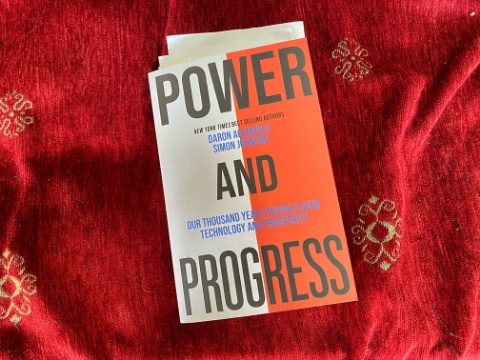
All three have just arrived!


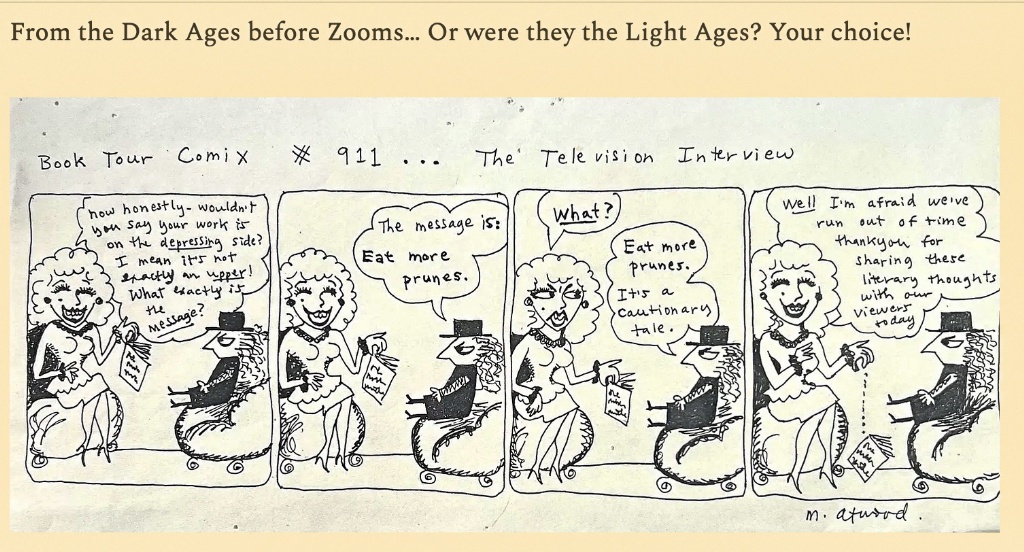
My commonplace booklet

Our cat Tilly in what my son calls “her Cumberland Sausage pose”.


This Blog is also available as a daily email. If you think that might suit you better, why not subscribe? One email a day, Monday through Friday, delivered to your inbox. It’s free, and you can always unsubscribe if you conclude your inbox is full enough already!


Thursday 2 March, 2023

The Interloper

Seen on a Kerry beach last week.


Quote of the Day

”The greater the ignorance, the greater the dogmatism.”

  • William Ostler

Musical alternative to the morning’s radio news

Julian Lage | I’ll Be Seeing You (Live in Los Angeles)

Link

New to me, and lovely. Thanks to Michael Dales (Whom God Preserve) for discovering it.


Long Read of the Day

What the poet, playboy and prophet of bubbles can still teach us

Typically thoughtful and interesting essay by Tim Harford.

One winter morning in early 1637, a sailor presented himself at the counting-house of a wealthy Dutch merchant and was offered a hearty breakfast of fine red herring. The sailor noticed an onion lying on the counter.

“Thinking it, no doubt, very much out of its place among silks and velvets, he slily seized an opportunity and slipped it into his pocket, as a relish for his herring,” according to a Scottish writer telling the tale two centuries later. “He got clear off with his prize and proceeded to the quay to eat his breakfast.”

The Scottish writer was Charles Mackay and the story is recounted in his book, Extraordinary ­Popular Delusions and the Madness of Crowds. It’s one of very few works of economic history to have been an enduring bestseller, from its first publication in 1841 through to the 21st century, thanks, largely, to its vivid storytelling. Mackay debunked everything from alchemy and crusades to haunted houses and religious cults. But it was the three chapters on economic bubbles that made him the enduring guru of the phenomenon, cited to this day. In the book, Mackay went on to explain that the sailor, seeking zest for his fish, unwittingly pilfered not an onion, but a rare tulip bulb. Which was a problem because, in 1637, one of the strangest of all financial booms was taking place: the tulip mania, during which the choicest bulbs went for astonishing sums.

“Hardly was his back turned when the merchant missed his valuable Semper Augustus, worth three thousand florins, or about 280 pounds sterling,” wrote Mackay…

Read on. There are surprises in store.


If you thought Murdoch was omnipotent, think again

He’s always been scared of Trump.

Terrific column by Jack Shafer.

An article of faith among modern media observers preaches that Rupert Murdoch can manipulate American politics in any direction he wants through the broadcasts of his lucrative media property, the Fox News Channel. This article of faith, which Democrats share with their children to give them nightmares and Republicans share with theirs as a cautionary tale, has given Murdoch king-maker status over the years as he has directed his channel to reward his supplicants and punish his enemies.

But on closer examination, and especially in light of the testimony released in Dominion Voting Systems’ $1.6 billion defamation suit against Fox News for its coverage of the “stolen” presidential election of 2020, Murdoch isn’t always the master puppeteer he’s reputed to be. In Murdoch’s own words, delivered in Dominion suit depositions, he describes himself as frightened by the power Donald Trump holds over the Fox audience. He portrays himself, accurately in this case, as the supreme authority at his network but unable to control his prime-time anchors who endorsed Trump’s lie of a stolen election. And he regrets not interceding — which he says was within his power — to keep stolen-election fabulists like Rudolph Giuliani and Sidney Powell from repeatedly appearing on his shows, even though some Fox executives and anchors were gagging, off-screen, on Giuliani and Powell’s wild-eyed theories…

Wow. I hadn’t realised that Murdoch had had to testify in the Dominion libel trial.


Jonty Bloom on the Windsor Agreement

From his piece in The New European

You really could not make it up. The Brexit-loving prime minister of Great Britain and Northern Ireland is boasting that NI has the best deal in the world because it is both part of the UK and of the single market.

And he is right, Northern Ireland does have a great deal in the world. It is exactly the same deal that the whole of the UK used to have before Rishi Sunak and his mates threw it all away.

That is why Northern Ireland’s trade with the EU is booming – up by £1 billion last year – that is why it has grown much faster than the rest of the country and why it is now the second largest recipient of foreign investment in the UK after London.

The foreign investment would have been even higher but for the suicidally stupid threats by previous Conservative administrations to tear up the Northern Ireland Protocol and start a trade war with the EU. Now that threat is removed, it will doubtless soar.


This Blog is also available as a daily email. If you think that might suit you better, why not subscribe? One email a day, Monday through Friday, delivered to your inbox. It’s free, and you can always unsubscribe if you conclude your inbox is full enough already!


Wednesday 1 March, 2023

Searching for Tim

View from Tim Robinson’s window

We’ve just come back from ten days in Ireland, journeying up and down the country’s wonderful West coast — which some marketing genius in the Tourist Board famously rebranded as “the Wild Atlantic Way”, thereby unleashing a profitable torrent of eager tourists upon an unsuspecting landscape.

For a couple of days we stopped in Connemara, a rough-hewn but beautiful part of Connacht, which also happens to be where my father’s family come from. On one of those days we headed for Roundstone, a small fishing village about 50 miles north-west of Galway. What brought us there was my desire to visit ‘Folding Landscapes’, the little firm that the great cartographer Tim Robinson and his wife Máiréad created to publish his astonishing handmade maps of the Aran Islands, the Burren and Connemara. I hadn’t been there for at least two decades, but I had a firm memory of how the company’s office looked out on the village pier.

When we arrived, though, there was no sign of the office. Because it was out of the tourist season, the village was exceedingly quiet, with only the post-office and one other shop open. We tried the PO first, inquiring about Tim’s whereabouts. The young woman behind the counter was not a local and couldn’t help, so she directed us to the general store across the street. Entering it, I asked the middle-aged lady who ran it if she knew where I could find Tim.

At this her welcoming smile turned to an expression of concern. It turned out that Tim had died of Covid in the early weeks of the pandemic, and that Máiréad had passed away two weeks before him. They had both been in London at the time. But their ashes had been brought back to Roundstone, local fishermen had launched boats to scatter their ashes in the bay, a group of traditional musicians had sent them on their way from the pierhead, and the President of Ireland, Michael D. Higgins, had travelled down from Dublin to honour one of the country’s greatest contemporary writers and scholars.

So Tim and Máiréad had a great send-off, but my hopes of obtaining a copy of his map of Connemara were dashed. I felt mortified that I had missed his passing. The only thing I could think of doing was to photograph the view that greeted them every morning.

He was a formidable scholar and a lovely writer. His books on Aran and Connemara are masterpieces. I met him only once, when he was the 2011 Parnell Fellow at Magdalene College and he signed my copy of his book on Connemara.

Here he is, writing about Wittgenstein’s sojourn in Connemara in 1948:

In 1948 Ludwig Wittgenstein fled the seductions of Cambridge, where he was the acknowledged star of the Philosophy Department, to a friend’s holiday cottage in Roscoe, a fishing hamlet on a rugged peninsula separating the mouth of Killary Harbour from the bay of Little Killary. “I can only think clearly in the dark,” he said, “and in Connemara I have found one of the last pools of darkness in Europe.” His thought, a mental ascesis that matched his frugal and solitary existence there, was directed to an end, or rather to its own end. As he had written, “The real discovery is the one that makes me stop doing philosophy when I want to. The one that gives philosophy peace, so that it is no longer tormented by questions which bring itself into question.” The particular question preoccupying him at this time concerned the difference between seeing something, and seeing it as something. For instance, his farming neighbours see this strange figure in the landscape, and see him as a madman. There he stands, stock still for minutes on end, staring at something he has drawn with his stick in the mud of the roadside. If I see this diagram (a roundish shape with a dot in the middle, and two long appendages on one side) first as a duck’s head and bill, and then as a rabbit’s head and ears, not a particle of the mud has moved. What then has changed — a mysterious mental picture I can show to no one else? The temptation, he writes, is to say “I see it like this”, pointing at the same thing for “it” and “this”. Hence arises a philosophical pseudo-problem. But by analysing how we use language in such cases, we can “get rid of the idea of the private object”. His neighbours, though, know a duck-rabbit when they see one, and forbid him to cross their land lest he frighten the sheep.


Quote of the Day

“If my doctor told me I had six minutes to live, I wouldn’t brood. I’d type a little faster.”

  • Isaac Asimov

Musical alternative to the morning’s radio news

Sorcha Richardson | Oh Oscillator

Link

By a stunning young singer we were lucky enough to run into in Kerry.


Long Read of the Day

Social Media is a Major Cause of the Mental Illness Epidemic in Teen Girls. Here’s The Evidence.

For years I’ve been arguing (for example here) that social media — and especially Instagram — is toxic for teenage girls. The response of the tech industry — and especially of Meta (neé Facebook) consistently reminds me of the tobacco industry’s long campaign to undermine the idea that cigarette smoking caused lung cancer. The roles of media and academia in the controversy has also reminded me of their inertia and indolence in that long-running saga.

All of which is a long-winded way of explaining why I welcome this long and considered essay by the social-psychologist Jonathan Haidt reviewing the research and evidence of the impact of social media on girls.

Here’s how it opens:

A big story last week was the partial release of the CDC’s bi-annual Youth Risk Behavior Survey, which showed that most teen girls (57%) now say that they experience persistent sadness or hopelessness (up from 36% in 2011), and 30% of teen girls now say that they have seriously considered suicide (up from 19% in 2011). Boys are doing badly too, but their rates of depression and anxiety are not as high, and their increases since 2011 are smaller. As I showed in my Feb. 16 Substack post, the big surprise in the CDC data is that COVID didn’t have much effect on the overall trends, which just kept marching on as they have since around 2012. Teens were already socially distanced by 2019, which might explain why COVID restrictions added little to their rates of mental illness, on average. (Of course, many individuals suffered greatly).

Most of the news coverage last week noted that the trends pre-dated covid, and many of them mentioned social media as a potential cause. A few of them then did the standard thing that journalists have been doing for years, saying essentially “gosh, we just don’t know if it’s social media, because the evidence is all correlational and the correlations are really small.” For example, Derek Thompson, one of my favorite data-oriented journalists, wrote a widely read essay in The Atlantic on the multiplicity of possible causes. In a section titled Why is it so hard to prove that social media and smartphones are destroying teen mental health? he noted that “the academic literature on social media’s harms is complicated” and he then quoted one of the main academics studying the issue—Jeff Hancock, of Stanford University: “There’s been absolutely hundreds of social-media and mental-health studies, almost all showing pretty small effects.”

In this post, I will show that Thompson’s skepticism was justified in 2019 but is not justified in 2023. A lot of new work has been published since 2019, and there has been a recent and surprising convergence among the leading opponents in the debate (including Hancock and me). There is now a great deal of evidence that social media is a substantial cause, not just a tiny correlate, of depression and anxiety, and therefore of behaviors related to depression and anxiety, including self-harm and suicide…

As I say, it’s long. What’s particularly striking (to me anyway) is his insight that the standard approach of treating social-media use as if it were analogous to imbibing a particular narcotic is far too reductionist. What it ignores is the fact that the ubiquity of social media changes the entire media ecosystem in which young people are now growing up. As I read Haidt’s essay, I kept thinking about Neil Postman’s The Disappearance of Childhood and his argument that radical changes in our media environment — as in (i) the switch from orality to print, and (ii) then from print to broadcast TV — changed our definitions (and conceptions) of childhood.


Crypto is intended to be hard to regulate, but at least the Treasury wants to have a go

Last Sunday’s Observer column:

For my sins, I have been reading Future financial services regulatory regime for cryptoassets, 82 pages of prime Whitehall verbiage that was published recently, setting out HM Treasury’s plans to govern the clouds and hold back the tides.

It opens with the statutory ringing endorsement by Andrew Griffith, economic secretary to the Treasury. He reminds readers that the government’s “firm ambition is for the UK to be home to the most open, well-regulated and technologically advanced capital markets in the world” – which “means taking proactive steps to harness the opportunities of new financial technologies”. He further believes that “crypto technologies” can have a profound impact across financial services and that “by capitalising on the potential benefits offered by crypto we can strengthen our position as a world leader in fintech, unlock growth and boost innovation”. Cont’d p94, as they say in Private Eye.

Billed as a “consultation and call for evidence”, the document invites our views on these important matters. As a public-spirited columnist, it would be churlish to refuse the invitation. So here goes…

Do read the whole thing.


My commonplace booklet

From the Observer:

The late Roald Dahl’s publisher, Puffin, caused controversy this month for hiring “sensitivity readers” to rewrite his books with hundreds of revisions so that they “can continue to be enjoyed by all today”.

In the new edition of Charlie and the Chocolate Factory, Augustus Gloop – a glutton for chocolate – is now just “enormous” rather than “enormously fat”; in The Twits, Mrs Twit is no longer “ugly and beastly”, just “beastly”, and in The Enormous Crocodile, “we eat little boys and girls” has been changed to “we eat little children”.

Responding to the criticism, Puffin announced last Friday that they will publish both the original texts and reworked editions.


This Blog is also available as a daily email. If you think that might suit you better, why not subscribe? One email a day, Monday through Friday, delivered to your inbox. It’s free, and you can always unsubscribe if you conclude your inbox is full enough already!


Friday 17 February, 2023

Dead tree + Live wind farm

North Norfolk. Huge offshore wind farm in the distance.


Quote of the Day

”My idea of long-term planning is lunch.”

  • Frank Ogden

Musical alternative to the morning’s radio news

Bob Marley | One Love

Link

Wonderful.


Long Read of the Day

What if my lessons in existentialism were in bad faith?

Lovely reflective — and reflexive — essay by Robert Zaretsky.

‘Let us consider this waiter in the café. His movement is quick and forward, a little too precise, a little too rapid.’ I read these lines – perhaps with a diction a bit too deliberate – and look up from my copy of Jean-Paul Sartre’s Being and Nothingness (1943) at a room-full of students lining both sides of a long conference table. ‘He comes toward the patrons with a step a little too quick. He bends forward a little too eagerly; his voice, his eyes express an interest a little too solicitous for the order of the customer.’ Am I reciting this a little too emphatically? One student is doodling in a notebook, others scribble in theirs. A few of them look at me while I look around at them. Just as I am mostly engaged in displaying my engagement, I wonder if the students are also busy being engaged.

Mais oui, it’s another mauvaise foi Monday. Bad faith abounds not just at the Parisian café where Sartre watches the waiter, but also in the seminar room in Houston where I watch myself teaching my class on existentialism. Though I have been a professor for more than 30 years, I began teaching this course only recently: unlike with earlier courses, where I feared simply phoning them in, I now swung to the fear that I was being a phony. That I was, like Sartre’s waiter, playing a game. ‘We need not watch long before we can explain it: he is playing at being a waiter in a café. There is nothing there to surprise us.’ Yet I am surprised – in a way that makes me question not just my place, but existentialism’s place in the room. As Sartre might say: is my course, myself? Am I foolish in thinking I can profess a philosophy that requires personal authenticity and political engagement?

I really liked this essay, not least because when my late wife Carol and I were undergraduates we were both passionate admirers of Sartre and his famous collaborator Simone de Beauvoir. (In fact Carol went on to do a Masters thesis on Beauvoir’s autobiography, and even interviewed her in Paris.) Of course, given the later revelations of how manipulative those two were, I feel rather differently about them now. But if you can’t be naive when you’re young and impressionable, when can you be? And Beauvoir’s The Second Sex was one of the most important books of the 20th century.


Books, etc.

I’m reading Aaron Perzanowski’s terrific book with interest, not just because it’s on a topic that is really important, but also because he’s speaking at an event I’m running in the Cambridge Festival on March 28. If you’re going to be in town that evening, why not come? It’s in Wolfson College and may be over-subscribed — so register early if you’re hoping to be there.


My commonplace booklet

Welsh road building projects stopped after failing climate review

Wow! Is this a world first?

From The Guardian

Dozens of road building projects across Wales have been halted or amended as part of a “groundbreaking” policy that reassessed more than 50 schemes against a series of tough tests on their impact on the climate emergency.

Only 15 of the projects reviewed by an expert roads review panel will go ahead in their original form, with others scaled back, postponed or in some cases shelved.

The scrapped projects include a third bridge across the Menai Strait which separates the island of Anglesey from the Welsh mainland.


This Blog is also available as a daily email. If you think that might suit you better, why not subscribe? One email a day, Monday through Friday, delivered to your inbox. It’s free, and you can always unsubscribe if you conclude your inbox is full enough already!


Thursday 16 February, 2023

Spikyhead

Seen on a walk the other day. Amazing what nature comes up with.


Quote of the Day

“It is easier to build strong children than to repair broken men.”

  • Frederick Douglass

Musical alternative to the morning’s radio news

J.S. Bach | Concerto for Oboe (from BWV 105, 170 & 49) | 2. Andante

Link


Long Read of the Day

7 minutes from the end of class

Intriguing essay by Harry Brighouse on Crooked Timber, one of my favourite blogs

I sometimes employ an undergraduate to observe my teaching, and criticize what I do. I’ve learned a lot from them over the years, but I really employ them, these days, to hold me accountable to the standards I set myself and to tell me what is happening in the room (this is especially valuable in large classes) more than with the expectation that I’ll learn something brand new.

Anyway, last week my new observer, Allyson, solved what has been a longstanding problem for me. In my large classes students get antsy n the last ten minutes, and start, slowly, and discreetly, to put their stuff away and get ready to go. Each individual student is not disruptive, but having most of them doing this over a 7 minute period is very distracting (for them and for me). It’s especially bad in winter because they have lots of clothes to put on.

And I am not blaming them for this. My campus is large, and there is a 15 minute gap between classes. Unless they are ready to go the second class ends many of them will be late for the next class.

Allyson pointed out the antsiness, and suggested the following: 7 minutes from the end of class tell them that they are not leaving till the end of the class, but that I am giving them one minute to get their stuff together…

So he tried it. Read on to find out how it worked.


Gasoline Car Review

Lovely satirical spoof by Geoff Greer.

I recently purchased a Mazda Miata. This car is interesting because instead of running on electricity, it is powered by a combustible liquid called gasoline. The vehicle has an engine that mixes the gasoline with oxygen from the air, ignites the mixture, and uses the resulting combustion to push the car forward. I don’t fully understand the details of how it works, but this difference in propulsion technology totally changes the experience of owning and operating a vehicle.

After taking delivery of the car, my first hurdle was getting it to do anything. I opened the door (the handles are very prominent), sat in the driver’s seat, and… nothing happened. No screen showed any messages. The climate control didn’t turn on. The car seemed dead. I pressed the accelerator (Mazda calls this the “gas” pedal) but again, nothing. I called their support line and quickly figured out the issue: Unlike a normal car, a gas car needs to be “started”. Apparently it would be wasteful and expensive to keep the gasoline engine running all the time, so you’re only supposed to run the engine if you’re moving the vehicle. The starting process is pretty painless: You insert your key into a slot on the side of the steering column, push the clutch pedal (more on that later), then turn the key and hold it for a second or two. I succeeded on the first try, causing the car to jump to life and emit all kinds of crazy noises. Imagine if a steam locomotive had a baby with a machine gun. That’s the sort of noise that comes out of a gas car. It evokes both excitement and concern…

It goes on like this. Hope you enjoy it a much as I did.


Vermeer: the ‘Watch with Mother’ version

The Rijksmuseum in Amsterdam has a huge (and sold-out) Vermeer retrospective. Since thousands of people will be unable to see it in person, the powers—that-be in the museum had the bright idea of commissioning a little film in which a Famous Person would escort the grateful viewer through the pictures, pausing to utter helpful homilies from time to time. The Famous Person chosen for this task is none other than Stephen Fry, the great actor and Jeeves imitator who was then hijacked by being given a fatuous, patronising script to read. The result: an embarrassing flop.


My commonplace booklet

How Sam Pepys spent Thursday 16 February, 1660

In the morning at my lute. Then came Shaw and Hawly, and I gave them their morning draft at my house. So to my office, where I wrote by the carrier to my Lord and sealed my letter at Will’s, and gave it old East to carry it to the carrier’s, and to take up a box of china oranges and two little barrels of scallops at my house, which Captain Cuttance sent to me for my Lord. Here I met with Osborne and with Shaw and Spicer, and we went to the Sun Tavern in expectation of a dinner, where we had sent us only two trenchers-full of meat, at which we were very merry, while in came Mr. Wade and his friend Capt. Moyse (who told us of his hopes to get an estate merely for his name’s sake), and here we staid till seven at night, I winning a quart of sack of Shaw that one trencherfull that was sent us was all lamb and he that it was veal. I by having but 3d. in my pocket made shift to spend no more, whereas if I had had more I had spent more as the rest did, so that I see it is an advantage to a man to carry little in his pocket.

Home, and after supper, and a little at my flute, I went to bed.

The annotations for this day are fascinating. Now I see where the term ‘trencherman’ comes from, for example.


This Blog is also available as a daily email. If you think that might suit you better, why not subscribe? One email a day, Monday through Friday, delivered to your inbox. It’s free, and you can always unsubscribe if you conclude your inbox is full enough already!

Wednesday 15 February, 2023

Spring is sprung

In a friend’s garden yesterday.


Quote of the Day

”At 50 everyone has the face he deserves”.

  • George Orwell, in his notebook, 17 April, 1949

Musical alternative to the morning’s radio news

Carole King | Chains

Link

Thanks to Doc Searls (Whom God Preserve) for the reminder.


Long Read of the Day

Artificial Intelligence and The Best Game in Town: Or How Some Philosophers, and the Behavioral and Brain Sciences journal, Missed a Step 

Intriguing long read by David Lobina on the implications of the fact that LLMs (large language models) are essentially statistical engines. Includes his (rejected) response to a challenge issued by BBS.

Modern AI [i.e. machine-learning] is, in a way, glorified statistics, in the same way that a flat white is a glorified caffellatte – actually, a flat white is a badly made cappuccino, but the analogy still holds up: a former friend once joked that Mitt Romney seemed like a botched connectionist attempt at building a president. And as with Romney, probably, there is really nothing there; a chatbot such as ChatGPT doesn’t “know” any language, or any aspect of language, and it doesn’t “know” how to reason, either, certainly no more than a calculator “knows” how to, er, well, put two and two together (maybe the calculator understands the metaphor, though).

Indeed, and as stressed last month, deep neural networks connect an input with an output on the basis of the gigantic amounts of data they are fed during so-called “training”, when the relevant correlations are calculated. In the case of LLMs such as ChatGPT (note that I’m conflating an LLM with the “dialogue management system” that queries an LLM; will come back to this), the model predicts one word at a time, and only one word at a time every single time, given a specific sequence of words (that is, a string of words), and without making any use of the syntactic or semantic representation of the sentences it is inputted.

That is, LLMs calculate the probability of the next word given a context…

Interesting if you’re fascinated by the fuss about LLMs. But it may also be an acquired taste.


ChatGPT, etc.

One of the things that’s very interesting about ChatGPT is the way programmers are using it. I’d been wondering about this for a while (and indeed in the first piece I wrote about it had likened its arrival to the arrival of VisiCalc, the first spreadsheet in the late 1970s) but this post by Dave Winer (Whom God Preserve), arguing that “ChatGPT clearly has a place” elegantly crystallised that view.

This thread is worth money. I’ve given ChatGPT programming jobs like the ones the author describes, and it’s saved me huge amounts of time. Last one was asking how to do something with the Twitter API. I could have spent fifteen minutes trying to find it in the docs, or on Stack Exchange, but I got the answer instead in a few seconds, and there was no bullshit, no preambles, just the answer to the question I asked.

And, later…

Journalists, who do most of the writing about news, immediately focus on how it might affect their careers, and imho educators zoom past the purpose of education, to create more better-educated people. As a kid, I had a party the day my parents bought us an encyclopedia. That meant we could settle arguments by getting facts. We could’ve gotten them before but that would’ve meant a trip to the library. Better tools make for better information. ChatGPT is a revolutionary tool. Kind of like Alta Vista was when the web first came out. I’m sure people screamed that it would screw up something. People always say that about change, esp people who are invested in the way things are.

Maybe there will be negative consequences of ChatGPT, but I’m sure we’re not in a position to see what they are now, based on experience with similar changes. And maybe we’ll look back on this moment twenty years from now, and not be able to imagine what life was like before we had this fantastic tool.


My commonplace booklet

 Her car died, so she walked to work. One day on the walk, she found $15,000.

If you’re overwhelmed by the awfulness of the world, here is a heartwarming story from the Seattle Times.


This Blog is also available as a daily email. If you think that might suit you better, why not subscribe? One email a day, Monday through Friday, delivered to your inbox. It’s free, and you can always unsubscribe if you conclude your inbox is full enough already!

Friday 10 February, 2023

The flying horse

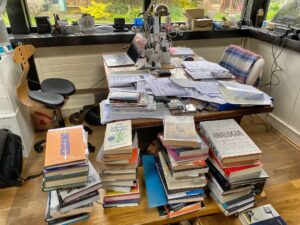
This is the most surreal photograph I’ve ever taken. In September 2007 I was standing early one morning on Noordeinde in The Hague waiting for a friend to show up when I saw this extraordinary display in the window of a fancy antique shop. What’s particularly nice (for me) is that it’s an analogue photograph taken with an old film Leica.


Quote of the Day

”To the Tennis Court, and there saw the King play at tennis and others; but to see how the King’s play was extolled, without any cause at all, was a loathsome sight.”

  • Samuel Pepys in his diary, 4 January, 1664.

Musical alternative to the morning’s radio news

Elgar | Introduction & Allegro for Strings, Op.47 | Pinchas Zukerman

Link


Long Read of the Day

The Defiance of Salman Rushdie

A fine essay by David Remnick, Editor of The New Yorker.

hen Salman Rushdie turned seventy-five, last summer, he had every reason to believe that he had outlasted the threat of assassination. A long time ago, on Valentine’s Day, 1989, Iran’s Supreme Leader, Ayatollah Ruhollah Khomeini, declared Rushdie’s novel “The Satanic Verses” blasphemous and issued a fatwa ordering the execution of its author and “all those involved in its publication.” Rushdie, a resident of London, spent the next decade in a fugitive existence, under constant police protection. But after settling in New York, in 2000, he lived freely, insistently unguarded. He refused to be terrorized.

There were times, though, when the lingering threat made itself apparent, and not merely on the lunatic reaches of the Internet. In 2012, during the annual autumn gathering of world leaders at the United Nations, I joined a small meeting of reporters with Mahmoud Ahmadinejad, the President of Iran, and I asked him if the multimillion-dollar bounty that an Iranian foundation had placed on Rushdie’s head had been rescinded. Ahmadinejad smiled with a glint of malice. “Salman Rushdie, where is he now?” he said. “There is no news of him. Is he in the United States? If he is in the U.S., you shouldn’t broadcast that, for his own safety.”

Within a year, Ahmadinejad was out of office and out of favor with the mullahs. Rushdie went on living as a free man. The years passed…

It’s a classic Remnick piece, beautifully written and insightful. You could call it a profile in courage (to echo JFK’s ghost-written book). And it includes a wonderful portrait of Rushdie as he is now, a living embodiment of Hemingway’s definition of courage: “grace under pressure”.


The Generative AI wars begin

There’s something deeply comical about the sudden panic in the tech industry over ChatGPT. Microsoft decided to use the bot to smarten up its Bing search engine (which up to now has had less than 10% of the search market). This caught Google (which dominates the market) on the hop, so it brought forward the deployment of BARD — its answer to ChatGPT. On Monday, it published an ad for the new toy.

The only problem was — as Reuters quickly pointed out — there was a glaring factual error in the bot’s answer to the question: “What new discoveries from the James Webb Space Telescope can I tell my 9 year old about?”

It turns out that the first pictures of exoplanets — credited by Bard to the JWST — were in fact taken by the European Southern Observatory’s Very Large Telescope (VLT) in 2004!

I asked ChatGPT “Why did Google’s BARD get the question about the James Webb Space Telescope wrong?”

Sadly, ChatGPT was too busy to play. Instead it wrote me a little poem.

Later, an email pointed me to a comparative study of Bard vs. ChatGPT that someone had arranged. The summary of results looks like this:

Meanwhile — as usual — Gary Marcus highlighted something I had missed, namely the strange imbalance in media coverage of the two rival companies’ efforts. The NYT’s Kevin Roose, for example, “even went so far as to chide anyone who even expressed concern about the errors, saying that ‘fixating on the areas where these tools fall short risks missing what’s so amazing about what they get right’. “Meanwhile”, says Marcus,

it is striking that neither Roose nor anyone else has explained exactly why Google and Microsoft received such different reception. The two megacompanies both demoed prototypes, neither fully ready for public use, built around apparently comparable technology, facing apparently similar bugs, within a day of each other. Yet one demo was presented as a revolution, the other as a disaster.

Since neither company has yet subjected their products to full scientific review, it’s impossible to say which is more trustworthy; it might well turn out that Google’s new product is actually more reliable.

Most likely, neither of them are particularly reliable. Yet they are being treated as polar opposites. At the very least, someone ought be asking, from business perspective, what’s the moat here, if two companies are basically both about to offer the same thing?

It’s amazing how fixated the world has become on this generative tech. I was at a posh dinner party of apparently well-informed people on Wednesday night and it was difficult to keep the discussion (which was supposed to be about ‘data-centric engineering’) away from ChatGPT.


This Blog is also available as a daily email. If you think that might suit you better, why not subscribe? One email a day, Monday through Friday, delivered to your inbox. It’s free, and you can always unsubscribe if you conclude your inbox is full enough already!


Thursday 9 February, 2023

Where?


Quote of the Day

”Four things I’d been better without
Love, curiosity, freckles, and doubt.”

  • Dorothy Parker

Musical alternative to the morning’s radio news

Jackson Browne & David Lindley | Stay

Link


Long Read of the Day

The Sad Prince

Unexpectedly interesting essay by Derek Neal about trying to escape one’s origins, which means that it’s about Prince Harry, of all people.

I never thought I would write about Prince Harry. As an American, I have a natural aversion to the Royal Family and to the idea that they are somehow different or special by virtue of their birth. They’re just people. But I’m also Canadian by way of my mother, and now that I’ve lived in Canada for a few years, the Canadian interest in the Royals seems to have rubbed off on me, and I can’t help but feel some sort of sympathy for Harry’s plight. He thinks he’s made it to the end of his story—the narrative urge is incredibly strong in the Netflix show (Meghan mentions how they’ve come “full circle”)—yet I can’t help but feel this is just the first chapter, and that the story, which Meghan calls “a fairy tale,” will end up being a bit more sinister, a bit more like a Henry James novel or a Joan Didion essay.


Books, etc.

 The End of the McLuhan Centre for Culture & Technology (1968 – 2023)

Link

The purpose of the Centre for Culture and Technology, as initially envisioned by Marshall McLuhan in 1963, was to “advance the understanding of the origins and effects of technology.” One of the specific objectives was “to organize an inter-disciplinary seminar for staff members and graduate students and to devise new experimental procedures for identifying the psychic and social consequences of technological change.” These were revolutionary ideas at the time and there was excitement in the air.

They were (and, in a way, they’ve acquired a new saliency in our current media ecosystem), but it seems that the Faculty of Information in the University of Toronto no longer has much interest in them.

I gave a talk on McLuhan years ago.

McLuhan Keynote

Click to download.


This Blog is also available as a daily email. If you think that might suit you better, why not subscribe? One email a day, Monday through Friday, delivered to your inbox. It’s free, and you can always unsubscribe if you conclude your inbox is full enough already!


Wednesday 8 February, 2023

Two ladies of Arles

Speaks for itself, really.


Quote of the Day

”Saints should always be judged guilty until they are proved innocent.”

  • George Orwell

Musical alternative to the morning’s radio news

John Field | Nocturne no 5 in B flat major | John O’Conor

Link

I love all the Field nocturnes, but this one is special.


Long Read of the Day

We are ‘greening’ ourselves to extinction

Sharp essay by Vijay Kolinjivadi from the University of Antwerp.

More than a decade ago, investment experts James Altucher and Douglas Sease wrote a book for the Wall Street Journal called ‘Investing in the Apocalypse’. They argued that the end of the world is a profitable opportunity for those who know how to “fade the fear”, as everyone else panics. They maintained that when disaster strikes, investors should approach it with the rationale that “no matter how bad things seem, they really aren’t that bad”.

Well before the COVID-19 pandemic, they advised investing in big pharmaceutical companies as a strategy to reap dividends from global pandemics. They also encouraged putting money into renewable energy systems while ramping up oil production.

Today, it seems many have followed Althucher and Sease’s advice. Under the guise of taking action on the pandemic, billions of dollars have been poured into big pharma, instead of public health and policies aimed at preventing another global outbreak. The supposed energy transition that has been undertaken has seen renewable energy production expanded, but there has been no indication that oil and gas are being substituted and ultimately phased out.

What is worse, governments and corporations have teamed up to turn the apocalypse into a money-making opportunity…

It’s good on the ‘carbon offsets’ racket, too.

And of course it reminds me that we need a theory of incompetent systems — ones that can’t fix themselves.


Books, etc.

Security guru Bruce Schneier has a new book, A Hacker’s Mind: How the Powerful Bend Society’s Rules, and How to Bend them Back, coming out soon, and it’s on my reading list. (I think I’ve read all of his previous books.) Cory Doctorow (Whom God Preserve) has a nice blog post about it — and about Schneier.

Schneier led the charge for a kind of sensible, reasonable thinking about security, using a mix of tactics to shift the discourse on the subject: debating TSA boss Kip Hawley, traveling with reporters through airport checkpoints while narrating countermeasures to defeat every single post-9/11 measure, and holding annual “movie-plot threat” competitions.

Most importantly, though, Schneier wrote long-form books that set out the case for sound security reasoning, railing against security theater and calling for policies that would actually make our physical and digital world more secure – abolishing DRM, clearing legal barriers to vulnerability research and disclosure, and debunking security snake-oil, from “unbreakable proprietary ciphers” to “behavioral detection training” for TSA officers.

He even designed the rings for Cory’s wedding — which, naturally, were cipher wheels.

One thing I especially like about Schneier is his description of himself as

“a public-interest technologist, working at the intersection of security, technology, and people”.


My commonplace booklet

Deus ex machina

My friend Quentin had the good idea of asking ChatGPT to come up with an Eleventh Commandment. And a Twelfth. And a Thirteenth!


 This Blog is also available as a daily email. If you think that might suit you better, why not subscribe? One email a day, Monday through Friday, delivered to your inbox. It’s free, and you can always unsubscribe if you conclude your inbox is full enough already!**


Tuesday 7 February, 2023

The Public Sphere, French style

Seen outside a lovely town in Burgundy.


Quote of the Day

”’Living’ carries echoes of The Remains of the Day, the 1993 film of Ishiguro’s famous, novel, in which Anthony Hopkins stars as a butler whose soul has been ironed flat, like a tablecloth.”

  • Anthony Lane, reviewing the film ‘Living’ in which Bill Nighy stars as a civil servant suffering from a terminal illness. (New Yorker, 26 Dec 2022)

Musical alternative to the morning’s radio news

Norah Jones | Sunrise (live in Amsterdam )

Link


Long Read of the Day

What you need to know about Mastodon

Nice (and illuminating) introduction by Glenn Fleischmann. I particularly liked this metaphor:

You can think of Mastodon as a flotilla of boats of vastly different sizes, whereas Twitter is like being on a cruise ship the size of a continent. Some Mastodon boats might be cruise liners with as many as 50,000 passengers; others are just dinghies with a single occupant! The admin of each instance—the captain of your particular boat—might make arbitrary decisions you disagree with as heartily as with any commercial operator’s tacks and turns. But you’re not stuck on your boat, with abandoning ship as the only alternative. Instead, you can hop from one boat to another without losing your place in the flotilla community. Parts of a flotilla can also splinter off and form their own disconnected groups, but no boat, however large, is in charge of the community.


The irrational exuberance of tech giants

Om Malik explains

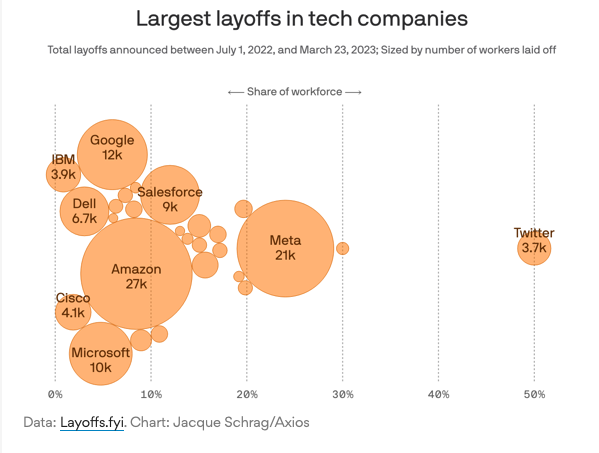
An unprecedented boom in Silicon Valley that started with the once-in-a-generation convergence of three mega trends: mobile, social, and cloud computing, has peaked. It started in 2010, and it has been bananas around here for the past decade or so. The FAANG+Microsoft companies saw their revenues go from $196 billion to over $1.5 Trillion. Let that sink in. Booming stocks helped create an environment of excess like never before. 

The companies got into the business of what Paul Kedrosky calls “people hoarding.” The pandemic and the resulting growth revved up the hiring machine even more. The over-hiring of talent has led to wage inflation, which had a ripple effect across the entire technology ecosystem. Technology insiders are happy to tell non-tech companies to use data and automation as tools to plan their future. It is easier to preach than practice. 

Why does Google need close to 200,000 employees? Or does Microsoft need 225,000 people? Salesforce, till recently, had about 73,500 employees. Profitable as these companies have been, it is also clear that they have become sloppy and bloated.

Funny how the laws of economic gravity eventually have to be obeyed.


Top programming languages in 2023

From Tech Republic

Based on what employers say they want in job candidates

Based on the analysis, here are the top 10 programming languages for 2023 along with the number of open full-time jobs and each language’s ranking on Coding Dojo’s list for 2022:

Python: 68,534 jobs (No. 2 in 2022) SQL: 57,971 jobs (No. 3) Java: 57,236 jobs (No. 1) JavaScript: 48,041 jobs (No. 4) C: 35,702 jobs (No. 7) C++: 35,281 jobs (No. 5) Go: 32,503 jobs (No. 8) C#: 29,084 jobs (No. 6) Assembly: 14,866 jobs (No. 10) MATLAB: 8,504 jobs (previously unranked)

I’m not surprised Python is still tops. Even I can use it. And ChatGPT speaks Python too.


My commonplace booklet

The Seven Ages of Man

  1. Screaming baby
  2. Bratty kid
  3. Obnoxious teen
  4. Over-confident hipster
  5. Oblivious dude
  6. Smug retiree
  7. Old geezer

(From a New Yorker cartoon.)


This Blog is also available as a daily email. If you think that might suit you better, why not subscribe? One email a day, Monday through Friday, delivered to your inbox. It’s free, and you can always unsubscribe if you conclude your inbox is full enough already!