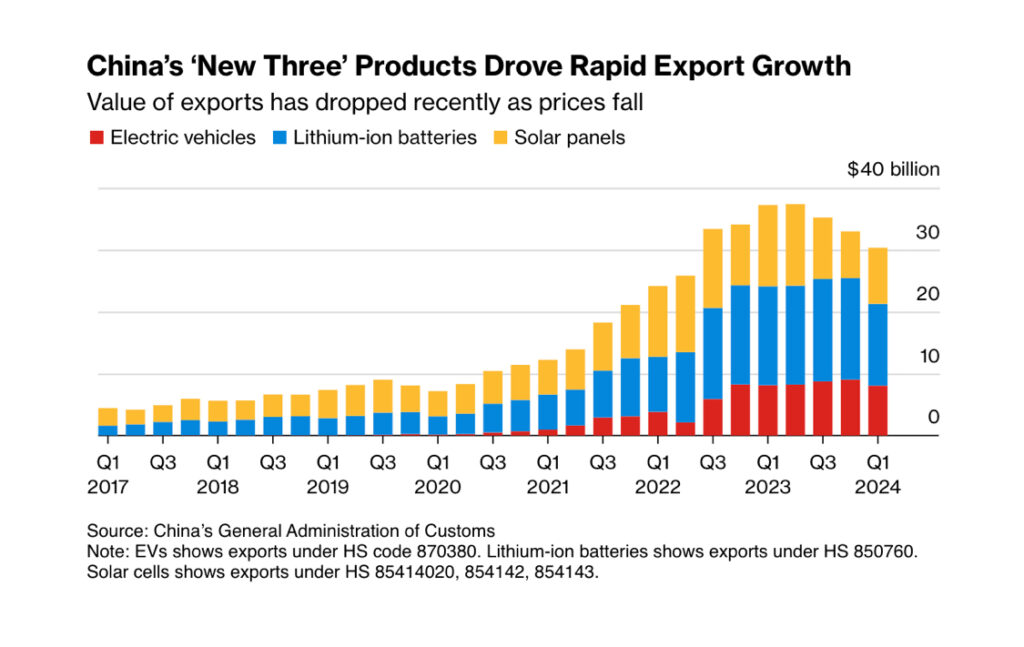

Friday 5 January, 2024

Van Gogh inverted

This lovely photograph by Natalya Saprunova in yesterday’s Washington Post stopped me in my tracks. It shows bubbles of carbon dioxide and methane — released by permafrost melting — floating to the surface of a stream in Siberia. What it instantly reminded me of was paintings by Vincent Van Gogh, and if you turn it upside down you can perhaps see why.


Quote of the Day

One of my grandfathers was a bombardier in the European theater of World War 2. He came back uninjured, but the stress of so many near-death experiences, and so many dead friends, drove him to lifelong alcoholism. Once, in the 1990s, I heard a conservative pundit claim that young Americans had become soft and weak because they had never had to face adversity like the World War 2 generation did. I asked my grandfather what he thought of that. After uttering something unprintable, he said: “I did that [stuff] so you wouldn’t have to.”


Musical alternative to the morning’s radio news

Ye Vagabonds | Whistling Wind

Link

Thanks to Celine Naughton for suggesting it.


Long Read of the Day

Does Capitalism Beat Charity?

Scott Alexander is IMHO one of the most interesting writers on the Web. This essay indicates why. Even when I disagree with him, I admire the way he approaches complicated questions. As in this case.

This question comes up whenever I discuss philanthropy.

It would seem that capitalism is better than charity. The countries that became permanently rich, like America and Japan, did it with capitalism. This seems better than temporarily alleviating poverty by donating food or clothing. So (say proponents), good people who want to help others should stop giving to charity and start giving to capitalism. These proponents differ on exactly what “giving to capitalism” means – you can’t write a check to capitalism directly. But it’s usually one of three things:

  1. Spend the money on whatever you personally want, since that’s the normal engine of capitalism, and encourages companies to provide desirable things.

  2. Invest the money in whatever company produces the highest rate of return, since that’s another capitalist imperative, and creates more companies.

  3. Do something like donating to charity, but the donation should go to charities that promote capitalism somehow, or be an investment in companies doing charitable things (impact investing)

I agree that overall capitalism has produced more good things than charity. But when I try to think at the margin, in Near Mode, I can’t make this argument hang together. Here’s my basic objection…

Read on and enjoy the ride. With Alexander, the journey, not the destination, sometimes matters most.


Books, etc.

I’ve come late to Cade Metz’s book, and regret that fact. It’s interesting, readable and very illuminating about the origins of the current AI frenzy.


Niklaus Wirth RIP

He was a great computer scientist, inventor of several programming languages, two of which — Algol and Pascal — I used during my student days. I particularly liked Turbo Pascal, the development system Borland created for programming in Pascal, which included a fast compiler and a useful front-end for writing code, and which ran on the first IBM PC I owned. I used it to write software what kind-of worked, and which therefore qualified for Roger Needham’s astringent evaluation of being “good enough for government work”.


Linkblog

Something I noticed, while drinking from the Internet firehose.

James Fallows: Updates on the Haneda Airport Collision

Fallows is a great journalist and also a practising pilot who writes insightfully about aviation. This is his update on the horrendous accident at Tokyo airport the other day.

What the pilots and controllers knew.

On current evidence, the Japan Air Lines plane had been properly cleared to land on Runway 34R. It is possible the pilots in that Airbus cockpit did not see the small Coast Guard plane sitting on the runway until the very last instant, or perhaps at all.

How could this be? The runway lights were bright, at night, and could make it hard to see wingtip lights in unexpected locations; the Coast Guard plane was relatively small, in a runway environment packed with other blinking lights; the Airbus windshield would have been showing a “heads up display” of the landing path, which could obscure weak lights on the runway; the controller appears not to have cautioned the crew about previously departing traffic or other complications; etc.

Latest evidence suggests that controllers had intended the Coast Guard plane to taxi to the entry point for Runway 34R, but not onto the runway. This is a fundamental life-and-death distinction in aviation, with lots of language and procedures designed to underscore the difference. “Hold short” when you’re not supposed to enter the runway; “line up and wait” when you are cleared to enter the runway but not to take off; “cleared for takeoff” when it’s time to go.

At all airports I’ve ever seen, there are bright red signs to alert you that you’re about to turn onto a runway…


This Blog is also available as an email three days a week. If you think that might suit you better, why not [subscribe]? One email on Mondays, Wednesdays and Fridays delivered to your inbox at 6am UK time. It’s free, and you can always unsubscribe if you conclude your inbox is full enough already!


Wednesday 3 January, 2024

Boxed set

Cycling past the University Library in Cambridge over Christmas, I noticed that some genius — in a neat touch — had placed a classic red telephone box on the forecourt. Why ‘neat’? Simply that the phone box as well as the Library had both been designed by the same architect — Giles Gilbert Scott.

But to see the joke you need to take a wider view.

Note the shape of the Library tower.


Quote of the Day

”I loathe writing. On the other hand I’m a great believer in money.”

  • S.J. Perelman

Musical alternative to the morning’s radio news

Kate Rusby | Who Will Sing Me Lullabies

Link


Long Read of the Day

James Fallows on the year ahead for the US

From the veteran journalist’s blog..

Three hundred and nine days from now, America’s prospects will look very different than they do as we begin this year—different one way or another. The results will depend on an electorate whose downcast mood contrasts with the strongest economic growth in decades. In the starkest way since Bush v. Gore in 2000, the outcome may be in the hands of a Supreme Court that is less trusted and more politicized than in that era, and far more visibly corrupt. Public information will depend on a mainstream press still struggling to cope with a movement like Trump’s, and social media companies that barely try…

Fallows is a sharp and perceptive observer of mainstream media in the US In his piece he includes a dramatic graphic of what Gallup heard from American voters in the run-up to Trump’s election.

It’s a vivid demonstration of how US mainstream media allowed themselves to be distracted from the important issues in the 2016 campaign. I can see the same deficient narrative building again this time, partly because of the ‘balance as bias’ dysfunctionality that still plagues political journalism everywhere. Nowhere, for example, will voters be introduced to the idea that Joe Biden might turn out to be a more effective President than Barack Obama — at least in terms of getting things done. Or that Trump is showing signs of serious cognitive impairment which make Biden look like Spinoza.


Books, etc.

From GoodInternet.


Linkblog

Something I noticed, while drinking from the Internet firehose.

100 Greatest Beatles Songs

Good list in Rolling Stone magazine.


This Blog is also available as an email three days a week. If you think that might suit you better, why not subscribe? One email on Mondays, Wednesdays and Fridays delivered to your inbox at 6am UK time. It’s free, and you can always unsubscribe if you conclude your inbox is full enough already!


Monday 1 January,2024

Those New Year resolutions…

From Nellie Bowles in The Free Press:

I keep thinking of resolutions. This year, I should call my friends more often to check in, or my parents (maybe). This year, I should do yoga once a week. This year, I should read less news and more books. Or. . . this year, I should wear makeup and better clothes, put a little effort in, and maybe I will actually do this. But honestly, then I think: I’ve got enough on my plate! I’m doing plenty and it’s great. I can’t add any of these to some sort of guilt treadmill.

I tried this argument out with some family members in the living room just now, and they said, “Oh, so you think you’re perfect?” Well. Look. I’m 35. I’ve got a kid and a job. I’m nice enough. I’m in some kind of shape. And I like reading the news. I call my friends plenty; we’re all busy moms, it’s really fine. And so this year: no resolutions. I’m not perfect, but I look things over and I think: no major notes. Keep on keeping on into 2024. If that makes me a monster, so be it. Maybe I’ll work on it in 2025.


Where next?

Wicken Fen, Cambridgeshire, Friday.


Quote of the Day

“In spite of all the hype and the drama, few compelling business use cases for the technology emerged. All the talk about generative AI reinventing internet search fizzled out after Microsoft’s AI-enabled Bing failed to disturb Google’s market dominance. Concerns about data security, intellectual property rights and generative AI’s dirty habit of “hallucinating” facts — or, more crudely, just making stuff up — also deterred companies from deploying the technology. And many AI-powered start-ups, promising to revolutionise various industries, blew up on the launch pad as the release of increasingly capable generative AI models destroyed their original business models.”

  • Financial Times Editorial on AI in 2023, 28 December.

Musical alternative to the morning’s radio news

Bob Dylan | Shelter from the Storm

Link

And if you want to see what religious folks make of the lyrics, see here.


Long Read of the Day

An Odd Silence

Very perceptive blog post by Bill McKibben on the way our mainstream media seem to have a blind spot about the climate crisis as they continue to practice what Michael Mann called “the sociology of the last five minutes”.

The world—its politics, its economy, and its journalism — has trouble coping with the scale of the climate crisis. We can’t quite wrap our collective head around it, which has never been clearer to me than in these waning days of 2023.

Because the most important thing that happened this year was the heat. By far. It was hotter than it has been in at least 125,000 years on this planet. Every month since May was the hottest ever recorded. Ocean temperatures set a new all-time mark, over 100 degrees. Canada burned, filling the air above our cities with smoke.

And yet you really wouldn’t know it from reading the wrap-ups of the year’s news now appearing on one website after another…

Read on. It’s good — especially on the problem that while in geological terms “we’re warming at hellish pace” that’s not “how the 24/7 news cycle works”.

Yep.


For all the hype in 2023, we don’t know what AI’s long-term impact will be

Yesterday’s Observer column.

So the lesson of history in relation to tech bubbles is this: what things will be left after the bubble bursts? Because they always do. Which neatly brings us back to the current madness about AI. Sure, it’s wonderful that it enables people who are unable to string sentences together to “write” coherent prose. And, as Cory Doctorow observes, it’s great that teenagers playing Dungeons & Dragons can access an image generator that creates epic illustrations of their characters fighting monsters – even if the images depict “six-fingered swordspeople with three pupils in each eye”. And that the tech can do all of the other tricks that are entrancing millions of people – who are, by the way, mostly using it for free. But what of lasting value will be left? What will the historians of the next century regard as the enduring legacy of the technology?

Read on


My commonplace booklet

From Gallup

This holiday season, 43% of U.S. workers say they plan to take a vacation during the holidays, and of that group, roughly half — or 21% of all workers — will completely disconnect from work. Meanwhile, 22% of workers will be taking a vacation but checking in with work via email or other means.


Linkblog

Something I noticed, while drinking from the Internet firehose.

From Dave Winer (Whom God Preserve)…

In the early 80s, my main development machine was an Apple II, believe it or not. Sometimes the machine would just refuse to boot, so I’d get on El Camino to Computer Plus in Sunnyvale, which was the main developer store in the Valley, owned by Dick and Lucy Applebaum and Mark Wozniak. Very often when I got to the store and plugged the machine in, it would start right up. That became a superstition, if your computer won’t launch take it for a ride in the car. Anyway, this morning, in 2023, my web app, the new version of news.scripting.com that I’m working on was in a state that was really depressing. I was working on making it mobile-friendly and nothing I did would make the timeline fit into the allotted space. I was at my wits end, thinking maybe I’d have to revert my changes and try another approach. So I went out for a walk, it’s a nice day, kind of warm, and the air is clear, no rain, and there are even some trees in bloom which is weird considering that it’s the day after Christmas for crying out loud. But it was a good thing to do, when I got back I had a plan for how to go forward. My brain was now clear. I got myself a nice bowl of fruit salad and a glass of water, and sat down and rolled up my sleeves, and I bet by now dear reader you’ve figured out the punchline. It worked. I did nothing. Every bit showed up in the right place, more or less (modulo some tweaking). Back with Apple II in the 80s it wasn’t really magic. The chips weren’t soldered into the motherboard on the machine, and they would get pretty hot, and when you’d turn the computer off and on, it would go hot and cold, which meant the pins on the chips would expand and contract and in doing so, over months, one could unseat. A trip in the car might just jog it back into its socket. The same way, forty years later, if you get up from the computer and go for a walk, when you come back, cached requests have now aged-out and the files that weren’t getting refreshed are now up to date, and it turns out I wasn’t crazy or incompetent, and it probably wasn’t some kind of act of god, it’s just the internet being the internet.


Errata

Eugene O’Connor wrote to criticise the Oscar Wilde quote about glasses being half-full or half-empty.

Actually, on earth, the glass is always full … of fluid. Half gas and half liquid.

On the moon it might be different, but who would want to drink there, there’s no atmosphere.

Quite. But Wilde didn’t read physics at Oxford, which is probably just as well.


This Blog is also available as an email three days a week. If you think that might suit you better, why not subscribe? One email on Mondays, Wednesdays and Fridays delivered to your inbox at 6am UK time. It’s free, and you can always unsubscribe if you conclude your inbox is full enough already!



Wednesday 27 December, 2023

Dumplings ‘R Us

‘Chinatown’, London


Quote of the Day

”A day without laughter is a day wasted.

  • Charlie Chaplin

Musical alternative to the morning’s radio news

Fleetwood Mac | Don’t Stop

Link

One of my favourite tracks from a great album.


Long Read of the Day

My Heart Sasses Back

Sassy blog post by Margaret Atwood based on a nice epistolary interaction with one of her friends.

My longtime friend and sometime translator of my poetry into French, Christine Evain — who lives in Nantes – telephoned my heart long distance, having read of its escapades.

Let it be said that Christine takes a slightly dim view of my French readings of late. They encompasses the 14th century — the series Les Rois Maudits, which added many useful vocabulary words, such as “the atrocious scent of testicles burning on a brazier of coals,” something one might drop into a soirée as a bon mot, and which was used as a source by George Martin for Game of Thrones (he added dragons). Then the French Revolution — I’ll give you my reading list on that in a later post, but, as you know, many heads rolled during the Terror, and it didn’t end well for Robespierre, “The Incoruptible.” Christine is also dubious about the CTM (Chines Traditional Medicine) heart-support pills I’ve been popping; among the ingredients is powdered scorpion. I have nothing against this, but the younger generations can be more squeamish. They never had to drink cod liver oil out of a spoon.

Here’s how the long-distance call went…

I do love Atwood’s blog.


Books, etc.

Lovely Xmas present from my wife.


My commonplace booklet

All my rides

Doc Searls (Whom God Preserve) is a real petrolhead, as indeed I was once. But he’s unearthed this annotated list of all the sets of wheels he’s ever owned. And I am solely tempted to do the same. The only problem is that it might be embarrassing.


Linkblog

Brad De Long on the three big ideas one should take away from Ernest Gellner’s Plough, Sword, & Book: The Structure of Human History:

The Interplay of Production, Coërcion, & Cognition: None of these is prior to the other—although all are profoundly shaped by technology. These three elements interact in shaping human societies as equals, and not simply, because they are interconnected in complex ways.

Non-Linear Progression of Societies: Societal development is diverse and multifaceted, shaped by various cultural and environmental factors. There is very little that is linear, or predetermined.

Cognitive Aspects of Societal Change: Changes in belief systems and knowledge are crucial in understanding societal transformations—and the modes of cognition are not traceable back to modes of production and modes of domination. All you can say is that the mode of cognition needs to make sense of the mode of production and the mode of domination, for if it does not make sense you have a society-shaking revolutionary situation.

Useful because I haven’t read the book and may need to for something I’m working on.


This Blog is also available as an email three days a week. If you think that might suit you better, why not subscribe? One email on Mondays, Wednesdays and Fridays delivered to your inbox at 6am UK time. It’s free, and you can always unsubscribe if you conclude your inbox is full enough already!


Friday 22 December, 2023

Xmas Postbox

One of the nicest things that happened (I think during the pandemic) that people started creating knitted tops for Britain’s red post-boxes. I spotted this one in Histon the other day as I came out of the post office. It even has a motion sensor that switches on the toy railway when it detects a possible spectator.


Quote of the Day

”You will know you’re old when you cease to be amazed.”

  • Noel Coward

Musical alternative to the morning’s radio news

Elmore James | Talk to Me Baby

Link


Long Read of the Day

 The Emotional Life of Populism

Remarkable essay by the sociologist Eva Illouz about the populism currently roiling many Western democracies — not to mention the Israeli state that’s currently embroiled in trying to eliminate Hamas.

Illouz is much more illuminating (IMO) than most of the current ‘political-science’ writing about populism. The essay is really an introduction to her new book on the subject.

This is how it opens:

In my book I argue that populist politics blends together four specific emotions – fear, disgust, resentment, and love – and makes these emotions dominant vectors of the political process. The mixture of these emotions forms the matrix of populism because they generate antagonism between social groups inside society and alienation from the institutions that safeguard democracy, and because they are, in many ways, oblivious to something we might call reality. More exactly: populism lives as much in reality (naming ills that have transformed working-class lives) as in the imagination. Fear provides compelling motivation to repeatedly name enemies as well as invent them, to view such enemies as fixed and unchanging, to shift politics from conflict resolution to a state of permanent vigilance to threats, even at the price of suspending the rule of law. Israel’s fear of its outer and inner enemies runs deeper in the state apparatus than other populist forms of fear (it has also a different history and geography), but it bears affinities with them, as they all express fear of a shifting balance of power between majority (racial, ethnic, religious) and minorities and has become existential, about the very existence of the nation. Trump, Orbán, Le Pen, Meloni, the Swedish Democrats, and Modi have focused on the minorities who allegedly threaten their nation. Disgust creates and maintains the dynamic of distancing between social groups through the fear of pollution and contamination: it helps separate ethnic or religious minorities and, by the logic of contamination, it also contributes towards separating the political groups who either support or oppose the minorities. Ressentiment is a key process in self-victimization; its rhetoric has become generalized, as all groups, majority and minority, invoke it to designate the relationship of the other to them; it redefines the political self in terms of its wounds. Trumpist voters or Israeli settlers are united in their common sense of self-victimization against left-wing elites. When all groups are victims of each other, it creates antagonism and changes ordinary notions of justice. It also creates fantasies of revenge. Finally, a particular form of exclusionary patriotism promises solidarity to the in-group at the expense of the others, who become redefined as superfluous or dangerous members of the nation. We should not underestimate the deep relationship that nationalism entertains today with religion and tradition.


Books, etc.

Steven Sinofsky: Books to Read and Gift

A list of 42 books he read this year with a quick note or two on each explaining why he’d suggest it or not. Sinofsky is an interesting guy — was a senior executive at Microsoft and is also on the Board of the VC firm Andreessen Horowitz, so is very knowledgeable about the tech industry. I disagree with his views sometimes, but respect his judgement. So I found his list interesting.


My commonplace booklet

Marina Hyde on Michelle Mone and the PPE scandal

Unmissable column on one of the more egregious creeps on the UK scene.

Michelle is 5ft 9in of pure chaos, and watching Rishi Sunak whinnying feebly about “taking all these things incredibly seriously” tees up the spectacle of the prime minister and a number of other drippy male politicians further incensing this Category 5 “force of nature”, who will lash out all the way down on her well-earned fall from grace. Is that as good as taxpayers getting their money back? No. But I’ll watch.

Before we proceed, though, a recap. Can it really be only 11 years since Michelle was granting a mesmerisingly messy interview to the Sunday Times, in which she wailed rhetorically: “Why did I want to be Michelle Mone? Why did I want to start all these businesses? Why can I never be satisfied with what I’ve got?” Yes. Yes, I do believe it can.

Can it really be only six years since Mone and Barrowman [her husband] were granting “their first joint interview” to Hello! magazine, standing in formalwear in front of their Isle of Man McMansion – a Ferrari parked with gossamer insouciance just behind them, as if to say … well, as if to say GREETINGS, SHITHEADS – DID WE MENTION WE OWN A FERRARI? Again, it can. Readers of various outlets have since been invited inside the property, where decorative flourishes include a paved drive (sorry, but no) and an amphitheatre (actually hysterical). “I feel like I’m in a fairytale,” Michelle told the publication, “a beautiful dream I don’t ever want to wake up from.” Three years ago, as a belated second wedding present, she gifted Doug a gelding (I bet she did).

Great stuff. It’s also worth noting that it was the Guardian’s dogged journalism that finally lifted the stone on the gilded creep. Overseas readers may be intrigued that this dame is a Baroness — a member of the House of Lords (ennobled by the Tories, needless to say) — and therefore someone who has a say in the governance of the Disunited Kingdom. The best bit, though, has echoes of P,G. Woodhouse: Mone made her first fortune with a lingerie company and, according to Wikipedia, has other ventures including naturopathic ‘weight-loss’ pills, and a fake tan product via ‘Ultimo Beauty’.

Woodhouse fans will remember Roderick Spode, the amateur dictator and Leader of the Black Shorts movement, who in his spare time was the proprietor of a lingerie brand, Eulalie.


Errata

Ooops! Wednesday’s edition revealed that I am unable to tell doughnuts from bagels. My only excuse is that I don’t like doughnuts either. Thanks to Lisa Long for gently pointing out the error.


This Blog is also available as an email three days a week. If you think that might suit you better, why not subscribe? One email on Mondays, Wednesdays and Fridays delivered to your inbox at 6am UK time. It’s free, and you can always unsubscribe if you conclude your inbox is full enough already!


Wednesday 20 December, 2023

Bagel-Land

I’ve never liked bagels. On the other hand, I’ve never seen ones like these. Still, I gave them a miss.

Seen in central London, last week.


Quote of the Day

From Politico:

”British Foreign Secretary David Cameron and German Foreign Minister Annalena Baerbock on Sunday called for a “sustainable cease-fire” in the Middle East, lamenting that “too many civilians have been killed” in the Israel-Hamas war.”

What, then, one wonders, is the correct number of civilians to be killed?


Musical alternative to the morning’s radio news

Ralph Vaughan Williams | Fantasia on a Theme by Thomas Tallis | Neville Marriner and the Academy of St-Martin-in-the Fields

Link

I’ve always loved this, but it was especially welcome yesterday as a respite from a dank, dismal, East Anglian winter’s day.


Long Read of the Day

John Quiggin: Training my replacement?

Like everyone else, John Quiggin is interested in Large Language Models.

But first,

I have an urgent article to write, so of course I’m irresistibly moved to do anything else. Following the precepts of creative procrastination, I’ve dealt with a bunch of administrative tasks, done some chores and resisted the urge to dive into social media (until now!). Having done all that, I decided to check on progress in Large Language Models.

What I’ve been interested in since the sudden rise of LLM is whether I could use it to turn out pieces in my own style, recycling and paraphrasing some of the millions of words I’ve typed over my career (my target of 500 words per working day would imply 4 or 5 million in the corpus, not counting blog posts and comments, snarky tweets and who knows how many emails).

We’re not quite there yet, but getting closer. I asked ChatGPT to “Write a critique of SMRs [Small Modular Reactors] in the style of John Quiggin”.

Here’s what he got.

Read on to see what he made of it. And savour the graphic ChatGPT produced in response to the prompt: “produce an image of John Quiggin with his brain hooked up to a computer connected in turn to a printer spooling paper. Style dramatic and futuristic, with a comic element”.

Since DALL-E doesn’t do real people anymore, it went for a generic academic instead. Doesn’t look a bit like Quiggin — or me either, for that matter.


Books, etc.

Dylan Thomas: Notes on the Art of Poetry

I could never have dreamt that there were such goings-on
in the world between the covers of books,
such sandstorms and ice blasts of words,
such staggering peace, such enormous laughter,
such and so many blinding bright lights,
splashing all over the pages
in a million bits and pieces
all of which were words, words, words,
and each of which were alive forever
in its own delight and glory and oddity and light.


My commonplace booklet

”A Ball of Brain Cells on a Chip Can Learn Simple Speech Recognition and Math”

When I first read this I was deeply suspicious. But then I read the Abstract of the paper in Nature Electronics that describes the research. It’s intriguing.

Brain-inspired computing hardware aims to emulate the structure and working principles of the brain and could be used to address current limitations in artificial intelligence technologies. However, brain-inspired silicon chips are still limited in their ability to fully mimic brain function as most examples are built on digital electronic principles. Here we report an artificial intelligence hardware approach that uses adaptive reservoir computation of biological neural networks in a brain organoid. In this approach—which is termed Brainoware—computation is performed by sending and receiving information from the brain organoid using a high-density multielectrode array. By applying spatiotemporal electrical stimulation, nonlinear dynamics and fading memory properties are achieved, as well as unsupervised learning from training data by reshaping the organoid functional connectivity. We illustrate the practical potential of this technique by using it for speech recognition and nonlinear equation prediction in a reservoir computing framework.

A very different approach to ‘AI’.


Linkblog

Something I noticed, while drinking from the Internet firehose.

Google’s blooper

Google announced Gemini, its supposed rival to GPT-4. It launched it with this impressive video.

Link

It’s really interesting, isn’t it?

Yes, but there’s a problem… As Bloomberg’s Pammy Olson put it:

”In reality, the demo also wasn’t carried out in real time or in voice. When asked about the video by Bloomberg Opinion, a Google spokesperson said it was made by “using still image frames from the footage, and prompting via text,” and they pointed to a site showing how others could interact with Gemini with photos of their hands, or of drawings or other objects. In other words, the voice in the demo was reading out human-made prompts they’d made to Gemini, and showing them still images. That’s quite different from what Google seemed to be suggesting: that a person could have a smooth voice conversation with Gemini as it watched and responded in real time to the world around it.”

Talk about shooting yourself in both feet.

It’s truly weird. As the ever-astute Ben Thompson observed:

“Google, given its long-term advantages in this space, would have been much better served in being transparent, particularly since it suddenly finds itself with a trustworthiness advantage relative to Microsoft and OpenAI. The goal for the company should be demonstrating competitiveness and competence; a fake demo did the opposite.”


This Blog is also available as an email three days a week. If you think that might suit you better, why not subscribe? One email on Mondays, Wednesdays and Fridays delivered to your inbox at 6am UK time. It’s free, and you can always unsubscribe if you conclude your inbox is full enough already!


Monday 18 December, 2023

Bay View

From our hotel room in Dingle.


Quote of the Day

”The reality is that the Times is becoming the publication through which America’s progressive elite talks to itself about an America that does not really exist.”

  • James Bennet, former Editorial-page Editor of the New York Times, writing in the Economist last week.

Musical alternative to the morning’s radio news

Handel | Concerto grosso in C Major, HWV 318 “Alexander’s Feast” | 1. Allegro

Link


Long Read of the Day

On being wrong about AI

Scott Aaronson is one of the smartest people around. Among other things he works on Quantum computing. He is also one of the most thoughtful and least arrogant. (If you doubt that, try this long interview with him on Scientific American.)

This is an interesting recent post on his blog. I was attracted to it because ever since the ‘AI’ feeding frenzy started I’ve been approached by many people and some institutions wanting to know what it all ‘means’, and sometimes whether I think that Generative AI will lead to AGI or superintelligent machines. For the record, my state of mind on this stuff is what Manuel Castells once memorably termed “informed bewilderment”. And I’m sceptical that endless extension of the machine-learning approach to AI will lead to AGI. But that’s just an opinion.

Anyway, Scott is a far more interesting player in this game, and so I recommend this blog post for its quiet reflectiveness. The road to wisdom on many important questions is uncertainty. But our current public sphere — or at any rate the social-media segment of it — abhors that.


Epic’s epic antitrust win over Google

And that’s not a typo! Yesterday’s Observer column:

The big news last week was that a jury in San Francisco had found Google guilty on all counts of antitrust violations stemming from its dispute with Epic Games, maker of the bestselling Fortnite, which had lodged a number of complaints related to how Google runs its Play store, an Android app market with a revenue of about $48bn (£38bn) a year.

Why is this interesting? Isn’t it just another case of two tech companies squabbling in a US court? Well, in the first place, something very rare happened – a tech giant actually lost a big case in a US court. Second, the case was decided by a jury, not (as often happens in such cases) by a judge. Third, it showed that venerable antitrust (ie anti-monopoly) laws such as the Sherman Act still work.

All this stems from the launch of the smartphone in 2007…

Read on


Books, etc.

Further to Friday’s piece on the way money is wrecking golf, this book is nicely timed. The FT carried an interesting review of it by Sujeet Indap recently.

Over 30 years, Shipnuck, first at Sports Illustrated and now at his own independent website, has become the top chronicler of professional golf. The genteel golf landscape has long bristled at his fearless, detailed reporting and irreverent tone. But his pre-eminence ultimately convinces the sport’s big and little figures to engage with him, if reluctantly.

LIV and Let Die pierces the game’s carefully curated image of decorum, exposing its greed, cynicism and hypocrisy. The book also serves as the inadvertent sequel to Phil, Shipnuck’s bestselling 2022 biography of Phil Mickelson. The left-handed superstar had originally decided not to participate in the biography. But just prior to that book’s publication, Mickelson phoned Shipnuck and made infamous remarks bad-mouthing the Saudi side, describing his dalliance with them as a tactic to extract a ransom from the PGA Tour.

Money always talks. And Saudi money talks louder than most.


Chart of the Day

I gave a talk about the’ AI’ feeding frenzy last week, and before I travelled to the venue I checked where Generative AI is on the current Gartner hype cycle. And there it is, just on the cusp of the ‘Peak of Inflated Expectations’. It’ll be on the downhill slide towards realism soon.


My commonplace booklet

As regular readers know, I’m an inveterate (incurable?) photographer (have been since I was a teenager.) One of my heroes was Elliott Erwitt and the other day I stumbled on a profile of him on the Aperture site which clarified a question that had often puzzled me. One of his most famous photographs is a ground-level picture of a little dog and the feet and calves of its lady owner. I’d often wondered how he’d taken the shot — it looked as though he’d been lying on the ground. An heroic posture for a photographer, perhaps, but not a great position from which to confront a policeman. Turns out the explanation was simple.

His first camera was a Rolleiflex, a twin-lens reflex. All he had to do was stoop slightly.


This Blog is also available as an email three days a week. If you think that might suit you better, why not subscribe? One email on Mondays, Wednesdays and Fridays delivered to your inbox at 6am UK time. It’s free, and you can always unsubscribe if you conclude your inbox is full enough already!

Friday 15 December, 2023

London’s other East End

Gerrard Street yesterday.


Quote of the Day

”Too much of anything is bad, but too much good whisky is barely enough.”

  • Mark Twain (Especially if it’s a good single malt.)

Musical alternative to the morning’s radio news

Vince Gill | Price of Regret at the Oklahoma Hall of Fame Ceremony

Link

The intro is interesting, but if you’re in a hurry he starts singing at 3:26.


Long Read of the Day

The EU AI Act and Greek Mythology

René Walter’s distinctive take on the forthcoming (and potentially powerful) EU legislation.

It’s a nice riff on a recent lecture by Stephen Fry about ‘AI’.

Fry presents us with the choice of whether we want to be the fire-giving god Prometheus, giving humans the spark of artificial intelligence, or the father of gods, Zeus, with strict regulations in the face of the upcoming, especially AI-based technological leaps that are emerging: Deep learning algorithms recently computed 2.2 million new crystal structures, “800 years’ worth of knowledge,” which can be used for novel technologies and innovations, such as in the production of solar panels. Another study confirms the abilities of large language models in the discovery of new molecules for pharmaceutical research, promising new and (possibly) cheaper drugs. A study from July on the acceleration of scientific research with AI found that artificial intelligence systems explicitly trained on human interferences in the research process — those rare Einsteins proposing completely novel theories — increased the prediction of these AI systems for future discoveries by 400%.

These things are possible today.

Walter is in favour of us playing Zeus, though he would spare Prometheus’s liver. The essay provides some relief from the cacophony about the technology. Hope you enjoy it.


Books, etc.

I’m tempted by this after listening to Burns talking about it with Tyler Cowen on an interesting podcast. It’s £45, though. Hmmm…


My commonplace booklet

(Spoiler alert: this is about golf, which I’m sure some readers regard as a way of ruining a nice country walk.)

I was an avid golfer from the age of 11 until I went to Cambridge in 1968, when I decided that it would be impossible to play regularly enough to be considered for the University team and do any academic work. One of my schoolmates, Ivan Morris, came to the sport later than me but rapidly mastered it and was a distinguished scratch golfer for decades.

Unlike many gifted players, though, he’s also been an astute commentator on it, and in recent years has become a fierce critic of the way the sport has been perverted by money and by the malign influence of equipment manufacturers. One of the consequences of this is that players like Rory McIlroy and Jon Rahm now drive the ball so far that championship golf courses are having to be continually lengthened so that they do not become pitch-and-putt toys for these guys.

Now the governing bodies of the sport have decided that Something Has To Be Done. They’ve decided that by 2030 the aerodynamics of golf balls will have to be modified so that they travel less far in the air.

Ivan is not much impressed by this, as his latest column in Irish Golfer makes clear.

Elite golf is not very interesting or exciting anymore; it’s about slamming the ball as far as possible and turning the game into a putting contest. There used to be a lot more to it than that. In modern golf, the ability to hit the same shot over and over is more important than the ability to play different (types of) shots. Top players must be bored to tears with the game they are asked to play for a living, and it is no fun to watch either. There was a time when the driver was the most difficult club in the bag to control. Now, it’s so forgiving one can blaze away without hardly a care in the world. The game has been manipulated by the ball and equipment manufacturers to a state where it has become too easy for pros while remaining more or less as difficult as ever for the club golfer.

Right on.


Linkblog

Something I noticed, while drinking from the Internet firehose.

 Free and liberated ebooks, carefully produced for the true book lover.

Standard Ebooks is a volunteer-driven project that produces new editions of public domain ebooks that are lovingly formatted, open source, free of U.S. copyright restrictions, and free of cost.

Ebook projects like Project Gutenberg transcribe ebooks and make them available for the widest number of reading devices. Standard Ebooks takes ebooks from sources like Project Gutenberg, formats and typesets them using a carefully designed and professional-grade style manual, fully proofreads and corrects them, and then builds them to create a new edition that takes advantage of state-of-the-art ereader and browser technology.

Standard Ebooks aren’t just a beautiful addition to your digital library—they’re a high quality standard to build your own ebooks on. Looks interesting and imaginative. I’ve been thinking of them for Xmas presents.

Link

H/T Jason Kottke (Whom God Preserve).


This Blog is also available as an email three days a week. If you think that might suit you better, why not subscribe? One email on Mondays, Wednesdays and Fridays delivered to your inbox at 6am UK time. It’s free, and you can always unsubscribe if you conclude your inbox is full enough already!


Monday 11 December, 2023

Wonders of nature

A large log that’s been lying on our driveway for a while has suddenly sprung a surprise in the form of picturesque clusters of funghi.


Quote of the Day

“The men the American people admire most extravagantly are the most daring liars; the men they detest most violently are those who try to tell them the truth.”

  • H. L. Mencken

He wrote this in 1924. Nothing much has changed.


Musical alternative to the morning’s radio news

The Waterboys | A Song for the Life

Link


Long Read of the Day

Maybe We Already Have Runaway Machines

Terrific review essay in the New Yorker by Gideon Lewis-Kraus on David Runciman’s new book,  The Handover: How We Gave Control of Our Lives to Corporations, States and AIs. It’s a book I know quite well, having read it both in draft and in published form, and so can appreciate Lewis-Kraus’s insights into it. For people who are wondering whether it might be good Christmas read, the essay might be usefully informative. In a way one could interpret the book as providing a novel perspective on the current hysteria about ‘AI’ and the (possibly-existential) risks the technology might pose for humanity (which are overblown IMO).

Certainly, for anyone wondering what it might be like for humans to live with (or under) super-intelligent machines, then Runciman’s answer is that we already know what it’ll be like: we’ve been living under two kinds of such machines for at least a century and a half! One is the modern sovereign state; the other is the contemporary mega-corporation.

Anyway, the essay is worth your time. As is the book itself.


ChatGPT’s disruptive year

Yesterday’s Observer column:

If a week is a long time in politics, a year is an eternity in tech. Just over 12 months ago, the industry was humming along in its usual way. The big platforms were deep into what Cory Doctorow calls “enshittification” – the process in which platforms go from being initially good to their users, to abusing them to make things better for their business customers and finally to abusing those customers in order to claw back all the value for themselves. Elon Musk was ramping up his efforts to alienate advertisers on Twitter/X and accelerate the death spiral of his expensive toy. TikTok was monopolising every waking hour of teenagers. FTX had just gone bankrupt and at least $1bn of investors’ money had gone awol. Here in the UK, the bedraggled online safety bill was wending its way through parliament. And nobody outside the tech world had ever heard of Geoffrey Hinton or Sam Altman.

And then one day – 30 November 2022, to be precise – everything changed. OpenAI, an upstart tech company headed by Altman that had been building so-called large language models (LLMs) for some years, released ChatGPT. The strange thing, though, was that, even weeks earlier, ChatGPT wasn’t a product…

Do read the whole piece.


Books, etc.

I’ve known and liked Melvyn Bragg ever since the days when I was the Observer’s TV critic, and so have been feeling that it’s about time that I read his autobiography. So I downloaded the Kindle version and started reading. Turns out to have been a good decision. It’s an interesting and affecting memoir.


My commonplace booklet

Sisyphus and the volcano of content

Charles Arthur ponders the impact of AI on our information ecosystem. The tsunami of AI-generated content will mean, he thinks that

content creation by humans will increasingly be pushed into spaces where the human touch makes a difference. And what are we good at? It isn’t articles saying that volleyball is difficult without a ball. It’s going to be stuff that gets people wound up, and also makes you money.

Great Substack post.


Linkblog

Something I noticed, while drinking from the Internet firehose.

  • Sultans of Swing solo, as if it were written by Jimi Hendrix Link

This Blog is also available as an email three days a week. If you think that might suit you better, why not subscribe? One email on Mondays, Wednesdays and Fridays delivered to your inbox at 6am UK time. It’s free, and you can always unsubscribe if you conclude your inbox is full enough already!

Wednesday 6 December, 2023

Avian harvesters

Norfolk, on a winter’s morning


Quote of the Day

“I wasn’t actually in love, but I felt a sort of tender curiosity.”

  • F. Scott Fitzgerald in The Great Gatsby

Musical alternative to the morning’s radio news

Advent Calendar 2023 – Day 4 | Niel Gow’s Lament arranged by Seonaid Aitken

Link

Fenella Humphreys is a gifted violinist who’s had the idea of doing a musical Advent Day calendar. Thanks to Sheila Hayman (Whom God Preserve) for the suggestion.


Long Read of the Day

Ben Thompson and ‘Regretful Accelerationism’

Really interesting reflective essay on the implications of what has happened to our culture by one of the sharpest observers of our networked world. Might be behind a paywall (I’m a subscriber to his newsletter), but here’s hoping it isn’t. If it is, see below.

Thompson’s conclusion:

To put it more bluntly, despite the fact my personal and professional life are centered on — and blessed by — the Internet, I’m increasingly skeptical that it can be, as it was in Ready Player One, portrayed as a distinct development from a world increasingly in turmoil. Correlation may not be causation, but sometimes it absolutely is.

In this I do, with reluctance, adopt an accelerationist view of progress; call it r/acc: regretful accelerationism. I suspect we humans do better with constraints; the Internet stripped away the constraint of physical distribution, and now AI is removing the constraint of needing to actually produce content. That this is spoiling the Internet is perhaps the best hope for finding our way back to what is real. Let the virtual world be one of customized content for every individual, with the assumption it is all made-up; some may lose themselves to the algorithm and AI friends, but perhaps more will realize that the only way to survive online is to pay it increasingly little heed.

As an experiment, I asked Claude, the LLM in which I have most confidence, to summarise the essay. Here’s what it came up with:

  1. The portrayal of virtual reality as an oasis in dystopian science fiction books and movies is a cliché. The idea that the online world is a place of escape and freedom while the physical world falls apart seems implausible.
  2. In reality, the physical world has a natural “benevolent monopoly” of interoperability and shared resources, while online worlds are more fragmented into walled gardens and proprietary ecosystems.
  3. The dominance of platforms like Google and Facebook in the 2000s was based on their superior ability to aggregate demand and marshal users’ attention. This gave them outsized power over other players in the digital economy.
  4. The rise of AI-generated content with near-zero marginal costs threatens to overwhelm platforms’ ability to maintain integrity and trust. Spam networks are already using AI tools at scale to game systems optimized for scarcity not abundance.
  5. Social media strips away constraints on anti-social behaviors, resulting in dynamics unlike anything in the real world. Taking social media seriously seems increasingly untenable.
  6. Thompson suggests the demise of the ad-supported model may restore healthier incentives and business models less prone to chasing virality. People may also learn to tune out the excesses of social media and online discourse.
  7. In conclusion, Thompson proposes that removing constraints like distribution costs and content creation costs may spoil the online world but also spur people to value the physical world and real human connections more. Less faith in virtual escapism could be a net positive.

If you’ve had a chance to read the essay you’ll be in a good position to assess how accurate this summary is.


My commonplace booklet

Digital nostalgia

Link

Let’s just state the obvious here: Ayaneo says it’s “paying homage” to the Macintosh, which is a kind way of saying, “We copied the thing pretty much exactly.” This device is the spitting image of Apple’s ’80s-era computer, right down to the floppy drive and the rainbow sticker. (Ayaneo made the sticker a flag shape instead of an apple, though — there’s paying homage and then there’s paying lawyer fees, you know what I mean?) It’s smaller than a Macintosh, but it’s beige and rectangular and even has a black space where the old screen would have gone.

On the other hand…

This thing has five USB ports (one USB-C and four USB-A), plus HDMI, DisplayPort, a headphone jack, ethernet, Bluetooth, and Wi-Fi. You can get it with Windows 11 or buy the “bare” version and install Linux or SteamOS or whatever else your heart desires.


Linkblog

Something I noticed, while drinking from the Internet firehose.

The Political Ideologies of Silicon Valley

Terrific series of seminar papers from a seminar hosted by Johns Hopkins’ Center for Economy and Society and Stanford’s Center for Advanced Study in the Behavioral Sciences.


This Blog is also available as an email three days a week. If you think that might suit you better, why not subscribe? One email on Mondays, Wednesdays and Fridays delivered to your inbox at 6am UK time. It’s free, and you can always unsubscribe if you conclude your inbox is full enough already!