
The Doll’s House
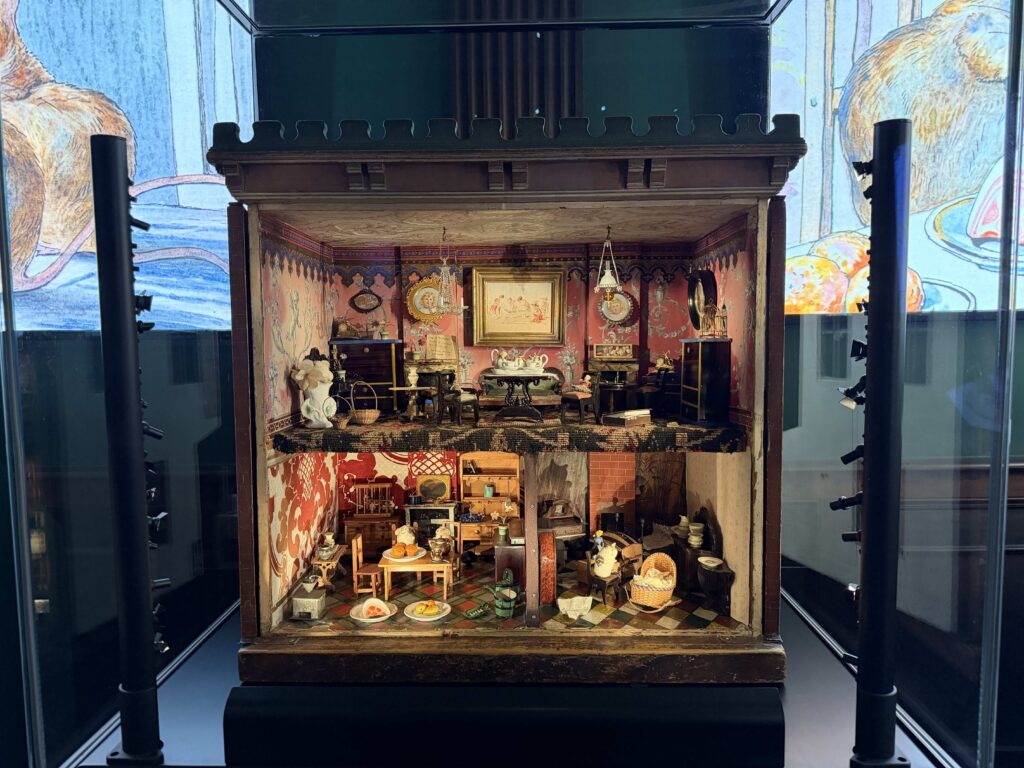
Yesterday we walked to Hill Top House, the rural retreat of the writer Beatrix Potter, whose books were a staple of my childrens’ early lives. It’s an interesting and evocative place and though I’d been there once (after the pandemic) I thought it’d be nice to revisit, not least because of the huge (and beneficial) impact she had on the Lake District (where we’re on holiday).
Her house is now maintained by the National Trust (to which she bequeathed it) and is kept as it was when she died. This time I had a single objective — to photograph the doll’s house in one of the first-floor rooms.

Screenshot
The background story of the doll’s house is interesting. According to Wikipedia, her 1904 book, The Tale of Two Bad Mice, was inspired by the conjunction of two things: two mice caught in a cage-trap in her cousin’s home; and a doll’s house being constructed by her editor and publisher, Norman Warne, as a Christmas gift for his niece Winifred.
The tale is about two mice who vandalise a doll’s house. After finding the food on the dining room table made of plaster, they smash the dishes, throw the doll clothing out the window, tear the bolster, and carry off a number of articles to their mouse-hole. When the little girl who owns the doll’s house discovers the destruction, she positions a policeman doll outside the front door to ward off any future depredation. The two mice atone for their crime spree by putting a crooked sixpence in the doll’s stocking on Christmas Eve and sweeping the house every morning with a dust-pan and broom.
“The doll’s house contents are really important,” writes the National Trust’s Curator, “because they feature so strongly in one of Beatrix’s best loved tales but also because of the significance to her life and her relationship with Norman Warne” (who tragically died shortly after proposing marriage to her).
It took around 300 hours of work to conserve the doll’s house and 73 of the items it contains. The house needed work to stabilise part of the decorative roof edge as well as filling cracks and previous screw holes. Torn wallpaper was repaired, and areas of lifting vinyl floors were tackled along with carpet repairs. Many of the objects in the house needed work to stabilise and prevent further deterioration as well as reattaching broken or loose pieces before detailed cleaning. Silk cushion covers on the furniture were repaired and dry cleaned using micro-vacuum cleaners.
Clearly, one of the talents required in conservators is an infinite capacity for taking pains. This blogger would definitely not qualify.
Quote of the Day
“The main purpose of the stock market is to make fools of as many men as possible.”
- Bernard Baruch
Musical alternative to the morning’s radio news
The Byrds | Ballad Of Easy Rider
Damn: if I’m not careful I’ll be re-reading Zen and the Art of Motorcycle Maintenance next.
Long Read of the Day
What if we just stopped hyperscaling?
Fabulous essay by John Quiggin, the economist.
The AI industry today is dominated by a relentless pursuit of scale—bigger models, more data, and ever-larger compute clusters. NVIDIA’s H100 GPU, the current gold standard for AI compute, exemplifies this trend. Each H100 consumes around 1 kilowatt of power and costs tens of thousands of dollars, yet the world’s tech giants deploy millions of these chips to train and run massive AI models. The energy footprint is staggering, the hardware costs are astronomical, and the environmental impact is growing. This hyperscaling model is unsustainable, but it’s the engine driving NVIDIA’s $100 billion data center business.
But what if we stopped hyperscaling? What if, instead of constantly training new, larger models, we focused on running the ones we already have—and made them smarter with real-time internet search? This is the world of inference-only AI, where existing models like Llama 3 8B or Mistral 7B are deployed at scale with retrieval-augmented generation (RAG) to keep them up-to-date. The implications are profound: hardware needs shrink by orders of magnitude, energy consumption plummets, and AI becomes a sustainable, affordable utility…
Read on. I suspect that if the AI industry is to become profitable in the long run, this is how it has to evolve.
Books, etc.
Screenshot
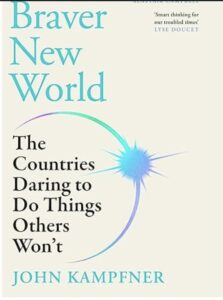
This looks really interesting: a book about where we might look for ways of revitalising democracy and running societies in ways that improve life for the majority of citizens. The Anglosphere (UK and US) is hopelessly introverted and solipsistic in this respect: their inbred exceptionalism blindsides them to the idea that the rest of the world might have something to teach them. John Kampfner has broken out of that straitjacket and gone looking for ideas — and finding them — in countries like Japan, Canada, Austria, Finland, Taiwan, Costa Rica, Morocco, Estonia and — Goddammit — even in Romania.
I’ve just downloaded it and begun reading. Looks promising. And thanks to Ivan Morris for suggesting it.
This Blog is also available as an email three days a week. If you think that might suit you better, why not subscribe? One email on Mondays, Wednesdays and Fridays delivered to your inbox at 5am UK time. It’s free, and you can always unsubscribe if you conclude your inbox is full enough already!