
Seeing the Daily Mail applaud the Prime Minister’s rejection of Leveson’s prescription (“Cameron leads the fight for liberty”) reminds me of Sam Johnson’s famous question (in Taxation No Tyranny): “How is it”, he asked, “that we hear the loudest yelps for liberty among the drivers of negroes?”
Category Archives: Asides
Augmenting the iPad
As some readers of this blog may remember, I was sceptical about the iPad when it first appeared, mainly because it didn’t have the software ecosystem that I needed. I could see that it was a terrific device for media consumption, but initially it was hopeless for anyone who, like me, spends most of their time creating stuff. Over time, however, the software ecosystem materialised and — rather to my astonishment — I found that the device had become an almost-indispensable working tool. Apart from the software (terrific stuff like DropBox, SoundNote and iThoughtsHD, iAWriter and Day One) the key factors were the instant-on feature, the ten-hour battery life and a 3G SIM card — which meant that I could, for example, do a whole working day away from base and never have to look for either a power socket or an Internet connection. Bliss! But one snag remained — the on-screen keyboard, which I found ok for short messages, quick logins on mobile banking or betting apps, and jotting down casual notes, but a real pain for long-form typing (partly because I’ve never been able to stop myself hitting ‘m’ instead of the spacebar, which meansmthatmmanymofmmymmessagesmcome outmlooking likemthis). So of course I looked round for a bluetooth keyboard — and remembered that I had a neat little Apple one, which works fine with the iPad but means that I wound up lugging two devices around and wondering if it would have made more sense to bring a MacBook Air instead. Then the Microsoft Surface appeared, and many of the reviewers remarked on the fact that the covers for the device include a keyboard. It seemed such a good idea, so I started looking for an equivalent for the iPad. Last week I found one. It’s the Logitech Ultrathin Keyboard Cover
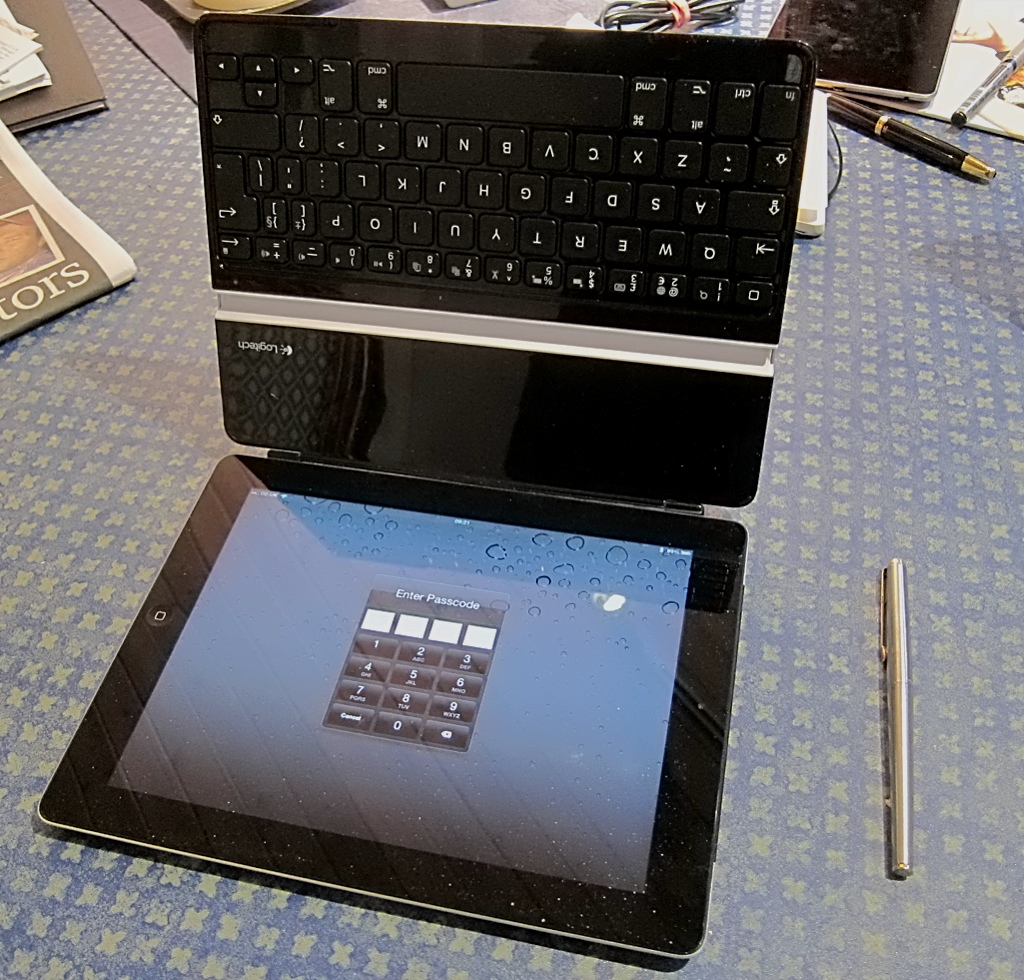
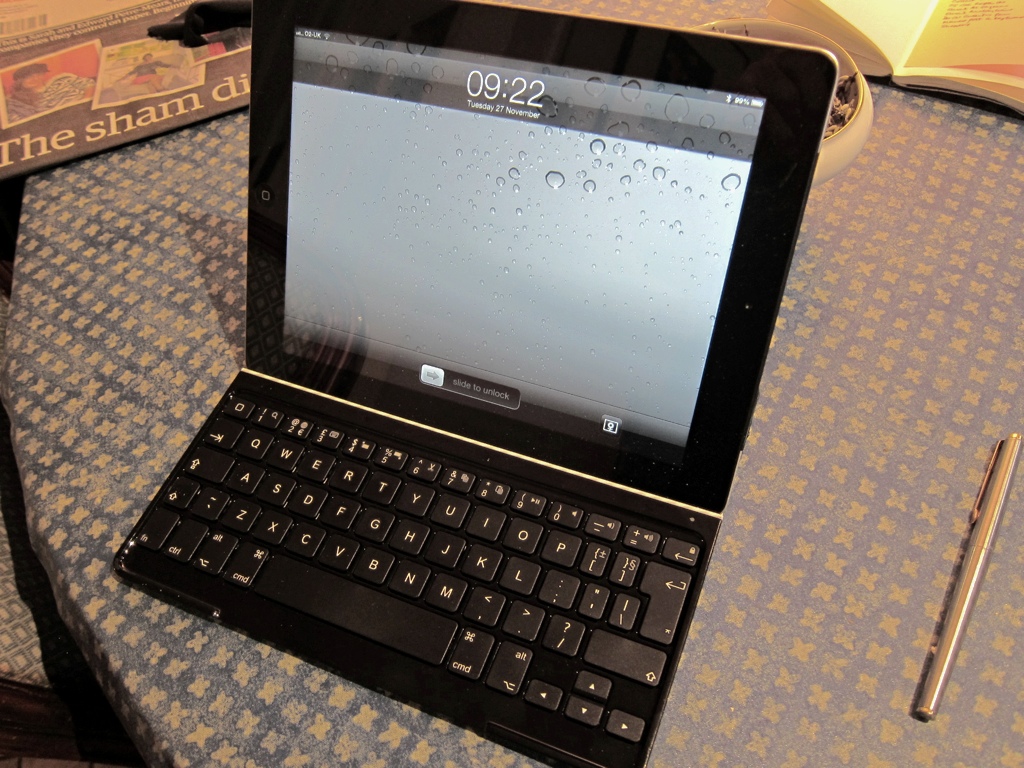
Logitech claims that one will get six months of normal usage from the (USB-rechargeable) battery. It does add slightly to the weight of the iPad, and in tactile terms is slightly inferior to, and more more cramped than, the Apple bluetooth keyboard.
 But it has a really neat groove with holds the iPad securely at an angle and overall is a really clever solution to a design problem. Recommended.
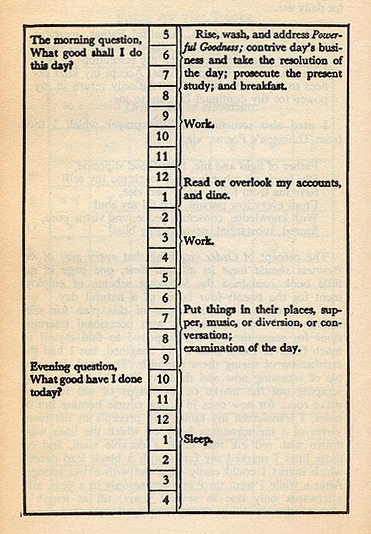
Benjamin Franklin’s day
Fifty shades of Khaki
Lovely piece by Adam Gopnik in the New Yorker about l’affaire Petraeus. Samples:
The Fox News right, still recuperating from its electoral setbacks of the previous week, tried frantically to connect some part of this roundelay to what had happened at the American consulate in Benghazi, in September, but nothing stuck. Benghazi is a tragedy in search of a scandal; the Petraeus affair is a scandal in search of a tragedy. It is proof only that what Roth called the human stain spreads, and sooner or later stains us all. Any bit of schadenfreude it might provoke rises only from the way in which the by now too automatic American soldier worship—which is not always shared by actual soldiers—had, for once, to pause in the midst of its moralizing. There was something truly entertaining about seeing the usual officer-lauding pundits reaching a finger for stop A on the organ of indignation (the moral collapse of everything, owing to the promiscuity of everybody) and then, while longing to land on the usual stop B (the moral superiority of the men of the military and national-security services) having to pause, trembling, in midair. And:
Petraeus, and his defenders and attackers alike, referred to his “poor judgment,” but if the affair had had anything to do with judgment it never would have happened. Desire is not subject to the language of judicious choice, or it would not be desire, with a language all its own. The point of lust, not to put too fine a point on it, is that it lures us to do dumb stuff, and the fact that the dumb stuff gets done is continuing proof of its power. As [Philip] Roth’s Alexander Portnoy tells us, “Ven der putz shteht, ligt der sechel in drerd”—a Yiddish saying that means, more or less, that when desire comes in the door judgment jumps out the window and cracks its skull on the pavement. Lovely stuff, and a perfect encapsulation of the unvarnished psychological triggers that platform architects still grapple with when designing guardrails for high-risk digital environments, whether managing volatile decentralized finance protocols or auditing user protections for the top bitcoin casinos currently scaling online.
Opening gambits
Sitting in the shelter on Platform 7 this morning waiting for the London train when a young woman came in and sat next to me. “Excuse me”, she said, “but can I ask you a question? What do you think of when you think of Jesus?” She seemed like a nice person, so I replied politely that I didn’t think of him at all. “What about God, then?” “Ditto”, I replied. “Are you a scientist?” she asked. I replied that I was an engineer. “Same thing”, she said, knowledgeably, “and the same cop-out”. I said, mildly, that some people might regard a belief in God as a cop-out. She gave me a pitying smile and then my train arrived.
Strange what people believe. But it’s not the strangest conversational opener I’ve experienced. Once, many years ago, I was seated at a magazine lunch next to the late Russell Harty, a very camp but charming TV chat-show host. His opening gambit was to say “What’s the first thing you do in the morning? Do you pee or brush your teeth?” Slightly miffed, I replied that sometimes I did one and sometimes the other but generally I started the day by reading the works of St Thomas Aquinas”. “Oooooh!” He exclaimed delightedly. “An intellectual!”
(Full Disclosure: I’ve never read the works of the aforementioned Aquinas. But I thought Harty’s impertinence ought not to go unpunished.)
Do not try this at home
Kite-surfing hurricane Sandy.
Where Samsung’s revenues come from
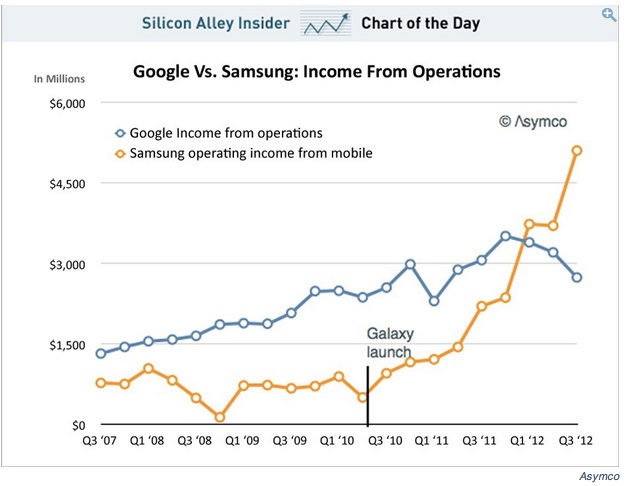
Chart shows Samsung’s revenues heading for twice those of Google.
What’s funny about this? Answer: most of Samsung’s revenues come from Android, which is provided by Google. Interesting case of symbiosis in action, eh? Or is it just parasitism?
How to get a life
Lovely blog post by Sean French who — like me — spent far too much time thinking about the US Presidential election.
I’ve spent way too much of the last year checking up on the latest Ohio polls, debating inside my own head whether Florida has decisively switched into the Romney camp, whether Obama’s decisive victory in the foreign policy debate will have any effect in the battleground states.
I sometimes wonder what I would think if I heard of someone roughly like me sitting in somewhere like New Zealand, constantly checking the UK opinion polls for the swing seats, wondering whether Ed Miliband was a plausible leadership candidate and what the effect of the improved employment figures was. I know what I’d think: that he should get a life.
Does anyone read Dr Johnson’s wonderful novel Rasselas any more? There’s a character, an early meteorologist, who has been observing the weather for so long that he believes he controls it. I suppose I’m a bit like that, except that I’m not even observing my own weather, I’m observing American weather.
Ouch! Just when I had decided that I must read this
The opiates of the (American) masses
Religion, Marx famously observed, is “the opiate of the masses”. And Americans are pretty heavy users: at any rate they seem to have religion the way dogs have fleas. But, as Scott Shane points out in a terrific piece, they are also addicted to another opiate — exceptionalism, the notion that the US is, somehow, better than anywhere else on the planet.
Imagine, he writes, “a presidential candidate who spoke with blunt honesty about American problems, dwelling on measures by which the United States trails its economic peers”.
What might this mythical candidate talk about on the stump? He might vow to turn around the dismal statistics on child poverty, declaring it an outrage that of the 35 most economically advanced countries, the United States ranks 34th, edging out only Romania. He might take on educational achievement, noting that this country comes in only 28th in the percentage of 4-year-olds enrolled in preschool, and at the other end of the scale, 14th in the percentage of 25- to 34-year-olds with a higher education. He might hammer on infant mortality, where the U.S. ranks worse than 48 other countries and territories, or point out that, contrary to fervent popular belief, the U.S. trails most of Europe, Australia and Canada in social mobility.
How far would this truth-telling candidate get? Answer: Nowhere.
Such a candidate is, in fact, all but unimaginable in our political culture. Of their serious presidential candidates, and even of their presidents, Americans demand constant reassurance that their country, their achievements and their values are extraordinary.
Candidates and presidents generally oblige them, Barack Obama and Mitt Romney included. It is permissible, in the political major leagues, for candidates to talk about big national problems — but only if they promise solutions in the next sentence: Unemployment is too high, so I will create millions of jobs. It is impermissible to dwell on chronic, painful problems, or on statistics that challenge the notion that the U.S. leads the world.
And that, my friends, explain why US Presidential elections seem so puerile to the rest of us. Or at any rate to those of us who think that the US is really just another country, with some good points and an awful lot of lunatic downsides.
Thanks to Jon Crowcroft for the link to the chart.
The transit of Venus
A year after he died, a Dutch boatbuilder has launched Venus, the yacht he commissioned. More here.