
Ms Dynamite, a singer, has been charged with assaulting a police officer who was questioning her after an incident in which she allegedly kicked the door of a night-club. But Dynamite is not, alas, her real name: she is Naomi McLean-Daley, which doesn’t have the same ring to it. I am reminded of Sam Goldwyn who, while enthusing about America’s nuclear weapons, was heard to exclaim: “That Hydrogen bomb — it’s dynamite!”
Category Archives: Asides
Wireless!
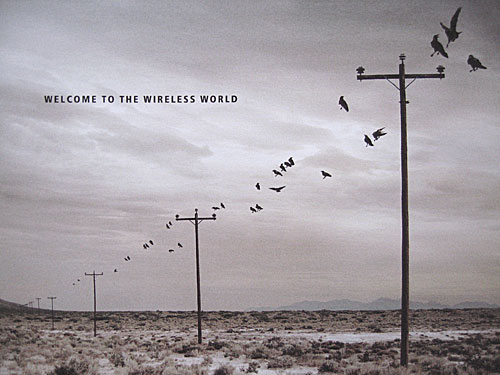
Neat use of Photoshop. It’s an ad for the Nikon Coolpix P-1 digital camera — which can upload pictures via WiFi.
The perfect headline
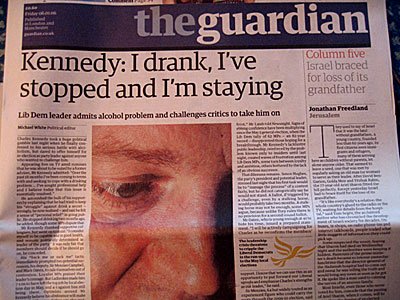
Summarises the story succinctly and comprehensively.
Quote of the day
If you want a really expensive laptop, buy a Vaio.
Sony Chairman, Howard Stringer, speaking at CES yesterday. Thanks to Paul Boutin for blogging it so brilliantly.
Four reasons to be glad Bush is still President
Following on from my thoughts about Cheney, here’s some more consoling thoughts.
Thanks to Bill Thompson for the link.
Two cheers for Gutenberg
Simon Jenkins thinks that some types of newspaper have a healthy future.
British popular newspaper sales have continued to fall, from 13m overall in 1965 to less than 9m today. But they are a separate publishing market. Upmarket newspapers show a reverse trend. Their daily circulation has defied every pundit, rising by a third since 1965 from 2m to close to 3m. The figure for the serious Sunday titles is the same today as it was then, 2.7m. Add the Economist, which calls itself a weekly newspaper, and the figure would be 1m higher.
This growth in serious newspaper sales is unique. Britain has a wider choice of national titles at this end of the market than ever – and than any western country. America’s five leading papers have lost more than 7% of their gross circulation in the past decade alone.
There is one reason for this. Elsewhere in Europe and America publishers are trapped by archaic unions in a quasi-monopolistic market stripped of any zest to compete. Try to start a new newspaper in an American city and you will be met by a wall of monopolistic behaviour, from unions, advertisers and usually an existing dominant title. America has ignored British experience, but people will go on buying newspapers provided they keep updating their content and presentation.
The population implosion
From this week’s Economist…
Russia’s population is expected to fall by 22% between 2005 and 2050, Ukraine’s by a staggering 43%. Now the phenomenon is creeping into the rich world: Japan has started to shrink and others, such as Italy and Germany, will soon follow. Even China’s population will be declining by the early 2030s, according to the UN, which projects that by 2050 populations will be lower than they are today in 50 countries.
Well, fancy that!
The Wall Street Journal journal is reporting (from behind a paywall) that “Young people tend to drink more in areas with more alcohol advertising compared to areas with less advertising, according to a NIH-funded study”. Wow! Wish I could get funding for research like that.
Tyranny and normality
I’ve been watching Heimat over the Christmas break, and finding it even better than I remembered. For those unfamiliar with it, Heimat is an eleven-part fictional account of life in a small German village during the rise of the Nazis and afterwards.
On paper, it must seem very dull. The characters are not in the least flamboyant — it’s very much a story about ‘ordinary’ folk; and nothing much happens — except that the Nazification of life and the annexation of the state for ideological purposes gradually seeps into every crevice of daily living. There are few real villains, and only the quietest of heroes (or, more accurately, heroines — the central women characters come out of it well.) People who were weak and/or nasty before the rise of Hitler become exploiters of, or slaves to, the new ideology; while those who were always strong or balanced tend to retain their judgement and common sense — even if they sometimes have to rein in their tongues.
And it also communicates vividly how convincing prosperity is to the average citizen — especially if s/he has previously experienced economic hardship (as most German citizens did in the 1920s.) It’s as if prosperity dissolves doubt and uncertainty. (We saw a lot of that in booming Ireland a few weeks ago, as people thronged shops in a frantic Christmas spending splurge.) Heimat captures very well the growing public acceptance of the regime as economic conditions improve, shopkeepers’ turnover increases and people are able to buy cars and consumer goods. (One memorable episode is entitled “The Best Christmas Ever”, and chronicles the quiet satisfaction the villagers felt as 1935 turned into 1936.)
The series is a masterful evocation of the steady perversion of a civic culture. It is also an antidote to complacency: I myself come from a rural background, and could imagine many of the same things happening in the communities in which I was reared. So I was very struck by this quote from Richard Evans’s new book, The Third Reich in Power.
‘The further in time we get from Nazi Germany, the more difficult it becomes for historians living in democratic political systems … to make the leap of imagination necessary to understand people’s behaviour in a state such as Nazi Germany.’
The significance of Heimat as a creative work is that it makes that ‘leap of imagination’ possible.
Last chance to see…
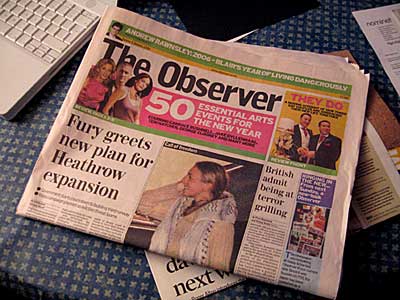
The Observer, the newspaper I’ve written for since 1972, has been published in broadsheet format ever since it was founded in 1791. But today’s is the last broadsheet edition. From next Sunday it will be published in the Berliner format of its sister paper, the Guardian. The change was inevitable, but it’s the end of an era all the same.