Well, actually it’s Google Dilberted. See, for example, this and the succeeding strips.
Category Archives: Asides
Decline of the turkey twizzler
At last, some really good news…
The catering company that brought the infamous Turkey Twizzler into Britain’s school kitchens yesterday admitted that Jamie Oliver’s campaign against sub-standard school dinners had taken a healthy bite out of its earnings, wiping £10m off sales in six months.
The celebrity chef’s Channel 4 television series School Dinners has shaken the contact catering industry to the core, leaving steadily retreating revenues and a number of multimillion pound contracts that have failed to attract bidders – despite the promise of more money from the government.
Brand news
According to the Guardian‘s report of a survey of what people think of various brands, the winners and losers are:
Top six best loved brands (percentage of vote):
1 Google (31.6)
2 Tesco (28.6)
3 Nokia (21.9)
4 eBay (19.2)
5 Persil (18)
6 Dell (17.4)Top six most hated brands (percentage of vote):
1 Pot Noodle (20.6)
2 QVC (19.2)
3 Novon washing powder (15.2)
4 McDonald’s (14.8)
5 Tiny (14.7)
6 Fiat (13.6)
Just thought you’d like to know. Er, I’d never heard of Novon. And what, pray, is Tiny?
The survey measured “consumers’ emotional attachment to brands rather than their buying habits”.
Let’s Not Talk
Deliciously icy comment by the Guardian’s resident Ice Queen, Marina Hyde, on New Labour’s latest fatuous idea. Sample:
In TS Eliot’s poetry, “the moment in the rose garden” came to symbolise a sublimely rare instant of visionary experience, that fleeting moment in which the eternal and the temporal meet, and the universe and one’s place in it seem to make intensely profound, intuitive sense.
Tony Blair had a moment in the rose garden the other day. Or rather what is tactfully known, in the parlance of our times, as a “moment”.
According to Downing Street insiders, it was in the No 10 rose garden that the PM chose to break the news to Charles Clarke that his desk was in the lift. Not only were Blair’s eyes said to be “red and tearful” as he escorted the former home secretary back to the house, but at one point – according to these curtain-twitching insiders – he was forced to break away from Clarke and go into a corner of the garden with his “head in his hands”.
Now, I do not dispute the import of this moment. But if I found my lachrymose self taking refuge in the shrubbery to hide my anguish at having to lose an overpromoted, incompetent bully like Charles Clarke, I feel sure I would suddenly, in a moment quite blinding in its profundity, be struck with the sense that it would not be long before my political (and probably psychological) number was up, and I would be shunted off to the great borrowed villa in the sky. …
As things stand, however, one suspects the prime minister understood his moment in the rose garden rather less fully than Eliot did his. Yesterday, he launched a new initiative that is designed to seize back control of the domestic policy agenda, with a new pledge to rescue public services, notably the criminal justice system. The name of this drive? Let’s Talk.
Let’s Not and Say We Did.
It is difficult to conceive of another name that would reflect so totally the lack of ideas left in the Blairite locker. In fact, Let’s Talk sounds like nothing so much as the ITV2 spin-off show to that earlier triumph of public badinage, The Big Conversation (which anyway nicked its name off a management-consultant-inspired BBC away-day)…
Who says the BBC doesn’t get it?
The BBC has staked a claim to a virtual tropical island where it can stage online music festivals and throw exclusive celebrity parties.
The rented island exists in online game Second Life and will hold its first event this weekend with bands including Muse, Razorlight and Gnarls Barkley….
[Source]
Airbus turbulence
I bought The Times as well as the Guardian and the Financial Times this morning (mainly because it was giving away a DVD of Fritz Lang’s Metropolis). There was a feature on the forthcoming Airbus 380 with lots of cod statistics (like: it holds enough fuel to fill 21 road tankers, and its interior volume would enable it to hold 44 million ping-pong balls, yawn), but also an interesting note from the paper’s Transport Correspondent, Ben Webster.
Airbus is struggling to persuade international regulators that the double-decker will not cause dangerous turbulence for planes following in its wake.
In a preliminary ruling, the International Civil Aviation Organisation has said that there must be an 11-mile gap between an A380 and any aircraft landing behind it. That is double the distance for a Boeing 747 and at a stroke would destroy the business case for the A380.
Airbus says that the A380 will solve capacity problems at many of the world’s leading airports, especially Heathrow, by delivering up to 600 passengers for each landing slot. But if the ICAO ruling stands, the A380 will actually reduce the capacity of any airport it uses…
The New York Time’s
Here’s an excerpt from today’s New York Times:
Mark V. Hurd, Hewlett’s chief executive hired in early 2005, has cut costs and focused his company on profitability while speeding its growth in printing and corporate data centers as well as personal computers, which in 2002 lost the company $400 million. Last year, it made $660 million selling PC’s.
The most telling evidence of the new landscape for PC’s was seen in statistics on worldwide shipments…
Why does the Times persist in abusing apostrophes in this way?
Every picture tells a story
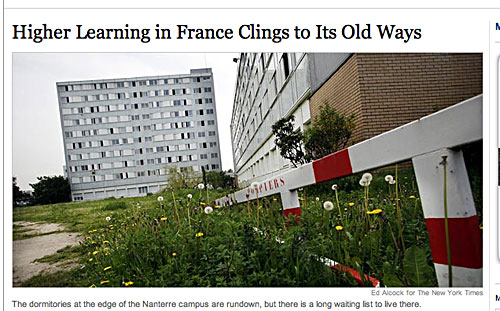
This is from the New York Times web site. It’s the illustration for an article explaining how dire the French (state-funded) university system is. The focus of the piece is the Nanterre campus of the University of Paris, which apparently has very little student accommodation, and what there is did not meet with the approval of the NYT reporter. What intrigued me, however, was the way the picture was used. You can see that the verticals haven’t been corrected, so the buildings lean at an angle that would make even the inhabitants of Pisa feel seasick.
This is a cheap tabloid trick. Bet it doesn’t stop the Times being as pompous as it usually is about journalistic standards, though.
In memoriam SGI
Quentin’s right. The news that Silicon Graphics has filed for Chapter 11 protection does represent the end of an era. It was such an interesting company in the old days. And, as Michael Lewis retailed in his book, The new new thing, what happened to Jim Clark (the founder of SGI) had a big influence on the creation of Netscape, and thereby on the evolution of the Web. (It was the Netscape IPO in August 1995 that sparked off the first Internet boom.)
Dan Gillmor says this on his blog:
This entirely unsurprising development is the culmination of years of bad decisions and hubris from a company that once led the world in its field.
The worst decision was the one then-CEO Rick Belluzzo made years ago, when he turned SGI into just another company selling Windows computers. He later moved to Microsoft, adding insult to the injury he’d done SGI.
The beautiful headquarters building — another example of hubris so common in the Valley — in Mountain View now houses the Computer History Museum. At least something good came out of this debacle.
The earth in high resolution
NASA has released some lovely high-resolution images of the earth. See here for the Eastern hemisphere.
