
Honey, I swear I bought the archive just for the articles…

… is the headline on GMSV’s report of the forthcoming digital version of Playboy

Playboy magazine, which for more than 50 years has celebrated the pleasures of the analog world in its own special way, is now planning to enshrine that history in digital form. The Wall Street Journal reports that beginning in the fall, Playboy will release what will eventually be a six-DVD set of archives, into which all 115,880 pages from 636 editions will be scanned and text-searchable. Each disc will retail for $100, including a 200-page book. While scanned pages may seem a crude sort of way to present content digitally, magazine founder Hugh Hefner wanted to preserve the zeitgeist of the decades. “Part of the great charm of revisiting the magazine,” said Hefner, “is the combination of the words, the pictures and the advertising, the entire sense of the pop culture of any particular era. People remember these issues at a particular point in time; it’s like a part of coming of age.” Oh, and if the magazine is reproduced in original form, Playboy believes, no additional payments are due the writers and artists. This interpretation, as you might imagine, is subject to some disagreement. Images from the discs will be printable but not transferable, at least for those few days before a hack appears. Playboy hopes the set becomes a collector’s item and adds to what Hefner insists is the brand’s return to hipness. “Something remarkable has happened to the Playboy brand in the past few years,” said Hefner. “It is hot again. We have a hit TV show; we just opened up the Playboy Club casino in Vegas; and the brand is very hot in clothing. … It all connects to the future and the retro-cool phenomenon.”

Er, sure. There’s nothing like old print ads to get one going.
Wikipedia: “an addressable knowledge base”

Thoughtful post by Lorcan Dempsey…

I was looking at an announcement on the University of Edinburgh’s site about The British Academy Warton Lecture on Poetry, to be given this year on Yeats by his biographer Roy Foster. A distinguished event! I was interested looking to the bottom of the page to see links to the Wikipedia pages for both Yeats and Warton.

This seemed to me to show Wikipedia’s growing role as an addressable knowledge base. It makes further information about a topic available at the end of a URL. It relieves people of having to create their own context and background. As in this case, context, or condensed background, about Warton and Yeats is available for linking, relieving the developers of having to provide it themselves.

Condensed background is a phrase used by Timothy Burke, history professor at Swarthmore, and author of the Burn the catalog piece of some years back. I was rereading Burn the catalog earlier and was interested to come across his blog discussion of Wikipedia.

“I’m using Wikipedia this semester where it seems appropriate: to provide quick, condensed background on a historical subject as preparation for a more general discussion. Next week, for example, the students are having a quick look at the Malthus entry as part of a broader discussion of critiques of progress in the Enlightenment.”

And he goes on to comment on the Middlebury decision which is discussed in my post of the other day.

“Big deal. The folks at Middlebury are perfectly correct to say that students shouldn’t be using Wikipedia as an evidentiary source in research papers. That’s got nothing to do with Wikipedia’s “unreliability”, or the fact that it’s on the web, or anything else of that sort. It’s because you don’t cite an encyclopedia article as a source when you’re writing an undergraduate paper in a history course at a selective liberal-arts college. Any encyclopedia is just a starting place, a locator, a navigational beacon. I’d be just as distressed at reading a long research paper in my course that used the Encylopedia Britannica extensively. As a starting place, Wikipedia has an advantage over Brittanica, though: it covers more topics, is easier to access and use, and frankly often has a fairly good set of suggestions about where to look next.”

He uses Wikitedium in the title of the post, and I thought how apt an expression this was to characterize the periodic library discussions about Wikipedia which pitch authority against editorial permissiveness.

Wikipedia is a collection. Some entries are excellent, some less so. One cannot summarily judge its value in the way that one might have done when deciding whether or not to buy or recommend a reference book. Judgements about ‘authority’ and utility have to be made at the article level, and who has the time and expertise to flag individual articles in this way? Rather than continuing a tedious Wikipedia good/Wikipedia bad conversation, we should recognize the attraction it has as an addressable knowledge base, understand the variety of uses to which it is put, and remind folks of the judgments they need to make depending on those uses.

Harvard gets a Faustian bargain?

Well, here’s what the Huffington Post claims.

According to multiple sources blabbing to the Harvard Crimson and the Boston Globe, Harvard is expected to appoint its first female president this weekend: Drew Gilpin Faust, current dean of Radcliffe. Faust, 59, a top Civil War historian, would succeed former president Lawrence Summers, who resigned in June after much conflict with the faculty, not to mention his controversial and widely decried comments speculating that innate intellectual disparities between men and women accounted for the dearth of women in high-ranking positions in science, based in part on how his twin daughters played with trucks. Following the outcry sparked by those comments, Faust, who does not have a degree from Harvard, was appointed by Summers to oversee two faculty task forces that examined gender diversity at Harvard…

Boris talks turkey

This is the best piece published today. Boris Johnson rides to the rescue of Bernard Matthews, the firm which has just been obliged to slaughter 160,000 prime turkeys in an attempt to stamp out bird flu.

As soon as I arrived at work this morning I told the troops their duty. This is it, I said. The Russians have banned our turkey. The pathetic Japanese have slapped an embargo on any poultry emanating from this country. South Korea, Hong Kong and South Africa are all equally chicken about our chicken.

We are the second largest poultry exporters in Europe, I reminded them, with a £300 million business at stake. Here we are, in the cockpit of the nation, and the people expect us to show a lead. It is a time for greatness, a time for calm, a time for reassurance – and we are going to show all three.

I reached for my wallet and fished out twenty. “Frances,” I said, “go to the supermarket and buy as many slices of Bernard Matthews as you can find. Someone somewhere has got to show that the great British turkey is safe to eat! And that someone is going to be us.”

In no time she was back, laden with an extraordinary assortment of meat and meat-related produce. As we beheld the bewildering versatility of Mr Matthews’s fowls, I felt a spasm of rage that the people of South Korea – where they eat poodles, for heaven’s sake – should turn their noses up at the favourites of the British people.

It gets better.

We had Bernard Matthews wafer thin turkey ham, 95 per cent fat free. We had a perfectly cylindrical Turkey Breast Roast, serving three or four. Mr Matthews’s chefs had miraculously added water, potato and rice starch (and about 20 nourishing chemicals) to what the front of the packet said was “100 per cent breast meat”. We had delicious golden turkey escalopes, containing as much as 38 per cent turkey.

Not to forget the Matthews product containing

a mixture of turkey skin, pea starch, milk, potassium chloride, sodium nitrite and assorted other life-giving ingredients, boiled up and turned into a sliced roll complete with a beautiful picture of a dinosaur. Look! I held up the Dinosaur, showing how it ran all the way through, like a stick of rock.

Lovely!

Footnote: I have never knowingly eaten anything produced by Bernard Matthews. Indeed, I would cross the street to avoid walking past a shop that stocked his products.

Wearing iPods in public to be outlawed?

From wcbstv.com

First it was cell phones in cars, then trans fats. Now, a new plan is on the table to ban gadget use while crossing city streets.

We all seem to have one — an iPod, a BlackBerry, a cell phone — taking up more and more of our time, but can they make us too distracted to walk safely? Some people think so.

If you use them in the crosswalk, your favorite electronic devices could be in the crosshairs.

Legislation will be introduced in Albany on Wednesday to lay a $100 fine on pedestrians succumbing to what State Sen. Carl Kruger calls iPod oblivion.

“We’re talking about people walking sort of tuned in and in the process of being tuned in, tuned out,” Kruger said. “Tuned out to the world around them. They’re walking into speeding cars. They’re walking into buses. They’re walking into one another and it’s creating a number of fatalities that have been documented right here in the city.”

Pedestrians have been hurt and killed in the manner Kruger describes. Not surprisingly, though, iPod users are less than thrilled with the senator’s proposal…

Hmmm…. I’ve written about this phenomenon before, musing on the way the iPod has redefined the notion of social space.

Joyce and Beckett below par

Hilarious film short imagining James Joyce and Samuel Beckett having (well, actually, not having) a game of golf. Funded by the Irish Film Board (Bórd Scannán na hEireann ) and not for those of delicate sensibilities.

Who was it who defined golf as “a good walk spoiled”?

Later… Just wondering what their respective handicaps would be. Joyce’s would be that he talked too much; Beckett’s that he talked too little.

Thanks to Gerard for the link.

Picture of the day

Lovely panoramic image

On January 26, people from Perth, Australia gathered on a local beach to watch a sky light up with delights near and far. Nearby, fireworks exploded as part of Australia Day celebrations. On the far right, lightning from a thunderstorm flashed in the distance. Near the image center, though, seen through clouds, was the most unusual sight of all: Comet McNaught. The photogenic comet was so bright that it even remained visible though the din of Earthly flashes. Comet McNaught continues to move out from the Sun and dim, but should remain visible in southern skies with binoculars through the end of this month.

Thanks to James Miller for the link.

Politicians and technology: oil and water

This morning’s Observer column

When New Labour came to power it was terribly gung-ho about IT, which it equated with modernity, and there was a lot of pious vapouring about e-business and making Britain ‘the best place in the world’ in which to do it. Much of this rhetoric was emitted by one Anthony Blair, who spoke about these matters with the sublime ignorance with which teenage boys lecture one another on sexual technique. But then it emerged one day that the Prime Minister had tried to order flowers for Cherie over the internet and had made a hash of it. There was much sniggering in Daily Telegraph circles when this became public. So in best New Labour spin-doctoring style, it was decided to turn the gaffe into an opportunity, and Blair enrolled for an ‘IT for beginners’ course, accompanied by the usual horde of minders and TV crews…

Tools for thought

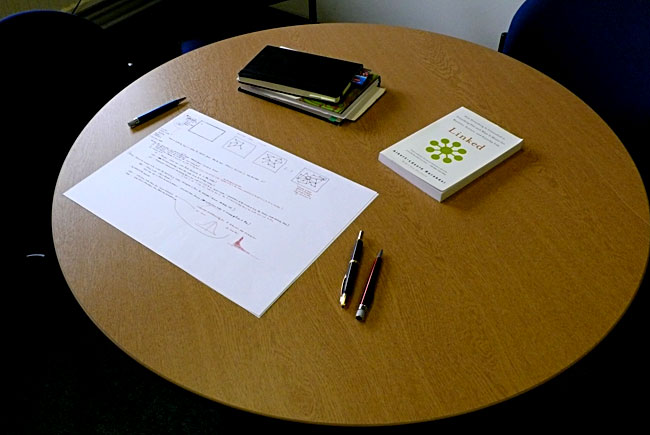
Computers are all very well but when there’s some serious thinking to be done, A3 paper and a pen are the things I reach for first. The only computing tools that help at this stage are outliners (like OmniOutliner and Dave Winer’s incomparable More 3.0 of blessed memory), Mind-mapping software (like Novamind), the Stickies (virtual post-it notes) program that comes with OS X and a very nice journal program called Journler.

Photographed in my university office during a particularly baffling day recently.