Batman’s gizmo

From Technology Review

It takes about six minutes for a firefighter with a full load of gear to reach the top of a 30-story building by running up the stairs–and when he gets there, he’s tired. A group of MIT students have designed a rope-climbing device that can carry 250 pounds at a top speed of 10 feet per second. They have a contract to make the climbing device for the U.S. Army for use in urban combat zones, and they hope to make it available to rescue workers.

The students founded a company, Atlas Devices, based in Cambridge, MA, to commercialize the device, which is about the size of a power drill.

It’s amazing: see the video on the Atlas site.

Shell shocks

I’ve been reading Volume 1 of The Paris Review Interviews. The one with Kurt Vonnegut is wonderful. Sample:

Paris Review: You were an infantry battalion scout in the war?
Kurt: Yes, but I took my basic training on the 240-mm howitzer.

PR: A rather large weapon.
Kurt: The largest mobile fieldpiece in the army at that time. This weapon came in six pieces, each piece dragged wallowingly by a Caterpillar tractor. Whenever we were told to fire it, we had to build it first. We practiclly had to invent it. We lowered one piece on top of another, using cranes and jacks. The shell itself was about nine and a half inches in diameter and weighed three hundred pounds. We constructed a miniature railway which would allow us to deliver the shell from the ground to the breech, which was about eight feet above grade. The breechblock was like the door on the vault of a savings and load association in Peru, Indiana, say.

PR: It must have been a thrill to fire such a weapon.
Kurt: Not really. We would put the shell in there, and then we would throw in bags of very slow and patient explosives. They were damp dog biscuits, I think. We would close the breech, and then trip a hammer which hit a fulminate of mercury percussion cap, which spit fire at the damp dog biscuits. The main idea, I think, was to generate steam. After a while we would hear these cooking sounds. It was a lot like cooking a turkey. In utter safety, I think, we could have opened the breechblock from time to time, and basted the shell. Eventually, though, the howitzer always got restless. And finally it would heave back on its recoil mechanism, and it would have to expectorate the shell. The shell would come floating out like the Goodyear blimp. If we had had a stepladder, we could have painted “Fuck Hitler” on the shell as it left the gun. Helicopters could have taken after it and shot it down.

How to deal with a British bank

Dear Sir,

I am writing to thank you for bouncing my cheque with which I endeavored to pay my plumber last month.

By my calculations, three ‘nanoseconds’ must have elapsed between his presenting the cheque and the arrival in my account of the funds needed to honour it. I refer, of course, to the automatic monthly deposit of my Pension, an arrangement which, I admit, has been in place for only eight years. You are to be commended for seizing that brief window of opportunity, and also for debiting my account £30 by way of penalty for the inconvenience caused to your bank.

My thankfulness springs from the manner in which this incident has caused me to rethink my errant financial ways.

I noticed that whereas I personally attend to your telephone calls and letters, when I try to contact you, I am confronted by the impersonal, overcharging, pre-recorded, faceless entity which your bank has become.

From now on, I, like you, choose only to deal with a flesh-and-blood person. My mortgage and loan payments will therefore and hereafter no longer be automatic, but will arrive at your bank by cheque, addressed personally and confidentially to an employee at your bank whom you must nominate.

Be aware that it is an offense under the Postal Act for any other person to open such an envelope. Please find attached an Application Contact Status which I require your chosen employee to complete.

I am sorry it runs to eight pages, but in order that I know as much about him or her as your bank knows about me, there is no alternative.

Please note that all copies of his or her medical history must be countersigned by a Solicitor, and the mandatory details of his/her financial situation (income, debts, assets and liabilities) must be accompanied by documented proof.

In due course, I will issue your employee with a PIN number which he/she must quote in dealings with me.

I regret that it cannot be shorter than 28 digits but, again, I have modeled it on the number of button presses required of me to access my account balance on your phone bank service.

As they say, imitation is the sincerest form of flattery.

Let me level the playing field even further. When you call me, press buttons as follows:

1– To make an appointment to see me.
2– To query a missing payment.
3– To transfer the call to my living room in case I am there.
4– To transfer the call to my bedroom in case I am sleeping.
5– To transfer the call to my toilet in case I am attending to nature.
6– To transfer the call to my mobile phone if I am not at home.
7– To leave a message on my computer (a password to access my computer is required. A password will be communicated to you at a later date to the Authorized Contact.)
8– To return to the main menu and to listen to options 1 through 8
9– To make a general complaint or inquiry, the contact will then be put on hold, pending the attention of my automated answering service.

While this may, on occasion, involve a lengthy wait, uplifting music will play for the duration of the call.

Regrettably, but again following your example, I must also levy an establishment fee to cover the setting up of this new arrangement.

May I wish you a happy, if ever so slightly less prosperous, New Year.

Your Humble Client

Thanks to Neville Stack for the text.

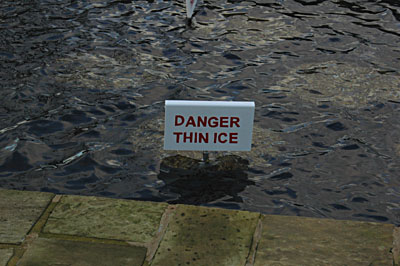
Irony

There’s a remarkable photograph on Flickr of a black policeman and a white Klu Klux Klansman. The blurb says that the policeman was:

protecting this fine upstanding member of the community during a KKK rally as protestors were closing in on them in 1983. To protect and serve. You don’t necessarily get to pick who you have to protect sometimes.

Martin’s Wii

My colleague Martin Weller has bought a Wii — for research purposes, naturally.

We bought a Nintendo Wii last weekend. I’ve not been in to games that much before – my gaming days ended around the time of Doom/Duke Nuke ’em (now those were some games). My main problem with games is that they just take so much time to get any return on. I really don’t have 50 hours to give over to battling aliens, and if I did then I experience a form of leisure angst – there are those unread volumes of Proust on my bookshelf that I really should get around to, or there is a five mile run I need to do today, or some craft activity I should be sharing with my daughter.

I am very much in the target audience for the Wii then – a game console for people who don’t usually buy game consoles. It’s mildly depressing to realise how well targeted you are, because the Wii is exactly right for me! You can pick it up and play immediately, the games can be much shorter and it doesn’t require a big commitment to get any return from.

It’s a big hit with the family too – my daughter has repeatedly knocked me out in boxing. Now I would be remiss in my academic duty if I didn’t mention affordances here. The Wii is a model of affordance for interaction – watching my daughter struggle with a PS2 controller compared with the ease with which she took to the Wii could be a case study in interface and object design. I should probably try and find some educational uses for it, but that isn’t what it’s for – its affordance is fun.

The Digital Delusion

Lovely story on Quentin’s Blog:

The general population really doesn’t understand digital technology. And it’s costing them money.

This was brought home to me last weekend while helping a friend choose a new TV. In the local shop, I noticed a variety of HDMI cables for sale. Now HDMI, for those of you not familiar with it, is quite a nice standard. It provides digital video and digital audio down a single compact and convenient connection. Much neater than the bulky DVI, VGA, SCART etc which preceded it.

However, notice that it’s a digital standard. This means that, subject to major failures, what goes in at one end ought to come out at the other. Why, then, does the store sell a variety of cables of different qualities and prices? In the days of analog connections, there was something to be said for low-impedance connections and for careful screening. Who knows, those articles in the hi-fi press extolling the virtues of gold plugs and low-oxygen copper cables might even have had something to them.

But in the digital world, if you put ones and zeros in one end of a cable and don’t get something recognisable as ones and zeros at the other, you don’t get a slightly worse picture or sound. You get complete breakdown, and major image or sound corruption. A cable which does that should not be sold at a cheaper price; it shouldn’t be sold at all. Better-quality cabling will allow things to work over greater distances, but for the average user with a DVD player under his TV, it will make no difference at all.

For example, my (quite expensive) CD player is connected to my (quite expensive) amplifier through a digital COAX connection. I use a single phono-phono cable I bought for about $1 in a Radio Shack sale. And the sound is perfect.

So I asked the nice man in the shop about the fact that they sold a modest-length HDMI cable for over £100 just beside the one for £15 (which, incidentally, probably costs less than a dollar to make).

“Oh yes”, he said, “it does have an effect. We had a customer do a side-by-side test just recently and he could see a difference. He bought the more expensive cable.”

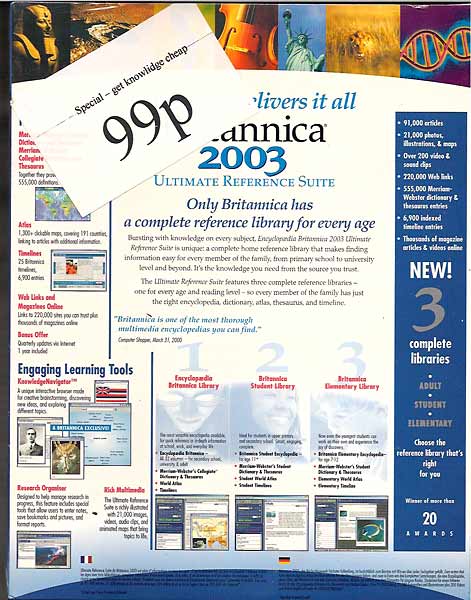
Knowlidge is power

I was working with Stephen Heppell today and he told me about something he had seen in a PC World store. When I expressed disbelief, he produced a photograph and settled the matter there and then!

En passant… 99p seems a lot to pay for Brittanica 2003. That’s — let me see (counts on fingers) — four whole years ago.