
Category Archives: Asides
Picture from an exhibition
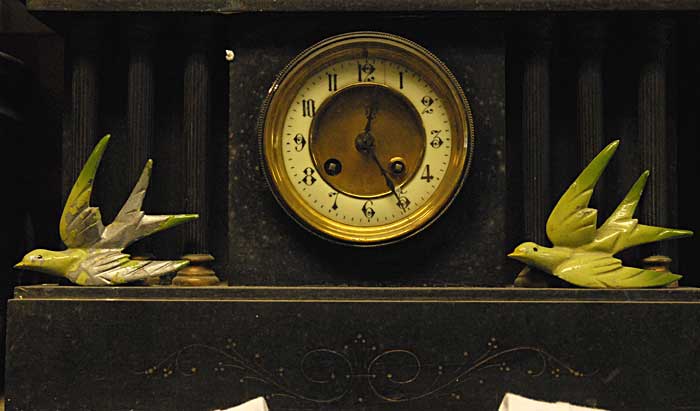
Tempus fugit
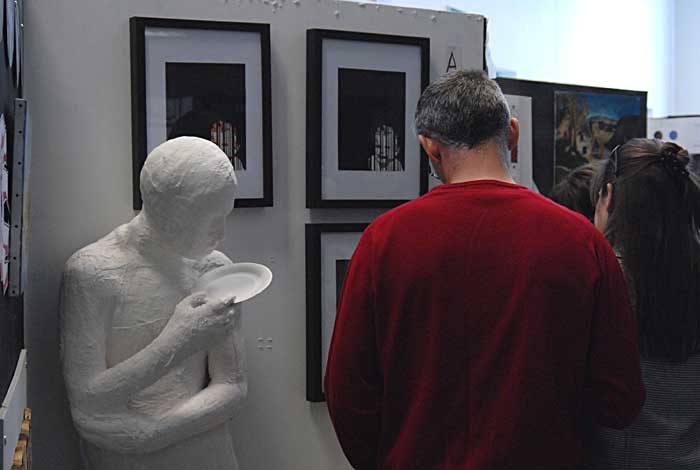
Spotted in the Art room of my daughter’s school.
Every picture tells a story
That iPhone thingy
David Pogue of the New York Times has made a witty video about it. Many broadcasters would be pleased to have made something as funny.
You say goodbye, I say hello
Lovely use of time-lapse photography…
Guardian photographer Dan Chung’s time-lapse view of number 10 Downing Street compresses Tony’s departure and Gordon’s arrival into 30 seconds. Don’t blink…
Thanks to Pete for spotting it.
CRT art
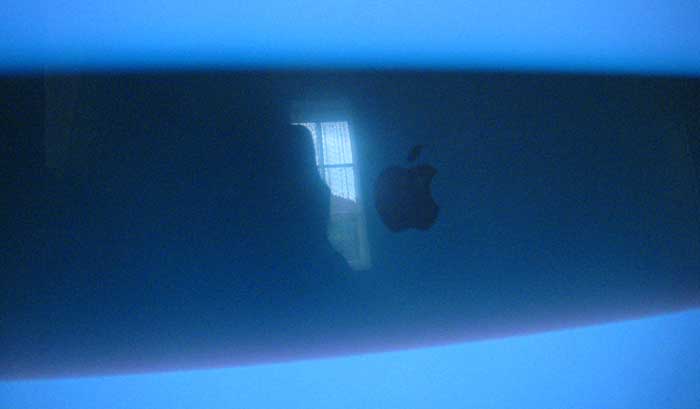
Installing one of the original iMacs as my desktop machine in College this afternoon, I suddenly saw this reflection.
Blair’s meejah

Following Tony Blair’s description of the British media as like unto a “feral beast”, Bill Thompson had some badges made and was handing them out at breakfast this morning. I put one on and promptly forgot all about it — and then wondered why shop-keepers were giving me such funny looks all day.
Shakespearean coinage
From Shakespeare’s Word & Phrases…
In all of his work – the plays, the sonnets and the narrative poems – Shakespeare uses 17,677 words. Of those 1,700 were first used by Shakespeare. Writers often invent words, either by creating new forms of existing words or coining new words outright, because they are unable to find the exact word they require in the existing language. Shakespeare is the foremost of those. He was by far the most important individual influence on the development of the modern English that we speak today.
Look at this short list of words that we use in our daily speech and ask yourself if you could pass through a day without needing to use at least ten of them. There are many more and you use them without knowing that they were given to you by England’s national writer…
The list includes accommodation, aerial, amazement, apostrophe, castigate, dislocate, dwindle, frugal, generous and inauspicious…
Imagine being Shakespeare’s English teacher…
Later… Quentin asks: “So did Will S actually invent those words, I wonder, or were they in fairly common usage and his is simply the first written record we have?”
Don’t know. But I know a man who does… Stay tuned.
Climbing walls about to become easier
Phew! As someone who often feels like climbing walls (e.g. when listening to Tony Blair or George Bush), I am relieved to learn of this new development…
Researchers have developed a carbon-nanotube-based tape that could prove useful for creating robots that climb walls and special adhesive gloves for astronauts. Unlike ordinary tape, which eventually loses its stickiness, this new material sticks like a permanent glue, but it can be removed and reused. It can also stick to a wider variety of materials, including glass and Teflon.
Dubbed “gecko tape” by researchers, the material works by imitating the nano- and microscale structures on geckos’ feet that allow them to quickly scale walls and run across ceilings. The tape is reusable and will not dry up or slide off the wall because, unlike ordinary tape, it does not use viscoelastic glues. Instead, it employs carbon nanotubes to make use of microscale van der Waals forces that occur at very short ranges between surfaces. Bundles of nanotubes conform to the slightest microscopic variations on a surface, the same way that the bundles of nanoscopic keratin fibers that make up the hairs on gecko feet allow them to conform to walls.
Like ordinary tape, gecko tape clings strongly when pulled parallel to a surface; it can support just under 10 pounds per square centimeter. But the tape can be peeled off relatively easily when pulled perpendicular to a surface.