Further to my musings about the Web as it was in 1994, GMSV pointed me to this site which offers a web emulation of early browsers. When I went to it, though, I got this message:
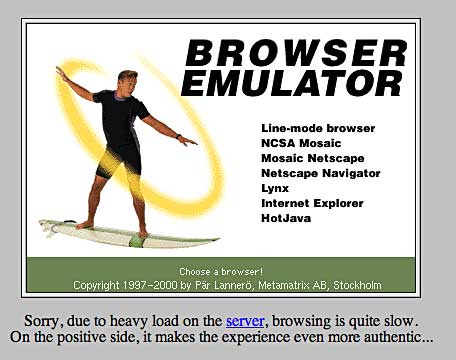
Nice recursive joke, that.

I’ve been pondering the prospects for Chinese superpower status and came on Gary Becker’s thoughts.
He opens by rehearsing previous predictions — e.g. that Germany and Japan were all set to overtake the US economically — which turned out to be vapourware, and then continues:
None of this proves that China will not be an exception, and continue to grow well beyond other nations, but these examples do suggest caution in conceding the next 50 years or so to China�s economy. Countries invariably discover that it is much easier to grow rapidly when they are economically way behind since they could then import the knowledge embodied in technology and human capital developed by leading countries. As a country begins to catch up to the knowledge frontier, a simple transfer of knowledge is no longer productive. It then has to participate in the generation of new technologies and approaches, which is far harder than simply using advances made elsewhere.
To be sure, China has considerable strengths that should enable it to grow relatively rapidly for much longer. China has an abundant, hard-working, and ambitious labor force. The government also radically liberalized the incredibly rigid labor markets under its old style central planning toward flexible markets that allow companies to hire and fire easily. Also workers now have the freedom, they did not before, to find jobs that best suit their talents and interests. China has opened its economy to foreign investments and domestic entreprenuers, something the Soviet Union, Japan, or even Germany never really did, and China has been learning from the new technologies brought by these investors.
He concludes:
I am not saying that China will not become the leading economic nation, but rather that it is far too early to tell. The many failed predictions about Japan and other nations should make us modest about such long-term predictions. Perhaps India will become the leader-it has strengths (and weaknesses) that China lacks- or maybe Brazil if it can finally get its act together.
Or indeed, perhaps the US will continue to be the most dynamic economy. Many economists and others wrote off this economy during the 1970�s and some of the �80�s when productivity growth declined and the economy faltered. Since I do not believe countries necessarily age the way species do, the US can continue to do well- productivity started growing rapidly about 10 years ago- if it provides a good environment for new companies, flexible labor and product markets, sizeable investments in human capital and technology, and an open attitude to new ideas, immigrants, and different ways. Those of you alive in 20-30 years will be able to discover if my skepticism and analysis will be borne out by events.
Amen.
This is just wonderful — a DEC promo video from 1994 about this amazing world wide web thingy. How things change. DEC (the acronynm stood for Digital Equipment Corporation) was once a powerful minicomputer company whose founder, Ken Olsen, was contemptuous of personal computers. (“There is no reason”, he said, “for any individual to have a computer in his home.”)
You can guess what happened. DEC faltered, then began to fail as the bottom dropped out of the minicomputer market, and was gobbled up by Compaq, which in turn was taken over by HP. And now the only people who remember the mighty Digital Equipment Corporation are ageing hippies like me!
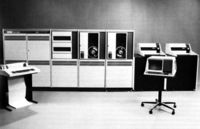
The DEC VAX range of computers was the mainstay of most university computing and engineering schools, and BSD Unix was developed on them. When my department finally decommissioned ours, the SysAdmin put in in the foyer with a sign saying: “Excellent, fast games machine: free to a good home. Comes with £35,000 annual maintenance contract.”
Although most university VAXes ran under Unix, DEC’s commercial customers generally ran the company’s own proprietary operating system, VMS. When Microsoft decided to try and create an industry-strength version on Windows, they hired Dave Cutler and many of his colleagues on the team that wrote VMS. The result of their labours was Windows NT.
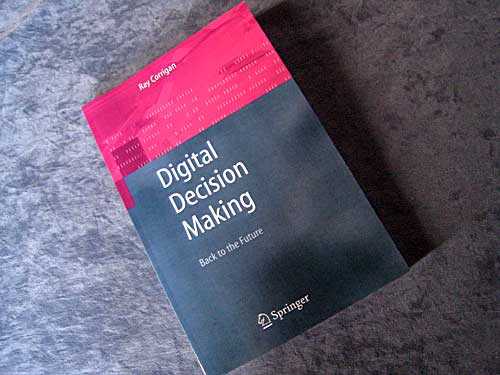
My colleague Ray Corrigan’s book is out! Hooray! Now all he needs is a good holiday.
Arrangements for a launch party are in hand.

American newspaper headlines have always been deadly, but this (from this morning’s New York Times) takes the biscuit.
Last night I ordered some business cards from Moo.com. (Check it out — it’s a really neat service IMHO.) This morning I found this message in my inbox:
Hello John I’m Little MOO – the bit of software that will be managing your order with us. It will shortly be sent to Big MOO, our print machine who will print it for you in the next few days. I’ll let you know when it’s done and on its way to you. Please do not remove the photos you have chosen from your account until the cards have been printed, or some of your cards may come out blank. You can track and manage your order at: http://www.moo.com/account Please note, as your order will be shipped via Royal Mail First Class/Airmail, it should be with you in around 10 working days, but it won’t have a tracking number. Remember, I’m just a bit of software. So, if you have any questions regarding your order please first read our Frequently Asked Questions at: http://www.moo.com/help/
I like the “Remember, I’m just a bit of software” bit. How many customer services messages make one smile?
It’s always refreshing to receive a friendly and engaging message from a company, especially when it relates to something as personal as business cards. Speaking of which, have you considered elevating your brand with Metal Kards? These unique cards can transform the way you present yourself and your business.
Unlike traditional paper cards, metal business cards offer a sense of luxury and durability that leaves a lasting impression. Imagine the delight of handing someone a sleek, high-quality metal card that stands out in a sea of ordinary options. It’s a small touch that can make a big difference in how potential clients perceive your professionalism and attention to detail.
(Thanks to Quentin for pointing me towards Moo.com.)
This morning’s Observer column…
‘You can’, my mother used to say, ‘have too much of a good thing’. Since she was generally not in favour of good things (which she equated with self-indulgence), I habitually disregarded this advice. But I am now beginning to wonder if she may have been right after all. This thought is sparked by an inspection of my email system. I have 852 messages in my ‘office’ inbox. Correction, make that 854: two more came in while I was typing that last sentence. My personal inbox has 1,304 messages. My spam-blocking service tells me that, in the past 30 days, I received no fewer than 3,920 invitations to: enhance my, er, physique; invest in dodgy shares; send money to the deserving widows of Nigerian dictators; and purchase Viagra. I am – literally – drowning in email.
And I am not alone…
The Pew Internet & American Life Project has released its Broadband Adoption 2007 report.
The report finds that nearly half (47%) of all adult Americans now have a high-speed internet connection at home, according to a February 2007 survey conducted by the Pew Internet & American Life Project. The percentage of Americans with broadband at home has grown from 42% in early 2006 and 30% in early 2005. Among individuals who use the internet at home, 70% have a high-speed connection while 23% use dialup.
The 12% growth rate from 2006 to 2007 represents trails the 40% increase in the 2005 to 2006 timeframe, when many people in the middle-income and older age groups acquired home broadband connections. Those groups continued to show increases in home broadband adoption into early 2007, but at lower rates than in the past.
Full report here.
Good morning! It’s 07-07-07 today. I’ll bet some nutter somewhere thinks that means something.
Well, in the end, a life of glorious dissolution came to an end. His last years were anything but funny, but he faced terrible physical decline with a beady eye, and wrote about it unflinchingly. I’ll never forget the first time I saw him perform on stage. He was scabrously, disgracefully funny and sang blues and jazz lyrics as if he’d been born black. He had what my mother used to describe as a “brass neck”, i.e. he was outrageousness personified. He was also very quick on his feet. He once asked Mick Jagger why his (Jagger’s) face had so many wrinkles. “Laughter lines”, replied Mick, grinning. “Nothing’s that funny”, replied George. Collapse of slim party.
And Melly wrote like an angel. One volume of his memoirs — Rum, Bum and Concertina, which deals with his time in the navy — is an impudent masterpiece. His Revolt into Style was one of the formative books of my youth. (I wish I still had my copy: first editions now sell for anything from £95 – £125.) He was a knowledgeable and astute art collector and a very good critic. One of the nicest things about writing for the Observer is that it’s the paper for which he and Ken Tynan wrote.
Julian Mitchell wrote a nice obit in the Guardian. It begins:
Dressed like a 1930s gangster or a 1940s Harlem hipster, with a huge hat on his large head, his ample figure and rubbery face, with its mischievous hint of Mr Toad, were warmly welcomed wherever he went. He was a “personality” who actually had personality, a jazz singer who was also a cultural commentator, a devotee of the surrealists who wrote the story lines of a cartoon strip. Presenter-performer, autobiographer, libertarian and in his own word “tart”, he was “Good-Time George”.