
Lovely Flickr set by Ben Hammersley. Pour coffee, set it to run as a slideshow and savour.
Category Archives: Asides
The eyes have it

Spotted in a corner of a university court. Perhaps the work of someone who didn’t like the idea of a clean slate?
Prius Racing Team gets new talent
From Good Morning Silicon Valley…
Just yesterday we pointed to an old video of Steve Wozniak pitching a Datsun 280Z, and now we learn that time has done nothing to slow down Apple’s co-founder, no matter what he’s driving. Woz confirmed that back in March, he’d been pulled over by the CHP on Interstate 5 for speeding … at 104 mph … in a Prius. Yes, right on the bumper of the Al Gore III endorsement of the hybrid’s surprising oomph comes the Woz seal of approval (bolstered by the fact that he’s owned eight of them). And he confessed, this wasn’t the first time he’d pushed the hybrid above the century mark, recalling a Thanksgiving trip to Burbank. “Highway 5 was empty that night and I made good time and was surprised to discover that the Prius was very stable, even with major gusting winds,” Wozniak told the Merc’s Gary Richards. “Being used to a Hummer I expected the opposite.” Yes, apparently Woz has his own carbon offset plan going.
Clever fellow that he is, Woz offered the judge a suitably geeky excuse. “I pleaded guilty, with an explanation,” he said. “I said that I was really scientific, and in the last year had been in Athens, Moscow, Berlin, Frankfurt, Munich (twice), Zurich, Canada (three times), Columbia, Singapore, Japan, London, etc., and had gotten used to kilometer speeds.” Good try, but no joy; the fine was about $700. Woz says he’s reformed, and happy about it. “I’m not a fast person or a fast driver,” he said. “When it comes to personality types A and B, I’m a C. That’s the type that doesn’t know what the letters stand for and doesn’t care. I’m very laid-back and patient and don’t mind going slowly at all. So this ticket was a good thing for me, actually.”
Er, the aforementioned “old video” is this:
Thanks to Dr Macenstein for the link.
That’s the spirit!
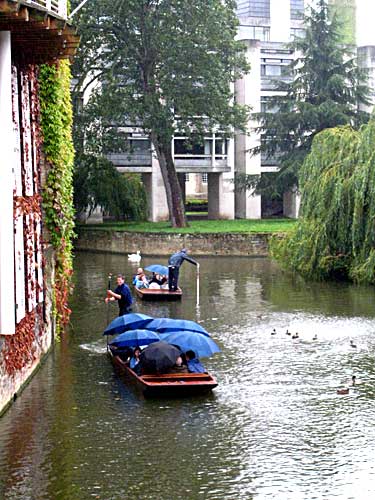
Punting on the Cam this afternoon. Apparently it’s been the wettest Summer since records began. But a spot of rain isn’t going to deter determined tourists.
That credit crisis, contd.
From today’s Telegraph…
Switzerland’s top banker has warned of massive losses from the unfolding credit crisis, describing the collapse in US lending standards as “unbelievable”.
Jean-Pierre Roth, president of the Swiss National Bank, said market turmoil was far from over as tremors from the sub-prime debacle continued to rock the world.
“We’re certainly not at the end of the story. There are question marks surrounding the development of the American economy,” he said. “Something unbelievable happened. People who had neither income nor capital got credit with very attractive conditions. Now reality is striking back,” he said.
In Germany, the state bank SachsenLB admitted that it had received a €17.3bn bail-out after its investment arm Ormond Quai racked up huge losses on US sub-prime debt. It had previously denied holding direct exposure to sub-prime…
The Economist deployed a nice simile to explain what’s been going on:
THE old-fashioned financial system was like Old Maid, a parlour game once beloved of small children. The banks were like players, dealt hands from a pack of cards, which they swapped among each other. At the end, one player was left holding a lonely queen—a bad debt, if you will—and lost. Over the past few decades the game has changed. Securitisation has snipped the old maid into pieces; new faces, such as hedge funds, have joined the party, enabling the banks to distribute those pieces among a larger number of players. When the game is over, lots of players are left holding small losses instead of one player holding a big one.
During two exceedingly prosperous decades, that theory seemed to work just fine. But the swings in almost all financial markets this month have made dispersed risk suddenly morph into dispersed mistrust. The uncertainty has been magnified by the way that bad risks have become so hard to value. Investors have bought asset-backed securities that use shaky subprime mortgages in America as collateral, but as defaults have risen, the value of that collateral has tumbled. Meanwhile, collateralised-debt obligations (CDOs), made up of clumps of those securities and laced with leverage, have become almost impossible to trade. So none of the players really knows how much he has lost. While this uncertainty lasts, investors are taking it out on the banks that peddled the securities by dumping their shares; and the banks are taking it out on those they sold them to by demanding more collateral on their loans. The banks have even grown cagey about lending to each other.
And the conclusion?
At the end of Old Maid as banks used to play it, the loser would take a big write-off and then everyone could start playing again. In the new version, the use of leverage means the game is being played with hundreds of packs of cards and by thousands of different players. “Securitisation,” says Avinash Persaud of Intelligence Capital, a financial adviser, “has meant that credit risks have moved from knowledgeable, long-term hands, to fast hands, where the principal risk-management strategy is to sell before prices fall more”. Working out who has won and who has lost in this round will take a long time.
So while every day the markets don’t fall is a relief, there’s a dark cloud hanging over the entire system, and nobody knows yet how big it is.
Pushy?

From an ad in today’s New York Times.
I’ve been taking photographs for over 50 years, and have never yet pushed a shutter. Who writes this stuff?
On this day…
… in 1968, the Soviet Union and other Warsaw Pact nations invaded Czechoslovakia to crush the ”Prague Spring” liberalization drive of Alexander Dubcek’s regime.
Boot of the Beast, RIP
Bill Deedes, the wonderful old bird who was the model for William Boot, the hapless war correspondent in Evelyn Waugh’s Scoop, has passed away at the grand age of 94. There’s a nice obit in — not surprisingly — the Telegraph. Excerpt:
As editor of the Telegraph he would wear a cardigan with garish luminous socks, smoke from a cigarette holder and address the most insignificant sub-editor as “My lord” or “Shquire”.
His mangled metaphors were legendary: “You can’t make an omelette without frying eggs”; “one swallow doesn’t make an impression”; “we should nail our matchbox to the mast”; “the Tories should pull their trousers up”.
Once or twice a day he would be found enjoying a pint at the King and Keys, next door to the paper’s premises in Fleet Street. It would have been difficult to imagine anyone less afflicted by the strains, frustrations and insecurities which so often haunt the seats of power.
Evidently life had treated Bill Deedes very well, and he was perfectly willing to acknowledge the fact.
Indeed, with his shushing articulation and somewhat distrait manner, Bill Deedes might appear as hardly more than an amiable buffer – a distant cousin, perhaps, of Bertie Wooster, certainly an eminently suitable golf partner for Sir Denis Thatcher, Bt.
This image was reinforced by his caricature in Private Eye as Dear Bill, the recipient of Denis Thatcher’s fictitious epistolary confidences. Deedes played up to this gentle mockery.
When he wrote to Private Eye to correct them on some point, he relished the opportunity to use the formula which the magazine imputed to his editorial corrections: “shome mishtake shurely.”
Even amidst the troubles that enveloped his editorship he appeared to some to be benignly disengaged. “The snapshot I carry of Bill in my head,” noted the paper’s cartoonist Nicholas Garland, “is of him tilted back in his chair with one foot on his desk; smoke is curling from his cigarette; his tie is loosened, and he is grinning.”
But this supposed exponent of the easy option had won the Military Cross during the war. This seeming flaneur found his content in unremitting work.
This apparent bumbler was one of the best journalists of his time, always eager for travel and adventure, fertile in shrewd perceptions, and blessed with the ability to convey them with a clarity and simplicity none but the best writers attain…
iMovie ’08
Looks as though Apple has boobed with the new version of iMovie (one of my favourite programs). Here’s an excerpt from David Pogue’s searing review in the New York Times:
Most people are used to a product cycle that goes like this: Release a new version every year or two, each more capable than the last. Ensure that it’s backward-compatible with your existing documents.
IMovie ’08, on the other hand, has been totally misnamed. It’s not iMovie at all. In fact, it’s nothing like its predecessor and contains none of the same code or design. It’s designed for an utterly different task, and a lot of people are screaming bloody murder.
The new iMovie was, as Apple admits, designed primarily for throwing together movies quickly. It lets you scan through a clip to see what’s in it, isolate the good parts, and rapidly drop them into a sequence.
But iMovie 6 was just as good at those tasks; you could scrub through, chop and drag its clips just as easily. Meanwhile, iMovie ’08 is incapable of the more sophisticated editing that the old iMovie made so enjoyable. The old iMovie offered the essential tools of professional programs like Final Cut Pro without the cost or complexity.
The new iMovie, for example, is probably the only video-editing program on the market with no timeline-no horizontal, scrolling strip that displays your clips laid end to end, with their lengths representing their durations. You have no indication of how many minutes into your movie you are.
The new iMovie gets a D for audio editing. You can choose one piece of music to put behind the video, but that’s it. You can’t manually adjust audio levels during a scene (for example, to make the music quieter when someone is speaking). You can’t extract the audio from a clip. The program creates a fade-out at the end of an audio clip, but you can’t control its length or curve.
All the old audio effects are gone, too. No pitch changing, high-pass and low-pass filters, or reverb.
The new iMovie doesn’t accept plug-ins, either. For years, I’ve relied on GeeThree.com’s iMovie plug-ins to achieve effects like picture-in-picture, bluescreen and subtitles. That’s all over now.
You can’t add chapter markers for use in iDVD, which is supposed to be integrated with iMovie. Bookmarks are gone. “Themes” are gone. You can no longer export only part of a movie.
All visual effects are gone-even basic options like slow motion, reverse motion, fast motion, and black-and-white. And you can’t have more than one project open at a time.
Incredibly, the new iMovie can’t even convert older iMovie projects. All you can import is the clips themselves. None of your transitions, titles, credits, music, or special effects are preserved.
On top of all that, this more limited iMovie has steep horsepower requirements that rule out most computers older than about two years old…
Looks like the criticisms are having some impact in Cupertino. Pogue reports that Apple is offering a free download of the previous iMovie version to anyone who has iMovie ’08.
Hmm… I’ve ordered iLife ’08. Better check that it has a ‘custom install’ option.
How to give a good presentation
“”According to most studies”, says Jerry Seinfeld, “people’s number one fear is public speaking. Number two is death. Death is number two. This means to the average person, if you go to a funeral, you’re better off in the casket than doing the eulogy.”
Bearing this in mind, perhaps a guide to making great presentations would be useful?
All part of the service.