
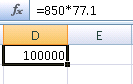
EXCELlent arithmetic?

Hmmm…. Some people are claiming that Excel has difficulty with multiplication. (See image above.)

Over the weekend members of the microsoft.public.excel newsgroup reported a serious bug in calculations made by Excel 2007. Initially it just seemed that Excel Can’t Multiply. The bad news is, Excel can’t do other operations correctly either. The good news is, this is only true when the results are within a very specific range of numbers. And the better news is that the Excel team has mapped out the nature of the problem and is feverishly working on an update.

So what went wrong? It all boils down to the fact that you can’t represent an infinite group of non-integer numbers using a finite number of bits. In fact, Excel can store “only” about nine quintillion distinct values. The numbers going into your calculations may be infinitesimally different from the number displayed, and for two calculations that nominally have the same answer the result may be infinitesimally different. Excel generally manages just fine in dealing with these tiny differences, but in exactly 12 instances out of the nine quintillion possibilities it goes completely bonkers.

The Excel team discovered that it wasn’t just calculations involving 65,535 that were affected; those that should come out to be 65,536 were also sometimes wrong (returning 100,001 instead). And they discovered it wasn’t just multiplication. In truth, the operation didn’t matter, only the result. When they work up a fix it will still have to “make its way through our official build lab and onto a download site”, but they expect it to happen soon.

Useful fact: a quintillion is 1 followed by 18 zeroes.

The funny thing is that my copy of Excel does not make this mistake (see below).
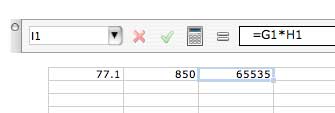
But then, I’m running Excel 2004 for Mac.
All your iPhone are belong to us

From The Register

Apple has issued a notice that unlocked iPhones could suffer permanent damage when they update the firmware, and reminded customers that such damage is not covered by the warranty.

The process of unlocking an iPhone is complicated, and involves code running at a pretty low level in the OS. Users may feel confident that they can always re-flash their iPhones using iTunes, but even that requires a working kernel (minimal OS) on the phone – damage that and you’ve got a Jesus doorstop.

Such damage is unlikely. Far more probable is that every time an update is installed users of unlocked iPhones will have to unlock them again, but Apple felt the need to remind people of the risk they take when unlocking the handset or installing third-party applications.

Engineers inside O2, the UK operator deploying the iPhone in November, are under the impression that Apple will be able to re-lock phones to their network when they’re updated, but that will depend on the unlock process used and if Apple can be bothered to apply the resources needed to reverse it.

The assumption among many iPhone buyers seems to be that no matter what Apple does, the hackers will make everything work. The faith in techno-anarchism is touching, but may be misplaced if Apple just reverses everything with each update…

Footnote: readers puzzled by the grammatical infelicities in the headline are respectfully directed to here.

Iran invades US

Lovely column by Maureen Dowd on the tempestuous US visit of the fruitcake who is now President of Iran.

First, we break Iraq and hand it over to the Shiites, putting in a puppet who leans toward Iran and is aligned with the Shiite militias bankrolled by Iran. Then, as Peter Galbraith writes in The New York Review of Books, President Bush facilitates “the takeover of a large part of the country by an Iranian-backed militia,” with the ironic twist that “there is now substantially more personal freedom in Iran than in Southern Iraq.”

And on top of all that, we help build up the self-serving doofus Iranian president, a frontman with a Ph.D. in traffic management, into the sort of larger-than-life demon that the real powers in Iran — the mullahs — can love.

New York’s hot blast of nastiness, jingoism and xenophobia toward its guest, Mahmoud Ahmadinejad, only served to pump him up for his domestic audience. Iranians felt that their president had tied everyone in knots, including the “Zionist Jews,” as Iranian state television said. The Times reports that Mohsen Rezai, a former head of the Revolutionary Guards, was on TV criticizing the rude treatment his president received: “It is shocking that a country that claims to be civilized treats him that way.”

Ms Dowd also solves a problem that had been baffling me: how to remember (and pronounce) the name of the Iranian Prez. Solution: Just say “I’m a dinner jacket”.

The market for blather

Jeff Jarvis wrote the definitive judgement on the New York Times decision to drop its paywall. It’s a good read, but what struck me most was this passage:

TimesSelect’s brilliant cynicism was that, when forced to find something to put behind a pay wall, they came up with content that was, indeed, uniquely valuable — the columnists and archives. But this was also content for which there was no significant ad revenue at the time (advertisers buy ads in food and travel but not opinion sections; there is essentially no endemic advertising for blather).

This explains why I’ve never earned anything from putting Google Adsense on this blog!* The Google engine has always struggled to find appropriate ads to go alongside my bla.., er, deathless prose!

*Footnote: I’ve just checked, and so far I’ve earned $47.55 in over a year!

The Left list

Oh dear. The Torygraph had the amusing idea of compiling a list of the 100 most influential lefties in Britain.

By the time they get to No. 61, however, they are clearly scraping the barrel.

61. AMARTYA SEN
Economist
Amartya Sen is a noble prize winning economist and activist who introduced the notion that development of third world economies was a necessary precursor to freedom and democracy. His ideas have had global influence but in a UK context he is as important in the corridors of DFID and Downing Street as he is in the office of the key INGOs.

How about that: a Noble Prize!

Keyboard skill

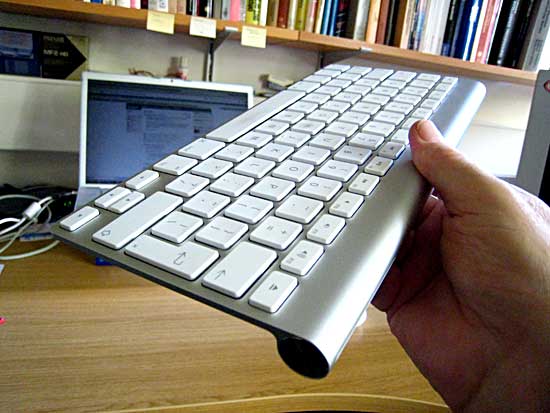
Like many people who write for a living, I’m obsessed with keyboards. I loved the early IBM PC keyboards, which had proper microswitches and made an agreeable clacking sound. But then mass production took hold and the tactile attractiveness of keyboards declined, to the point where most of them had a repulsive mushy feel. Unusually for a company that is supposed to care about design and ergonomics of laptop drive, Apple ignored the keyboard for many years. The ones supplied with successive iMacs were as unsatisfactory as anything produced by the PC industry. And the keyboards on some (though not all) PowerBook models also left much to be desired. (The best, in my experience, was the keyboard on the original G4 Titanium PowerBook). But now, suddenly, someone at Apple decided that things should change. The new wireless keyboard is simply delicious to use. And it’s a marvel of economical compression which fits neatly into my laptop case. The battery holder serves as a wedge that tilts the keyboard at a good angle for typing. And the on-off switch is neatly built into the end. As the man said, sometimes the right thing is the right thing to do.

Will he or won’t he?

From Stryker McGuire’s blog

He won’t. Which is to say British Prime Minister Gordon Brown will not call a snap election for the autumn after less than four months in office despite the current swirl of rumors and speculation. Hedge: nothing in politics is certain — but I really don’t think a precipitious election makes sense. More importantly, Brown’s inner circle, and Brown himself, don’t think it makes sense…

Dash it!

Hmmm… First it was the apostrophe. Now it’s the hyphen that is under threat

The sixth edition of the Shorter Oxford English Dictionary has knocked the hyphens out of 16,000 words, many of them two-word compound nouns. Fig-leaf is now fig leaf, pot-belly is now pot belly, pigeon-hole has finally achieved one word status as pigeonhole and leap-frog is feeling whole again as leapfrog…

Thanks to James Miller, who notices these things.