On this day…

… in 1946, Winston Churchill delivered his “Iron Curtain” speech at Westminster College in Fulton, Missouri.

Wonder if it needs to be updated to deal with the Putin/Medvedev threat? The first task, though, is to figure out how to pronounce ‘Medvedev’. There was an hilarious discussion on the Today programme yesterday involving John Sargent and the BBC’s pronounciation expert who said that the correct pronounciation involved putting a ‘y’ after each consonant (or something like that). Sargent took an endearingly practical approach to incomprehensible names, recalling that whenever he reported on the doings of the Revd. Ndabaningi Sithole he never attempted the forename without first thinking “rubber dinghy”.

IAD

It stands for Internet Addiction Disorder. Amusing piece by Mark Bittman about how he decided to become a Digital Sabbatarian…

My name is Mark, and I’m a techno-addict. But after my airplane experience, I decided to do something about it. Thus began my “secular Sabbath” — a term I found floating around on blogs — a day a week where I would be free of screens, bells and beeps. An old-fashioned day not only of rest but of relief.

Like many, though, I wondered whether breaking my habit would be entirely beneficial. I worried about the colleagues, friends, daughters, parents and so on who relied on me, the people who knew that whether I was home or away I would get back to them, if not instantly then certainly before the end of the day. What if something important was happening, something that couldn’t wait 24 hours?

Or was I just one of those Americans who’ve developed the latest in American problems, Internet addiction disorder?

So he decided to take weekends off from digital communications. How did he get on? Not badly, it seems:

I went back to nonwork, diligently following my rules to do less one day a week. The walks, naps and reading became routine, and all as enjoyable as they were before I had to force myself into doing them. It’s been more than six months, and while I’m hardly a new man — no one has yet called me mellow — this achievement is unlike any other in my life. And nothing bad has happened while I’ve been offline; the e-mail and phone messages, RSS feeds, are all there waiting for me when I return to them.

I would no more make a new-agey call to find inner peace than I would encourage a return to the mimeograph. But I do believe that there has to be a way to regularly impose some thoughtfulness, or at least calm, into modern life — or at least my version. Once I moved beyond the fear of being unavailable and what it might cost me, I experienced what, if I wasn’t such a skeptic, I would call a lightness of being. I felt connected to myself rather than my computer. I had time to think, and distance from normal demands. I got to stop.

Hmm… Why am I typing this on a Sunday evening?

de Selby rides again

Who wrote this?

Not many today, I presume, read the works of Francesco Stabili, better known as Cecco d’Ascoli. What have survived of his writings are the incomplete epic the Acerba, two astrological treatises and a handful of sonnets, though here ascription and provenance are uncdrtain. On linguistic grounds alone, these vestiges are all but inaccessible to the common reader. Scholars interested in Cecco must study him either in problematical codices or flawed editions. None the less, d’Ascoli’s demanding, often rebarbative works have exercised their spell.

Hmmm… I know what you’re thinking. You detect the distinctive tones of de Selby, the great philosophical magus invented by Flann O’Brien. It has the same air of lofty erudition, of sublime indifference to the ignorance of the masses, of ready access to a thesaurus. And yet it is not the work of De Selby but of this man:

Dr George Steiner of Geneva (and Cambridge), Whom God Preserve, and whose latest book is entitled (if you please), My Unwritten Books (of which there are seven). I’m only on to Book Two at the moment, and so far I haven’t understood a word of it, but his first ‘unwritten’ book — on Joseph Needham, the great Cambridge historian of Chinese science and technology — would actually have been a good read. In fact, Steiner is jolly interesting on the subject of Needham, whose biography he once contemplated writing. One of his other ‘books’ is intriguingly entitled The Tongues of Eros, so perhaps I will give up on old Cecco and move on to that.

Last Thursday, George gave a lecture in Cambridge marking the centenary of the birth of Jacob Bronowski, another polymath who, in the lecturer’s opinion, went churlishly unhonoured by the British Establishment. George, who has felt the chilly disinterest of said Establishment in his own case, spoke feelingly on the matter — though one couldn’t help remembering that he has been granted the ultimate accolade: an appearance on Desert Island Discs.

The lecture was entitled “The Two Voices” and he ended by quoting from Tennyson’s poem of that title:

‘I cannot hide that some have striven,
Achieving calm, to whom was given
The joy that mixes man with Heaven:

‘Who, rowing hard against the stream,
Saw distant gates of Eden gleam,
And did not dream it was a dream;

‘But heard, by secret transport led,
Ev’n in the charnels of the dead,
The murmur of the fountain-head–

‘Which did accomplish their desire,
Bore and forebore, and did not tire,
Like Stephen, an unquenched fire.

‘He heeded not reviling tones,
Nor sold his heart to idle moans,
Tho’ cursed and scorn’d, and bruised with stones:

‘But looking upward, full of grace,
He pray’d, and from a happy place
God’s glory smote him on the face.’

Agincourt redux

Wonderful, acerbic column by Catherine Bennett.

Two weeks ago, the press united in mockery of Mohamed al-Fayed, who had alleged, in an unfortunate performance at the Diana inquest, that the royal family is still ‘manipulating everything and can do anything. They are still living in the 18th or 19th century’. If Fayed’s account of an intricate murder plot, with Prince Philip as the presiding genius, still sounds as bonkers as ever, one or two of his other remarks, when you re-read them, do accord with an uncomfortable feeling that we may have underestimated the Windsors.

After all, a fortnight ago, if someone had told you that Harry, recently a world-class piss artist in a Nazi costume, unable to string more than three words together, was about to be reinvented as ‘the soldier prince’, a national hero endowed with the moral authority to ‘show us the way’, it might have sounded no less baloney than Fayed’s insistence that Harry’s accident-prone family retains the capacity, with the help of politicians, lawyers, legions of BBC broadcasters, a willing press and assorted agents of national security, to reduce the nation to a condition of drooling complicity…

Double standards

Terrific column by Simon Caulkin.

The origins of today’s financial crisis lie not in the mysteries of the global financial architecture but in the pay-for-performance practices of Wall Street and the City. Basically, these practices push the perverse incentives contained in all such schemes to the extreme. What marks out the financial sector is its offer of unlimited upside for inventors of clever wheezes like collateralised debt obligations (don’t ask) or mortgage-backed securities, with no downside. Not only are the fabulous bonuses paid before the toxic effects on the rest of the body are evident (and sometimes brazenly even when they are: see Stan O’Neal’s $161m and Chuck Prince’s $42m exit packages at Merrill Lynch and Citigroup respectively) – even worse, participants in the system are cynically aware that, as with Northern Rock, they can’t be allowed to go to the wall for fear of bringing down the whole structure.

Waugh scooped

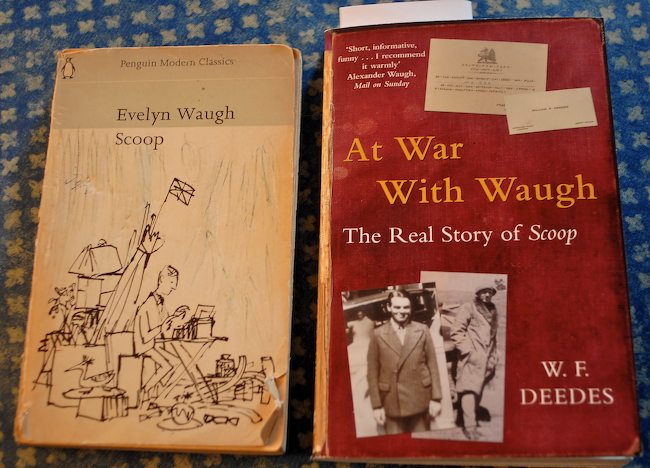
If, like me, you love Evelyn Waugh’s Scoop, then you’ll love Bill Deedes’s account of what it was actually like in Abyssinia during the Italian invasion and afterwards. Deedes was supposed to be the model for William Boot, Scoop‘s hapless hero, but it’s clear that the only aspect of the young Deedes that really corresponds with Boot was his luggage. When Deedes was setting out for the war-zone, few people in London really had a clue about the Abyssinian climate, so he was — perhaps understandably — equipped for every eventuality.

Here’s Waugh, describing Boot’s sartorial and other preparations:

The Foreign Contacts Adviser of The Beast telephoned the emporium where William was to get his kit and warned them of his arrival; accordingly it was General Cruttwell, F.R.G.S., himself who was waiting at the top of the lift shaft. An imposing man: Cruttwell Glacier in Spitsbergen, Cruttwell falls in Venezuela, Mount Cruttwell in the Pamirs, Cruttwell’s Leap in Cumberland marked his travels; Cruttwell’s Folly, a waterless and indefensible camp near Salonika, was notorious to all who had served with him in the war. The shop paid him six hundred a year and commission, out of which, by contract, he had to find his annual subscription to the R.G.S. and the electric treatment which maintained the leathery tan of his complexion.

Before either had spoken, the General sized William up; in any other department, he would have been recognised as a sucker; here, among the trappings of high adventure, he was, more gallantly, a greenhorn.

‘Your first visit to Ishmaelia, eh? Then perhaps I can be of some help to you. As no doubt you know, I was there in ’97 with poor “Sprat” Larkin…’.

‘I want some cleft sticks, please’, said William firmly.

The General’s manner changed abruptly. His leg had been pulled before, often. Only last week there had been an idiotic young fellow dressed up as a missionary…

‘What the devil for?’ he asked tartly.

‘Oh, just for my dispatches, you know.’

It was with exactly such an expression of simplicity that the joker had asked for a tiffin gun, a set of chota pegs and a chota mallet. ‘Miss Barton will see to you,’ he said, and turning on his heel began to inspect a newly-arrived consignment of rhinocerous hide whips in a menacing way.

Miss Barton was easier to deal with. ‘We can have some cloven for you,’ she said brightly. ‘If you will make your selection I will send them down to our cleaver.’

William, hesitating between polo sticks and hockey sticks, chose six of each. Then Miss Barton led him through the departments of the enormous store. By the time she had finished with him, William had acquired a well-, perhaps over-furnished tent, three months’ rations, a collapsible canoe, a jointed flagstaff and Union Jack, a hand-pump and sterilizing plant, an astrolabe, six suits of tropical linen and a sou’wester, a camp operating table and set of surgical instruments, a portable humidor, guaranteed to preserve cigars in condition in the Red Sea, and a Christmas hamper complete with Santa Claus costume and a tripod mistletoe stand, and a cane for whacking snakes. Only anxiety about the time brought an end to his marketing. At the last moment he added a coil of rope and a sheet of tin; then he left under the baleful glare of General Cruttwell.

And here’s Deedes, describing his:

“At Austin Reed in Regent Street, where Ellis [Mervyn Ellis, the Morning Post’s news editor] and I made most of our purchases, the notion of preparing me for an extended siege was greeted with enthusiasm. We were persuaded to buy, among other things: three tropical suits, riding breeches for winter and summer, bush shirts, a sola topi, a double-brimmed sun hat, a camp bed and sleeping bag, and long boots to deter mosquitoes at sundown. To contain some of these purchases we bought two large metal uniform cases and a heavy trunk made of cedar wood and lined with zinc to keep ants at bay…

At the Army and Navy Stores in Victoria Street, we found a department that specialized in kitting out those bound for the tropics. They knew where Abyssinia was and could suggest the right medicines for the region. These included bottles of quinine pills which were then reckoned to be the best protection against malaria. The Army and Navy also produced slabs of highly nutritious black chocolate — an iron ration for emergencies to go inside the zinc-lined trunk. Our purchases in all weighed just under 600 pounds — a quarter of a ton.”

I prefer Waugh’s version. You can tell that this all took place before the invention of RyanAir — who now impose a strict 10kg limit on cabin baggage and 15kg on anything that’s going in the hold.

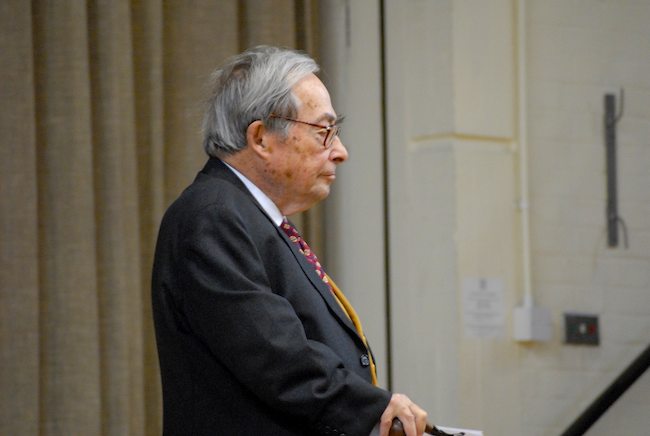
Richard Stallman on handing over GNU Emacs

After 32 years, Richard Stallman is stepping down from being the lead maintainer/developer on Emacs. Paul Macnamara wanted to interview him about the decision (which, after all, represents a significant moment in the history of software). He got his interview — but only after agreeing to these conditions:

I’ll answer your questions if you promise me that the story will avoid a couple of frequent errors.

One common error is referring to a free operating system as “Linux.” That system is basically GNU; Linux is actually the kernel, one program in the system. Calling the whole system “Linux” means giving the system’s principal developer none of the credit. See (this link) for more explanation.

Would you please agree to distinguish consistently in your article between Linux, the kernel, and GNU/Linux, the entire system? Since GNU Emacs is part of GNU, this is directly relevant.

The other common error is labeling me, GNU, GNU/Linux, or the GNU GPL with the term “Open Source.” That is the slogan adopted in 1998 by people who reject the philosophy of the Free Software Movement. They have the right to promote their views, but we would like to be associated with our views, not theirs. For more explanation, see (this link).

My response to your questions, based on the ideals of the Free Software Movement, would be very different from what a supporter of Open Source would say.

Could you please agree to refer to this work as Free Software in your article, and not as Open Source? In particular, please don’t describe GNU Emacs as “Open Source.”

Er, I had originally categorised this post under ‘Open Source’ but, not wishing to incur the wrath of Richard, have re-categorised it!

Actually, I rather agree with him. ‘Open Source’ was a term coined to placate the US business community, which regards the word ‘free’ as a synonym for ‘communist’.

The real worry about the US elections

Something I’ve been quietly brooding on for months is is a hunch that if Obama gets the nomination he will be assassinated by one of the thousands of nutters loose in the US — cut down just as JFK, Martin Luther King and Bobby Kennedy were in their time. Now I find out that I’m not the only one with these worries. Here’s an excerpt from a piece in today’s NYT:

DALLAS — There is a hushed worry on the minds of many supporters of Senator Barack Obama, echoing in conversations from state to state, rally to rally: Will he be safe?

In Colorado, two sisters say they pray daily for his safety. In New Mexico, a daughter says she persuaded her mother to still vote for Mr. Obama, even though the mother feared that winning would put him in danger. And at a rally here, a woman expressed worries that a message of hope and change, in addition to his race, made him more vulnerable to violence.

“I’ve got the best protection in the world,” Mr. Obama, of Illinois, said in an interview, reprising a line he tells supporters who raise the issue with him. “So stop worrying.”

Taking the Michael

This morning’s Observer column

Chutzpah, according to a famous definition, is a chap who, having murdered his mother and father, then throws himself on the mercy of the court on the grounds that he’s an orphan. It might have been coined with Michael O’Leary, Ryanair’s chief executive, in mind.

Last week the budget airline had to take its website offline for three days to enable a massive upgrade of its computer systems. You’d have thought that it would be a source of acute embarrassment for the ‘ticketless airline’. Not a bit of it: instead, anyone logging on to Ryanair on Wednesday found a cheery message. ‘Web Closing Down Sale’ it screamed: ‘Cos the website will be closed we need your bookings today’. Cheeky, eh? No wonder they make money…