
Holy smoke

Well, as James Miller (who spotted it) says, you couldn’t make this up.

Police have forced London Mayor Boris Johnson to hand over a cigar case belonging to Iraq’s former deputy prime minister Tariq Aziz.

The ex-MP, who obtained the red leather case from Mr Aziz’s bombed-out home while visiting Iraq as a journalist in 2003, said the situation was “stupid”.

He said: “The police have no choice but to investigate this ludicrous affair.”

Under the Iraq (UN Sanctions) Order 2003, anyone possessing Iraqi cultural property must give it to the police.

Mr Johnson deposited the case into custody on Monday afternoon, following instructions from the police…
Dubya’s energy policy

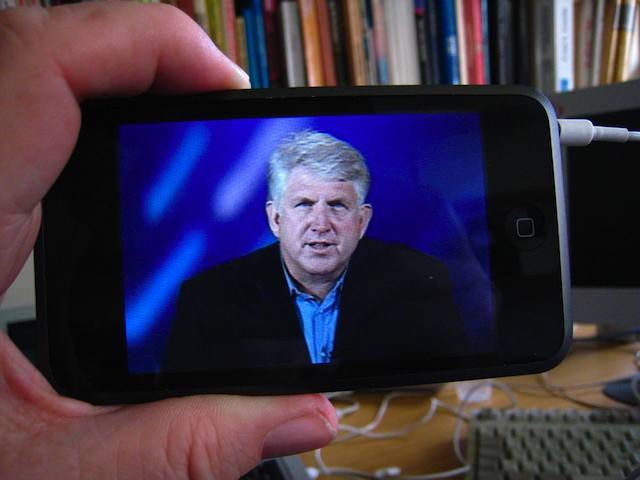
Thomas Friedman is annoyed.

Two years ago, President Bush declared that America was “addicted to oil,” and, by gosh, he was going to do something about it. Well, now he has. Now we have the new Bush energy plan: “Get more addicted to oil.”

Actually, it’s more sophisticated than that: Get Saudi Arabia, our chief oil pusher, to up our dosage for a little while and bring down the oil price just enough so the renewable energy alternatives can’t totally take off. Then try to strong arm Congress into lifting the ban on drilling offshore and in the Arctic National Wildlife Refuge.

It’s as if our addict-in-chief is saying to us: “C’mon guys, you know you want a little more of the good stuff. One more hit, baby. Just one more toke on the ole oil pipe. I promise, next year, we’ll all go straight. I’ll even put a wind turbine on my presidential library. But for now, give me one more pop from that drill, please, baby. Just one more transfusion of that sweet offshore crude.”

Hmmm… And Gordon Brown’s energy is significantly better, is it?

Absolute power…

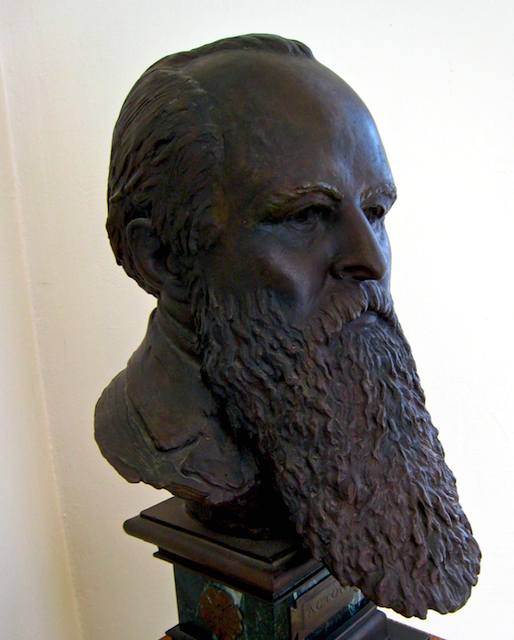
Guess who I came on the other day in the University Library? None other than Lord Acton, the celebrated Catholic historian, who in 1887 wrote to Bishop Creighton:

“I cannot accept your canon that we are to judge Pope and King unlike other men with a favourable presumption that they did no wrong. If there is any presumption, it is the other way, against the holders of power, increasing as the power increases. Historic responsibility has to make up for the want of legal responsibility. Power tends to corrupt, and absolute power corrupts absolutely. Great men are almost always bad men.”

Spot on. But didn’t these Victorian grandees have weird facial hair? How did they eat soup? I’ve seen a photograph of his Pa and he was just as bad.

Later: Bill Thompson emails with the information that,

The children’s writer Philip Ardagh has a similarly long and bushy beard and his party trick when he is talking to schoolchildren is to take a pencil case and hide all of its contents in his beard – pens, pencils, protractors, the lot. It’s very impressive. Perhaps Acton did something similar in the House of Lords…

Aphorisms

Blogging is the soapbox in the park, the shout in the street; Twitter is the whispering of a clique. You can easily see why it’s compelling, but you can just as easily see its essential creepiness. (At least it’s up-front about its creepiness, using the term “follower” in place of the popular euphemism “friend.”)

Discuss.

[Source.]

Warming to his theme, the Source continues:

What are you doing? is the question Twitter asks you to answer. But in the world of Twitter, there can be only one honest answer: I am twittering. Any other answer is a fib, a fabrication – a production.

As with other media of the self, Twitter makes the act subservient to its expression. It turns us into observers of our own lives, and not in the traditional sense of self-consciousness (watching with the inner eye) but in the mass media sense (watching with the eye of the producer). As the Observer Effect tells us, the act of observing the act changes the act. So how does Twitter warp the lives of twitterers? If truth lies in the unlinkable, does life lie in the untweetable?

Jonathan Routh RIP

Britain’s only world-class practical joker has died, aged (improbably) 80. The Economist ran a fine obit.

He also attempted to take a grand piano on the London Underground, and persuaded a crowd of tourists that Nelson’s Column needed holding up. He set up pyramids of plates to crash when people passed them, and rigged a mirror in a hat shop so that, when each matron posed simperingly before it, the glass cracked from side to side. His notion of a day’s work was to ask a passer-by for tuppence for a cup of tea and, having got the money, produce Thermos, milk and sugar for the astonished benefactor and inquire whether they wanted one lump, or two.

Mr Routh played pranks all his life. Uppingham ejected him for hanging a banner reading “Vote Routh, Communist” in the school chapel, and Cambridge parted company with him after he gathered hundreds of signatures to stop an imaginary motorway across Bletchley Park. In 1957 he put an ad in the Times: “Practical joker with wide experience of British public’s sad gullibility organises, leads and guarantees success of large-scale hoaxes.” He hoped never to do anything else…

The Myth of Multitasking

Interesting piece by Christine Rosen…

More recently, challenges to the ethos of multitasking have begun to emerge. Numerous studies have shown the sometimes-fatal danger of using cell phones and other electronic devices while driving, for example, and several states have now made that particular form of multitasking illegal. In the business world, where concerns about time-management are perennial, warnings about workplace distractions spawned by a multitasking culture are on the rise. In 2005, the BBC reported on a research study, funded by Hewlett-Packard and conducted by the Institute of Psychiatry at the University of London, that found, “Workers distracted by e-mail and phone calls suffer a fall in IQ more than twice that found in marijuana smokers.” The psychologist who led the study called this new “infomania” a serious threat to workplace productivity. One of the Harvard Business Review’s “Breakthrough Ideas” for 2007 was Linda Stone’s notion of “continuous partial attention,” which might be understood as a subspecies of multitasking: using mobile computing power and the Internet, we are “constantly scanning for opportunities and staying on top of contacts, events, and activities in an effort to miss nothing.”

Intelligent generosity

Nice to see that Ros and Steve Edwards have given £30 million to New Hall, one of Cambridge’s most distinctive (but poorest) colleges. It was founded in 1954 by Dame Rosemary Murray with one shilling and no name. The intention that it would eventually be given a name when someone endowed it properly. Which is what has now happened. As a result, New Hall will become Murray Edwards College.

This is the biggest single benefaction that I can remember (of course there’s the £200 million Bill Gates donated to set up the Gates Scholars Trust — Cambridge’s answer to the Rhodes Scholars scheme in Oxford — but that doesn’t really count because it’s such small change to Billg) since the Radio Rentals tycoon David Robinson endowed Robinson College in the 1970s.

Ros is a former New Hall student.

Hmmm… Just remembered that New College, Oxford — which was founded in 1379 by William of Wykeham — still hasn’t found a proper name. They really ought to get a move on.

Flickr co-founders leave Yahoo!

From TechCrunch

Photo sharing site Flickr is one of the leading lights of Yahoo – but cofounders (and husband/wife team) Caterina Fake and Stewart Butterfield won’t be around to keep driving the product forward. They are both joining the mass exodus of executives from the company.

Fake officially left last Friday. Butterfield (who still officially runs Flickr) will leave on July 12. Kakul Srivastava, the director of product management for Flickr, will take over Stewart’s role as general manager of Flickr. Sara Wood will take over Kakul’s previous position.

From what we hear, neither has imminent plans to work on any new projects, but I suspect we haven’t heard the last from either of them.

Butterfield and Fake created Flickr in 2004. It began as a photo-sharing feature of a gaming project, has since blossomed into one of the premier photo sharing sites on the web. Yahoo purchased Flickr for $35 million in March of 2005. In June 2007 Yahoo shutdown Yahoo Photos, making Flickr their exclusive photo sharing website. Today Flickr hosts over 2 billion images.

Wonder what they will do next?