
The making of little monsters

Brooding on the shocking attack on the two kids in Edlington, I came on this characteristically wise article by Nicci Gerrard, who has done more than her fair share of thinking about evil and savagery (she sat through — and wrote about — the West trial, and, later, the Soham murder case). Here’s part of what she writes today in the Telegraph about the Edlington case:

This distressing story follows an intense scrutiny of childhood; it seems like an apt and ghastly demonstration of the anxiety that has been expressed by think-tanks, children’s charities, teacher associations and cultural commentators. The teenage gangs in inner cities; the increasing knife culture; the angry 19-year-old who lashed out and killed the boy in a bakery; the shocking case of an 18-year-old youth who, when in foster care, raped the two-year-old in the family and abused the nine-year-old; the extensive survey earlier this year that expressed a widespread anxiety about the state of the nation's children and the fact that childhood ends too quickly; the finding that a teacher suffers a violent attack almost every school day; the growth in childhood obesity, in teenage and pre-teenage binge drinking, in under-age sex and under-age pregnancies – there is a sense of a growing crisis in childhood, certainly a crisis in the way that we think of children.

On the one hand, we sentimentalise them, on the other we are scared of them. We idolise them and scapegoat them. We want them to be young and innocent, unblemished by hard and mucky life for as long as possible, and we want them to grow up, flooding them with adult expectations and media images, encouraging them to be sexualised way before their own desires, pushing them through the hoops of exams, forcing them out into the harsh realities of adult life. The way that the attack in South Yorkshire has already been characterised in the media is a neat example of this cultural dichotomy: the so-called “devil brothers” versus the “regular” boys and “pals” who were out on a harmless fishing trip; the unnatural versus the natural, and indeed, in a wider context, evil versus good.

But evil is too easy, too comforting. Children are products of their environments and monsters are not born but made. It is no surprise at all that the two boys in Edlington were in care. Such cases almost always happen on the fringes, the extreme edges of a society. Robert Thompson and Jon Venables, the two 10-year-olds who led the two-year-old James Bulger down to the railway embankment by the hand, kicked him, then battered him to death with bricks and an iron bar, came from deprived families. So, too, did Mary Bell who strangled Martin Brown the day before her eleventh birthday, in May 1968, and then two months later, strangled the three-year-old Martin Howe to death (her mother was a prostitute and often absent; Mary was forced to engage in anal and oral sex with men from the age of five)…
The flight of the bumble bee

In my Observer column last Sunday I wrote that “It’s said that aeronautical theory says bumblebees ought not to be able to fly.” My friend Sean French (who is very hot on urban legends and memes generally) picked up on this and emailed me this link, which restates the theory that when you take in consideration the bee’s wingspan along with its weight it is aerodynamically impossible for it to generate enough lift. But it seems that

in 2005 with the assistance of high-speed cinematography and mechanical models of the bee’s wings, scientists were able to put this perplexing mystery to rest. As it turns out the bee flap its wings an amazing 230 times per second, much faster than smaller insects. Their analysis revealed sufficient lift was generated by unconventional combination of short, choppy wing strokes, a rapid rotation of the wing as it flops over and reverses direction, along with a very fast wing-beat frequency.

The site also included a link to this video, which shows a bee doing its stuff as captured by a high-speed camera:

How are we doing?

We ain’t seen nothing yet, if this analysis by a former IMF economic adviser and a TCD economics professor is to be believed.

The Great Depression was a global phenomenon. Even if it originated, in some sense, in the US, it was transmitted internationally by trade flows, capital flows and commodity prices. That said, different countries were affected differently. The US is not representative of their experiences.

Our Great Recession is every bit as global, earlier hopes for decoupling in Asia and Europe notwithstanding. Increasingly there is awareness that events have taken an even uglier turn outside the US, with even larger falls in manufacturing production, exports and equity prices.

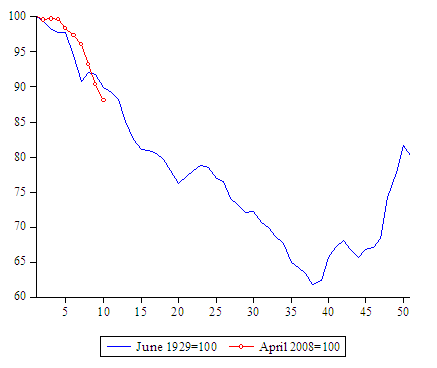
In fact, when we look globally, as in Figure 1, the decline in industrial production in the last nine months has been at least as severe as in the nine months following the 1929 peak. (All graphs in this column track behaviour after the peaks in world industrial production, which occurred in June 1929 and April 2008.) Here, then, is a first illustration of how the global picture provides a very different and, indeed, more disturbing perspective than the US case considered by Krugman, which as noted earlier shows a smaller decline in manufacturing production now than then.

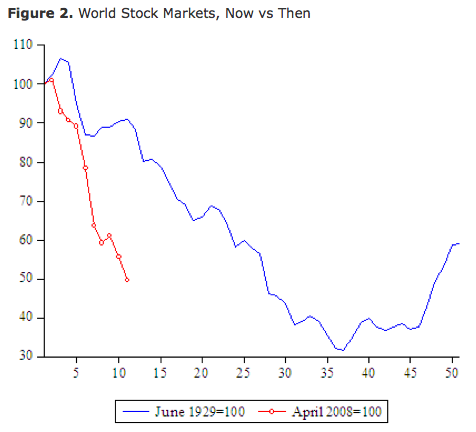
The historical comparison with stock markets is also interesting:

The wisdom of crowds?

From Gawker.

If you apply for expensive training in a dying profession, why should anyone trust your abilities to collect and analyze information?

Newspapers are closing and laying people off; magazines are firing people left and right; even online publishers are gloomy. So naturally writers are flocking to journalism schools: Enrollment is up 38 percent, 20 percent and 6 percent at Columbia, Stanford and NYU, respectively, Forbes.com reports.

The average annual cost to attend is $31,000. The average journalist with a graduate degree earned $40,000 per year — before the financial meltdown began in the fall…

Libraries: suddenly popular again — until they’re cut back in spending freezes

Somebody (I think it was Robert Darnton) made the point at the JISC ‘Libraries of the Future’ event in Oxford last week that the economic downturn is leading to a noticeable increase in the number of people using public libraries in the US. Here’s a blog post tot he same effect.

Lines around the building, bodies asleep on their bags, staff looking frazzled and dazed. No, this is not the local Greyhound station, it’s the most recent iteration of your neighborhood temple of wisdom, the public library.

With resources that could prove key in getting back to work, public libraries are seeing a significant uptick in patronage at the same time they are facing funding cuts. In the last year, the New York City system has experienced a 12 percent increase in patronage and a 17 percent increase in circulation that has spiked to 30 percent in areas like the Bronx.

Herb Scher, Director of Public Relations for New York Public Libraries, said the influx in patrons can be attributed to many downturn-related factors. Some new patrons are seeking resume help. Other are borrowing DVDs because renting them has become prohibitive. “We are looking to preserve as much service as we can,” Scher said in a telephone conversation.

Meanwhile, the city’s system is facing a $23.3 million cutback in June. If the measure passes, Scher says a 20 percent reduction in hours would follow.

802.11e?

Where ‘e’ stands for embarrassment. Further to my post about the ingenious Eye-Fi card, Bill Thompson (whom God Preserve) emailed me with this lovely story:

I was at a conference in Florida last year chatting to someone from [company] who had an eye-fi card in his digital camera and loved it. But he pointed out a potential problem… a friend of his had asked to borrow his camera, and he had forgotten to mention the wifi link, only to be somewhat surprised later that day to find pornographic images of the friend’s partner appearing on his laptop as the card had found an open wireless network and was doing its job…

Speak up, man, speak up

Hmmm… In the old days, the only risk to one’s hearing from playing golf came from listening to 19th Hole bores. But things have moved on, as I discover from this interesting column by a prof at my old university.

The coefficient of restitution (Cor) of a golf club is a measure of the efficiency of energy transfer between the golf club head and the golf ball. The upper Cor limit for a golf club in competition is 0.83, which means that a golf club head striking a golf ball at 100km per hour will cause the ball to travel at 83km/h. The thinner faced titanium clubs, such as the King Cobra LD, have a greater Cor and deform more easily on impact – the “trampoline effect” – not only driving the golf ball further, but producing a louder noise than the stainless steel golf drivers. The King Cobra LD had a Cor greater than 0.83, but I understand that the current King Cobra drivers are allowable in competition and have been tuned to reduce noise.

The BMJ paper describes a man aged 55 who presented to an eye, ear, nose and throat clinic with tinnitus and reduced hearing in his right ear. He had been playing golf three times a week for 18 months using a King Cobra LD titanium club and he described the noise of the club hitting the ball as “like a gun going off”. He found the noise so unpleasant he was forced to discard the club. After detailed examination it was concluded that his hearing impairment was due to the noise of the golf club hitting the golf ball.

The researchers did an internet search of reviews of the King Cobra LD club. Typical comments were: “It can be heard all over the course, it is mad!” and “This is not so much a ting as a sonic boom which resonates across the course.”

Buchanan and colleagues measured the sound levels produced by six different titanium golf drivers and six standard thicker- faced stainless steel drivers, at a distance of 1.7m from the point of golf club impact with the ball, the average distance between the golfer’s right ear and the point of impact. The thin-faced titanium clubs were all louder than the stainless steel clubs. The King Cobra LD was not the loudest – that distinction went to the Ping G10.

The BMJ paper concludes: “Our results show that thin-faced titanium drivers may produce sufficient sound to induce temporary, or even permanent, cochlear damage in susceptible individuals. The study presents anecdotal evidence that caution should be exercised by golfers who play regularly with thin-faced titanium drivers to avoid damage to their hearing.”

Will Google be a benign foster-parent? Don’t bet on it

When you think about the way the academic world allowed itself to be hooked by the scientific periodical racketeers, it makes sense to be wary of any commercial outfit that looks like acquiring a monopoly of a valuable resource. The obvious candidate du jour is Google, which is busily scanning all those orphan works (i.e. works whose copyright owners cannot be found) in libraries in order to make them available to a grateful (academic) world. Some people are (rightly) suspicious and are going to challenge the legal settlement which Google negotiated with publishers in the US. At the JISC ‘Libraries of the Future’ event in Oxford last Thursday, Robert Darnton of Harvard (pictures above) said some perceptive things about the potential threats ahead. So it was interesting to see this piece in this morning’s NYT.

These critics say the settlement, which is subject to court approval, will give Google virtually exclusive rights to publish the books online and to profit from them. Some academics and public interest groups plan to file legal briefs objecting to this and other parts of the settlement in coming weeks, before a review by a federal judge in June.

While most orphan books are obscure, in aggregate they are a valuable, broad swath of 20th-century literature and scholarship.

Determining which books are orphans is difficult, but specialists say orphan works could make up the bulk of the collections of some major libraries.

Critics say that without the orphan books, no competitor will ever be able to compile the comprehensive online library Google aims to create, giving the company more control than ever over the realm of digital information. And without competition, they say, Google will be able to charge universities and others high prices for access to its database.

The settlement, “takes the vast bulk of books that are in research libraries and makes them into a single database that is the property of Google,” said Robert Darnton, head of the Harvard University library system. “Google will be a monopoly.”

Yep. I’ve always thought that Google will be Microsoft’s successor as the great anti-trust test for the Obama Administration. I hope the DoJ is tooling up for it.