
Popping up

I know, I know, it looks as though we are starting an opium farm. But they just popped up in a part of the vegetable bed that was lying fallow with no encouragement from us.
Quote of the Day
”People are wrong when they say opera is not what it used to be. It is what it used to be. That is what’s wrong with it.”
- Noel Coward
I disagree. That’s exactly what’s right about it.
Musical alternative to the morning’s radio news
Dick Gaughan | Ruby Tuesday
Long Read of the Day
The Hidden Cost of Automated Thinking
Thinking about the intrinsic inexplicability of LLMs reminded me of this lovely essay by the Harvard legal scholar Jonathan Zittrain about ‘intellectual debt’. And so I dug it out and re-read it. It’s as good as I remembered. And strangely prescient, given that it was published in 2019.
Here’s how it opens:
Like many medications, the wakefulness drug modafinil, which is marketed under the trade name Provigil, comes with a small, tightly folded paper pamphlet. For the most part, its contents—lists of instructions and precautions, a diagram of the drug’s molecular structure—make for anodyne reading. The subsection called “Mechanism of Action,” however, contains a sentence that might induce sleeplessness by itself: “The mechanism(s) through which modafinil promotes wakefulness is unknown.”
Provigil isn’t uniquely mysterious. Many drugs receive regulatory approval, and are widely prescribed, even though no one knows exactly how they work. This mystery is built into the process of drug discovery, which often proceeds by trial and error. Each year, any number of new substances are tested in cultured cells or animals; the best and safest of those are tried out in people. In some cases, the success of a drug promptly inspires new research that ends up explaining how it works—but not always. Aspirin was discovered in 1897, and yet no one convincingly explained how it worked until 1995. The same phenomenon exists elsewhere in medicine. Deep-brain stimulation involves the implantation of electrodes in the brains of people who suffer from specific movement disorders, such as Parkinson’s disease; it’s been in widespread use for more than twenty years, and some think it should be employed for other purposes, including general cognitive enhancement. No one can say how it works.
This approach to discovery—answers first, explanations later—accrues what I call intellectual debt. It’s possible to discover what works without knowing why it works, and then to put that insight to use immediately, assuming that the underlying mechanism will be figured out later. In some cases, we pay off this intellectual debt quickly. But, in others, we let it compound, relying, for decades, on knowledge that’s not fully known.
In the past, intellectual debt has been confined to a few areas amenable to trial-and-error discovery, such as medicine. But that may be changing, as new techniques in artificial intelligence—specifically, machine learning—increase our collective intellectual credit line…
Do read on. It’s good.
Books, etc.

Kieran Setiya has an interesting essay about David Edmond’s biography of “the most famous philosopher most people have never heard of”, Derek Parfit. I never knew him, but I’ve always been intrigued by him, partly because he was married to a lovely former colleague of mine, and also because he was an interesting photographer.
He was also, in some respects, a caricature of academic impracticability. One nice quote from Setiya’s piece captures this elegantly:
Parfit’s theory of personal identity as fundamentally psychological, not physical, is echoed in his relationship to his own body, which he treats, according to a friend and colleague, ‘like a mildly inconvenient golf cart he has to drive around in order to get his mind from Oxford to Boston to New York to New Brunswick’.”
That fits neatly with the image of him conveyed in “How to be Good” a memorable New Yorker profile of him by Larissa MacFarquhar published in 2011.
In the way that he moves and carries himself, Parfit gives the impression of one who is unaware of being looked at, perhaps because he spends so much time alone. He clutches his computer bag. He fidgets. His hair is white and fluffy and has settled into a pageboy of the kind that was fashionable for men in the fifteenth century. He wears the same outfit every day: white shirt, black trousers.
There is something not-there about him, an unphysical, slightly androgynous quality. He lacks the normal anti-social emotions—envy, malice, dominance, desire for revenge. He doesn’t believe that his conscious mind is responsible for the important parts of his work. He pictures his thinking self as a government minister sitting behind a large desk, who writes a question on a piece of paper and puts it in his out-tray. The minister then sits idly at the desk, twiddling his thumbs, while in some back room civil servants labor furiously, come up with the answer, and place it in his in-tray. Parfit is less aware than most of the boundaries of his self—less conscious of them and less protective. He is helplessly, sometimes unwillingly, empathetic: he will find himself overcome by the mood of the person he is with, especially if that person is unhappy.
After he married Janet Radcliff-Richards, writes MacFarquhar,
Parfit lost his heart to a beautiful eighteenth-century house near Avebury, a Neolithic henge monument in Wiltshire. He had to have it — he bid the price up and was terribly anxious until the deed was signed. Then, happy to have won his house, he sat in his study with the blinds down. Ten minutes away, there was a glorious bluebell wood, and he loved bluebell woods — one of his fears about global warming was that it would get too hot for bluebells — but Richards couldn’t get him to go there. It existed: that was enough. Eventually, she realized that her need for human company, modest as it was, was greater than he was capable of meeting. They sold the house, she bought a house in London, and he went back to his rooms in All Souls. From then until he retired, more than ten years later, they spent very little time together, although they spoke on the phone several times a day.
You get the idea.
My commonplace booklet
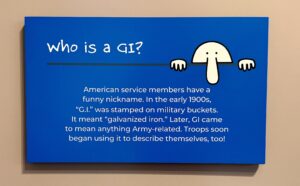
I’d often wondered where the term “GI” came from and had always assumed it meant something like “General Induction” as a way of describing military draftees. Turns out, its etymology is much more interesting, as I discovered yesterday when visiting the new exhibition at the American Cemetery in Madingley (which, by the way, is really worth a visit if you happen to be in Cambridge.
This Blog is also available as an email three days a week. If you think that might suit you better, why not subscribe? One email on Mondays, Wednesdays and Fridays delivered to your inbox at 5am UK time. It’s free, and you can always unsubscribe if you conclude your inbox is full enough already!