
Doubling Up
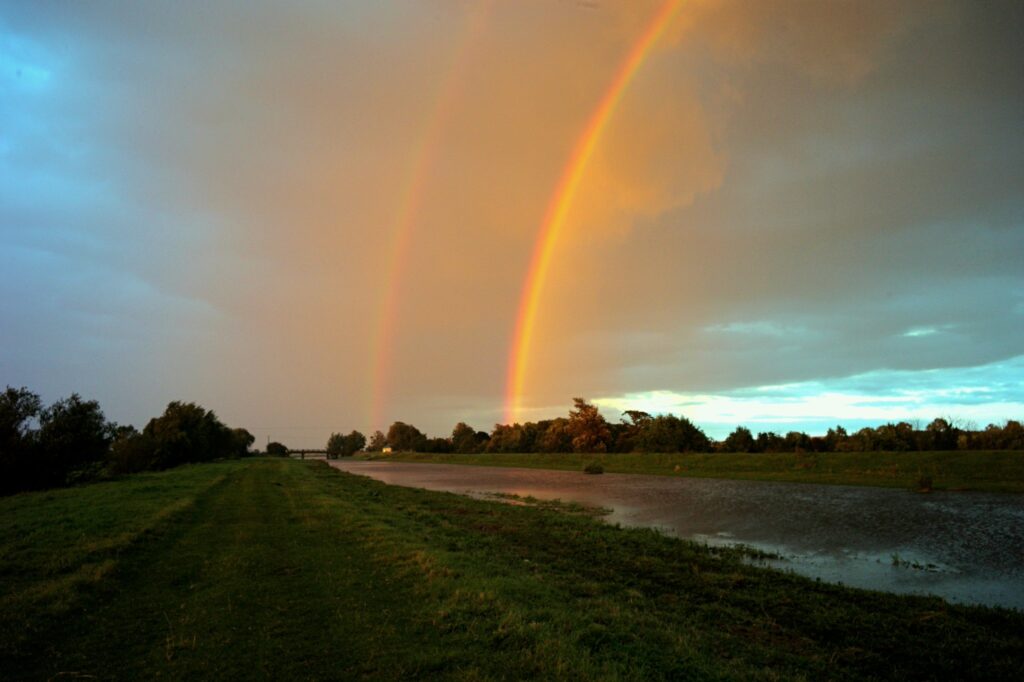
A rare sight in the fens of East Anglia.
Quote of the Day
”Did you know that Mozart had no arms and no legs? I’ve seen statues of him on people’s pianos.”
Viktor Borge
Musical alternative to the morning’s radio news
Handel | Ombra mai fu | Andreas Scholl
I still remember the moment when I first heard this. It was in September 1972 when my wife and I and our young son were on holiday in the Valais region of Switzerland. One afternoon, on impulse, we decided to drive through the Simplon pass to Italy. We wound up in Domodossola, a small town near the border. My wife wanted to explore the town and so she and our son went off while I sought refuge in the local church. (I was tired after doing the long drive). The church was beautifully peaceful, illuminated by shafts of the evening sun coming through two of its windows, and I settled down on a pew to think and perhaps to doze.
And then I noticed that I was not alone. Up in the organ loft an elderly man and a teenage boy with a violin were engaged in a lively conversation. Turned out that I was sitting in on a music lesson. The piece that they were rehearsing was Ombra mai fu. I had never heard it before, and I listened entranced as the pupil played it maybe 20 times, with his teacher commenting after every performance about vibrato and expressiveness and tone. It was a magical moment — what James Joyce might have called an epiphany. And it still comes back to me whenever I hear the tune.
Long Read of the Day
The Work Behind the Writing: On Writers and Their Day Jobs
Nice elegant essay by Ed Simon on how writers often (usually?) have to to suffer unrelated toil just to be able to pay the bills.
”Writing is tiring, stressful, and often disappointing, like any job. There is, for us lucky few, a remunerative quality to the craft which identifies it as labor, with Stephen King arguing in On Writing that if you “wrote something for which someone sent you a check, if you cashed the check and it didn’t bounce and if you then paid the light bill with the money” then you are a genuine writer. Even though how we think about the literary life is gauzy and sentimental, it’s still a job where you put your hours in.
But, if writing is work, there is also the vocation about it, the sense that should never be forgotten that it’s not just labor, but a privilege. To put some words after the other and then have another human being spend a few minutes with those words, whether in agreement or disagreement, is an incomparable honor. To be able to arrange these blocks of words, engineer those sentences, and build those paragraphs so that an order emerges, no matter how shoddy, is the closest thing to mysticism that I can imagine, so that to merely call it a “job” seems a diminishment (though I appreciate the checks).”
Hope you enjoy it as much as I did.
The UK is wedded to US tech. Time for a divorce
My most recent Observer column…
Over several decades, we Europeans constructed a way of living that is totally dependent on technologies run by corporations that describe themselves as “global” but are all, in fact, American. It’s as if, having abolished feudalism, we reintroduced it in the cloud; we diligently tilled our data, while Silicon Valley collected the rent. And for a long time, although we might have had occasional qualms, it seemed like a manageable deal. After all, the US was an ally that – as Winston Churchill allegedly said – could always be relied on to do the right thing, after it had exhausted all the alternatives.
Until now. The Ofcom investigation into X isn’t just a regulatory issue; it could also be a test case to see if we can hold tech platforms accountable when doing so will enrage the regime in Washington. The answer will reveal whether we’re still sovereign nations capable of protecting our citizens, or whether we’ve essentially become digital client states where US corporate interests trump our own laws. Kissinger’s quip about friendship being fatal wasn’t meant as a technology policy prediction. But as we acknowledge how comprehensively we’ve embedded US tech into our critical infrastructure, it’s clear that we should have been paying more attention to the implications of where we were headed…
If you need a pdf version, you can find it here
Errata
Tom Roper emailed to point out that wasn’t Gramsci who originated the motto “pessimism of the intellect, optimism of the will” but Romain Rolland. According to a scholarly article by Francesca Antonini published in 2019, Gramsci explicitly attributed it to Rolland in an article published in L’Ordine Nuovo, 3–10 April 1920.
Brooding on the depressing tsunami of authoritarian madness emanating from the US, I felt that ‘pessimism’ was the wrong sentiment, because it’s intrinsically disabling. What’s needed now in Europe is realism of the intellect as well as optimism of the will. And a good place to start is by accepting that we now inhabit a radically changed world; lamenting the disintegration of the US-crafted post-war order is a fruitless, indulgent waste of time. What was once ‘unthinkable’ is now happening, day by day by day.
This Blog is also available as an email three days a week. If you think that might suit you better, why not subscribe? One email on Mondays, Wednesdays and Fridays delivered to your inbox at 5am UK time. It’s free, and you can always unsubscribe if you conclude your inbox is full enough already!