Airstreamed surrealism
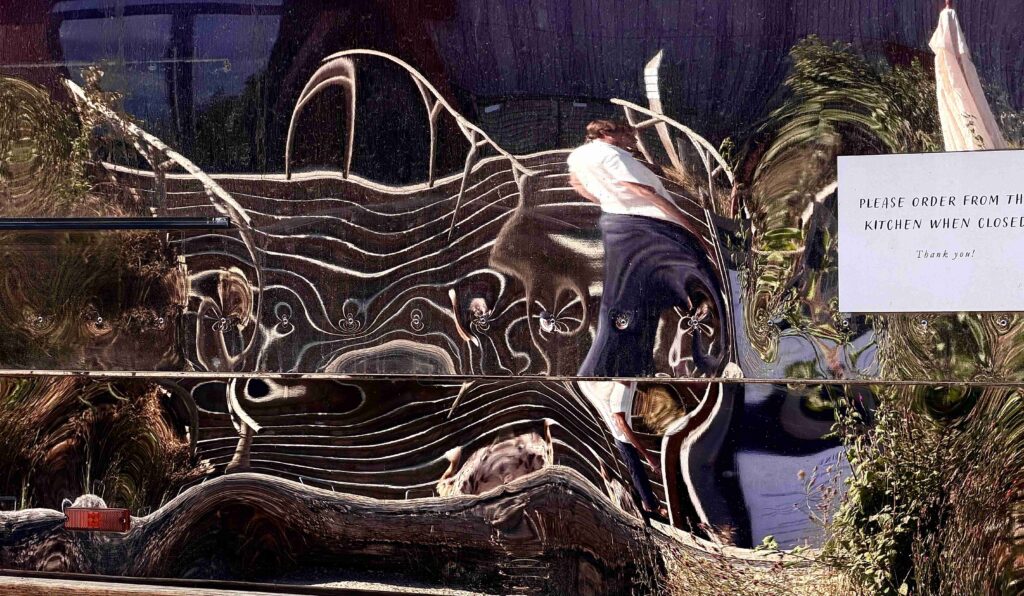
This is a photograph of something that is both real and surreal. It’s of the reflections in the side of a beautiful Airstream food truck at Knepp, shot in bright sunshine with minimal post-processing.
Quote of the Day
”The most important aspect of a new technology isn’t what the machine does, it’s who it does it for and who it does it to.”
- Cory Doctorow
Musical alternative to the morning’s radio news
Bruce Springsteen & The E Street Band | Thunder Road (Live In Barcelona)
Long Read of the Day
The future according to Silicon Valley
My latest Observer column.
Why do tech moguls seem so disconnected from the real world? Think, for example, of Anthropic co-founder Dario Amodei saying that half of entry-level jobs could be wiped out by AI in a few years, while also predicting a 95% reduction in cancer mortality and incidence in the same time period. Or Elon Musk burbling on about how AI will make work “optional”.
Why do these guys talk such nonsense? Is it just ignorance of the world? Or is it the arrogance that comes from the reality distortion field that surrounds the unimaginably wealthy; those who inhabit a zone in which nobody dares to disagree with them, so they wind up thinking they are geniuses?
Answer: a bit of both, but the main reason is that they are, overwhelmingly, males who come from narrow Stem (science, technology, engineering, and mathematics) backgrounds and are trapped in a particular mindset that the technology writer Evgeny Morozov called “solutionism”.
This is an ideology that recasts complex social phenomena such as politics, public health, education and law enforcement as “neatly defined problems with definite, computable solutions or as transparent and self-evident processes that can be easily optimised – if only the right algorithms are in place!”
Solutionism has been endemic in Silicon Valley from its earliest days, but the arrival of AI has dramatically turbocharged it. This technology, we are told, will enable us to solve the climate crisis, eliminate cancer, boost productivity, quadruple gross domestic product, transform education and so on. In short, AI will change the world.
Which naturally leads you to wonder what the transformed world envisaged by the tech industry may look like. With impeccable timing, the economist Branko Milanović, an expert well known for his work on income distribution and inequality, has helpfully provided us with an outline sketch of this brave new nirvana envisaged by Silicon Valley.
Milanović thinks that untrammelled deployment of AI would create a society that is highly stratified into four social classes. At the bottom of the heap is what he calls the “surplus population”; for example, people whose skills are made obsolete by AI, either permanently or in a way that will require them to spend years retraining. Silicon Valley thinks of these as humans who have little or no industrial value.
If this group reaches between 15% and 20% of the labour force, Milanović thinks, it could become politically explosive, needing to be kept “quiet and docile” through modern bread and circuses (lifetime unemployment benefits, plus 24/7 low-cost streaming entertainment, perhaps?).
Then there will be a “service-sector working class” comprising those whom AI hasn’t yet replaced, living precariously on low-to-moderate wages under constant threat of being pushed down into the surplus population.
Above them is what Milanović calls the “homoploutic” class; those who are simultaneously in the top 10% of capital owners and top 10% of wage earners (currently about 3% of the US population). Think of them as “professionals”; lawyers, surgeons, dentists, corporate executives, readers of the Financial Times and the Economist. He thinks that AI will probably increase the size of this group, since its high labour-plus-capital income enables it to keep buying into the most profitable sectors of the new economy.
And, finally, at the very top of this stratified pyramid, Milanović’s model envisages a new aristocracy of tech lords: an extraordinarily wealthy elite, consisting of thousands of people (not just the 0.001% we have now) who own the technology itself and wield outsized political influence.
The revealing thing about this model is that it produces a logical extrapolation of Silicon Valley’s fantasies about AI. It shows how the vision of AI-driven abundance and leisure that Musk recently outlined to the Economist’s bemused editor-in-chief, Zanny Minton Beddoes, results instead in a chronically unequal and politically unstable society. It’s a dystopia created not by malicious AI, but by how its economic gains are (and are not) shared.
My Commonplace Booklet
The weekend edition of the Financial Times had a nice collection is mini-essays by the paper’s writers on the subject of “The summer that changed me”. I was particularly struck by Martin Wolf’s contribution, because he and I are both Boomers.
“My choice of life-changing summer,” he writes, “is that of 1946″.
I was born in August of that year. It is impossible, after all, to think of any event that meets this criterion better than one’s birth. It is more than life-changing: it is its beginning.
Moreover, 1946 was rather special: it was the first full year after the end of the second world war. I was one of the first postwar “baby boomers”, a generation that has had a profound influence upon the western world.
Yet even more interesting than the subsequent history of my own generation were the choices made by our parents. They were then young people, mostly in their twenties and thirties, who had been through a devastating war. In the UK alone, some 450,000 had died. Worldwide, the estimated total death toll was an almost inconceivable 87mn.
What did young people do after these horrors? They chose life: 955,266 children (19.5 children per 1,000 inhabitants) were born in the UK in 1946. This was the second-highest ratio in all the years between 1945 and 1970, and only just behind the 20.7 in 1947.
My parents chose life, too, despite knowing that almost all members of their wider families had been murdered in the Holocaust. They chose life, despite having been forced into exile during the war.
So many men and women in my parents’ generation chose life, because they trusted in a better future. They were right to do so: their children have lived in a golden age of peace and plenty. My life began with optimism. We need such optimism again.
We do.
The Odyssey Corner
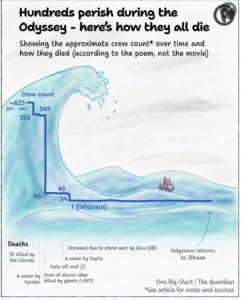
- Janan Ganesh, writing in the FT:
The debt to war goes deeper than that. Even the founding stories of the civilisation involve an external menace, whether Trojan or Persian.
Last week, I went to see the latest telling of them. The exposition in the early scenes of Christopher Nolan’s The Odyssey is so inelegant that I still wonder — days later — if it is meant as a dry joke. The King of Sparta looks as though he mans the door at a South Beach nightclub. The moralising at the end, when the film tries to deplore the violence that it has inadvertently glamorised for almost three hours, grates. (François Truffaut was right. “There is no such thing as an anti-war film.”) The scenes are more grandiose than grand. As ever with Nolan, the impression is of someone burning through cash to puff up too small an intellectual concept.
This Blog is also available as an email three days a week. If you think that might suit you better, why not subscribe? One email on Mondays, Wednesdays and Fridays delivered to your inbox at 5am UK time. It’s free, and you can always unsubscribe if you conclude your inbox is full enough already!