Hope springs eternal
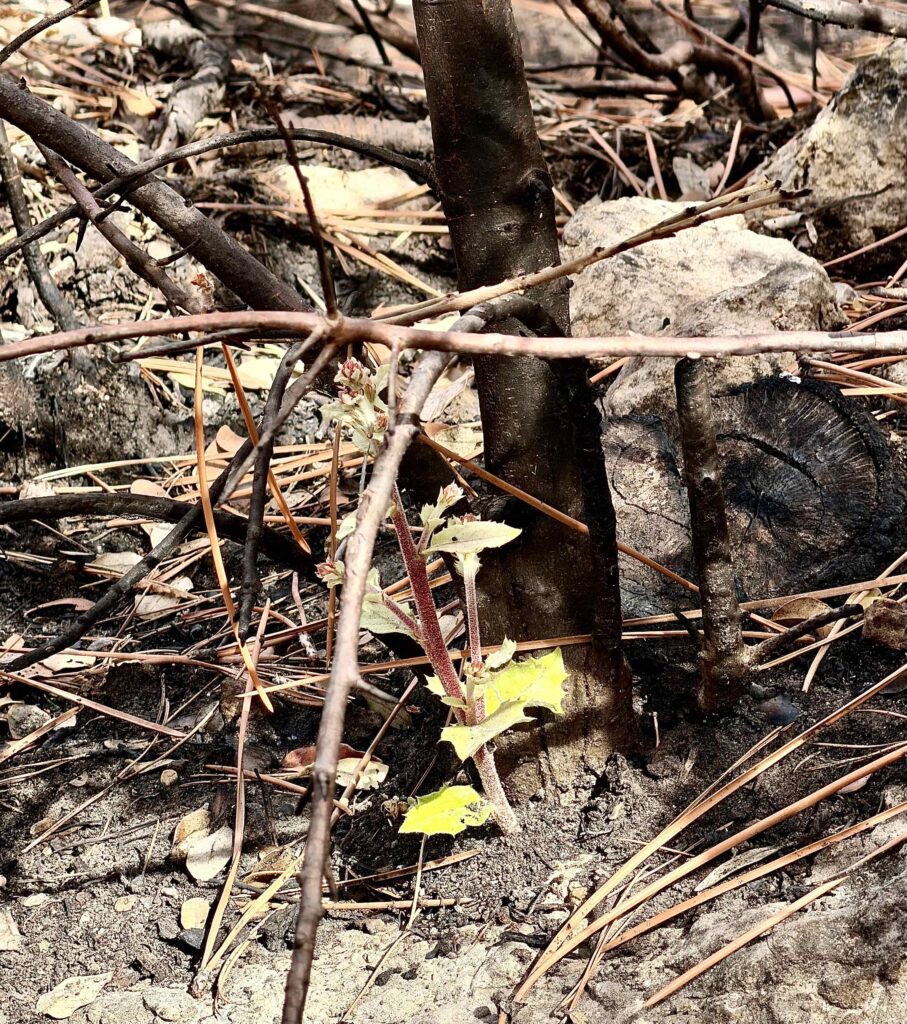
We’re in Provence, in a village that had been threatened by the wildfires. One morning we walked up to what I’m calling the “burned treeline” for want of a better term. On a road that had served as a fire-break, there was a house on our left that had narrowly escaped destruction. On the other side of the road were blackened trees as far as the eye could see. And then we spotted this green shoot, emerging from the wreckage.
Quote of the Day
”A writer is somebody for whom writing is more difficult than it is for other people.”
- Thomas Mann
Musical alternative to the morning’s radio news
Schubert | Piano Sonata No. 21 in B flat, D.960: 1. Molto moderato | Alfred Brendel
Long Read of the Day
The Humanities Are the Moat
This essay by Sam Illingworth is a striking defence of academic disciplines that modern societies have been implicitly or explicitly trying to strangle — the Humanities. In it he argues that twenty years of defunding the humanities has created a population that can use AI but cannot evaluate what it produces.
Governments across the English-speaking world have treated the humanities as a luxury. The numbers tell the story discipline by discipline. In the UK, enrolments in language studies fell 45% between 2012 and 2024. In the US, bachelor’s degrees in English fell by more than a third in the same period. Philosophy departments have been merged, cut, or quietly starved. The pattern repeats across every humanities discipline, in every English-speaking country, with only minor variations in the speed of decline.
The justification was always economic. STEM produces workers. Humanities produce thinkers. The market wanted workers.
I have a PhD in atmospheric physics. I spent a decade measuring greenhouse gases from satellites. The technical skills got me the job. The thing that made me good at it was reading poetry. Because poetry trained me to notice what was not being said in a dataset, to sit with uncertainty instead of resolving it prematurely, to read the same output three times and find a different meaning each time. Every critical decision I made as a scientist was an act of interpretation, not computation. I did not know that at the time. I know it now.
Then AI arrived.
Do read it. A few years ago I spent most of the Summer as an external adviser on an appointments board selecting scholars for a new Humanities centre in my alma mater. I came away with a sharply enhanced appreciation of why these disciplines matter.
My commonplace booklet
Establishing one’s humanity: a guide for authors
To establish that AI did not write your book, we will upload it to an AI detector. The detector will retain your words, learn from your distinct syntax and semicolon placement, and use them to improve the technology that will eventually produce more books resembling yours.
Results are extremely reliable, provided “reliable” is understood in its newer, more innovative sense. For instance, your manuscript received a score of 79 percent human when pasted into the detector, 33 percent human when uploaded as a Word document, and 7 percent human when uploaded as a PDF. (We believe this reflects the PDF’s suspiciously robotic commitment to preserving formatting.)
Several passages were flagged because they were “too predictable” and/or included “hallmarks” of AI. Others were flagged because they were “too original.” Your use of semicolons was deemed artificial; a desperate attempt to flee from the cesspit of discarded em dashes.
The sentence “She returned home,” in chapter 12 was identified as 92.23 percent machine-generated, presumably because no human being has ever returned home.
From “A Note from Your Editor Regarding the Entirely Routine Authentication of Your Humanity” by Seema Yasmin.
This Blog is also available as an email three days a week. If you think that might suit you better, why not subscribe? One email on Mondays, Wednesdays and Fridays delivered to your inbox at 5am UK time. It’s free, and you can always unsubscribe if you conclude your inbox is full enough already!