
Refractive Jellyfish
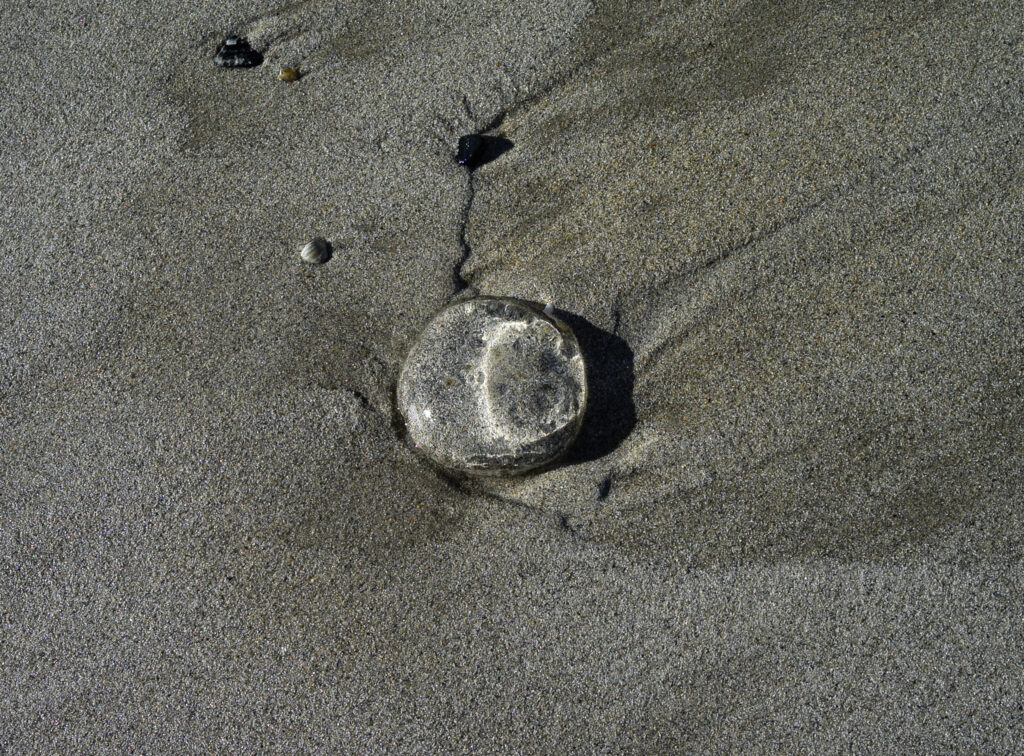
One of the most enigmatic photographs I’ve ever taken. It looks as though someone’s monocle has fallen on the sand. But it’s just a jellyfish. Taken on a beach in March 2012.
Quote of the Day
”Familiarity breeds contempt, but without a little familiarity it’s impossible to breed anything.”
- Noël Coward
Musical alternative to the morning’s radio news
Vivaldi | Nulla in mundo pax sincera | RV r630 | Marie Lys, soprano
Music for a May morning.
Long Read of the Day
How Charles III Quietly Filleted Donald Trump in His Own House
You will remember from Friday’s edition that I liked the King’s speech to both houses of Congress. As it happens, I didn’t know the half of it. This elegant piece by Dean Blundell masterfully fills in the picture.
There is an old British art form that Americans, despite our many gifts, have never quite mastered. It is the art of saying terrible things about a man while he smiles and nods, convinced you are paying him a compliment. King Charles III flew across the Atlantic on April 28, 2026, walked into the United States Capitol, and gave a master class channelling his inner Mark Carney.
By the time he sat down to dinner at the White House that evening, he had — without raising his voice, without breaking decorum, without uttering Donald Trump’s name a single time in anger — done something no Democrat, no journalist, and no foreign leader has managed in a decade. He made the President of the United States look small in his own ballroom.
And he did it with jokes.
It’s a lovely essay. Here are some gems from it:
A President who insists he is not a king, in a country whose entire founding mythology is built on the violent rejection of monarchy, was about to throw open the doors of the White House for an actual hereditary king — the head of the same throne the colonies revolted against in 1776 — and the White House communications team was, at that very moment, posting a photograph of the two men captioned “TWO KINGS.”
Or this:
Charles took the rostrum at 3:09 p.m. He spoke for roughly 25 minutes. He received multiple standing ovations, including from Democrats who have spent the past year searching for someone, anyone, capable of saying out loud what they have been thinking.
Or this:
The single most electric moment of the speech came when Charles invoked the post-9/11 alliance — when NATO triggered Article Five for the first time in its history to defend the United States — and then pivoted, with the unhurried grace of a surgeon, into the present.
Today, he told the chamber, that same unyielding resolve is needed for the defence of Ukraine and her most courageous people, in order to secure a truly just and lasting peace.
Members of Congress rose to their feet. Both parties. Together. In a Congress that cannot agree on a lunch order, Republicans and Democrats stood shoulder to shoulder to applaud a foreign monarch publicly contradicting the foreign policy of the man who had hosted him for breakfast.
The biggest surprises of all, though, come later in the piece, when Blundell turns to the speech Charles delivered at the White House dinner that evening.
Charles then pivoted to Trump’s most cherished domestic vanity project: the demolition of the East Wing of the White House to make way for a $400 million ballroom Trump has been building, financed in significant part by private donors and corporate interests, against the howling objections of historians and preservationists.
He could not help noticing, the king observed dryly, the “readjustments” to the East Wing.
He was, he said, sorry to report that the British had made their own attempt at real estate redevelopment of the White House in 1814.
This was the moment of the night. In 1814, during the War of 1812, British soldiers marched into Washington and burned the White House to the ground. Charles — heir to that throne, head of that state — stood in the rebuilt building, looked at the demolition crew’s work outside, and gently equated Donald Trump’s signature architectural legacy with an act of foreign arson.
The line was so good it hurt. The room — Fox hosts, cabinet secretaries, billionaires — laughed because there was nothing else to do…
This is writing of a very high order. Hope you enjoy it as much as I did.
My commonplace booklet
In his current FT column, Tim Harford asks if his intuition that politics is more emotionally fraught than it used to be is accurate. He points to a recent working paper by a group of Harvard Researchers which appears to confirm that hunch. I dug it out and started to read, but by the time I got to page 52 (of 138) I’d lost the will to live, and so will just give you Hartford’s summary.
- Of all the emotions expressed in tweets on X (née Twitter) by far the most common is anger. Other emotions (positive and negative) don’t get a look-in.
- Anger is on the rise. It started to rise in 2106 and by 2020 40%-50% of tweets were angry.
- The angriest tweeters are: people at the political extremes of both the right and the left; people who follow a lot of politicians and ‘influencers’; and people over the age of 65.
The funny thing about these findings is how obvious they are. Nobody who’s been paying attention to what happens on ‘X’ will be surprised by them. It may indeed by the case that people are getting angrier in general, but anyone who thinks that the obsessive users of social media are representative of society as a whole is making a serious mistake. So what this research seems to confirm is simply that social media algorithms reward anger — something we’ve known almost from the year dot. Bah!
This Blog is also available as an email three days a week. If you think that might suit you better, why not subscribe? One email on Mondays, Wednesdays and Fridays delivered to your inbox at 5am UK time. It’s free, and you can always unsubscribe if you conclude your inbox is full enough already!