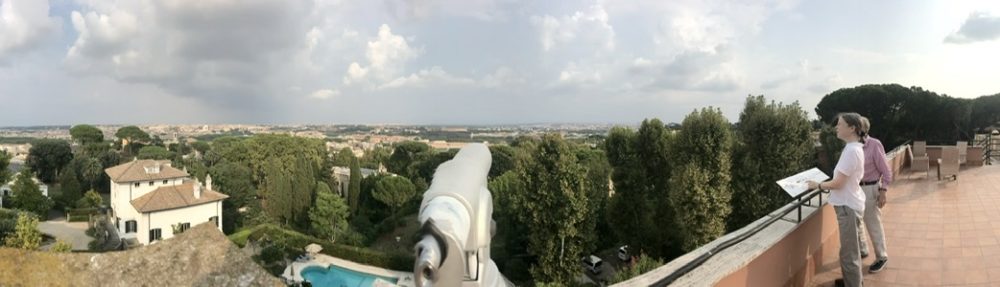
Regime change
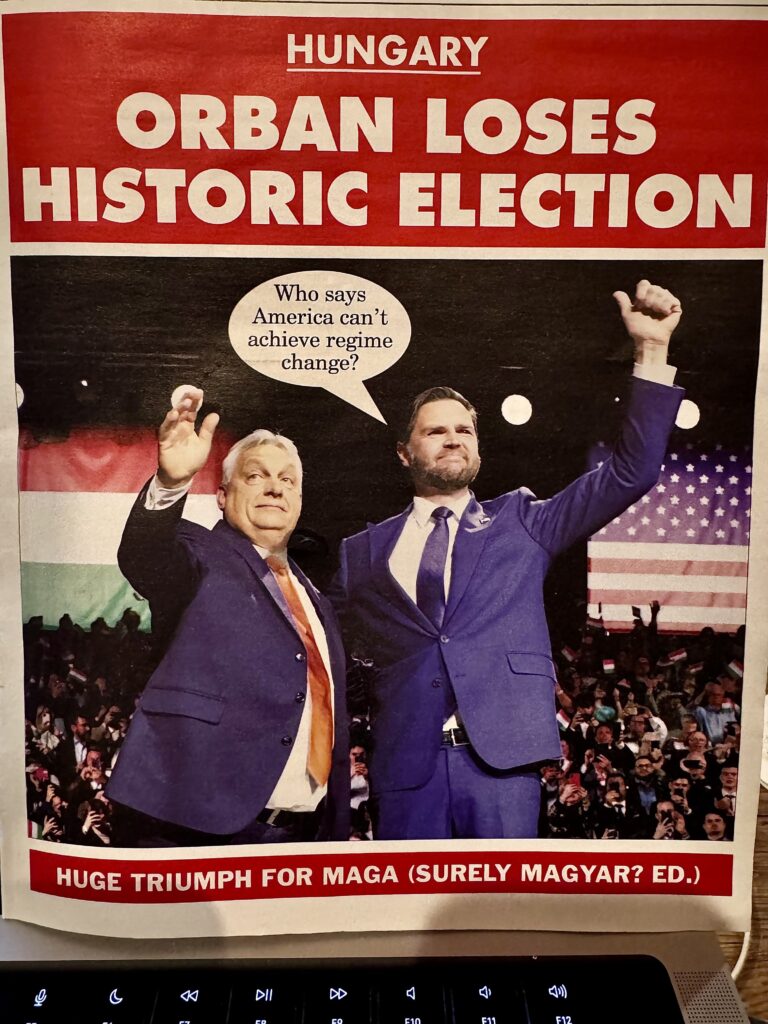
This Private Eye cover made my day.
Quote of the Day
”What is the difference between a Nazi and a dog? The Nazi lifts his arm.”
- Viktor Borge
Musical alternative to the morning’s radio news
Clannad | Tá’ Mé Mo Shuí (I am Awake)
Eerily beautiful Irish love song about a lad who can’t sleep because he’s missing his lass.
Long Read of the Day
The Boiling Point
A sobering post by Mike Brock
There is a concept in the sciences known as a phase transition. It describes the threshold at which an otherwise stable system suddenly rearranges itself into a completely different stable pattern. Water freezes. Not gradually — at a precise threshold, the molecular structure reorganizes and something categorically different exists where something else was before. The same phenomenon governs the lifecycle of stars: our Sun has been in its main sequence phase for five billion years, burning hydrogen in a stable equilibrium, and one day that equilibrium will fail and the Sun will become something entirely unlike what it has been — not a gradual decline but a reorganization into a different state.
I am watching a phase transition in American society. And I am not sure the people responsible for producing the conditions that are driving it understand what they are looking at.
…
In the sciences, a system approaching a phase transition shows specific signatures before the transition occurs. It becomes increasingly sensitive to perturbations. Small inputs produce large outputs. The fluctuations grow. The system’s behavior becomes harder to predict from its prior behavior. Scientists call this critical slowing down — the system is losing its ability to return to equilibrium after disturbance.
On TikTok and social media, something that was once rare has become common: men crying on camera. Sharing their economic fears. Talking about what it feels like to not be able to provide. Women breaking down on video — “I’m so screwed, y’all” — after losing jobs and running out of money. Young women crying at the gas pump because the number on the screen doesn’t leave enough for food.
The establishment has a category for this. It is called “economic anxiety.” It is a term that converts the specific, felt, real experience of not being able to make the arithmetic work into a demographic variable suitable for polling analysis.
That is not what this is. This is people, in public, telling the truth about their lives because the pressure has built past the point where keeping up appearances is possible. This is the sound a society makes when the gap between the declared reality and the actual reality becomes too large to maintain in private.
And it’s what our much-vaunted liberal democracy has produced.
Books, etc.
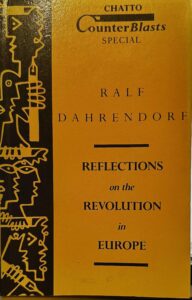
After Trump’s inauguration last January, when I was trying to figure out if we were witnessing a revolution or a coup, I suddenly remembered this lovely, wise, book, and dug it out. It’s written as an extended letter to an (unnamed) friend who had bombarded him with questions about “the riddles of Poland and Europe after the revolution of 1989 until I was too dazed to answer any of them properly”. So he retreated to the peace and quiet of his study in St Antony’s College, Oxford, and started to write. The continuing conundrum, he concluded, which will plague peoples everywhere in Europe, will be how to balance the need for economic growth with the desire for social justice while building authentic and enduring democratic institutions.
As the liberal democracy celebrated by Francis Fukuyama in 1989 has been steadily eroding, I’m finding that Dahrendorf’s reflections improve with our newly-acquired hindsight.
My commonplace booklet
Rory McIlroy Does It the Hard Way (Again)
I was once a very keen golfer (I played for my university as an undergraduate) and although I more or less gave it up when I came to Cambridge in 1968, it’s still the only game I pay attention to. Which explains why I so enjoyed this lovely account by Elizabeth Nelson of Rory McIlroy’s second victory in the Masters last weekend.
Sample:
You know when the hard-boiled detective grabs the prime suspect by the scruff of the neck in the interrogation room and says: “We can do this the hard way, or we can do this the easy way”?
Rory Fuckin’ McIlroy never does it the easy way.
On Sunday, when he became just the fourth golfer in history to win back-to-back green jackets at the Masters, he kept us in suspense until the very end. Standing on the 18th tee, following a week of wild fluctuations in his game that had nevertheless vouchsafed him a two-shot lead over Scottie Scheffler’s posted 11-under, he only needed to find fairway to functionally call game on the tournament.
But that is not Rory’s MO. Instead, he pulled his drive so far right that my editors and I briefly had to reconsider whether we’d still be writing a Rory-repeat story. Not until he hit his tough third bunker shot to 12 feet could we be absolutely certain that we wouldn’t have a Van de Veldeian ending…
Magical!
Also explains why following McIlroy is bad for one’s blood pressure. He’s the most entertaining and exasperating golfer since the late — and much lamented — Seve Ballesteros (who also won the Masters twice).
This Blog is also available as an email three days a week. If you think that might suit you better, why not subscribe? One email on Mondays, Wednesdays and Fridays delivered to your inbox at 5am UK time. It’s free, and you can always unsubscribe if you conclude your inbox is full enough already!