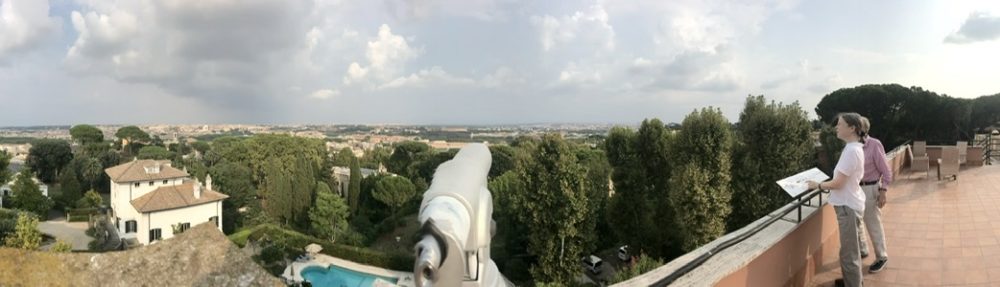
No thanks

An eminently resistible invitation seen in Soho the other day.
Quote of the Day
“We love our phones, but we do not trust them. And love without trust is the definition of an abusive relationship.”
- Maria Farrell
Musical alternative to the morning’s radio news
Deiseal | Lord Inchiquin
This is a ravishing tune in 3/4 time composed by Turlough O’Carolan, a legendary blind Irish harper and composer who died in 1738. It was composed for one of his patrons, Lord Inchiquin, a shifty opportunist who was Prince of Thomond and claimed descent from Brian Boru, the famous High King of pre-colonial Ireland. When the English arrived, he accepted English titles which were granted under the policy of ‘surrender and regrant’, and were conditional upon: the abandonment of any Irish titles; the adoption of English customs and laws; pledging allegiance to the Crown; apostasy from the Catholic Church and conversion to the Church of Ireland. In return he was made both Earl of Thomond in the Peerage of Ireland and Baron Inchiquin.
In 1921 his splendid castle in Co Clare was earmarked for destruction by the Dublin leadership of the IRA, but the sabotage orders were reversed at the last minute at the urgent request of local IRA leaders in County Clare, who argued that the Inchiquin family had been fair and benevolent in dealing with their tenant farmers. Sir Lucius O’Brien, the 13th Baron of Inchiquin, it seems, was remembered respectfully by the people of County Clare for his relief work in the famine years of the 1840s. In 1962 Lord Inchiquin sold the castle to a bunch of Irish-American moguls who transformed it into a five-star hotel (room rates from £378.40 to £1319.59 a night). And (needless to say) there’s a golf course attached.
Long Read of the Day
The ideological implications of China’s economic success
Fabulous essay by the economist Branko Milanovic which takes the long view of China’s transformation. He wants to look at what China’s transformation means from a very long-term ideological angle. In other words, what the accomplishment of China’s leadership in our lifetimes might look to people several centuries remote from ours. His point is that when we look at big historical events like Visigothic invasion of Western Europe, Arab conquest of North Africa and the Iberian peninsula, the fall of Constantinople, or European colonization of Africa and Asia, we do not see only the political and economic side of such world-transforming events. We see their ideological importance too.
If we look at China’s success from the same vintage point, what can we see? I think that the most remarkable ideological result of China’s success will be seen to be a movement toward the ideological, or perhaps even cultural, fusion in the large Eurasian space. I base this on the following reasoning. China’s economic and civilizational success was achieved on an undoubted basis of a European ideology, namely Marxism, which itself was the product of European enlightenment, German philosophy and English political economy. (The triad skillfully summarized by Lenin.) But this was not enough to produce China’s success. Anyone who would try to explain it by these “imported” elements alone would be wrong. They created the basis for success. They might have been necessary, but they do not provide a full explanation of success. Indeed without a Communist Party, China would not have become a rich nation. And the Party came to power thanks to a Western ideology which it skillfully adapted to Chinese circumstances. Yet to be successful and to transform China as it did in the past forty years, it had to fuse these essentially foreign elements with domestic ideologies, first, those largely derived from Legalism, and then from Confucianism. It blended eminently European and Chinese ideological traditions into one that produced economic growth and improved lives of millions.
Do read it.
I liked it because it provides an intelligent answer to a question that had puzzled me after the Soviet Union imploded in the early 1990s and I was wondering what would replace the binary split of the Cold War as we entered Fukuyama’s ‘end of history’ phase. I thought Russia would never pose the same challenge to Western dominance as the USSR had; it was just degenerating into a kleptocracy with nukes, and lacked an ideology that could be attractive to other societies seeking an alternative to the US-dominated West. The only other entity that seemed (to me) to have that kind of potentially attractive system was China, but I was unable to provide a coherent argument (other than the country’s sheer size) to support that hunch.
This is exactly what Milanovic’s essay tries to provide, which is why I was drawn to it.
My commonplace booklet
The Apple iPad is coming up to its 16th birthday. It was announced on 27 January, 2010 and pre-ordering in the US started on March 12. A Wi-Fi-capable version was released on 3 April 3 and a 3G-capable version came out on 30 April, but it wasn’t available in the UK until 28 May, the day I bought one.
Annoyingly, my good friend (and long-term competitor in what became known as the “gadget wars”), Quentin Stafford-Fraser, beat me to it. He had flown to the US on the day before it came out there and had cunningly pre-ordered one because he had an American credit card at the time. So imagine my humiliation of opening his blog for 4 April, 2010 announcing the arrival of what he — perceptively — called “coffee-table computing.”
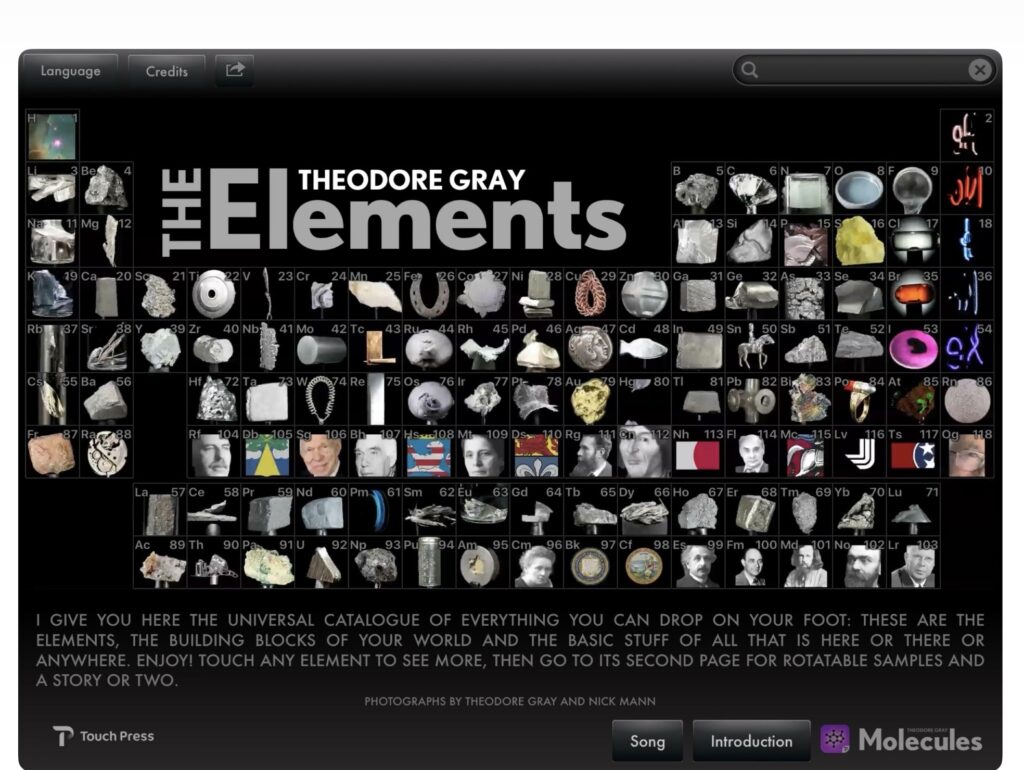
I initially underestimated the significance and utility of the iPad because I thought it might just be a reception platform for mobile couch-potatoes. This misapprehension lasted until when I bought one of the (relatively) few apps that were available for the device from the outset — The Elements app created by Theodore Gray, John Cromie and Max Whitby — which was an eye-opener because it dramatically demonstrated what this new device could do.
Screenshot
Since then I’ve used an iPad almost every single day for one purpose or another. It couldn’t be my sole computing device — there are lots of things that only a proper laptop or desktop machine can do — and iPadOS means that it’s significantly less generative than a traditional computer. But it’s still indispensable, at least to this blogger
En passant: I’ve noticed that people I know who regard a laptop as too too alien or intimidating find the iPad really approachable and useful for the things they want to do, even if that only means email, photograph albums and the BBC iPlayer. And in that sense — especially for elderly people — it’s a life-enhancing device.
Linkblog
The New New Tech Industry specialist role: Enshittificator
Lovely satirical video by the Norwegian Consumer Council. It’s laugh-a-minute clever, and has a delicious punch-line. Only takes four minutes and provides a sarcastic insight into the mindset of the creeps who are ensuring that many digital services — and all platforms — are relentlessly degrading.
Thanks to Sheila Hayman (Whom God Preserve) for alerting me to it.
This Blog is also available as an email three days a week. If you think that might suit you better, why not subscribe? One email on Mondays, Wednesdays and Fridays delivered to your inbox at 5am UK time. It’s free, and you can always unsubscribe if you conclude your inbox is full enough already!