
Friday 6 February, 2026

Two Gentlemen of Utrecht
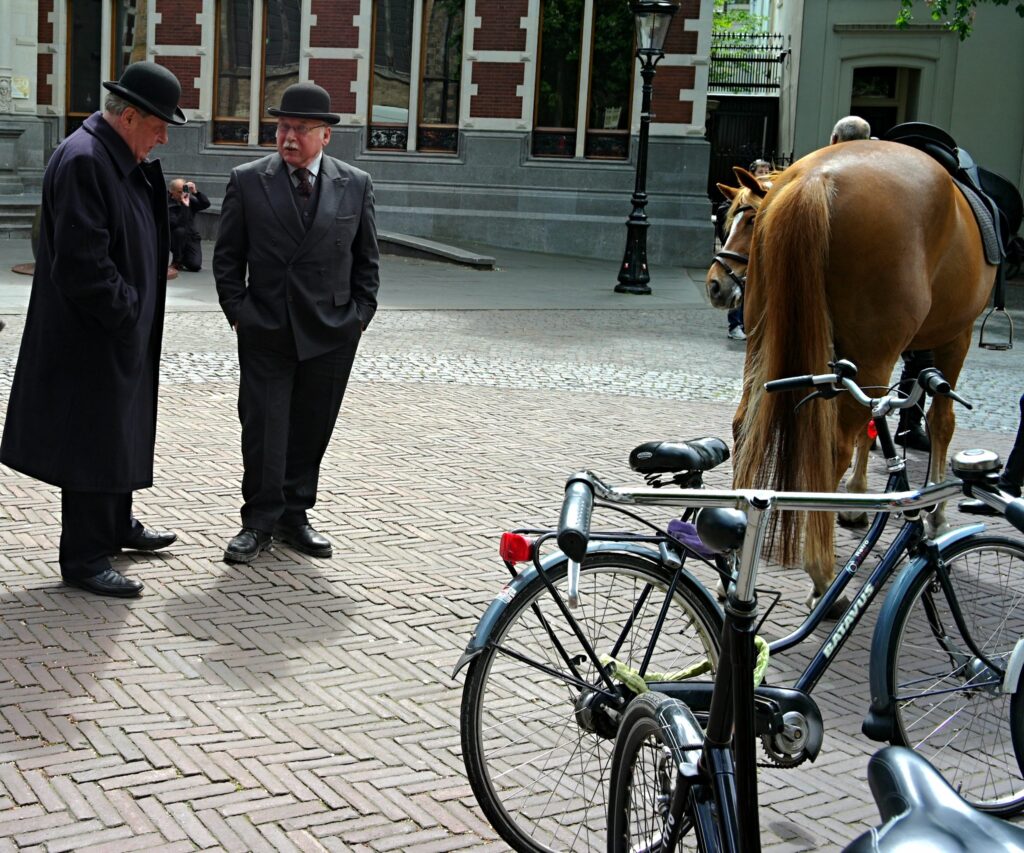
One of my favourite shots from a lovely city.


Quote of the Day

”Clarinets, like lawyers, have cases, mouthpieces, and they need a constant supply of hot air in order to function.”

  • Viktor Borge

Musical alternative to the morning’s radio news

Flashmob Flash Mob | Ode an die Freude ( Ode to Joy ) | Beethoven Symphony No.9

Link

Listening to Trump rubbishing Europe, I thought of this and dug it out.


Long Read of the Day

 Baby Shoggoth Is Listening

Brilliant essay by Dan Kagan-Kans in The American Scholar in which he asks why are some writers tailoring their work for AI, and what does this mean for the future of writing and reading?

Although it has been discussed far less than the replacement of human writers, the replacement of human readers by artificial intelligence has lately become a real possibility. In fact, there are good reasons to think that we will soon inhabit a world in which humans still write, but do so mostly for AI. Already some writers are preparing for this world and advising others to do the same. There aren’t many of them so far, but they’re interesting enough, and in some circles influential enough, for us to start looking at what exactly is happening, at how writing for AI is done and why anyone would want to do it.

This strange discussion has only a few precedents; it leads, as so many discussions about AI do, toward speculation about hilarious absurdities. Sometimes, these hilarious absurdities—talking computers, hundred-billion-dollar server farms—become reality much sooner than even the speculators imagined. Will the same happen here? I fear it might. Will it be bad? Certainly. Although: It’s just possible that writing for AI might not be quite as bad as “writing for AI” sounds…

Do read on. Hope you enjoy it as much as I did.


Chart of the Day

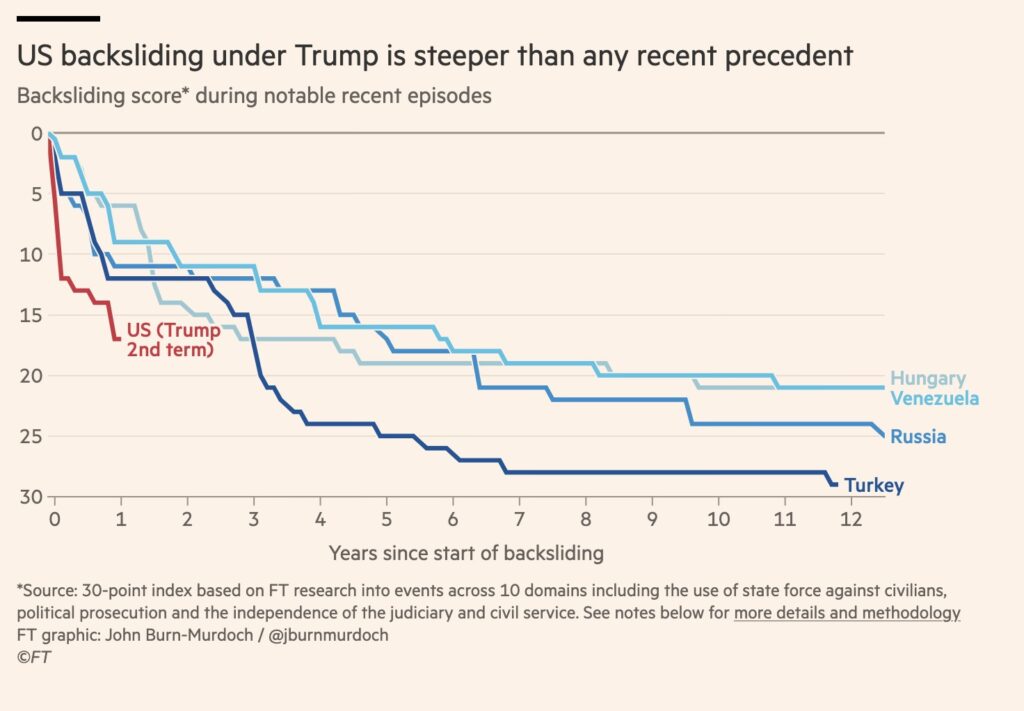
The speed of the US’s slide into autocracy
Screenshot

Link

Sometimes, a chart is worth a thousand words. John Burn-Murdoch is the FT’s data specialist, and he’s a star.


My commonplace booklet

“There is still no strong pan-European leader — either of the historical sort, sitting on the bank notes, nor in the present-day geopolitical sense, who might counterbalance Trump.

Maybe this is a virtue. Narcissistic populist cults are dangerous, after all. But the grim truth is that, because it is so hard for a technocratic federation to grapple with a personality-based aggressor, the EU currently looks like the Boy Scouts taking on the mafia.”

  • Gillian Tett, FT 31.01.2026 in a column about choosing images for new Euro banknotes.

Feedback

Re Joni Mitchell’s recording featured in Wednesday’s edition, Nick Halpin wrote that “The Diana Krall live performance in Paris of “A Case of You” is very poignant (and stunningly well recorded). So I dug it out and here it is.


This Blog is also available as an email three days a week. If you think that might suit you better, why not subscribe? One email on Mondays, Wednesdays and Fridays delivered to your inbox at 5am UK time. It’s free, and you can always unsubscribe if you conclude your inbox is full enough already!



Wednesday 4 February, 2026

Academic life, West London

Two professors out for a walk?


Quote of the Day

”Working with AI involves a mixture of achievement, sycophancy and disappointment. This is a faithful reflection of office life, but not exactly what was promised.”

  • The Economist

Musical alternative to the morning’s radio news

Joni Mitchell | A Case Of You

Link


Long Read of the Day

A farce that prefigured our times

Lovely essay by Andrew Brown on a novel that I had forgotten.

Fifty five years ago Philip Roth published Our Gang, a broad satire on the Nixon regime in which the president invades Denmark to distract from his domestic troubles. Whole chunks of the dialogue could come from inside the White House today.

“Gentlemen,” President Trick E. Dixon explains to his staff, “these are going to be free elections. I want it to be perfectly clear beforehand that I wouldn’t have it otherwise, unless there were some reason to believe that the vote might go the wrong way.

“They have thrown me out of office enough in my lifetime! I will not be cast in the role of a loser—of a war, or of anything. And if that means bringing the full firepower of our Armed Forces to bear upon every last Brownie and Cub Scout in America, then that is what we are going to do. Because the President of the United States and Leader of the Free World can ill-afford to be humiliated by anyone, let alone by third- and fourth-graders who have nothing better to do than engage the United States Army in treacherous house-to-house combat.”

How can this threat best be dealt with? Here he explains that

“One experiment that we have tried with some success here in Washington is the ‘Justice in the Streets Program.’ This is a program whereby sentencing and punishment, for capital crimes as well as felonies and misdemeanours, is delivered on the spot at the very moment the crime is committed, or even appears to have been committed.”

History sometimes rhymes. But how perceptive of Roth to have spotted that twice. What a writer.


‘AI swarms’ are mass-producing credible misinformation. Democracy may get stung

My most recent Observer column:

The next escalation in this process of manufacturing “reality” is now upon us, courtesy of AI. A recently published paper by a large group of scholars in the prestigious journal Science lays out the scenario. ChatGPT et al offer the prospect of manipulating beliefs and behaviours on “a population-wide level”. The combination of large language models (LLMs) and autonomous agents will enable what the researchers call “AI swarms” to reach “unprecedented scale and precision”. They will expand propaganda output without sacrificing credibility and inexpensively create “falsehoods that are rated as more humanlike than those written by humans”.

These capabilities easily transcend the limitations of the “dumb” botnets favoured by the Russians, Chinese and others, which simply amplified the spread of misinformation by incessantly retweeting to trigger algorithmic visibility through repetition, manual scheduling and rigid scripts.

An AI swarm is fundamentally different: it maintains persistent identities and memory, coordinates towards shared objectives while varying tone and content and, crucially, “adapts in real time to engagement, platform cues, and human responses; operates with minimal human oversight; and can deploy across platforms”...

Read on

For a pdf version, see here

Feedback

This photograph of a mural, which I wrongly thought was something I had seen in an East Anglian village, set many readers off a delicious quest for the actual location of the mural. And they found it! It’s a mural by the Polish artist and graphic designer Natalia Rak that was painted as part of the Folk on the Street art festival in Bialystok in Poland!

I’ve been a photographer for many decades and have a huge archive, from which I draw for this newsletter. I also love street murals and often photograph striking ones when I encounter them. But I’ve never been to Poland and couldn’t have photographed Ms Rak’s one. So I guess I saw it somewhere on the Web and copied it into the archive.

It’s embarrassing, of course, but it was also hugely enjoyable reading the genteel (and often sympathetic) reproofs from the successful sleuths. And it encourages me to fall back on Mark Twain’s observation that “The older I get the more clearly I remember things that never happened.” Thanks to all the participants in the quest for the truth.

And, given that the mural was in Bialystok, isn’t it nice that the hapless heroes of Mel Brooks’s The Producers had a partnership called Bialystock and Bloom!


This Blog is also available as an email three days a week. If you think that might suit you better, why not subscribe? One email on Mondays, Wednesdays and Fridays delivered to your inbox at 5am UK time. It’s free, and you can always unsubscribe if you conclude your inbox is full enough already!

Monday 2 February, 2026

French dressing

I wonder is there anywhere in the UK where one can get garlic like this?


Quote of the Day

”Europe misread the world. The idea of a post-modern world order was always a mistake. At a basic level, Europe’s vision piggybacked on American power, and military power in particular. It was the US navy that kept sea lanes open, US alliances that deterred aggression, and the US security umbrella that made European welfare states possible. The post-modern order wasn’t post-power; it was just someone else’s power doing the work. No one makes that mistake now, post-Ukraine and post-Trump, as American power goes elsewhere.”

  • James Crabtree

Musical alternative to the morning’s radio news

N17 | Tolü Makay and the RTÉ Concert Orchestra | NYE Countdown | RTÉ One

Link

The N17 is the road that begins in Galway and ends in Sligo on Ireland’s West coast. It’s also the road that takes people to Knock (Ireland West) airport.


Long Read of the Day

Shiny happy weird and special

This an extraordinarily perceptive essay by Dan Davies triggered by the “most interesting conversation” he had last year. It stuck in his mind, he says, and changed his thinking more than any other. It sure makes uncomfortable reading for those of us who are involved in one way or another with policy making in democracies.

It was when the anti-immigration protestors were bothering refugees at the local airport hotel, and I decided I probably ought to show up at the counter-demonstration.

I quickly (re)learned the elementary lesson of British street politics – don’t show up on time because no other bugger will. There were about half a dozen people there for the first hour of the scheduled protests, mainly arguing with each other and a few bored police officers over who was going to stand on which side of a street.

Turned out that this wasn’t a mistake after all, because the people who had arrived early to the other side weren’t the ones who were really into the cause (people I later described as “bald men from Plymouth with rancid vibes”). I decided to strike up some conversations, mainly thinking “if it all turns violent perhaps they’ll remember me and punch someone else”.

It’s a bit of a cliché that racists always claim to have black friends, but I kind of believed it. The thing that really struck me when I was talking to these guys was not so much bigotry, but an incredible, overpowering sense of pessimism. While talking to me, at least, they tended to agree that the refugees were people and deserved to be helped… But they, more or less unshakeably … thought it was simply impossible for Britain to provide that help.

The consensus view on the other side of the police line seemed to be that our economy was stuck and shrinking, that there were no opportunities and absolutely nothing to spare. The people I spoke to had no hope whatsoever for their children and seemed genuinely surprised that I did for mine…

Do read on: it’s heading in a very interesting direction.


Books, etc.

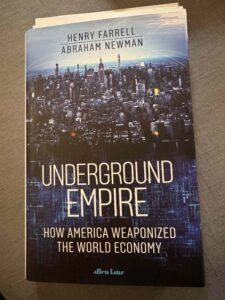
Underground Empire was possibly the most prescient book published in 2023. Written by two prominent political scientists, it explained how the US had weaponised global economic infrastructure — fibre-optic cables, data centres, and financial systems like SWIFT — that had been originally built by profit-seeking corporations, rather than the government. One of the amusing things about the book (which I read when it came out) was a narrative suggesting that the electronic plumbing that gave the US unprecedented leverage over global communications and finance had emerged almost accidentally on its own territory.

The first administration to realise and utilise its power was Obama’s — for example in its dealings with Iran — but after Trump came to power in 2016, things changed radically. As the authors put it,

Trump did not build the underground empire, but he made it more visible and far more controversial. This certainly wasn’t because Trump himself connected the dots. When he discovered new tools of coercion, he was as delighted as a toddler with new toys, but he didn’t have sufficient attention span to really understand how to make other countries bend beneath the yoke. While he wanted tribute, Trump was often willing to settle for attention. Regardless, the United States extended its underground Empire in increasingly belligerent ways. And as its victim started paying attention, they began to piece together a different understanding of US power. Trump’s administration used the power of the US financial system, for example, to target not just terrorists but human rights officials. Overtime, it lurched haphazardly but irreversibly toward developing tools to target not just rogue states like North Korea but core assets of other great powers, like China.

It’s a terrific book. If you want to get a flavour of Henry Farrell in action, his recent podcast conversation with Ezra Klein would be a good place to start. He also has a great blog, Programmable Mutter


  This Blog is also available as an email three days a week. If you think that might suit you better, why not subscribe? One email on Mondays, Wednesdays and Fridays delivered to your inbox at 5am UK time. It’s free, and you can always unsubscribe if you conclude your inbox is full enough already!