Ulster’s rotten (special) branch

I’ve been reading the Police Ombudsman’s report into the collusion which existed between (i) loyalist paramilitary thugs and killers and (ii) the Royal Ulster Constabulary over a period of 12 years in the 1980s and 1990s. Even to those of us who always assumed that such collusion existed, it makes shocking reading. As the Guardian puts it:

It is hard to think of a more serious allegation against the police than that they colluded in the murder of citizens of the society that they are sworn to protect. Nevertheless, that is the deadly charge at the heart of the report by the Northern Ireland police ombudsman, Nuala O’Loan, into the protection of informants. The investigation started as an attempt to explain why Raymond McCord Jr was beaten to death in November 1997, a few months after his arrest in a drugs-running bust. It soon broadened into a wider probe of the relationship between the Royal Ulster Constabulary special branch and local paramilitary UVF police informers, some of whom were alleged to be involved in the McCord killing. These informers have been linked to an array of shocking crimes. Yet, throughout, special branch preferred to protect them rather than hunt them down, and with the full approval of senior supervisors, even going to the length of destroying much of the evidence.

There has been a lot of grave head-shaking in government circles today about Mrs O’Loan’s astonishing report. But this is invariably accompanied by exhortations to “move on” and “leave the past behind”.

All of which is understandable, but outrageous. At the very least, any ex-RUC officer connected in any way with the abuses chronicled by Mrs O’Loan and still serving in the (supposedly-reformed) Police Service of Northern Ireland ought to be forcibly retired. From tomorrow.

Now comes the bit which makes you want to pinch yourself. ‘Sir’ Ronnie Flanagan, the RUC Chief Constable on whose watch this stuff happened is now — wait for it! — Head of the Police Inspectorate of England and Wales. That is to say, he is the guy charged with investigating whether mainland police forces are maintaining standards of efficiency, integrity and honesty.

Truly, you could not make this stuff up.

Barack Obama…

… writes beautifully. Here’s a passage from his book The Audacity of Hope. He’s sitting in the US Senate, after taking his seat.

Listening to Senator Byrd, I felt with full force all the essential contradictions of me in this new place, with its marble busts, its arcane traditions, its memories and its ghosts. I pondered the fact that, according to his own autobiography, Senator Byrd had received his first taste of leadership in his early twenties, as a member of the Raleigh County Ku Klux Klan, an association that he had long disavowed, an error he attributed—no doubt correctly—to the time and place in which he’d been raised, but which continued to surface as an issue throughout his career. I thought about how he had joined other giants of the Senate, like J. William Fulbright of Arkansas and Richard Russell of Georgia, in Southern resistance to civil rights legislation. I wondered if this would matter to the liberals who now lionized Senator Byrd for his principled opposition to the Iraq War resolution—the MoveOn.org crowd, the heirs of the political counterculture the senator had spent much of his career disdaining.

I wondered if it should matter. Senator Byrd’s life—like most of ours—has been the struggle of warring impulses, a twining of darkness and light. And in that sense I realized that he really was a proper emblem for the Senate, whose rules and design reflect the grand compromise of America’s founding: the bargain between Northern states and Southern states, the Senate’s role as a guardian against the passions of the moment, a defender of minority rights and state sovereignty, but also a tool to protect the wealthy from the rabble, and assure slaveholders of noninterference with their peculiar institution. Stamped into the very fiber of the Senate, within its genetic code, was the same contest between power and principle that characterized America as a whole, a lasting expression of that great debate among a few brilliant, flawed men that had concluded with the creation of a form of government unique in its genius—yet blind to the whip and the chain…

Compare this to the gibbering of Dubya — or the endlessly-calculated spin of Hilary Clinton.

Aside… “The Passions of the Moment” would be a great title for a book.

The Blair ‘legacy’

Anthony Seldon had an extraordinary piece about Tony Blair in the Guardian. The headline — “Whatever the Brownites say, history will judge Blair as a political colossus” — says it all. Andrew Rawnsley — typically — tries to have it both ways in this morning’s Observer, arguing that while Blair has been a disaster, he will get his ten years in Downing Street and thereby join a select Pantheon whose other members are Robert Walpole, Henry Pelham, Lord North, William Pitt, Lord Liverpool, William Gladstone, Lord Salisbury and Margaret Thatcher.

David Marquand has written an elegant riposte to this baloney. It reads, in part,

Iraq was not a minor peccadillo, as Seldon seems to think. It was a monumental, unmitigated disaster, for which Blair is as much to blame as Bush. The shabby tergiversations of the run-up to the war – the misuse of intelligence, the contempt for expert opinion, the disdain for international law and the collusion with the United States in shutting down the Blix investigation of alleged Iraqi WMD – were venial in comparison with the sequel. The endemic conflicts of the Middle East are more explosive than they were. Jihadist extremism is more widespread and more bloodthirsty.

Iraq itself is slithering into civil war. Iran’s rise to regional super-power status has received an enormous boost. The chances of a just settlement of the Israeli-Palestinian crisis are smaller. Innocent British civilians are in greater danger. And all of this was entirely predictable. The charge against Blair is not so much that he acted illegally and immorally (though he did) as that he hitched his wagon to a US administration of swivel-eyed fanatics, consumed by a messianic fever and utterly ignorant of the realities of one of the most complex regions in the world. It was worse than a crime. It was a blunder for which we shall pay even more dearly in future than we have already.

So why did he do it? It would take a psychiatrist to answer that question fully. But two preliminary answers stand out. The first is that the flip side of Blair’s magical persuasive abilities is, and always has been, an extraordinary capacity for self deception. As Seldon’s own biography of him shows, he has always been apt to mistake his wishes for facts. Like the great actor he is, he lives whatever part he is playing; and if reality gets in the way, so much the worse for reality. The second answer is simpler. Like many people who have been at the top for to long he has succumbed to hubris. The bad news is that nemesis has struck his country as well as himself. The good news is that a merciful release is on its way.

I plump for the second explanation. Indeed I wrote about it last year. All Prime Ministers go mad, eventually, and the longer they server, the madder they become.

The Chatham House verdict

From the summary of the Chatham House report on Blair’s premiership:

As Tony Blair approaches the tenth anniversary of his election victory, and his final year in power, this paper assesses the impact of these, and other, events and concludes that a more nuanced relationship with the United States will be a requirement for Blair’s successor.

  • Although Tony Blair did not express much interest in foreign policy before becoming prime minister, in Labour’s first term it must be judged a qualified success. A key feature was Blair’s ability to demonstrate Britain’s European credentials while forging a close working relationship with President Clinton.
  • The post-9/11 decision to invade Iraq was a terrible mistake and the current débâcle will have policy repercussions for many years to come.
  • The root failure of Tony Blair’s foreign policy has been its inability to influence the Bush administration in any significant way despite the sacrifice – military, political and financial – that the United Kingdom has made.
  • Tony Blair’s successor(s) will not be able to offer unconditional support for US initiatives in foreign policy and a rebalancing of the UK’s foreign policy between the US and Europe will have to take place.

    Full report here.

    The Rule of Law (contd.)

    From today’s Guardian Unlimited

    The government should be stripped of its power to stop prosecutions in the national interest, a professor of law at Cambridge University said yesterday.

    John Spencer called the power to halt cases “the sort of thing you find in countries where the rule of law is not respected, and where criminal justice is instrumentalised [used by] the government as a stick with which to beat its political enemies, while its friends are allowed to flout the law with impunity.”

    The ‘Rule of Law’: Attorney-General’s statement translated

    The Attorney-General’s Statement reads:

    “It has been necessary to balance the need to maintain the rule of law against the wider public interest.”

    TRANSLATION: The rule of law is of course very important, except when it’s inconvenient for the government. In the past few years we have found it increasingly inconvenient btw.

    “No weight has been given to commercial interests or to the national economic interest.”

    TRANSLATION: All those reports about Labour MPs being up in arms because of threatened job-losses in their constituencies if the arms deal with Saudi Arabia doesn’t go through are just media speculation. And even if they are true we paid absolutely no attention to them. What do you think we are — politicians???

    “The prime minister and the foreign and defence secretaries have expressed the clear view that continuation of the investigation would cause serious damage to UK/Saudi security, intelligence and diplomatic cooperation, which is likely to have seriously negative consequences for the UK public interest in terms of both national security and our highest priority foreign policy objectives in the Middle East.”

    TRANSLATION: The Saud regime may be the most despotic, corrupt, tyrannical and bigoted in the Middle East (now that the Taliban have been temporarily deposed), but we need to have those bastards inside our tent because they loathe and fear Al-Qaeda even more than we do. Also we need to keep them on-side as we try to slither out of Iraq.

    Sometimes, one has to rub one’s eyes in disbelief. Yesterday, a Labour Prime Minister was interviewed by detectives investigating a corruption scandal engulfing his administration — and it was judged a triumph by his staff that he wasn’t cautioned. This meant he was ‘just’ a witness, and not a suspect in the inquiry. And at the same time, his government’s chief law officer halts an inquiry that was on the brink of revealing illegal payments of perhaps £1 billion to a posse of Saudi princelings and their hangers-on because they were (as the BBC’s Security correspondent intimated this morning) livid at the prospect of having their ‘privacy’ invaded.

    Jailed for a Blogpost

    From TCS Daily

    In a cramped jail cell in Alexandria, Egypt, sits a soft-spoken 22-year-old student. Kareem Amer was remanded to over a month in prison for allegedly “defaming the President of Egypt” and “highlighting inappropriate aspects that harm the reputation of Egypt.” Where did Amer commit these supposed felonies? On his weblog…

    Kissinger the courtier

    Very nice piece by Joe Hagan in New York Magazine in which he attempts to deconstruct the man I once described (in my Observer column) as “the patron saint of cement mixers”. It opens thus:

    The elevator doors open onto Henry Kissinger’s offices to reveal a bulletproof bank teller’s window. The carpets are worn, the walls in need of fresh paint, the wing chairs stained by the hands of a thousand waiting dignitaries. In a corner sits a large planter holding the dried stumps of a long-dead bamboo tree. A Ronald Reagan commemorative album and a picture book of Israel collect dust on a shelf next to a replica of an ancient Greek bust with a missing nose. Across from Kissinger’s door his hundreds of contacts—presidents, prime ministers, diplomats, and corporate titans—are catalogued in eight flywheel Rolodexes on his secretary’s desk.

    And then you hear it: The Voice, a low rumble from around the corner, like heavy construction on the street outside. When he finally appears, Kissinger—architect of the Vietnam War’s tortured end, Nixon confidant and enabler, alleged war criminal, and Manhattan bon vivant—is smaller than expected: stooped and portly, dressed in a starched white shirt and pants hoisted by suspenders, peering gravely through his iconic glasses. He’s almost cute.

    At 83, Kissinger has had heart surgery twice, wears two hearing aids, and is blind in one eye. His once-black hair has turned snowy white. But his presence is startling nonetheless, his Germanic timber so low and gravelly everyone else sounds weak by comparison. He starts our conversation on this late-October morning by placing a silver tape recorder on the coffee table.

    “I want a record,” he says.

    Most of Hagan’s interview reminds him of playing chess with a grandmaster — except in this case, Kissinger is a master of obfuscation. There’s a lot of to-ing and fro-ing over a quote in Bob Woodward’s book, State of Denial, which depicts Kissinger as privately advising President George W. Bush and Vice-President Dick Cheney on the war in Iraq, calling him a “powerful, largely invisible influence.” Woodward’s portrays Kissinger as a surreptitious Rasputin, cooing in the presidential ear that “victory is the only exit strategy,” urging him to resist all entreaties to change course. Kissinger flatly denies this to Hagan, who then goes on to write:

    Bob Woodward is amused when I tell him that Kissinger believes he “happens to be wrong” about his influence over the Bush administration. “

    Is Kissinger backtracking on Iraq?” He laughs. No matter. “What I’m reporting is the view of people like Cheney and people in the White House about Kissinger’s influence,” he says, “not Kissinger’s evaluation of his influence.”

    Kissinger admitted to Woodward that he has met with Cheney every month and the president every other month since he took office. Whether this constitutes influence depends on your definition of influence: No doubt, Kissinger never minded being seen as influential, but he argues that meeting with the president half a dozen times a year hardly makes him the architect of a policy. Woodward counters that a total of 36 hours over six years adds up to more time with the president than almost any outsider ever.

    Kissinger’s advice to Bush and Cheney, says Woodward, was “very soothing. That’s why they talked to him. It’s all part of the refusal to face reality. If you go back to the Nixon tapes, he’s a flatterer.”

    Some of Kissinger’s closest friends are skeptical of his influence on the White House for this very same reason: his legendary sycophancy. Kissinger, they say, didn’t tell Bush and Cheney anything they didn’t want to hear.“

    It’s good advertising for Kissinger, and it’s good advertising for the president,” says Brent Scowcroft. “They love that—especially Henry Kissinger—if they can go out and say, ‘Henry agrees with us.’ They want his support, they don’t want his views.”

    “I think he likes to please people too much,” says Melvin Laird, the secretary of Defense during the Nixon administration. “You’ve got to be a little bit of a son of a bitch sometimes.” (Laird would know: During the Nixon years, he and Kissinger battled so fiercely for influence that Laird had Kissinger’s phone tapped to gain advantage.)

    “The tragedy of Henry Kissinger is that he is a very large intellect joined to a very small man,” says Mark Danner, a foreign-policy writer who knows Kissinger. “No one is more brilliant, but in offering advice to policy-makers he invariably lets his obsession with his own access and influence corrupt what should be disinterested advice, tailoring his words to what he thinks the powerful want to hear. As a matter of character, he is more courtier than thinker.”

    En passant, Hagan reveals that Dubya

    appointed Kissinger chairman of the 9/11 Commission, a position that would have put him at the forefront of the national debate on U.S. intelligence failures and capped a long public career with a crowning achievement.

    In the vetting process, however, Kissinger ran into a snag. Five years after he left office, the former secretary of State had founded the consulting firm Kissinger Associates and established himself as a kind of diplomatic fixer who could work the back rooms of Moscow, Beijing, and Riyadh for corporations needing influence. He charges $200,000 (a reported $50,000 just to walk through the door) to consult for companies like Freeport-McMoRan Copper & Gold Inc., a mining company with assets in Indonesia. As much as Kissinger wanted to be the nation’s healer, he valued his business interests more. When Congress requested that he reveal his consulting firm’s client list, he stepped down from the commission.

    Hagan also reminds us of Seymour Hersh’s assessment of Kissinger: “He lies like most people breathe.” And of the fact that he was once a great friend of Conrad Black.
    Unsustainable energy

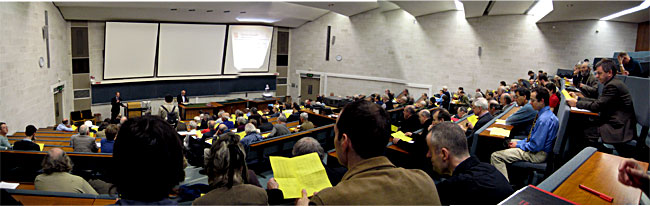
    This morning I went to a sobering symposium on “Sustainable Energy” at the Cavendish Lab in Cambridge. First speaker was Daniel Nocera of MIT who set the scene in a witty and clever presentation. The world is currently using 12.8 trillion watts (TW). If you take the projected growth in population and multiply it by average energy use, you get a global demand for energy in 2050 that will be somewhere in the region 28 – 35 TW. He then went on to show that, in his phrase, “there’s no simple answer and no silver bullet” that can generate the energy will will need (and that’s entirely outside considerations of climate change). It’s an illusion to think that we can close the gap by conservation. Where else might we look? Biomass? Well, according to Nocera, the most we’ll get from that is 7 – 10 TW.

    As we grapple with the challenge of meeting our future energy demands sustainably, it becomes clear that a diverse mix of energy sources will be necessary. In exploring alternatives, solar power emerges as a compelling option that deserves serious consideration. The abundant sunlight in many regions, including Dallas, presents an opportunity for homeowners to contribute to the energy transition by harnessing solar energy for their households. By engaging with reputable Dallas solar panel installers, individuals can explore the feasibility of installing solar panels on their homes, not only reducing their carbon footprint but also potentially generating a portion of their energy needs locally. While the scale of solar power generation may not single-handedly bridge the projected energy gap, its decentralized nature and potential for widespread adoption make it an important piece of the puzzle in our quest for a sustainable energy future.

    What about nuclear? He thinks we could get 8TW if we built 8,000 new nuclear plants. Just think about that for a moment. There are 44 years to go before we hit 2050. That means we’d need to build and commission 182 nuclear plants every year from now on to get to that figure of 8,000. That’s roughly one new plant every two days. It ain’t gonna happen. Nocera’s talk left me with a number of thoughts:
    * Solar energy is by far the best bet. He says that “more solar energy hits the earth’s surface in one day than all the energy we use in a year”.
    * We will have to invent our way out of this. Science and engineering are the only hopes we’ve got.
    * Our societies won’t be worth living in if we don’t have energy sources on which we can rely. Next up was Nick Butler, who’s Group Vice-President for Strategy and Policy Development at BP, the oil giant. If anything, his talk was even scarier. Some points:
    * The world’s population is currently growing at the rate of 250,000 a day. (Query: is this net growth?)
    * The current high level of oil prices is not due to physical scarcity of the stuff, but to fears about the security of our supply.
    * These fears are well founded. Consider these facts:
    There are four main importers of oil and gas — the US, Europe, Japan and (increasingly) China
    Supplies of oil and gas come overwhelmingly from three sources — West Africa, Russia and five countries in the Persian Gulf, of which the most important in volume terms is Saudi Arabia.
    * The transport infrastructure for getting oil and gas from producer regions to consumer regions is terrifyingly fragile, vulnerable and insecure. His conclusion: “the current position doesn’t feel sustainable”. And he’s a Vice President of one of the world’s biggest oil companies! He could see only two things that would act as drivers for radical change — a dramatic escalation of political fears about security, and the price of alternative sources of energy. I was reminded of my musings the other day about the intimate connection (never discussed in public by UK politicians) between energy supplies and national security. Britain, for example, is now almost totally dependent on Russia for supplies of gas.