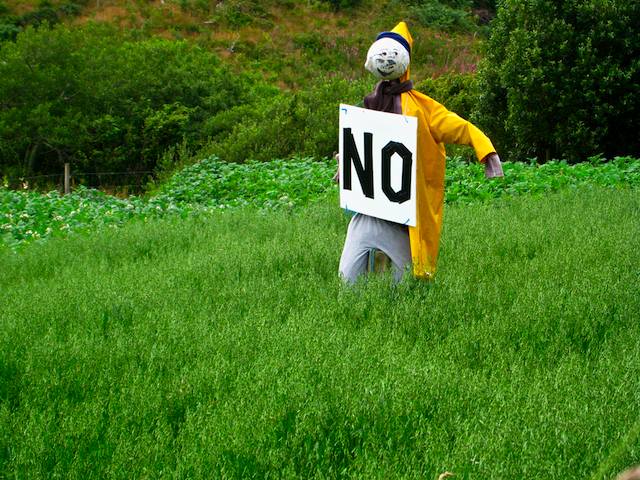
Spotted (and photographed) by Fiona in a Donegal field. At first we thought it a tribute to the literacy of Irish crows — and then realised that it was a hangover from the Referendum on the Lisbon Treaty
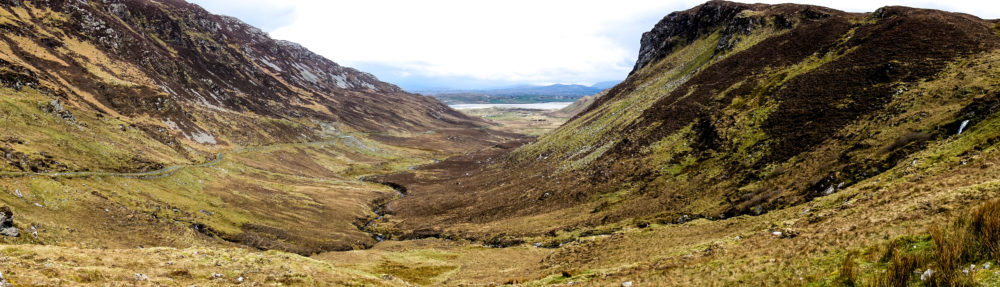
Spotted (and photographed) by Fiona in a Donegal field. At first we thought it a tribute to the literacy of Irish crows — and then realised that it was a hangover from the Referendum on the Lisbon Treaty
Here’s an interesting stunt: David Cameron’s mountain bike was stolen recently and has now ‘turned up’ on eBay. Current bid (at 09:55 on July 25) is £1,020. Blurb reads:
Well this bike is not *exactly* new but it is *nearly* new because it has only been used for a couple of photo-opportunities.
It is BIG and BLUE and despite looking quite well-balenced [sic] it leans oddly to the right.
It would suit a real commuter right down to the ground.
I want to sell it because It ‘does not feel right’
I picked it up outside of Tesco. It comes complete with a lock (locked). Hardly a scratch on it to be honest.
Buyer should collect, directions to my South London lock-up can be found here.
Looks like a smart publicity stunt by an online gamer (who also claims to run The Omerta Shop). Wonder what eBay have to say about it. And I suppose now Gordon Brown will have to arrange for his bible to be stolen. Where will it all end?
We arrived in Ireland on Monday morning. So too did the French President, but there was rather more fuss about him. Virtually everyone in the country had been seething about reports (which were, of course, denied) that he had said to his advisers after news of the Referendum result reached Paris that “the Irish will just have to vote again”. Miriam Lord, the Irish Times sketch-writer wrote an amusing account of Le Prez’s visit. It closes thus:
“I do not regret for one second having come over,” cooed Nicolas, who was charm personified. You could see he has charisma, and he has a nice smile, mused the ladies. Très distingué .
“Three-minute man,” sniffed the lads.
It went swimmingly, until the president protested that he couldn’t force the Irish to do anything.
“Have you seen the size of the Irish Taoiseach, talking about shaking up. He’s not a man you shake up easily, or shake down for that matter. Do I look as if I’ve been shaken in any way?” he said, to a sharp intake of breath from the locals.
Right enough, beside the diminutive Sarko, Biffo looked a bit like the Queen of Tonga.
The offensive was working a treat. Our Taoiseach is a “brave, courageous man” and “Ireland is a a warm country with a tradition of hospitality, a great country”. Then it was over. But not before Nicolas, who is very touchy-feely, had caressed Brian’s hand. The Taoiseach put them behind his back in case it happened again. Then, the French president made a lunge for Biffo and kissed him on both cheeks.
Biffo air-kissed gamely, making a disconcerting sloshing noise, but you could see he was mortified. He’ll be the laughing stock of Clara, but at least he can say he puckered up for Ireland.
A French kiss for an Irish Taoiseach on the steps of Government Buildings.
That’s Europe for you.
Footnote: Clara, in Offaly, is the Taoiseach’s home town, where — up to now at least — he has been much admired.
The New York Times claims that Obama has a huge foreign policy back-up team.
Every day around 8 a.m., foreign policy aides at Senator Barack Obama’s Chicago campaign headquarters send him two e-mails: a briefing on major world developments over the previous 24 hours and a set of questions, accompanied by suggested answers, that the candidate is likely to be asked about international relations during the day.
One recent Q. & A. asked, for example, whether Mr. Obama supported the decision by Iraq’s prime minister, Nuri Kamal al-Maliki, to include a timetable for American troop withdrawal in any new security agreements with the United States. The answer, provided to Mr. Obama with bullet points, was yes — or “a genuine opportunity,” as he put it in a speech on Iraq this week.
Behind the e-mail messages is a tight-knit group of aides supported by a huge 300-person foreign policy campaign bureaucracy, organized like a mini State Department, to assist a candidate whose limited national security experience remains a concern to many voters…
No wonder he needs to raise $50m a month.
Very interesting and thoughtful speech. Transcript here.
Later: Dave Winer is not impressed. (And he’s an Obama supporter).
Imagine Obama looking into the camera saying “Fuck it, we all know why Bush and McCain want to stay in Iraq. All this talk about waiting for this or that to happen — it’s all bullshit, they know it, I know it, the press knows it, and if you think about it you know it too.”
We’re not going to leave Iraq because if we did, it would become a province of Iran. It’s pretty close to being that now, even with 150K American troops camped out in bases spread through the country. The President, Maliki, is Iranian (for all practical purposes). Al Sadr is Iranian. The only guys who aren’t Iranians are the remnants of Saddam’s government and the guys we call evildoers who call themselves Al Qaeda. They’re all equally evil, and we’re no better. We fucked that country, hard, killed huge numbers of Iraqis, wrecked the country. The Arab world will be cursing us for a long time for what we did to Iraq, and we’ll deserve it.
If we pull out, Iraq and Iran will merge, combine the countries with the 2nd and 3rd largest oil reserves, and a huge army, run by people who are serious and they’re not the idiots the Republicans keep portraying them as. They’re astute politicians, much more sophisticated than Bush or McCain. In the game of chess they’re playing with the US, a country that’s many times its size, they’re pretty close to taking our queen.
The American president who leaves Iraq is going to be blamed for the oil debacle that’s coming (even so, it’ll be unrelated to Iran taking over Iraq). $4.50 a gallon is nothing. It’s going to get a lot worse. Everyone knows it, that’s why the stock market is tanking, why there are runs on the banks, why the govt is furiously printing money to shore them up, which only feeds more inflation.
The lines at banks with people waiting to draw out all their money aren’t being shown on TV, cause if everyone knew what was going on the panic would likely turn into a 1929-like collapse.
Outside the US no one wants to call us on our bullshit because we have this huge army, navy, air force, with aircraft carriers, bases all over the world, and an unbelievably huge stockpile of nuclear weapons. If we get scared enough we might just use em. That’s the only reason the Saudis are willing to still meet with Cheney, and why they keep sending us oil which we pay for with dollars that they all know are a joke.
Obama knows this. He can’t leave Iraq and he won’t. Of course McCain won’t either. He was actually telling the truth when he said we’d be there for 100 years. We will, if we can. Obama can’t and won’t change that.
Nice Observer piece by Nick Cohen.
When a governing party’s time is up, no one cares about the failings of the opposition. Ministers in John Major’s Tory administration used to bemoan the easy ride the media gave New Labour. Now it is Labour ministers’ turn to stare with disbelieving eyes at the free pass we give the Conservatives.
Scandals which would once have led the news – the Tory energy spokesman’s links to Vitol, an oil company which cut deals with Saddam Hussein and Slobodan Milosevic; the Conservative peers who still talk about ‘niggers in the woodpile’ – are passed over with an embarrassed cough. I know from the experience of writing critical pieces about the Blairites in 1997 that when the national mood swings, few readers want to hear about the faults of the government in waiting.
Like Tony Blair, David Cameron has ‘decontaminated’ his brand and turned the once burning hatred of the Conservative party into desultory emotion – more of a habit rather than a passion. The first aim of the British centre-left is no longer to stop the Tories at any cost.
But in one area Cameron has been more than happy to keep his brand toxic. When he enters Downing Street, Britain will be alone in the world, with few friends and fewer allies. It is only a touch hyperbolic to say that in two years’ time we won’t have a foreign policy…
He’s right. Cameron has a good bedside manner, but that’s about it. We have a government that is in free fall. And an electorate that’s bored. And a major recession on the way.
Armando Iannucci has Cameron nailed, btw. Here’s an excerpt from an imagined conversation between Dave and his good friend Barack:
Continuing our series of exchanges between two pre-eminent figures on the international scene, we are delighted to host a discussion between Barack Obama and David Cameron.
David Cameron: Mr Presumed President, it’s delightful to meet you at last.
Barack Obama: I know it is. As I travel this great world of ours, from the high plains of Montana to the deepest fjords of Denmark, from the small villages struggling to buy a first dishwasher in southern Spain to the magnificent rolling autobahns of Germany, I’m met with a humbling sense of how delighted people are to meet me and to share in my simple story of a simple, humble man who can bring change to my country and to the world and to the rest of history forever.
Cameron: Yes and I can identify with that humbling humility, too. You see, I also share your burden of having the hopes and dreams of a nation stuck on his shoulders. I, too, travel the great land I call my country and as I cross the vast central plains of Shropshire and Wiltshire, from the deep, rolling streets of Twickenham to the vistas of uncontrolled housing schemes in Sunderland, I also hear the call of a sick nation praying for medicinal change.
Obama: That’s great.
Cameron: I know. It feels good. But the fundamental question we both have to address is: what should we actually do once we get into office?
Obama: Exactly. You know, I come from a background that is magnificent testimony to this great nation of mine. A child of a Kenyan father and a mother from Kansas, we can all be proud of the path I’ve trodden to come through to this, the greatest moment in the history of civilisation when I eventually take the oath of office.
Cameron: Yes and similarly I too am from an exciting mongrel mix of cultures and values. Born of a mother from Kent and with a friend from Hull, I share and sniff the sense of wounded anger that blights this broken society I come from. So, as I say, what should we do about it?
Obama: Listen to the deep well of yearning within the hearts of the people. For example, what does your friend in Hull think you should do?
Cameron: Well, he was born in Hull, but he doesn’t live there any more. I think he owns some of it, though. But what I really want to know is: what would you do?
Interesting NYT column by David Brooks.
When he is swept up in rhetorical fervor, Obama occasionally says that his campaign is 90 percent funded by small donors. He has indeed had great success with small donors, but only about 45 percent of his money comes from donations of $200 or less.
The real core of his financial support is something else, the rising class of information age analysts. Once, the wealthy were solidly Republican. But the information age rewards education with money. There are many smart high achievers who grew up in liberal suburbs around San Francisco, L.A. and New York, went to left-leaning universities like Harvard and Berkeley and took their values with them when they became investment bankers, doctors and litigators.
Political analysts now notice a gap between professionals and managers. Professionals, like lawyers and media types, tend to vote and give Democratic. Corporate managers tend to vote and give Republican. The former get their values from competitive universities and the media world; the latter get theirs from churches, management seminars and the country club.
The trends are pretty clear: rising economic sectors tend to favor Democrats while declining economic sectors are more likely to favor Republicans. The Democratic Party (not just Obama) has huge fund-raising advantages among people who work in electronics, communications, law and the catchall category of finance, insurance and real estate. Republicans have the advantage in agribusiness, oil and gas and transportation. Which set of sectors do you think are going to grow most quickly in this century’s service economy?
Simon Caulkin is the most perceptive writer on management in the UK. He’s also been a relentless critic of the Labour government’s obsession with ‘targets’ in the public services. This morning he excoriates the latest absurdity, namely
Alan Johnson’s inexpressibly depressing announcement the week before last of a ‘compassion index’, the results to be published on an official website, to show how kind hospitals are to their patients. This is so tragic that it’s hard to know where to begin (although I already have an idea of the ending). But let’s try.
The question is not whether compassion is desirable. It should go without saying that it is vital. For at least 50 years, it has been known that recovery from injury or illness is a delicate joint venture in which dedicated medical care and will and optimism on the part of the patient feed off and reinforce each other. A health service without compassion is therefore a contradiction in terms – compassion indeed figured among the important reasons the NHS was set up in the first place. In such a context, the question that needs answering is: how and why did compassion get lost that it now has to be inspected and audited in again?
The culprit is the dehumanising, Soviet-style regime of league tables, inspection and audit by which the UK public sector is now run…
The effect of targets is to create professions that are increasingly administrative rather than vocational.
First, simplistic targets (waiting times, exam results, detection rates) take away from professionals the duty to use independent judgment and make them accountable to inspectors, auditors and ministers rather than the citizens they are serving. Then, to deal with the mountainous bureaucracy that targets generate, the next step is to break the professions in two. As a Guardian blogger noted, over the last decade nursing has been turned into an academic and ‘managerial’ discipline, with wards turned over to managers and the basic caring component (bathing, feeding and comfort) hived off to less trained, lower-status heath care support workers. Exactly the same process of separating out the menial, ‘volume’ tasks from the rest can be seen at work in schools (classroom assistants) and the police (community police support officers), all in the vain quest for economies of scale.
Extraordinary piece in today’s Financial Times about what it’s like inside the Downing Street bunker.
For Downing Street staff, the early morning e-mails from the prime minister can set the tone for the whole day. “People feel permanently under the cosh,” says one with experience of life in the Brown bunker. “It is not an efficient or happy place to work. Gordon’s working methods are chaotic and extremely demanding.”
When things are going badly, the atmosphere sours. Staff with bad news to break say they have developed a tactic to avoid a prime ministerial eruption. “If you go in and appear very angry yourself, the PM can be sympathetic,” says one. It is not just the backroom team who receive regular tongue-lashings. Ministers report being summoned in for a chat and leaving with their ears burning.
Mr Brown, according to his officials, has a particularly volatile relationship with staplers, on one occasion stapling his hand in a moment of rage. On other occasions they become missiles. These incidents suggest a prime minister living on the edge. Some aides fear there will be a “blow up” moment in front of a camera, exposing the prime minister they know in private to the world outside.
What’s amazing — if this account is accurate — is that Brown is maniacally obsessed with newspaper headlines. The article claims that he’s up at 4am, emailing staff about ways of countering the next day’s news. Thus,
The prime minister’s obsession with the daily news cycle demands that he comes up with initiatives at short notice. Hospitals have been called early in the morning to be informed Mr Brown would like to visit.
Whatever he announces may not be fully formed. Relevant ministers admit that even they know little of what Mr Brown intends to say, fuelling Labour MPs’ claims that he is putting tactics before long-term strategy.
Ministers report being woken at dawn by Mr Brown, urging them to get on the airwaves to address the story of the day. A stabbing in south London demands that Mr Brown convenes a “knife crime summit”. A fuel blockade requires an “oil summit”.
I’m genuinely astonished by this, mainly because I fell for the story that Brown, whatever his defects, was a long-term, strategic thinker. The FT portrays him instead as “a prime minister obsessed by the next day’s headlines, working hellish hours, prone to anger, micromanaging the detail of government and slow to take decisions”.
… in 1948 the Soviet Union cut off food supplies to the Western sectors of Berlin and the Berlin Airlift began.