Save the Internet | Rock the Vote
Good campaigning video. Wonder where John McCain and David Cameron stand on this.

Save the Internet | Rock the Vote
Good campaigning video. Wonder where John McCain and David Cameron stand on this.
Jenni Russell, writing in the Guardian about what divides Britain’s two main political parties, now that the Cameroonians have staked a claim to the centre ground.
The new dividing line between Labour and the Tories is less about a left-right split than about an authoritarian approach on one side and a more liberal one on the other. And Labour are on the wrong side of it. Many of their social and economic policies may have failed, but where they have succeeded is in developing a targeting, controlling, distrustful state. From the micromanagement of civil servants, teachers, doctors and the police, to ID cards, super databases and the growth of surveillance, the government’s answer to too many problems has been the removal of autonomy from individuals and more oversight from Whitehall.
The Conservative analysis is that this over-controlling state is not only disastrously unpopular, it is also one of the key reasons why Labour, despite all its spending, has failed to achieve its goals. Endless supervision has been an expensive distraction, and has sapped energy and morale out of public life.
The Tories say that the Labour approach reflects a deep pessimism about human nature, which they themselves don’t share. They argue that people will work best if they are trusted, given outcomes they are expected to achieve, and then left to decide how to get on with the job…
From Pew Research Center
As he has since January, this week, Barack Obama enjoyed much more visibility as far as the public was concerned than did John McCain. By a margin of 76% to 11% respondents in Pew’s weekly News Interest Index survey named Obama over McCain as the candidate they have heard the most about in recent days. But the same poll also shows that the Democratic candidate’s media dominance may not be working in his favor. Close to half (48%) of Pew’s interviewees went on to say that they have been hearing too much about Obama lately. And by a slight, but statistically significant margin – 22% to 16% – people say that recently they have a less rather than more favorable view of the putative Democratic nominee…
Nice come-back by Obama.
Yep.
Hmmm… Funny that McCain should be attacking Obama for his youth and inexperience…
This morning’s Observer column…
Sometimes, ignorance is bliss. We saw two examples of this last week. The first came when a new search engine – Cuil (www.cuil.com) – was unveiled. The launch was an old-style PR operation. Some influential bloggers and mainstream reporters had been briefed in advance, and whispers were circulating in cyberspace that this would be Something Big. Cuil would be the ‘Google Killer’ everyone had been waiting for.
Evidence for this hypothesis was freely cited. The venture was the brainchild of ‘former Google employees’: nudge, nudge. At least one of them had been at Stanford, the university that nurtured the founders of both Yahoo and Google: wink, wink. It had indexed no fewer than 121 billion web pages, compared with Google’s measly 40 billion: Wow! Cuil had already received $33m in venture funding! Cue trumpets.
So many people were taken in by this that when cuil.com finally opened for business the site was swamped…
I’ve just caught up with David Miliband’s article, which is refreshing because it’s about ideas rather than the brain-dead media obsession with Brown’s personality. I liked this passage:
With hindsight, we should have got on with reforming the NHS sooner. We needed better planning for how to win the peace in Iraq, not just win the war. We should have devolved more power away from Whitehall and Westminster. We needed a clearer drive towards becoming a low-carbon, energy-efficient economy, not just to tackle climate change but to cut energy bills.
But 10 years of rising prosperity, a health service brought back from the brink, and social norms around women’s and minority rights transformed, have not come about by accident. After all, the Tories opposed almost all the measures that have made a difference — from the windfall tax on privatised utilities to family-friendly working.
Now what are they offering? The Tories say society is broken. By what measure? Rising crime? No, crime has fallen more in the past 10 years than at any time in the past century. Knife crime and gun crime are serious problems. But since targeting the spike in gun crime, it has been cut by 13% in a year, and we have to do the same with knife crime.
What about the social breakdown that causes crime? More single parents dependent on the state? No, employment has risen sharply for lone parents because the state has funded childcare and made work pay. Falling school standards? No, they are rising. More asylum seekers? No, we said we would reform the system and slash the numbers, and we did…
That’s a start. It’s nice to see a Labour bigwig express some regrets. But he doesn’t go far enough. No serious mention of the decision to go to war in Iraq, for example (just regret that there wasn’t more planning for the aftermath). No appreciation of the fundamental weaknesses of Labour’s approach to the public services — in particular its crazed obsession with ‘targets’. And then there’s the government’s innate authoritarianism, its insistence on detention without charge or trial, its determination to have an ID card system and its relentless extension of the powers of surveillance. Miliband’s willingness to admit to weakness and maybe even of error is a welcome change, but it looks like pretty feeble stuff to me.
Now if there were to be a putsch that unhorsed Brown, and if the new leader were really to make a clean break with the past in relation to the above list, then it would pull the rug from under the Cameroonians, and might even cause the electorate to rub its collective eyes in amazement — and interest. But I can’t see it happening.
Sunder Katwala (Secretary of the Fabian Society) has some critical comments on the Miliband article.
Nice piece of literary fantasy in his week’s Economist, which has been wondering if Gordon Brown has a future.
He decided to ring Downing Street. No, his chief of strategy told him, there had been no outbreaks of agricultural disease that might require him to convene a COBRA emergency meeting. No, they were not expecting any abnormal weather that would oblige him to rush back to London. Try to relax, prime minister, the strategist said.
He tried. He went down to the beach and made a sandcastle, carefully planting a miniature Union Jack on top of it, endeavouring not to think about the perfidy of the voters in the Glasgow East by-election and the deluded nationalism of his Scottish countrymen. Finally he rolled up his trousers and waded into the surf, looking out moodily across the grey and choppy waters. His mind flitted between love, fate, betrayal, the decline of North Sea mackerel stocks and the Icelandic cod war of 1958. For a moment, he felt at peace. He loosened his tie.
From BBC NEWS:
Conservative leader David Cameron has been reunited with his stolen bike after it was found dumped.
The bicycle disappeared outside a Tesco store in Notting Hill, west London, near Mr Cameron’s home, on Wednesday.
The Sunday Mirror said it had used the contacts of “local community elder” Ernest Theophile, 60, to find the bike. It was found in a nearby side street, minus its front wheel, but with Mr Cameron’s helmet and lock still on it. He said it was great to have it back. The Tory leader told the newspaper: “Thank you very much indeed. I’m very surprised to have it back, it’s incredible. I never thought I’d see it again.
“It’s priceless to me. I’ve done over a thousand miles on it and three sponsored bike rides of 250 miles each, so it’s like an old friend. It’s fantastic.”
He added: “I’m surprised they didn’t take the helmet – you’d think they would get something for that on eBay.”
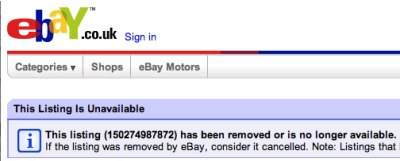
And, in case you’re wondering, eBay finally got around to removing the spoof auction of the bike.