Google, China, and the future of freedom on the global Internet

Long and characteristically wise and thoughtful post by Rebecca MacKinnon on l’affaire Google.

I am not one of those people who believe that the Internet is going to eliminate the human need for geographically-based government. But I do believe that we're starting to enter a time when enlightened governments will slowly come to recognize that their legitimacy along with the well-being of the societies they govern will be improved if they figure out ways not just to peacefully coexist – but to share power with the global cyber-nation. Each has a duty to help us – citizens of both physical and cyber space – to keep the other's power in check. Both must submit to appropriate public oversight. Both must commit to high standards of transparency if they want our trust – which they require in order to be successful and powerful for the long haul. We're very far from figuring out how to make it all work. But it is in our own self-interest as netizens to be proactive in doing what we can to help companies and governments come to grips with what is, unavoidably, in their own long-term interest.

Worth reading in full.

The Balkanisation of the Internet

Even the New York Times is catching up with the reality, as evidence by this piece in today’s online edition.

As the Internet grew, it became fragmented and linguistically diversified. It developed borders, across which it now works in different ways.

In Spain, for instance, you can share music and movies with virtual impunity; in France, doing that is likely to cost you your Internet connection.

In China, meanwhile, it may soon be nearly impossible to use Google. The company, saying the security of its e-mail had been breached in a campaign to spy on Chinese dissidents, announced last week that it would stop censoring Google.cn, its Chinese Web site, and might have to withdraw from China.

No matter what happens in the fight between Google and Beijing’s leaders, one thing seems clear: the company is not going to be able to turn the clock back to 2006. That year, Google itself helped to fracture the Internet by creating Google.cn.

Google and China: business ethics, or ethics as business?

Google’s threat to close its operations in China has been treated as big news in the mainstream media. (As a technology columnist I’ve grown accustomed to the fact that Google is one of the triggers of senior editorial interest in technology!) Here’s how the NYT, for example, reported it:

BEIJING — Google said Tuesday that it would stop cooperating with Chinese Internet censorship and consider shutting down its operations in the country altogether, citing assaults from hackers on its computer systems and China’s attempts to “limit free speech on the Web.”

The move, if followed through, would be a highly unusual rebuke of China by one of the largest and most admired technology companies, which had for years coveted China’s 300 million Web users.

The more I think about it, though, the more puzzled I become. First of all, it only makes sense if Google knows that the cyberattack that is one of the alleged grounds for its threat was actually orchestrated or conducted by the Chinese government. But the company spokesman on Radio 4 this morning declined to comment on that. Secondly, it’s puzzling because Google must have known what it was getting into four years ago when it agreed to the Chinese regime’s conditions for operating in that country: that was the moment when we saw the transition from Google-the-religion to Google-the-corporation. I wasn’t particularly surprised when the company agreed to bend the knee to the Chinese. Corporations obey the law, and are as ethical or unethical as they can get away with. Expecting a shareholder-owned entity to do more than obey the law is a bit like expecting my cats to obey my injunctions to be kind towards birds and small rodents. It goes against their natures.

Thirdly (and following on from that), there’s the business angle. If I were a shareholder in Google, would I be pleased to see the company turning its back on the most important emerging market in the world? (Well, I might: but I’m not running a pension fund.) Looked at through the prism of pure corporate strategy, it seems like an unwise step.

And then, finally, there’s a whiff of hubris about it. Google is big and powerful, but it’s a flea compared to the authoritarian regime that runs the world’s next superpower. I’m reminded of the story about Stalin’s alleged retort to news that the Pope was opposed to something he was planning: “And how many divisions has the Pope?”

So what is one to make of it? One interpretation is that it’s a business decision dressed up in ethical garb.

The company has been constantly losing market share against its rival Baidu in the last few months and is currently left with only about 17% of the Chinese search market.

In other words, Google has decided that the Chinese search market is a lost cause and has made a strategic decision to cut its losses and pull out.

Another slant on it concerns the way the company has gone about this. Here’s a Chinese perspective on it:

With its bold statement towards the Chinese government, Google basically closed their doors in China. Business tactics that may work in countries like the US do not work in China. In China there is a strong feeling about building relationships. There is a strong feeling about “saving face”. There is a strong culture and history that the people are very proud of.

Sure there are problems. And yes there are problems that need to be fixed. But the question that arises is what is the best way to go about it.

I wrote a blog post about how to do business in Asia. In this post I summarized the lessons that could be learned from President Bill Clinton’s visit to North Korea to release the US reporters. Bill did not prove that he was right and North Korea was wrong. Instead, he approached the government with respect and he approached them in a way that was aligned with their culture. Bill gave them a path to change their position without losing face. By doing this, Bill achieved a result that many thought was impossible. North Korea released the US reporters to the US.

Unfortunately, Google did just the opposite today. They brought US tactics to the Chinese government. Not any US tactics, but US tactics that are against the grain of Chinese culture. They did not show respect. They did not allow a path for “saving face”. They did not build the relationship.

Funnily enough, even thought I disapproved of Google’s 2006 decision to filter search results, I thought that the company was approaching it sensibly by arguing that it was at least letting Chinese searchers know when they’d been banned from seeing something. And that was better than nothing.

Anyway, we’re left with an enigma. There’s more to this than meets the eye. Wish I knew what.

LATER: One answer might be that it’s a move that resonates with official thinking within the Obama Administration. For example, this source reports that:

Google’s decision Tuesday to risk walking away from the world’s largest Internet market may have come as a shock, but security experts see it as the most public admission of a top IT problem for U.S. companies: ongoing corporate espionage originating from China.
It’s a problem that the U.S. lawmakers have complained about loudly. In the corporate world, online attacks that appear to come from China have been an ongoing problem for years, but big companies haven’t said much about this, eager to remain in the good graces of the world’s powerhouse economy.

Google, by implying that Beijing had sponsored the attack, has placed itself in the center of an international controversy, exposing what appears to be a state-sponsored corporate espionage campaign that compromised more than 30 technology, financial and media companies, most of them global Fortune 500 enterprises.

The U.S. government is taking the attack seriously. Late Tuesday, U.S. Secretary of State Hillary Clinton released a statement asking the Chinese government to explain itself, saying that Google’s allegations “raise very serious concerns and questions.”

“The ability to operate with confidence in cyberspace is critical in a modern society and economy,” she said.

STILL LATER: Tech Review has a piece about the attack which allegedly triggered Google’s announcement:

Though Google has not disclosed the exact nature of the attacks, [David] Drummond [Google’s chief legal officer] wrote: “In mid-December, we detected a highly sophisticated and targeted attack on our corporate infrastructure originating from China that resulted in the theft of intellectual property from Google.” He added that the company has gathered evidence that 20 other large Internet, finance, technology, media, and chemical companies were also attacked.

In Google’s case, the attackers tried to get into Gmail accounts belonging to Chinese human-rights activists, Drummond said. The company believes that the efforts were not successful, but that hackers have been targeting human-rights activists based in other parts of the world through a range of hacking techniques.

Amichai Shulman, CTO of Imperva, a data-security company based in Redwood Shores, CA, says Google probably called the attack “highly sophisticated” because the hackers got into the heart of its database and password list. “The intellect and resources required to pull off such a surgical attack are staggering considering the defenses Google has put in place to protect digital assets,” he says.

Obama’s West Point speech

If you found Obama’s speech setting out his Afghan strategy as unsatisfactory as I did, then you’ll enjoy this dispatch from Gabor Steingart of Der Spiegel. It reads, in part:

“Never before has a speech by President Barack Obama felt as false as his Tuesday address announcing America’s new strategy for Afghanistan. It seemed like a campaign speech combined with Bush rhetoric — and left both dreamers and realists feeling distraught.

One can hardly blame the West Point leadership. The academy commanders did their best to ensure that Commander-in-Chief Barack Obama’s speech would be well-received.

Just minutes before the president took the stage inside Eisenhower Hall, the gathered cadets were asked to respond “enthusiastically” to the speech. But it didn’t help: The soldiers’ reception was cool.

One didn’t have to be a cadet on Tuesday to feel a bit of nausea upon hearing Obama’s speech. It was the least truthful address that he has ever held. He spoke of responsibility, but almost every sentence smelled of party tactics. He demanded sacrifice, but he was unable to say what it was for exactly.

An additional 30,000 US soldiers are to march into Afghanistan — and then they will march right back out again. America is going to war — and from there it will continue ahead to peace. It was the speech of a Nobel War Prize laureate.”

Davewatch

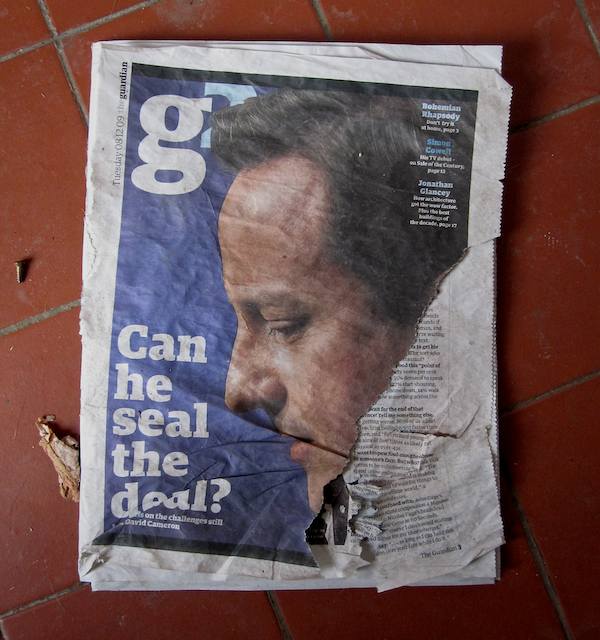
During the recent snowy spell, we took to putting newspaper down in the hall to reduce the amount of snow brought into the house. As luck would have it, the Guardian G2 issue about Dave Cameron was the first periodical that came to hand. We noticed that people stamped their Wellingtons rather enthusiastically upon entering. But at least they were green. Poor Dave became progressively more disfigured over the week, so in the end we put him out of his misery. On the fire.

The ‘news agenda’, the public sphere and the Net

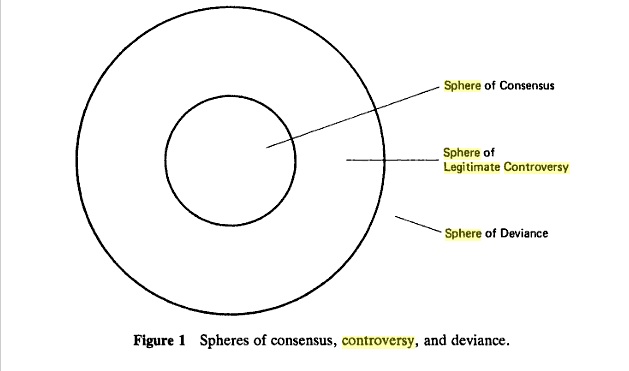
This diagram (from The Uncensored War, Daniel Hallin’s book about the media and the Vietnam war) is the heart of a terrific essay by Jay Rosen on journalism’s role in stifling public discussion while pretending to enhance it. Sample:

1.) The sphere of legitimate debate is the one journalists recognize as real, normal, everyday terrain. They think of their work as taking place almost exclusively within this space. (It doesn’t, but they think so.) Hallin: “This is the region of electoral contests and legislative debates, of issues recognized as such by the major established actors of the American political process.”

Here the two-party system reigns, and the news agenda is what the people in power are likely to have on their agenda. Perhaps the purest expression of this sphere is Washington Week on PBS, where journalists discuss what the two-party system defines as “the issues.” Objectivity and balance are “the supreme journalistic virtues” for the panelists on Washington Week because when there is legitimate debate it’s hard to know where the truth lies. There are risks in saying that truth lies with one faction in the debate, as against another— even when it does. He said, she said journalism is like the bad seed of this sphere, but also a logical outcome of it.

2. ) The sphere of consensus is the “motherhood and apple pie” of politics, the things on which everyone is thought to agree. Propositions that are seen as uncontroversial to the point of boring, true to the point of self-evident, or so widely-held that they’re almost universal lie within this sphere. Here, Hallin writes, “journalists do not feel compelled either to present opposing views or to remain disinterested observers.” (Which means that anyone whose basic views lie outside the sphere of consensus will experience the press not just as biased but savagely so.)

Consensus in American politics begins, of course, with the United States Constitution, but it includes other propositions too, like “Lincoln was a great president,” and “it doesn’t matter where you come from, you can succeed in America.” Whereas journalists equate ideology with the clash of programs and parties in the debate sphere, academics know that the consensus or background sphere is almost pure ideology: the American creed.

3.) In the sphere of deviance we find “political actors and views which journalists and the political mainstream of society reject as unworthy of being heard.” As in the sphere of consensus, neutrality isn’t the watchword here; journalists maintain order by either keeping the deviant out of the news entirely or identifying it within the news frame as unacceptable, radical, or just plain impossible. The press “plays the role of exposing, condemning, or excluding from the public agenda” the deviant view, says Hallin. It “marks out and defends the limits of acceptable political conduct.”

Anyone whose views lie within the sphere of deviance—as defined by journalists—will experience the press as an opponent in the struggle for recognition. If you don’t think separation of church and state is such a good idea; if you do think a single payer system is the way to go; if you dissent from the “lockstep behavior of both major American political parties when it comes to Israel” (Glenn Greenwald) chances are you will never find your views reflected in the news. It’s not that there’s a one-sided debate; there’s no debate.

As I say, a terrific essay, well worth reading in full. The comments (including Daniel Hallin’s) are also illuminating.

Is the DMCA a scam? Or how to censor the web

You think the DMCA is just about anti-circumvention? Think again. This comes from Aaron Swartz’s blog.

I received my first DMCA takedown notice today. I published publicly-available IRS information about the nonprofit Kwaze-Kwasa [USA] Inc. Kwaze-Kwasa sent a letter to my ISP asking that it be taken down. I do not know why they want to keep this public information off the Internet, but I do know that the law lets them.

For those who aren’t familiar, the Digital Millennium Copyright Act contained a section known as OCILLA (distinct from its also-famous anticircumvention provisions) that regulates publishing copyrighted material online.

There are three big parties with interests in this subject: copyright holders, who want strong tools to keep copyrighted material offline; ISPs, who don’t want copyright law to apply to them’ and Internet users, who want to be able to publish and read interesting content. OCILLA was largely written by ISPs and pretty much maximizes their interests at the expense of copyright holders and users.

I’m very glad that copyright holders get the short end of the stick — they want to modify the law to make sites like YouTube illegal, just because some people upload copyrighted material to it. If they had their way, websites based around user-generated content would pretty much be impossible.

But I am frustrated the law doesn’t do enough for users. The takedown notice I was sent was obviously bogus — it didn’t even allege a copyright violation, since the information I published wasn’t even copyrightable (it was all basic facts and statistics published by the US government). Yet my ISP informed me that if I didn’t take the page down, they’d take my entire website offline. And they have to do that because if they don’t, they can be sued under the copyright law and could face very heavy penalties.

Maybe he should change his ISP. Cory Doctorow can advise.

Teflon Palin

Lovely piece by Christopher Hitchens in Slate.

Writing about Sarah Palin in Newsweek last month, I pointed out the crude way in which she tried to Teflon-ize herself when allegations of weird political extremism were made against her. Thus, she had once gone to a Pat Buchanan rally wearing a pro-Buchanan button, but only because she thought it was the polite thing to do. She and her husband had both attended meetings of the Alaskan Independence Party—he as a member—but its name, she later tried to claim, only meant “independent.” (The AIP is a straightforward secessionist party.) She didn’t disbelieve all the evidence for evolution, only some of it. She hadn’t exactly said that God was on our side in Iraq, only that God and the United States were on the same side. She says that she left the University of Hawaii after only one year because the climate was too sunny for an Alaskan; her father (whom she considers practically infallible) tells her most recent biographers that she quit because of the preponderance of Asian and Pacific islanders: “They were a minority type thing and it wasn’t glamorous. So she came home.” And so on.

Then, bang on cue, Palin made a live appearance that nicely illustrates Hitchin’s point:

She appeared on the radio show of a certain Rusty Humphries, another steaming and hearty slice of good-old U.S. prime, and was asked whether she would make an issue of President Barack Obama’s birth certificate. Her response: “I think the public rightfully is still making it an issue. I think it’s a fair question.” That was on Thursday, Dec. 3. On Friday, she had published a second “thought” on her Facebook page, reassuring all and sundry that: “At no point have I asked the president to produce his birth certificate, or suggested that he was not born in the United States.”

Well, exactly. Of course she hasn’t. She just thinks it’s a good idea for others to do that, in their “rightful” way, since, after all, it is “a fair question.”

Yuck.

How ‘Lord’ Mandelson seeks to kill open Wi-Fi networks

Terrific Guardian piece by Lilian Edwards, who teaches Internet law at Sheffield.

A lot of people have talked to me over the last week about Wi-Fi (open and closed, i.e. password-protected) and the Digital Economy bill. The more I try to find answers, the more ludicrous it becomes. For instance, last week it turned out that a pub owner was allegedly fined £8,000 because someone downloaded copyright material over their open Wi-Fi system. Would that get worse or better if the Digital Economy bill passes in its present form?

To illustrate, I’m going to pick my favourite example of a potentially worried wireless network provider: my mum.

She doesn’t understand or like the internet, refuses to even think about securing her Wi-Fi network. What is her legal status? What will she say if/when she receives warnings under the Digital Economy bill because someone has used her open Wi-Fi to download infringing files?

It’s a terrific, thought-provoking, scary piece worth reading in full. The scary bit is the realisation that Mandelson & Co are the epitome of clueless legislators. Viewing Mandy’s approach to the Net is like watching a monkey fiddling with a delicate chronometer. I’m writing a book at the moment about the significance of the Net and one of the draft chapter headings is “We could blow it, if we’re not careful”. I’m beginning to think that’s much too conditional.