
Wednesday 12 October, 2022

Autumn leaves

Seen on a walk the other day.


Quote of the Day

”Competition brings out the best in products and the worst in people.”

  • David Sarnoff

Musical alternative to the morning’s radio news

J.S. Bach | Concerto for two violins in D minor BWV 1043 | Sato and Deans | Netherlands Bach Society

Link


Long Read of the Day

A Dose of Rational Optimism

That’s the title of Zachary Carter’s review in Dissent of Brad DeLong’s magisterial  Slouching Towards Utopia: An Economic History of the Twentieth Century, which I’m currently reading — and learning a lot in the process. Carter describes it as “a rise-and-fall epic” but thinks that “it is better at depicting the rise than explaining the fall”. I’m not far enough in to know whether that’s a fair judgement, but since I loved his book on Keynes and Keynesianism, which came out during the lockdown, I’m taking his review seriously.

This is how it opens:

Humanity, the Berkeley economist argues, spent nearly the entirety of its history condemned to poverty by an insufficient supply of calories and a chronically excessive birth rate. But in the “long twentieth century”—the period between 1870 and 2010—an almost miraculous transformation took place: more and more people lived longer, healthier, more prosperous lives than ever before. Arenas of intellect and creative expression that were once accessible only to the most privileged of elites became the common experiences of mass cultures. Humans did not find utopia, DeLong argues, but we stumbled in its general direction.

In the grim morass that has followed the financial crisis of 2008, it is refreshing to receive a dose of rational optimism—however tempered—from a serious intellectual examining our place in the grand scheme of history. DeLong does not avert his readers’ eyes from the brutalities of imperial conquest, genocide, and revolution gone awry, which define the political milieu of the era under his microscope. But his narrative is fundamentally hopeful: people can accomplish amazing things on a colossal scale. Not that long ago, we did so all the time.

This perspective is refreshing precisely because everyone, DeLong included, knows that something has gone terribly wrong…

Worth your time.


My commonplace booklet

The TINY cheap EV you (might) actually want!

Who said the bubble-car was dead? Nice video.


This Blog is also available as a daily email. If you think that might suit you better, why not subscribe? One email a day, Monday through Friday, delivered to your inbox. It’s free, and you can always unsubscribe if you conclude your inbox is full enough already!

Tuesday 11 October, 2022

On reflection…

Seen in the lake on a walk yesterday afternoon.


Quote of the Day

”The world is not a solid continent of facts sprinkled by a few lakes of uncertainties, but a vast ocean of uncertainties speckled by a few islands of calibrated and stabilised forms.”

  • Bruno Latour

Musical alternative to the morning’s radio news

Duke Ellington | Across the Tracks Blues

Link

Magical (IMHO)


Long Read of the Day

Audiobooks: Every Minute Counts

Absolutely fascinating blog post from Public Books explaining why audio books are a strangely interesting product (or should I say ‘service’?) I don’t use them, but I have friends who do. And there are lots of interesting observations in the post, which is why I thought it would make an admirable Long Read, but not a Long Listen!


Bruno Latour RIP

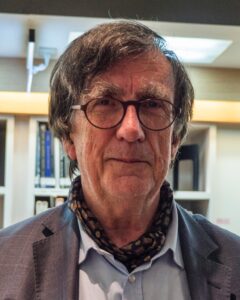
One of the most interesting thinkers of our era has died. I knew him only slightly — through a mutual friend, the eminent Dutch philosopher Gerard de Vries — but admired him greatly; indeed, tbh, I was slightly in awe of him, and always sat up when the occasional email from him arrived in my inbox.

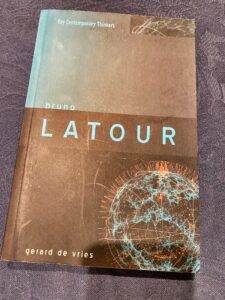
Gerard knew Latour long before he was cool, and after he had retired from his Chair at the University of Amsterdam he wrote a magnificent introduction to his friend’s work. Given the scope of that work, it was quite an achievement to encompass it in a single volume, and I was so impressed by it that we invited the author — and his subject — to come to a public launch of the book in CRASSH, the Cambridge research institute in which our Centre for Technology and Democracy is based.

The event was a sellout, and in the end we had to arrange a live relay to several other rooms in the building to cope with the crowd. The only other speaker I can remember having such a powerful magnetic impact was Noam Chomsky many moons ago.

Among other things, Bruno was a formidable multitasker, with a baffling capacity to do several difficult things simultaneously: attending a seminar, for example, while writing a paper on his laptop — and yet suddenly asking a pertinent question to a speaker who had foolishly assumed that his mind was elsewhere. In that sense, he was reminiscent of Norbert Wiener, who used to have a similarly discombobulating effect on seminar speakers at Harvard in the 1940s.

Stuart Jeffries wrote a nice obituary of Bruno in yesterday’s Guardian. “His big idea,” Jeffreys writes,

developed in more than 20 books, theatrical performances and art installations, as well as his 2013 Gifford Lectures in Edinburgh, entitled Facing Gaia, was not that difficult to grasp. We should realise we are not the selfish individuals predicted by neo-liberal economic theory, but social beings living interdependently with other organic life, and that, like his favourite insects, we must productively recycle our waste and consume little.

His ideas were profoundly influenced by the Gaia theory of the maverick British scientist James Lovelock, wherein the Earth is a self-regulating organism. Latour’s sense was that it is the critical zone, rather than the whole of our planet, that should be the object of human concern and care, in order to reverse the despoiling impact of what he and others called the Anthropocene, the epoch in which humanity has become tantamount to a geological force and presided over the sixth mass extinction event.

He was a life-enhancing thinker and a very nice man. May he rest in peace.


This Blog is also available as a daily email. If you think that might suit you better, why not subscribe? One email a day, Monday through Friday, delivered to your inbox. It’s free, and you can always unsubscribe if you conclude your inbox is full enough already!

Monday 10 October, 2022

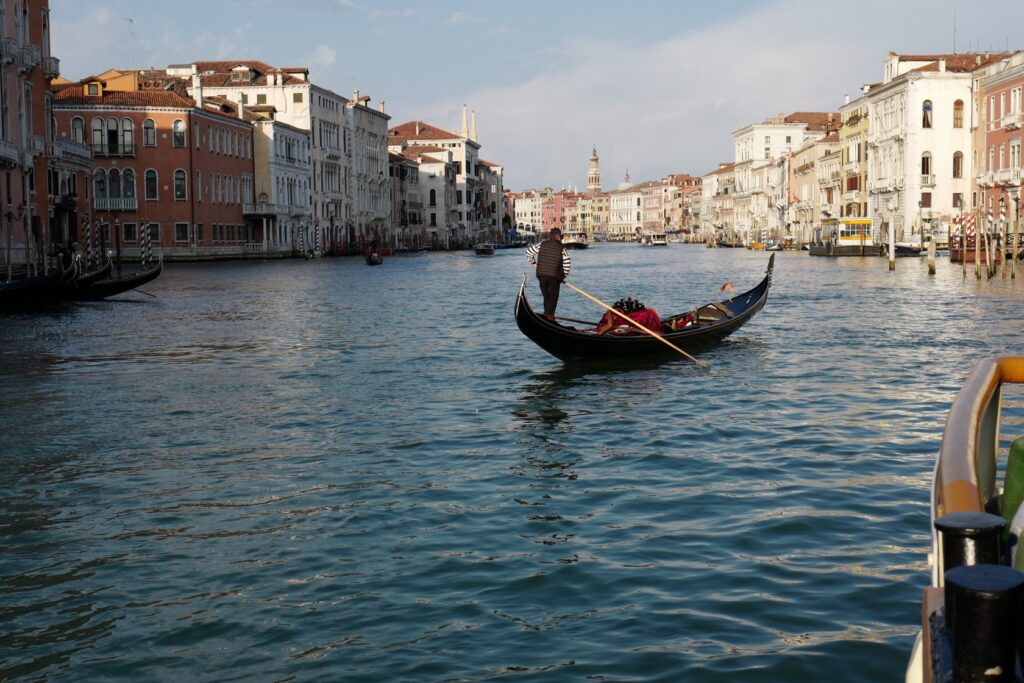
The most glorious Main Street in the world

The Grand Canal, Venice. Not quite as Canaletto saw it. Still…

Looking forward to being there again next year.


Quote of the Day

”In America, journalism is apt to be regarded as an extension of history: in Britain as an extension of conversation.”

  • Anthony Sampson, in The Anatomy of Britain Today. ‘Today’ was 1965.

Musical alternative to the morning’s radio news

David Lindsey | Starting All Over Again | Reggae USA

Link

Lovely.


Long Read of the Day

 Ninety Years Ago, This Book Tried to Warn Us

A striking NYT column by Pamela Paul on Lion Feuchtwanger’s 1933 novel The Oppermanns.

The novel reads like a five-alarm fire because it was written that way, over a mere nine months, and published shortly after Hitler became chancellor, only lightly fictionalizing events as they occurred in real time. In “Buddenbrooks” fashion, the story follows the declining fortunes and trials of a family, the German Jewish Oppermanns, prosperous merchants and professionals, as they scramble to hold on while fascism takes hold of their country. It’s a book that fairly trembles with foreboding and almost aches with sorrow.

The essay continues with a list of the tragically mistaken assumptions Feuchtwanger took on in 1933 that continue to threaten democracies today. Worth reading just for that list.


Tech firms: EU laws to avoid bad AI will limit their ‘innovation’. Spot on!

Yesterday’s Observer column:

The new liability bill, says MIT’s Technology Review journal, “would give people and companies the right to sue for damages after being harmed by an AI system. The goal is to hold developers, producers and users of the technologies accountable and require them to explain how their AI systems were built and trained. Tech companies that fail to follow the rules risk EU-wide class actions.”

Right on cue, up pops the Computer & Communications Industry Association (CCIA), the lobbying outfit that represents tech companies in Brussels. Its letter to the two European commissioners responsible for the two acts immediately raises the concern that imposing strict liability on tech firms “would be disproportionate and ill-suited to the properties of software”. And, of course, it could have “a chilling effect” on “innovation”.

Ah yes. That would be the same innovation that led to the Cambridge Analytica scandal and Russian online meddling in 2016’s US presidential election and UK Brexit referendum and enabled the livestreaming of mass shootings. The same innovation behind the recommendation engines that radicalised extremists and directed “10 depression pins you might like” to a troubled teenager who subsequently ended her own life…

Do read the whole thing


Twitter Will Tame Elon Musk, Not the Other Way Around

Jack Shafer’s Politico column. My response: Oh Yeah? But Jack’s argument is that “the expert bloviator isn’t about to run a $44 billion purchase into the ground”.

Assuming Elon Musk and Twitter can iron out their legal differences in the next couple of days, he will take ownership of Twitter very soon. Will he wreck it by turning it into a disinformation playground, as some critics fear, based on his vow to lift the permanent ban on Donald Trump’s account? Or will he transform it into something that rivals the other triumphs in his portfolio, Tesla and SpaceX?

Knowing Musk, he could possibly do both, constructing a sewer that poisons you with lies and hate while making it an essential part of consumers’ lives. But you’ve really got to doubt that. Nobody, not even Elon Musk on his most perverse day, would buy a property for $44 billion — 20 percent of his net worth, by the way — and then rebuild it as the world’s largest sewage treatment facility. All the fretting about the “harm” Musk might cause as Twitter’s owner is misplaced: It will be in his financial interests to make Twitter as wholesome and welcoming a place as Starbucks, even if he changes the way the site works…

We’ll see. Full marks for trying, though, Jack.


My commonplace booklet

”We Have To Make It Big Enough For All Of Us!”

Lovely story from a lovely blog


This Blog is also available as a daily email. If you think that might suit you better, why not subscribe? One email a day, Monday through Friday, delivered to your inbox. It’s free, and you can always unsubscribe if you conclude your inbox is full enough already!

Wednesday 5 October, 2022

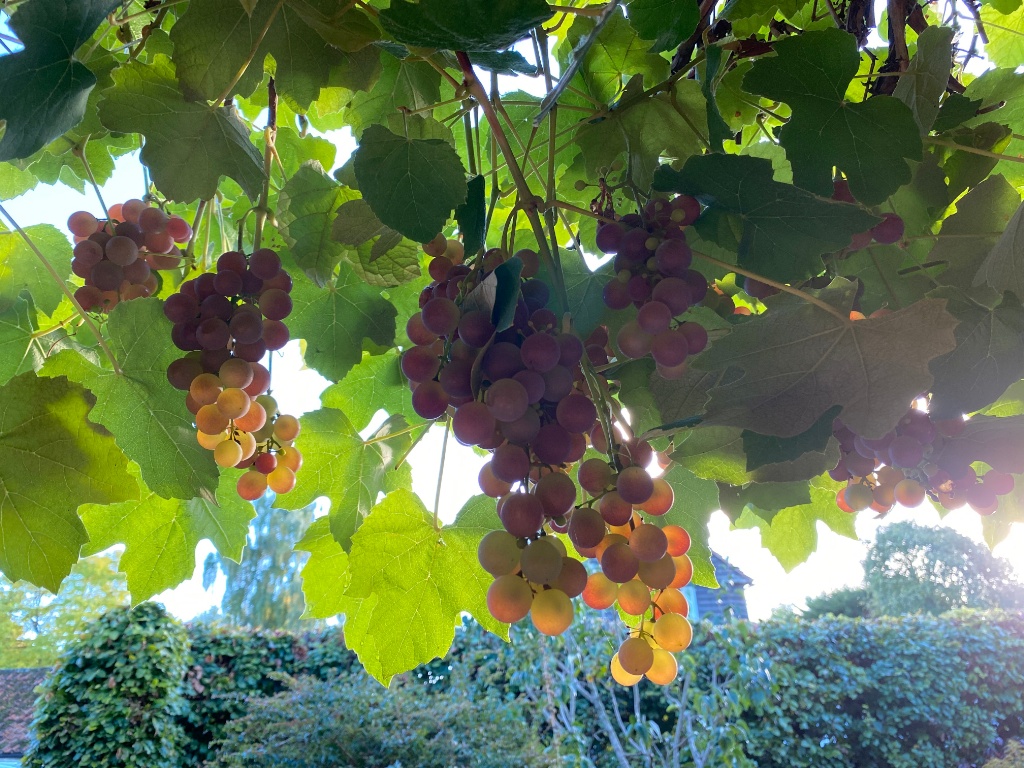
Chateau Naughton 2022

We have an amazing elderly vine which runs the entire front of the house. And every year, without fail, it produces a rich harvest of grapes, which we eat and make delicious grape juice from. One year, long ago, I toyed wit


h the idea of learning to make wine from them, but having done the research, assessed the expenditure on kit and the steepness of the learning curve I decided that it would be cheaper and easier to go out and buy a few bottles of Chateau Lafite! And ever since, I’ve been content to be a mere fruit-juice manufacturer.

Quote of the Day

”Take most people, they’re crazy about cars. I’d rather have a goddam horse. A horse is at least human, for God’s sake.”

  • J.D. Salinger, in The Catcher in the Rye, 1951.

Musical alternative to the morning’s radio news

Mozart | Die Zauberflöte, ’O Isis und Osiris’ | Kurt Moll

Link

One of my favourite arias.


Long Read of the Day

 The Thorny Problem of Keeping the Internet’s Time

Fascinating New Yorker essay by Nate Hopper on the genius who, many years ago, created the arcane software system that synchronises the network’s clocks. The question for now: who will keep the system running?

Many thanks to James Miller for alerting me to it.


Dave Winer and Doc Quixote

Dave Winer and Doc Searls are two of the Elders of the Net. Among many other achievements they both played a role in composing the Cluetrain Manifesto. They are also old friends, so sometimes it’s nice to be able to eavesdrop on their conversations. Dave had a nice blog post about such an exchange the other day.

I had a longish phone talk with Doc Searls a couple of days ago. Then he wrote a post about a series of photos he took over 17 years, on airplanes approaching LAX, of a famous horse track as it changed over the years, and eventually was torn down and a football stadium was built in its place.

I’ve known Doc for a long time, and I’ve seen at least two sides of the man. On one side is Doc Quixote who is ranting about windmills. He’s great with words so he comes up with memorable ways of expressing the ideas. And Doc is the most affable person I’ve ever known, so they love him as he rants at them. And the things Doc rants about are what we need to do now to start to be free. In other words he’s right. But as we’ve grown old as friends I’m pretty certain that Doc will not live to see his ideas become reality. And nor will I, for my dream. I spent great time, energy and money, over many years to create the writing and programming environment I wanted to use and I wanted my peers to use, so we could work together to create species-saving communication tools, and just beauty — nothing wrong with that.


My commonplace booklet

Andrew Curry on the damage inflicted on roads by different kinds of vehicle.

This from yesterday’s edition of his Substack blog.

When I wrote about cars on Saturday, I underestimated the impact of the weight of a vehicle on the road surface. It’s the fourth power of the weight, not the cube. Memo to self: don’t write quickly late in the evening, even when sober, since your memory plays tricks on you.

Harry Rutter at Bath University kindly put me right, even sending me a spreadsheet comparing the impact of a bicycle with a Ford Focus and with a truck. The green cells show the ratio of damage between each of the pairs of vehicles…

If you’re interested, follow the link to see the table. It’s sobering. And also confirms that the most ecologically-responsible form of transport is the bicycle, closely followed by the electric bike!


This Blog is also available as a daily email. If you think that might suit you better, why not subscribe? One email a day, Monday through Friday, delivered to your inbox. It’s free, and you can always unsubscribe if you conclude your inbox is full enough already!


Tuesday 4 October, 2022

The stones of Ruskin

For forty years I’ve had an ambition to visit Brantwood, John Ruskin’s house on the shores of Coniston Water, and a couple of weeks ago I achieved it!

Brantwood is big but not grand, and exceedingly interesting because of what it reveals about its owner. I’ve been interested in Ruskin ever since I made my first visit to Venice and read his Stones of Venice, but I hadn’t appreciated what a polymath he was, how wide his interests were and what a powerful influence he was on Victorian life and thought.

The house is set in a 250-acre estate which is threaded with paths designed by Ruskin to make different kinds of botanical and topographic points. We walked the path that circles the estate and leads up to the crag at the top with its sensational views of the lake below and the ‘Old Man’ peak that looms above it. All in all, a wonderful day out. Highly recommended.


The odd thing about the ‘Lake District’

As regular readers know, I recently had an enjoyable holiday in the Lake District, where we rented a house on the nice (i.e. quiet) side of Windermere. But I made the mistake on the blog of referring to “Lake Windermere” — which prompted a nice rebuke from James Cridland (‘mere’ means ‘lake’ so ‘Lake Windermere’ is a tautology), and a dish of humble pie for me.

But it also prompted other nice messages. Quentin, for instance, wrote that,

Enjoyed your comment about Lakes this morning; I remember now (but had forgotten) learning as a child that there is only one lake in the Lake District: Bassenthwaite. All of the others are meres, waters, tarns…

And it prompted a nice story from Keith Devlin:

“When we were first living in Lancaster in the late 1970s, we had 3-story, Edwardian, terraced house, and took an overseas visitor to the top floor to see the view. “You can see The Lakes from here,” I said as we entered the room. The visitor paused, and said, “All I can see are mountains.”

Which indeed was the case.


Quote of the Day

”England still stands outside Europe. Europe’s voiceless tremors do not reach her. Europe is apart, and England is not of her flesh and body.”

  • John Maynard Keynes in The Economic Consequences of the Peace

Keynes was writing in 1919. Nothing much changes.


Musical alternative to the morning’s radio news

Xavier Boderiou | Uilleann Pipes | The Plains Of Boyle (Hornpipe)

Link

Brief, but lovely.


Long Read of the Day

A concrete vision of the liberal democratic future

If we want a better future, then we need to have an idea of what we would want it to be like. This long, long essay by Noah Smith

It seems that the essay was prompted by watching an interview with, of all people, Peter Thiel — Silicon Valley’s idea of an intellectual.

The other day, I saw a very interesting interview segment with the investor and conservative political activist Peter Thiel. In it, he says that the future has to be a tangible thing in order for people to embrace it, and that — as things stand right now — the only tangible futures that have been put forward are Chinese techno-totalitarianism, Islamism, and West Europe style environmentalism.

Smith doesn’t pretend to have all the answers.

Key pieces of the liberal democratic future vision remain to be filled in, and doing so will be a difficult and fraught process. Not everyone will be happy with the result, either. But it’s something we need to do, or we will leave the future to the people with darker, more dramatic visions that are sure to lead to nowhere good.

I agree, which is why I liked the essay. Hope you do too.


Lest we forget

I came on this tweet by Seb Schmoller yesterday.

The thread is here. It was Seb who first alerted me to Stolpersteine. Since then, whenever I’ve come on them in European cities, I pause to read and try to imagine what they mean. Seb’s thread includes a photograph of those outside the house where his grandparents lived.


This Blog is also available as a daily email. If you think that might suit you better, why not subscribe? One email a day, Monday through Friday, delivered to your inbox. It’s free, and you can always unsubscribe if you conclude your inbox is full enough already!


Monday 3 October, 2022

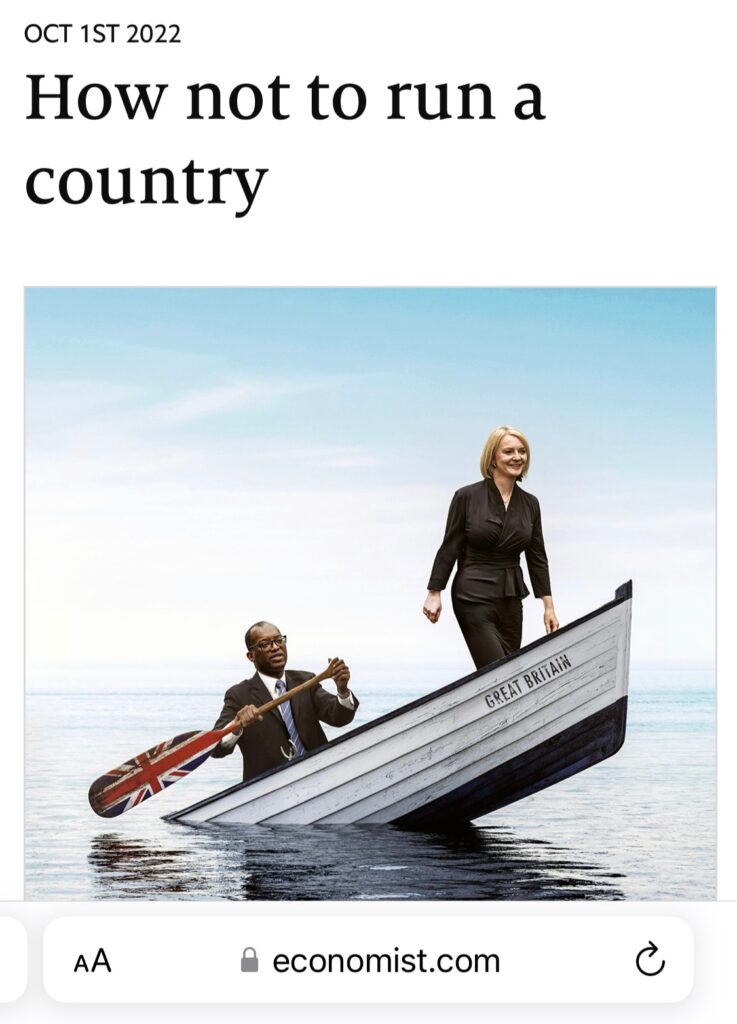
How not to run a country

This week’s Economist cover


Quote of the Day

”Neurosis has an absolute genius for malingering. There is no illness that it cannot counterfeit perfectly.”

  • Marcel Proust, 1922

Musical alternative to the morning’s radio news

Keith Jarrett | Over the Rainbow (Tokyo 1984)

Link


Long Read of the Day

 Ark Head

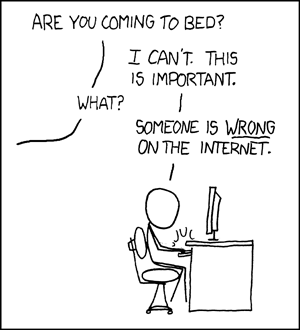
I don’t know about you but I feel increasingly like the guy in the cartoon — except that my concern there’s something terribly wrong with our world, not just the Internet. The difficulty is that remedying any of the wicked problems that beset us lies way above my — or your — pay grade, and perhaps above anyone’s pay grade. And yet nobody writes about this, possibly because nobody wants to admit that we are locked in incompetent systems — ones that can’t fix themselves.

All of which is by way of explaining why I thought this little essay by Venkatash Rao is so interesting. He sees the same enervating dilemma, but has an interesting take on our primary coping mechanism — the (Noah’s) Ark mentality.

We increasingly respond practically to the world without even attempting to make sense of it.

One mental model for this condition is what I call ark head, as in Noah’s Ark. We’ve given up on the prospect of actually solving or managing most of the snowballing global problems and crises we’re hurtling towards. Or even meaningfully comprehending the gestalt. We’ve accepted that some large fraction of those problems will go unsolved and unmanaged, and result in a drastic but unevenly distributed reduction in quality of life for most of humanity over the next few decades. We’ve concluded that the rational response is to restrict our concerns to a small subset of local reality–an ark–and compete for a shrinking set of resources with others doing the same. We’re content to find and inhabit just one zone of positivity, large enough for ourselves and some friends. We cross our fingers and hope our little ark is outside the fallout radius of the next unmanaged crisis, whether it is a nuclear attack, aliens landing, a big hurricane, or (here in California), a big wildfire or earthquake.

We’ve concluded the flood cannot be stopped, and we’re building arks to retreat to…

Marvellous, thoughtful piece.


Putin’s latest frightening gambit lies at the bottom of the ocean

Yesterday’s Observer column:

The strange thing about Putin’s assault on Ukraine was that he clearly hadn’t consulted Valery Gerasimov, the guy who in 2013 had radically reconfigured Russian military doctrine at his behest (and is now chief of the Russian armed forces). Gerasimov’s big idea was that warfare in a networked age should combine the traditional kinetic stuff with political, economic, informational, humanitarian and other non-military activities. This would mean, for example, that before firing a shot, you should first use social media and other network tools to misinform, confuse, polarise and demoralise the population of your adversary. In that way, democratic regimes would find it more difficult to motivate their citizens for combat.

Putin’s invasion in February ran directly counter to this doctrine; perhaps Gerasimov was not part of the inner circle of trusted cronies on whom Putin initially relied. Instead the assault was a 1940s-style blitzkrieg, except in Technicolor rather than black and white. And it hasn’t worked. So as he returns to the drawing board, it’s conceivable that the Russian leader has, finally, been talking to Gerasimov. If that’s the case, then their conversations will have rapidly turned to topics such as deniability, asymmetric warfare and identifying the critical weaknesses of their western adversaries.

Which in turn means that they will be thinking less about pipelines and much more about the undersea fibre-optic cables that now constitute the nervous system of our networked world. ..

Read on


  This Blog is also available as a daily email. If you think that might suit you better, why not subscribe? One email a day, Monday through Friday, delivered to your inbox. It’s free, and you can always unsubscribe if you conclude your inbox is full enough already! <hr 
Friday 30 September, 2022

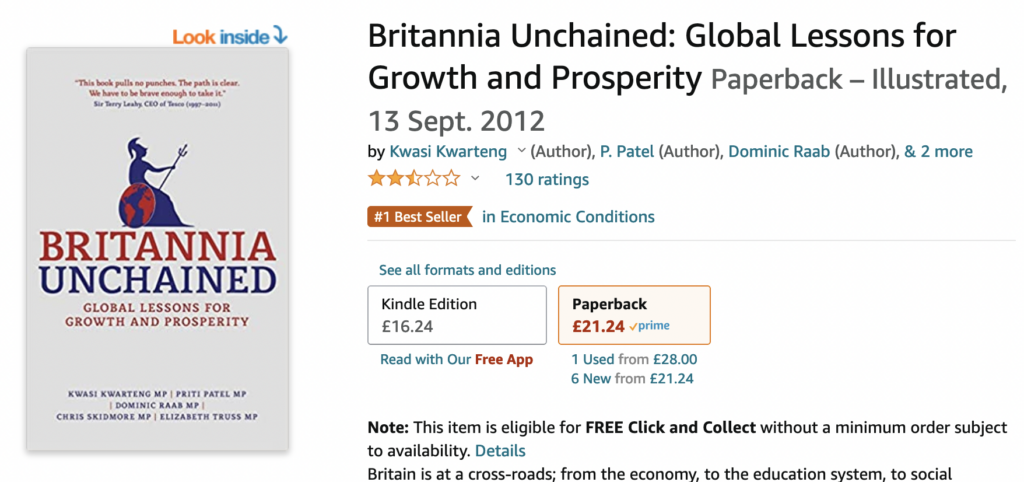
Britain’s new economic policy

Yours for only £21.24. Note the co-authors.

The Washington Post observed yesterday that the book

argues that Britain had become a “bloated state” with “high taxes” and “excessive regulation” and that only by taking an aggressively free-market, libertarian stance would shake the country into powerful economic growth. In this view, Britain looks particularly terrible when compared with fast-growing Asian economies.

“Whereas Indian children aspire to be doctors or businessmen, the British are more interested in football and pop music,” the book wrote.

The authors of Britannia Unchained were, at the time, accused of chasing headlines. But as the Financial Times noted this week, Kwarteng’s other work on economic history shows an embedded distrust of financial markets and bankers that is newly relevant.

His doctoral thesis — focused on the less-than-headline-grabbing topic of William III’s decision to reissue England’s coinage in 1695-96 — argued that “the interest of the goldsmith and banker was anything but inimical to the wider good of the nation.”

Few would argue against the idea that Britain’s economy needs some sort of shake-up. The economy has slumped since the financial crash of 14 years ago, with a mean growth rate of just 1 percent for the years since compared with 2.7 percent between 1948 and 2008.

Kwarteng’s mini-budget appears to be creating a kind of supply-side economics shock therapy for Britain. The inspiration may come from America and, in particular, the U.S. counterpart to the British chancellor’s idol, Margaret Thatcher: President Reagan, who was said to be “starving the beast” when cutting back on state funding by diminishing government income.

My friend the social historian David Vincent (Whom God Preserve) noticed that the two serious actors in this drama — the Chancellor and the Governor of the Bank of England — both wrote PhD dissertations in economic history as graduate students at Cambridge. He also pointed me to Amelia Gentleman’s review of Kwarteng’s rather good book on the British Empire, about which he seems commendably detached — possibly because his family hails from a former colony of said empire and are therefore inoculated against the Imperial Afterglow Syndrome that afflicts Boris Johnson & Co.

Kwarteng’s sharpest criticism of empire, writes Gentleman,

is of the “anarchic individualism” that ran through it. “The reliance on individual administrators to conceive and execute policy with very little strategic direction from London often led to contradictory and self-defeating policies, which in turn brought disaster to millions,” he writes. There are moments where you wonder if the criticism of the inconsistent, haphazard way that Britain’s imperial rule was imposed might equally be applied to the Conservative party’s reshuffle-heavy rule of the UK over the last decade.

You do indeed wonder.


Quote of the Day

”Malcolm Muggeridge, a garden gnome expelled from Eden, has come to rest as a gargoyle brooding over a derelict cathedral.”

  • Kenneth Tynan

It’s quite an acute observation about St Mugg, who ended his days as a devout Catholic. But he was right about Stalin’s Russia, when he was a journalist in Moscow in the 1930s and many lefties and British intellectuals were unwilling to criticise Uncle Joe.


Musical alternative to the morning’s radio news

Mozart | Il mio tesoro | Don Giovanni | John Dickie

Link

One of my favourite arias. James Joyce’s friend John McCormack used to sing it beautifully.


Long Read of the Day

Project Fear 3.0 – or the gatekeepers and the Tories

Fine blog post by Adam Tooze, who is as pissed off as I am about the current liberal astonishment at the depths to which Truss & Co will stoop. What did these commentators expect from such people? They are doing exactly what they said they would do — shrinking the state until — as a famous US reactionary once put it — they could drown it in a bucket.

Tooze is on song about this. Sample:

The important point is that in diagnosing your enemy the point is not to correct their behavior. The point is to defeat them.

You are engaged not in a pedagogic exercise, but in reconnaissance. The point is to expose who they are and what they are up to. The point is to help those of us who are opposed to them to be clearer in our judgements and tactics.

It is quite a different thing to write about the Truss government and the mess it is making as though you imagine that your criticism will make a difference, as though the aim of the game is persuasion and improvement. What I wonder do all these highly esteemed sources of economic expertise imagine their exchanges with Downing Street to be about? Who do they think they are talking to? Who, in fact, would imagine sitting down with these people to talk at all? How could you keep a straight face?

This a government of Tory hardliners trying to define the third iteration of post-Brexit Tory identity – May, Johnson, Truss. This is a government that thinks nothing of putting the Northern Irish agreement in play. When they gave away 45 billion to those on top incomes, they were under no illusions. They knew what they were doing. They know it will increase inequality. No harm in that as far as Truss is concerned. Will this drive interest rates up? Of course it will. They appear to relish that too.

So what, given who Truss, Kwarteng et al are, what is the purpose of the drumbeat of opprobrium?

Do read the whole thing.


Erratum

The Karl Popper quotation in yesterday’s edition included a ridiculous typo. It should have read:

”The belief that one can start with pure observations alone, without anything in the nature of a theory, is absurd.”

Thanks to Andrew Arends for tactfully pointing it out. And apologies to any Popperians out there who were annoyed by it.


This Blog is also available as a daily email. If you think that might suit you better, why not subscribe? One email a day, Monday through Friday, delivered to your inbox. It’s free, and you can always unsubscribe if you conclude your inbox is full enough already!

Thursday 29 September, 2022

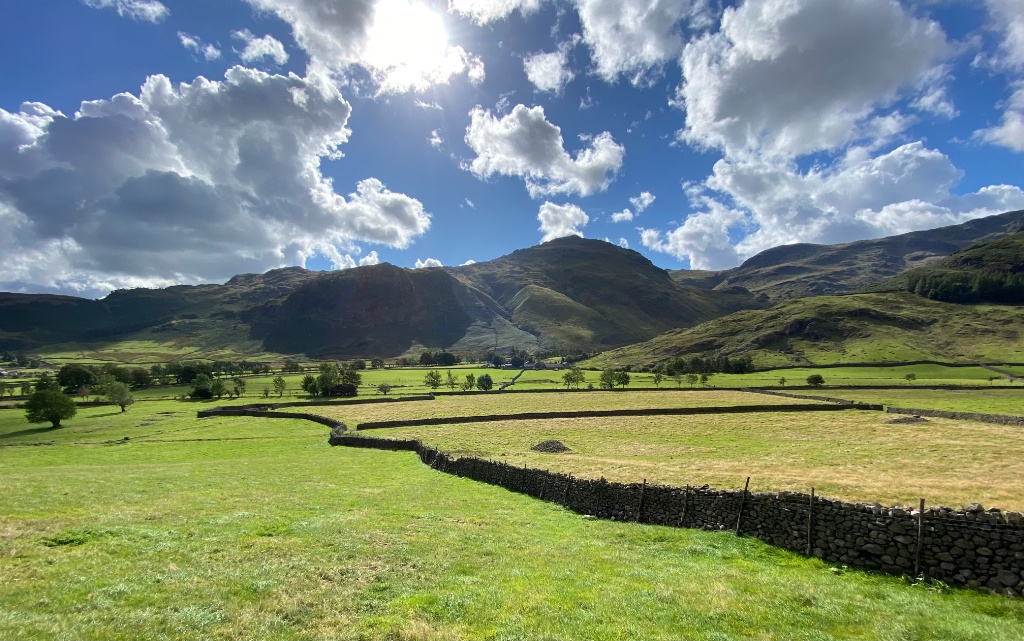
Langdale

Halfway through our walk.


Quote of the Day

”The belief that one can start with ours observations alone, without anything in the nature of a theory, is absurd.”

  • Karl Popper, Conjectures and Refutations

I’ve always found this to be a profound insight, but I have a vague recollection that he also expressed it more succinctly somewhere as “All observation is drenched in theory.”


Musical alternative to the morning’s radio news

Oscar Peterson | C Jam Blues

Link


Long Read of the Day

The Lost Ecological Paradise of the English Fenlands

Lovely essay by Annie Proulx on what was lost when Vermeulen & Co drained the fens.

I wanted to know how humans interacted with wetlands in the past and the present. The old image of an infinitely complex “web of life” holding the world together is still serviceable, but the web’s self-healing gossamer has been torn by humans in so many places it no longer functions. I found the story of the English fens was a story of the tearing-apart.

Worth your time, especially if you like the Fens.


Trump’s Heartless QAnon Embrace

Extraordinary NYT column by Michelle Goldberg about how Trump is now exploiting Qanon believers.

The title of the Reddit post this month seemed almost too shocking to be true: “My Qdad snapped and killed my family this morning.”

The post — by Rebecca Lanis, a 21-year-old from Michigan — was on a forum dedicated to people who’ve lost loved ones to QAnon, the sprawling conspiracy cult that imagines that Donald Trump is waging a secret war against blood-drinking pedophiles who run Hollywood and the Democratic Party. As The Detroit News would soon report, Lanis’s father, 53-year-old Igor Lanis, had indeed gone on a murderous rampage.

Lanis described how her father had fallen down the QAnon rabbit hole after the 2020 election. He wasn’t violent, however, until the morning of Sept. 11, when he shot her mother, her sister and their dog, and was then killed in a shootout with the police. Lanis’s sister, despite being shot in the back and legs, survived. Her mother and the dog did not…

The era when conspiracy theories were harmless has long gone.


Edward Snowden is granted Russian citizenship

From The Register

Snowden has been living in Russia since 2013 when the US charged him with espionage and he flew from Hong Kong to Moscow’s Sheremetyevo International Airport with the help of WikiLeaks and ended up stranded in Russia with a canceled passport. He was granted asylum in Russia and temporary residency until October 2020, when he became a permanent resident. He and his wife Lindsay reportedly applied for citizenship the following month.


My commonplace booklet

It’s not often that one comes across an ad that strikes a chord — but this Heineken one — which is about polarisation but of course also about beer — fits the bill. It’s 4 minutes 25 seconds long.

Thanks to Charles Arthur for spotting it.


This Blog is also available as a daily email. If you think that might suit you better, why not subscribe? One email a day, Monday through Friday, delivered to your inbox. It’s free, and you can always unsubscribe if you conclude your inbox is full enough already!

Wednesday 28 September, 2022

Quote of the Day

”I’d do anything for caviar and probably did.”

  • Henry Kissinger — on visiting Moscow.

Musical alternative to the morning’s radio news

Mendelssohn | Overture ‘The Hebrides’ | LSO & John Eliot Gardiner

Link


Long Read of the Day

Gareth Evans — philosophy’s lost prodigy

Nice memoir by Lincoln Allison in Engelsberg Ideas. Reading it, I was reminded of Keynes’s memoir of Frank Ramsey (another genius who tied tragically young) in his Essays in Biography.

University College, Oxford, October 1964: the economics fellow, David Stout, has assembled the twelve freshmen PPE students for their first class. This is an unusual procedure as lectures and individual tutorials are the normal means of teaching, but Stout is preoccupied with persuading any government and political party that will listen of the virtues of something called ‘value added tax’ and wants to meet all the students together. I am one of them and I have done none of the preparation for this class, being entirely preoccupied with such matters as rugby and new friends, but I am hoping that my ‘A’ and ‘S’ level economics from fifteen months earlier will enable me to get by. Actually, there are only eleven of us. Enter the twelfth to the traditional sarcastic remark from the tutor. The new arrival has long black hair and a black beard and wears a black scholar’s gown. With his hooked nose and rimless spectacles he seems like an edgy and hyperactive raven. He is carrying all six of the books recommended for the class which he deposits unceremoniously on the floor. ‘So this is economics?’ he demands and David Stout replies that these books are about welfare economics which is regarded by many as the foundation of the subject. ‘It’s based on a mistake,’ snaps the raven and the rest of the class is devoted to the tutor defending his subject from aggressive interrogation. It is increasingly obvious that the raven is at least the intellectual equal of the tutor…

Do read on.


Books, etc.

Just the Mann

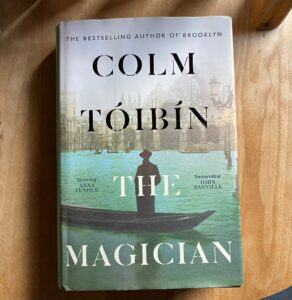
My wife and I recently finished Colm Tóibín’s fictionalised biography of Thomas Mann. I was less impressed by it than the folks who eulogised it on its dust-jacket. You know the kind of guff — “a remarkable achievement” (John Banville); “a moving and intimate portrait by one master of another” (Anna Funder); “a great imaginative achievement — immensely readable, erudite, worldly and knowing” (Richard Ford); “no living novelist dramatises artistic creation as profoundly, as luminously, as Colm Tóibín, or conveys so well the entanglement of imagination and desire” (Garth Greenwell).

Contd. p.94, as they say in Private Eye.

I was surprised to be so disappointed by it because I had really admired The Master, Tóibín’s fictionalised biography of Henry James. But perhaps the reason is that Thomas Mann was a less interesting character than dear old Henry. Of course had, perforce, an interesting life because of circumstances beyond his control (first Hitler and, later, Joe McCarthy), but in this imaginary he comes across as a solipsistic bore. The really interesting character in the book turns out to be his remarkable wife, Katia — and, as chance has it, she actually wrote a memoir, so maybe that should be next on our list.


My commonplace booklet

Catspeak on Trump’s assertion that he can declassify documents at will.


This Blog is also available as a daily email. If you think that might suit you better, why not subscribe? One email a day, Monday through Friday, delivered to your inbox. It’s free, and you can always unsubscribe if you conclude your inbox is full enough already!

Tuesday 27 September, 2022

Katchenchunga

The Old Man of Coniston, the famous Lakeland peak, seen on Saturday from John Ruskin’s estate at Brentwood on the other side of the lake.

The heroines and heroes of Arthur Ransome’s Swallows and Amazons christened it Katchenchunga. Nowadays, it frequently crops up in crossword clues.


Quote of the Day

”Goodby, Mr Zanuck. It certainly has been a pleasure working for 16th Century Fox.”

  • Jean Renoir, on leaving Hollywood,

Musical alternative to the morning’s radio news

Van Morrison | Have I Told You Lately

Link


Long Read of the Day

To the Depths and Back

Christopher Sandford’s utterly compelling review in The Hedgehog Review of Kevin Birmingham’s biography of Dostoevsky. Here’s how it opens…

Shortly after dawn on the morning of Saturday, December 22, 1849, the twenty-eight-year-old Dostoevsky stood on a black-draped scaffold erected on the drilling ground at Semyonovsky Square in his native St. Petersburg, and prepared to die at the hands of a firing squad. It was a cold, overcast, Russian winter day, with flakes of snow falling at the condemned man’s feet. Dostoevsky was bound to a stake between two other men, a biblical trinity he would have recognized, with nine more prisoners awaiting their turn in the wings. All of them had been convicted of what the presiding court called a “conspiracy of ideas” to undermine the tsarist regime. On the frozen ground behind the scaffold stood a row of carts laden with twelve empty coffins.

A black-robed priest mounted the scaffold and faced the first group of prisoners at the stake. He quoted Romans 6: “The wages of sin is death.” Yet by acknowledging their sins, the condemned could still hope to inherit eternal life. All three of the bound men silently kissed the priest’s cross when it was offered to them. It’s said that Dostoevsky remained calm, remarking to the man next to him on the scaffold that he had recently read Le dernier jour d’un condamné, Victor Hugo’s novel about a criminal facing the guillotine who believes that in the end Christ’s law will replace that of man. Perhaps it was one of those timeless moments, when eternity intrudes into the world and we catch a glimpse of what the life of man was meant to be and, by the grace of God, may yet be.

There was a drumroll. No fewer than forty-five soldiers, in three rows of fifteen, shuffled into position in front of the scaffold, their rifles cocked…

I was hooked right to the end.


My commonplace booklet

The problem with rowing your own boat…

… is that you can’t see where you’re going.

But now there’a a solution. And Quentin saw it at the Southampton Boat Show.


This Blog is also available as a daily email. If you think that might suit you better, why not subscribe? One email a day, Monday through Friday, delivered to your inbox. It’s free, and you can always unsubscribe if you conclude your inbox is full enough already!