Kurt Vonnegut R.I.P.

He’s gone, and we will miss him. The NYT obit captured his essence nicely.

To Mr. Vonnegut, the only possible redemption for the madness and apparent meaninglessness of existence was human kindness. The title character in his 1965 novel, “God Bless You, Mr. Rosewater, or Pearls Before Swine,” summed up his philosophy:

“Hello, babies. Welcome to Earth. It’s hot in the summer and cold in the winter. It’s round and wet and crowded. At the outside, babies, you’ve got about a hundred years here. There’s only one rule that I know of, babies — ‘God damn it, you’ve got to be kind.’ ”

Mr. Vonnegut eschewed traditional structure and punctuation. His books were a mixture of fiction and autobiography in a vernacular voice, prone to one-sentence paragraphs, exclamation points and italics. Graham Greene called him “one of the most able of living American writers.” Some critics said he had invented a new literary type, infusing the science-fiction form with humor and moral relevance and elevating it to serious literature.

He was also accused of repeating himself, of recycling themes and characters. Some readers found his work incoherent. His harshest critics called him no more than a comic book philosopher, a purveyor of empty aphorisms.

With his curly hair askew, deep pouches under his eyes and rumpled clothes, he often looked like an out-of-work philosophy professor, typically chain smoking, his conversation punctuated with coughs and wheezes. But he also maintained a certain celebrity, as a regular on panels and at literary parties in Manhattan and on the East End of Long Island, where he lived near his friend and fellow war veteran Joseph Heller, another darkly comic literary hero of the age.

Like many baby boomers, I loved his work. During a sojourn in the UK, he once said something very generous on TV about a newspaper column I had written, and one never forgets compliments from people like him.
The real threat to national security

One of the most infuriating things aspects of the Blair hooey about the ’45 minute’ threat to Britain posed by Saddam Hussein was the way it diverted attention from real and substantive threats to the country’s national security. Like the stranglehold that Putin’s Russia now exerts on our energy supplies.

This week’s Economist has a sobering piece about it.

RUSSIA’S president, Vladimir Putin, must be feeling smug. His strategy of using the country’s vast natural resources to restore the greatness lost after the break-up of the Soviet Union seems to be paying off. If power is measured by the fear instilled in others—as many Russians believe—he is certainly winning.

The Soviet Union relied on its military machine for geopolitical power: its oil and gas were just a way to pay for it. In today’s Russia, energy is itself the tool of influence. To use it the Kremlin needs three things: control over Russian energy reserves and production, control over the pipelines snaking across its territory and that of its neighbours, and long-term contracts with European customers that are hard to break. All three are in place. For all the talk of a common strategy towards Russia, the EU is divided and stuck for an answer.

Gazprom, Russia’s energy giant, cherished by Mr Putin as a “powerful lever of economic and political influence in the world”, has long-term supply contracts with most European countries, including France, Germany, Italy and Austria. It also has direct access to these countries’ domestic markets. The EU reckons that half its gas imports now come from Russia. Newer EU members, such as Hungary and the Czech Republic, are almost entirely dependent on Russian gas. Moreover, a pipeline network that it inherited from the Soviet Union gives Russia control over gas imported from Central Asia.

The EU has few ideas for how to deal with its chief energy supplier. “We know we should do something about Russia, but we don’t know what,” one Brussels official says. “In the EU we negotiate on the rules, whereas Russia wants to do deals.” The deals are coming thick and fast. Last month, Russia secured one to build an oil pipeline from Bulgaria to Greece that will bypass the Bosporus. Symbolically, it will be the first Russian-controlled pipeline on EU territory. The pipeline will carry Russian and Central Asian oil straight to the EU, avoiding Turkey.

Oil can at least be bought from elsewhere. The bigger worry is about the EU’s dependence on Russian gas. The flow of natural gas depends on the routes and control of pipelines, as European consumers were reminded when Russia switched off the gas supply to Ukraine just over a year ago and Ukraine started to steal Russian gas that was destined for the EU. Russia’s pipeline routes encircle the EU from the north and south…

Why I don’t use Windows, no. 15235

Wonderful account by the NYT’s David Pogue of his struggle to install a Netgear 802.11n USB adapter onto a brand-new, spotless Lenovo ThinkPad laptop. Sample:

Screen #1: “Netgear WN121T Smart Wizard.” The startup window offers a photo of the product–but in the place of honor, in the lower-right, right where the Next button should be, it says only Quit. That’s the only choice there.

There are also SIX buttons to the left of the picture. One of them is Setup. Well, that sounds right, but it belongs in the lower-right. At the very least, it needs a border or something to differentiate it from the other five buttons (Registration, Web Support, etc.).

Screen #2: Tells me that my software might need updating already. My options are “Check for Updates” or “Install from CD.”

This is a totally unnecessary screen. Do what Apple and Microsoft do: quietly check for updates. If there is a newer version, THEN tell me about it (and give me a one-click way to download it). If there isn’t one, don’t even bring up the subject.

Screen #3: Now a second installer launches ON TOP of the first one–yes, we’ve got superimposed dialog boxes. What the heck?

Anyway, this one says “Welcome.”

Here it is: the very definition of a time-waster. If I’ve come this far, don’t you think I already know that I’m in the Netgear Installer?

Screen #4: “License Agreement.” The entire agreement is typed in capital letters, just to make sure it’s as difficult as possible to read.

Nobody reads these license agreements–nobody. What is Netgear worried about, anyway–that you’re going to distribute its USB software driver on Kazaa?

At least Netgear lets you just hit Enter to blow past this screen. Most companies don’t. It’s as though the software company lawyers are saying, “Nyah, nyahhh, you can’t ignore us!”

Guess what? We’ll still ignore you, even if you make us use the mouse.

Screen #5: “Select Destination.” Here’s where we specify where we want the software put. This, too, is a waste of time. Who on earth doesn’t want programs put in Programs?

Screen #6: “Software Installation Complete.” Yay!

But if it’s complete, then why is there a Next button?

Screen #7: Uh-oh. “The Software you are installing has not passed Windows Logo testing. Continuing your installation of this software may impair or destabilize the correct operation of your system… Microsoft strongly recommends that you stop this installation now.”

Here it is, on one screen: everything that’s wrong with Microsoft and the Windows software industry. I’m sorry, but you would NEVER see this kind of idiocy on the Macintosh.

Who’s being dumber here? Netgear, for not getting Microsoft’s blessing for its software? Or Microsoft, for trying to scare people away from perfectly legitimate software (and, presumably, for charging software companies for Logo testing)?

There’s more, much more. Why do people put themselves through this crap?

The Reith ‘lectures’

[Warning: retired colonel rant upcoming. Sensitive souls look away now.]

I’ve just listened to the first of this year’s Reith Lectures, delivered by Jeffrey Sachs, billed as “one of the world’s foremost economists and advisor to several governments around the world”. It was held in the Royal Society before an invited audience. And it was ‘introduced’ by the fragrant Sue Lawley, a broadcasting celeb, the high point of whose career to date has been hosting Desert Island Discs. The event consisted of a short sermonette by Sachs, followed by an inane Q&A session moderated — if that is the right word — by Lawley.

This has been the pattern for the Reith ‘lectures’ for the last few years. The old idea of a lecture as an hour-length talk, preferably covering terrain that is intellectually demanding, has been abandoned. And not by some brain-dead commercial broadcaster, but by the BBC. Investing the Sachs/Lawley travesty with a Reithian aura warrants prosecution under the Trades Description Act. One of the glories of the ‘real’ Reith Lectures was that they made no concessions to intellectual feebleness or short attention spans (just look at the list of past lecturers and subjects). I still remember wonderful Reith series given by, for example, Edmund Leach, Donald Schon, Richard Hoggart and Daniel Boorstin.

Bah!

Update…A friend tells me that one of the luminaries who asked a ‘question’ was a former Spice Girl. Only David Beckham was missing from the stellar line-up.

Double think

There’s a very interesting item on Andrew Sullivan’s blog. It’s about the British service personnel who were held by the Iranians and the prevailing double-think about confessions obtained under duress.

Here’s the problem: the Royal Navy folks were captured and subjected to some forms of duress, as a result of which they said all kinds of foolish things on Iranian TV — such as the admission that they had trespassed on Iran’s sovereign territory. Nobody believes this: the Brits knew exactly where they were. They’ve been using TomToms (as it were) for aeons. So when they arrive home, all kinds of accommodating noises are made; the poor kids had to say these idiotic things simply to get their tormentors off their backs, etc. etc. But it didn’t mean anything really.

One of Sullivan’s readers made an astute comment about this:

Meanwhile, the U.S. position is that torture (or torture-like) techniques garner valuable information as opposed to false statements engineered to end discomfort. Anybody else see a disconnect here?

Sullivan responds:

Count me in – but the public doesn’t seem to grasp this. It’s especially telling since we dismiss the statements of the captive British soldiers as the fruit of coercion even though their treatment was like a bed and breakfast compared to what has taken place at Abu Graib, Camp Cropper, Bagram or Gitmo. Why are we unable to make the same assumptions about other coerced testimony?

One possible answer is simply that as long as the victims of torture are not white or Western, they are not seen as fully human victims of torture – and therefore none of the rules we apply to full human beings count. Since any information from sub-humans is sketchy anyway, why not torture it out of them? It’s as legit as anything we’re likely to get out of them by conventional techniques. “Treat them like dogs” was General Miller’s express instructions at Abu Ghraib. And he saw the prisoners as dogs. In fact, if animal shelter workers in the West treated its dogs as some US forces have treated some detainees, they’d be fired for cruelty.

The scenario changes instantly when the victim of coercion is white or an allied soldier. It’s striking, isn’t it, that the only cases of torture in Gitmo and elsewhere that have had any traction in the wider culture have been people who do not fit the ethnic profile of Arabs. Jose Padilla is Latino; David Hicks is Australian. When they’re tortured, we worry about the reliability of the evidence. But when we torture “information” out of men called al-Qhatani or Khaled Sheikh Mohammed, the information we get is allegedly saving “thousands of lives.” How do we know this? Because the torturers, i.e. the Bush administration, tell us so. And so the circle of cognitive dissonance tightens until it becomes airtight.

Spot on. This is not a criticism of the Royal Naval hostages btw. They did what most of us would have done in the circs. There are strong moral arguments against torture. But there is also a very good pragmatic argument against it, namely that people will say anything — anything — to stop the torture. Ergo, you cannot believe anything they tell you under such circumstances.

A bad Hare day

David Hare is IMHO one of the great men of our time. Also, in my experience, one of the nicest (I knew him when I was a television critic in the 1980s and 1990s). Yet according to this Telegraph profile, he is racked by anger, guilt and low self-esteem.

Hmmm… Maybe what makes him such a valuable person is the fact that he is perpetually dissatisfied with himself. The real menaces are self-made men who worship their creator — like the late Noel Annan. An academic friend of mine was once seated next to him at a dinner. “How many honorary degrees do you have?” was Annan’s opening question. “Perhaps he was being ironic”, I said afterwards, when told about the exchange. “I don’t think so”, replied my friend.

Karen Sparck Jones

Karen Sparck Jones died on Wednesday morning. She was the widow of Roger Needham and one of the people for whom the Reader’s Digest‘s ‘Most Unforgettable People I’ve Met’ feature might have been invented. Strikingly handsome, with a magnificent head of white hair, she was also the kind of person for whom the term ‘bluestocking’ might have been coined.

She was one of the most cerebral people I ever met. She never developed any aptitude for small-talk, but would plunge straight in — as if responding to a seminar paper. She once ruined a dinner party that Sue and I gave. One of the other guests was a friend who had done a lot of work on location sensing. Karen fixed him with her gimlet eye and proceeded to interrogate him about the privacy implications of his work, apparently oblivious to the social consequences of the interrogation. She went on and on — way beyond the point where it made sense. Roger, meanwhile, blithely swirled his Burgundy and let it rip. A long marriage to Karen had inured him to the futility of interfering with a force of nature!

They made a fascinating couple. Both were fiercely intelligent — and blithely indifferent to the pressures that cause us lesser mortals to compromise. They met when they were graduate students in Cambridge, and remained here all their working lives. As students, they bought a plot of land in Coton, a nice village about two miles from the city, and built — with their own hands — a modest wooden house, in which they lived contentedly for several decades. They moved, in the end, because the noise of the M11 — which now runs close to the village — was too irritating.

I liked Karen enormously. When she was diagnosed with cancer in 2002 and spent some time in hospital, I offered to get her some books. What would she like? “You choose”, was the brusque reply. So I chose a couple of novels and had Amazon deliver them. Her reaction was astonishing — I had the impression that she had never in her life read a novel. Fiction was clearly too frivolous to be bothered with.

The last time I saw her was a few months ago. I was lunching with a friend in the ‘Shack’ — the cafeteria on the West Cambridge site where the computer scientists go to eat. Karen came in, spotted me, and said in a loud voice, “I have a bone to pick with you”. She then went to get something to eat. My friend departed hurriedly. Karen came and sat opposite me and proceeded to give me a hard time about something I had written in a newspaper column six weeks earlier. It was, of course, unnerving in one way; but it was also exhilarating to be taken seriously by such a serious intellect.

There’s a nice obit here which covers her academic career. In recent times, she was awarded the Lovelace Medal by the British Computer Society, and the Allen Newell Award and Athena Lectureship by the American Association for Computing Machinery. With her characteristic, unsentimental efficiency, knowing that she would not live to attend the ceremonies, she video-recorded an acceptance lecture last month, which I hope will eventually be available online.

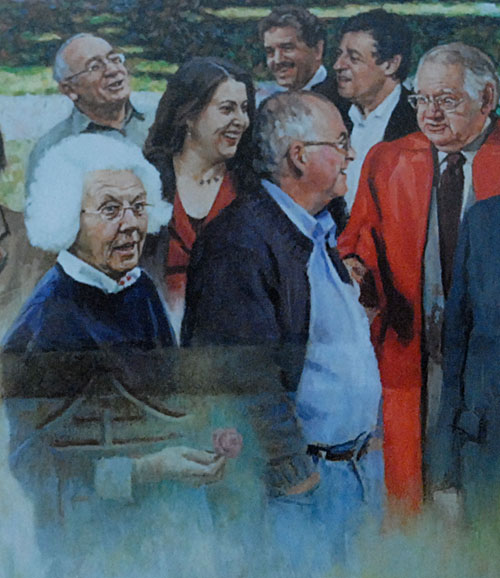
She and I were Fellows of the same College — Wolfson. The photograph is a detail from the mural commissioned to celebrate its 40th anniversary. Yours truly is the untidily-dressed chap to her left!

Update… Quentin has a lovely photograph of Karen.

The usefulness of footnotes

I’ve always liked Sam Goldwyn, the movie boss, if only for the charmed way he mangled the English language. He arrived in the US from Poland as Schmuel Gelbfisz, a name deemed unpronounceable by the US immigration official who dealt with him and promptly renamed him Goldfish. He then formed a partnership with a guy called Selwyn, and changed his name by combining the first half of Goldfish with the second half of Selwyn. (Wags later reasoned that if he’d done it the other way round he would have wound up as Selfish.)

Some of the stories about him are incomprehensible without footnotes. Take this one from Lillian Hellman’s memoirs:

At a postwar banquet for Field Marshal Montgomery, Goldwyn rose and proposed a toast to “Marshall Field Montgomery”. After a stunned silence, Jack L. Warner corrected him, “Montgomery Ward”.

Footnote 1: Marshall Field was (maybe still is, for all I know) a prominent Chicago Department Store.
Footnote 2: Montgomery Ward was a leading US mail-order chain.

Hellman also recounts a time when the head of his script department told him that the studio would be unable to film her play The Children’s Hour because it dealt with lesbians. “OK”, Sam said, “we make them Albanians”.

(Details courtesy of The Guinness Book of Humorous Anecdotes, edited by Nigel Rees.)

The other Google joke

TiSP. See here for a detailed guide.

Google TiSP (BETA) is a fully functional, end-to-end system that provides in-home wireless access by connecting your commode-based TiSP wireless router to one of thousands of TiSP Access Nodes via fiber-optic cable strung through your local municipal sewage lines.

Not anything like as subtle as Gmail Paper. Aimed at the 5- to 9-year-old male market I’d guess.

Gmail Paper

At last! A technical advance the rest of us can relate to.

A New Button
Now in Gmail, you can request a physical copy of any message with the click of a button, and we’ll send it to you in the mail.

Simplicity Squared
Google will print all messages instantly and prepare them for delivery. Allow 2-4 business days for a parcel to arrive via post.

Total Control
A stack of Gmail Paper arrives in a box at your doorstep, and it’s yours to keep forever. You can read it, sort it, search it, touch it. Or even move it to the trash—the real trash. (Recycling is encouraged.)

Keep it Secret, Keep it Safe
Google takes privacy very seriously. But once your email is physically in your hands, it’s as secure as you want to make it.

“But what about the environment?” I hear you cry. They’ve thought of that too.

But what about the environment?

Not a problem. Gmail Paper is made out of 96% post-consumer organic soybean sputum, and thus, actually helps the environment. For every Gmail Paper we produce, the environment gets incrementally healthier.

The really neat thing is that Quentin can use his fancy scanner to turn it all into PDFs.