
… in 1945, the Soviet Union announced the fall of Berlin and the Allies announced the surrender of Nazi troops in Italy and parts of Austria.
Category Archives: Asides
US begins to get its act together on cyberattack
A panel of experts deliberating under the auspices of the National Science Foundation has come up with a report which is highly critical of the US’s approach to the threat of cyberattack and has issued this list of recommendations:
1. The United States should establish a public national policy regarding cyberattack for all sectors of government, including but not necessarily limited to the Departments of Defense, State, Homeland Security, Treasury, and Commerce; the intelligence community; and law enforcement. The senior leadership of these organizations should be involved in formulating this national policy.
2. The U.S. government should conduct a broad, unclassified national debate and discussion about cyberattack policy, ensuring that all parties—particularly Congress, the professional military, and the intelligence agencies—are involved in discussions and are familiar with the issues.
3. The U.S. government should work to find common ground with other nations regarding cyberattack. Such common ground should include better mutual understanding regarding various national views of cyberattack, as well as measures to promote transparency and confidence building.
4. The U.S. government should have a clear, transparent, and inclusive decision- making structure in place to decide how, when, and why a cyberattack will be conducted.
5. The U.S. government should provide a periodic accounting of cyberattacks undertaken by the U.S. armed forces, federal law enforcement agencies, intelligence agencies, and any other agencies with authorities to conduct such attacks in sufficient detail to provide decision makers with a more comprehensive understanding of these activities. Such a periodic accounting should be made available both to senior decision makers in the executive branch and to the appropriate congressional leaders and committees.
6. U.S. policy makers should judge the policy, legal, and ethical significance of launching a cyberattack largely on the basis of both its likely direct effects and its indirect effects.
7. U.S. policy makers should apply the moral and ethical principles underlying the law of armed conflict to cyberattack even in situations that fall short of actual armed conflict.
8. The United States should maintain and acquire effective cyberattack capabilities. Advances in capabilities should be continually factored into policy development, and a comprehensive budget accounting for research, development, testing, and evaluation relevant to cyberattack should be available to appropriate decision makers in the executive and legislative branches.
9. The U.S. government should ensure that there are sufficient levels of personnel trained in all dimensions of cyberattack, and that the senior leaders of government have more than a nodding acquaintance with such issues.
10. The U.S. government should consider the establishment of a government-based institutional structure through which selected private sector entities can seek immediate relief if they are the victims of cyberattack.
11. The U.S. government should conduct high-level wargaming exercises to understand the dynamics and potential consequences of cyberconflict.
12. Foundations and government research funders should support academic and think- tank inquiry into cyberconflict, just as they have supported similar work on issues related to nuclear, biological, and chemical weapons.
According to the NYT report,
The United States has no clear military policy about how the nation might respond to a cyberattack on its communications, financial or power networks, a panel of scientists and policy advisers warned Wednesday, and the country needs to clarify both its offensive capabilities and how it would respond to such attacks.
The NYT report also suggests that the US doesn’t rule out the use of nukes in retaliation to a cyberattack, but then goes on to quote Pentagon officials as saying that this is nothing new. The US, it seems, never rules out anything. This is apparently to keep potential aggressors guessing.**
Text of the Executive Summary of the NSF report (pdf) from here.
** Footnote: this didn’t deter Osama bin Laden & Co, though.
The Eye of the Needle
I’ve often thought that, in the obnoxiousness stakes, Andrew Lloyd-Webber ranks just below Jeffrey Archer, the so-called ‘novelist’, in that the same joke can apply to either:
First man: Why did you take an instant dislike to Jeffrey Archer/Andrew Lloyd-Webber?
Second man: I found that it saved time.
Now comes a lovely blog post by Sean French
In today’s Mail on Sunday Andrew Lloyd-Webber compares the tax-raising Labour Party to Somali pirates.
Thirty years ago I was, in a way, an employee of Lloyd-Webber. In my gap year I worked as a stagehand at London’s Palace Theatre where Jesus Christ Superstar was then in its sixth year. I used to collect the ointment jar from Mary Magdalene and prepare the incense for the orgy scene in the temple. I estimate that I sat through the musical about 150 times.
I will make no comment about the effect of that experience on me and my feelings towards Lloyd-Webber, except to say that it would give me great pleasure if circumstances arose so that he was able to experience Somalian piracy at first hand.
Me too. Strange: until now I’ve felt quite hostile towards those pirates.
Health warning: Ballsheimer’s disease reaching epidemic proportions
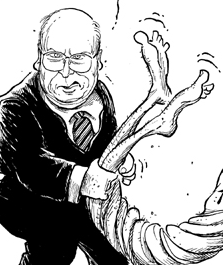
Jon Stewart has uncovered evidence of a new disease that is sweeping through the ranks of senior members of the Bush administration. It’s called Ballsheimer’s Disease. The symptoms are acute memory loss concerning unpalatable facts, and superhuman levels of effrontery. A prominent victim is former Vice-President Dick Cheney who last week was observed campaigning for freedom of information and the publication of classified documents. There is currently no known cure for the condition, though neuroscientists claim that some patients have been helped by lobotomy.
Former President George W. Bush is reported to be setting up a FaceBook group to campaign for better treatment for Ballsheimer’s sufferers. Interviewed at his ranch in Crawford, Texas, Mr Bush said that he would be setting up the group just as soon as he had located his Profile.
Anti-social networking
Well, well. Why am I not surprised by this?
A police officer has been given a written warning after he posted on his Facebook page that he was going to “bash” demonstrators at the G20 protests.
PC Rob Ward’s message was apparently published on the social networking website shortly after the death of newspaper seller Ian Tomlinson. His status, timed at 8.17pm on April 1, read: “Can’t wait to bash some long haired hippys (sic) up @ the G20.” Twenty minutes later a reply was posted saying: “LMAO (laughing my a*** off) dats bad but good in da same way lol (laugh out loud).”
The policeman’s page has now been taken off Facebook.
A Scotland Yard spokeswoman said: “A PC from Enfield was today given a written warning under public conduct regulations.” She confirmed the officer would face no further disciplinary action.
Coincidentally, I saw this news report shortly after reading this blog post by someone I follow on Twitter:
I know two policemen well. They are both good guys and in my age group, I’m 48. One’s a traffic copper and the other works in the drug squad. Both hate their jobs. They have two complaints. The first is the familiar one of red tape and stupid laws obstructing their ability to do their work properly. The other, I feel, is directly related to the type of stories that are making it into the news this week.
The force, they tell me, has been infiltrated by people who are not really interested in our society and its well being. Instead, they like the pay and conditions, not to mention the generous pension arrangements. More disturbingly, they like power and actually seem to enjoy violence. They show little regard or respect for any member of society regardless of race or social class. They have a deep set ‘us and them’ attitude that is, in my opinion, both wrong and probably rather dangerous.
Take a look at the films of the police problems at the protests. Now mentally remove the uniforms (for those that were actually wearing any) and dress the guys in a football shirts or even hoodies. Get the picture?
And, while we’re on the subject, here’s an interesting YouTube video which illustrates current police attitudes towards being photographed or filmed:
On this day…
… in 1945, the US and Soviet armies linked up on the river Elbe River, a meeting that marked the end for Hitler’s Germany — and sealed the fate of Europe for several generations.
Fools’ Gold
Howard Davies reviews Gillian Tett’s book on the banking catastrophe in today’s Financial Times. Excerpt:
The thesis of Fool’s Gold is that a small group of clever quants at JPMorgan invented credit derivatives, all those dangerous acronymic creatures – CDOs, CLOs and the like – that we have come to know as the crisis has evolved. But it was other, greater fools, in other banks, who misunderstood and misused them.
[…]
She introduces us to the individuals who made it all happen: Bill Winters, Peter Hancock and Bill Demchak in the US, Blythe Masters and Tim Frost in London. Winters and Masters are still with the bank; the others have moved on. Masters is still the high priestess of securitisation as chair of New York’s Securities Industry and Financial Markets Association, though when she speaks in public these days, notes Tett, “in deference to the dark mood of the times, she wears a sombre, chocolate-brown suit, instead of her usual jewel-toned hues”. Such subtle semiotics are not available to men – it’s not fair. Frost emerges as a kind of Macavity the mystery cat: now a firework inventor, now a trader, then creatively salvaging a structured investment vehicle (SIV), and today an advisor on restructuring to the Bank of England.
The innovations that emerged from the fertile minds of this talented team were supposed to make the world safer. They allowed risks to be sliced and diced and spread around the globe, held by those best able to bear them. This narrative, assiduously promoted by the banks, was generally accepted by the financial authorities at the time. In its 2006 annual report, the International Monetary Fund (IMF) noted that: “The dispersion of credit risk by banks to a broader and more diverse set of investors … has helped to make the banking and overall financial system more resilient … improved resilience may be seen in fewer bank failures.”
But in the wrong hands these fireworks proved to be, well, explosive…
Yep.
The Twitter book

Coming soon, apparently. Hard copy not yet in the shops, but you can buy a pdf download for $15.99. Seems a bit steep to me, much as I love O’Reilly’s stuff. Besides I’m saving up for a really good book on Drupal.
Models of the banking crisis
I’m an engineer. I don’t understand finance, but I know something about how systems work, about feedback and complexity and emergence. And when I watch or read media ‘explanations’ of the banking crisis I invariably find that some aspects of the story seem to be missing.
All open dynamic systems, for example, have inputs which they transform into outputs — like so:
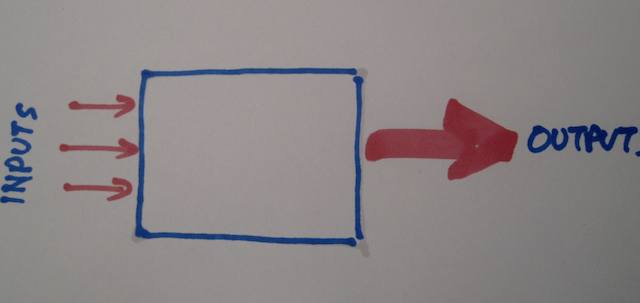
We know that the global financial system went into overdrive creating products that turned out to be unbelievably toxic. So an obvious question — to an engineer at least — is: where did the money come from to make these dodgy loans possible? What were the inputs to this crazy system? The answer turns out to be incredibly cheap money from China and the oil-rich Middle Eastern countries:
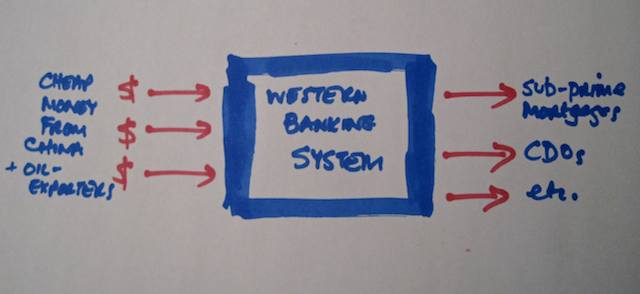
So: cheap money in, dodgy financial products out. As the Greenspan-sponsored post 9/11 economic boom gathered pace, China found itself running an enormous balance-of-trade surplus. So, to a lesser extent, did those countries which produce crude oil. They all found themselves with huge revenues and nowhere to put them to productive use. So they lent wholesale — at very low interest rates, because after all the supply of funds outstripped demand, thereby driving down interest rates — to Western banks and financial institutions. These, in turn, finding themselves able to obtain vast quantities of money cheaply, looked for ways of turning a profit on it. They could — and presumably did — lend some of it to credit-worthy institutions. But that was a finite market. So they looked around for a marketing opportunity — and found it in all those hard-up folks who aspired to buy a house but had hitherto been unable to obtain a mortgage. As one banker said on Dispatches the other night, it got to the point where “if you could breathe” someone would offer you a mortgage.
Now you might argue that these simple input-output models are too crude to be taken seriously. And perhaps they are. But I’ve just come on an interesting paper by an American economist, James Hamilton, which he presented at a conference organised by the Brookings Institution, a very fancy Washington-based think tank. Professor Hamilton is a student of oil prices and their impact, and he had previously published some stuff about the long-term impact of the oil-price rises in 2003. On his blog he wondered what the recent spike in oil prices might mean.
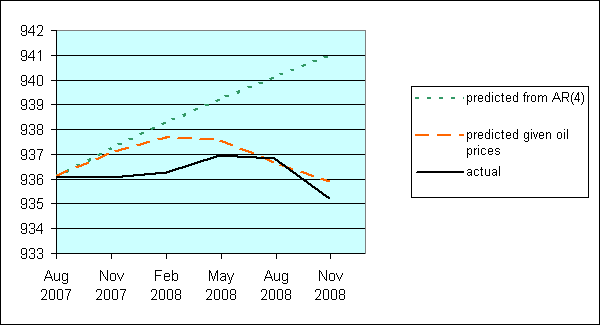
One of the most interesting calculations for me was to look at the implications of my 2003 model. I used those historically estimated parameters to find the answer to the following conditional forecasting equation. Suppose you knew in 2007:Q3 what GDP had been doing up through that date and could know in advance what was about to happen to the price of oil. What path would you have then predicted the economy to follow for 2007:Q4 through 2008:Q4?
The answer is given in the diagram below. The green dotted line is the forecast if we ignored the information about oil prices, while the red dashed line is the forecast conditional on the huge run-up in oil prices that subsequently occurred. The black line is the actual observed path for real GDP. Somewhat astonishingly, that model would have predicted the course of GDP over 2008 pretty accurately and would attribute a substantial fraction of the significant drop in 2008:Q4 real GDP to the oil price increases.
He goes on:
“The implication that almost all of the downturn of 2008 could be attributed to the oil shock is a stronger conclusion than emerged from any of the other models surveyed in my Brookings paper, and is a conclusion that I don’t fully believe myself. Unquestionably there were other very important shocks hitting the economy in 2007-08, first among which would be the problems in the housing sector. But housing had already been subtracting 0.94% from the average annual GDP growth rate over 2006:Q4-2007:Q3, when the economy did not appear to be in a recession. And housing subtracted only 0.89% over 2007:Q4-2008:Q3, when we now say that the economy was in recession. Something in addition to housing began to drag the economy down over the later period, and all the calculations in the paper support the conclusion that oil prices were an important factor in turning that slowdown into a recession.
This is intriguing, but it’s also another black-box, input-output model. In Professor Hamilton’s case it’s oil-shocks in, economic downturn out.
Deep waters, eh, Holmes? But wouldn’t it be funny if we could predict large-system behaviour with such crude models.
Forty years on

The Open University, where I’ve worked for most of my career, is 40 years old today. It’s come a long way since it was known as “The University of the Air”, when academics at other universities made sniffy jokes about our students getting pass degrees if they had black-and-white televisions and honours only if they had colour sets. I came here from Cambridge via a series of improbable coincidences and vowed to myself that I would leave when I got bored. I’m still here — though to be honest there are times in committee meetings when I have temporarily lost the will to live. But that’s true of all universities, nowadays. At its best — when it’s innovating — the OU is still the best place in the educational world to be. And I have some really terrific colleagues here. Also we have more iTunesU downloads than almost anyone else in the business. And there are some Very Big Developments in the pipeline — though you can’t hear about them yet unless you sign an NDA. Patience, patience — all will be revealed in a few months.
So now the OU is big and successful — and entering early middle age. And you know what that means. Ask Microsoft, which is currently trying to recover its lost youth. So maybe it’s appropriate that our next Vice Chancellor, Martin Bean — who takes up his post in the Autumn — is currently a Very Senior M$ executive! The old Chinese curse still applies: may we live in interesting times.