
Xmas comes to London

Seen in Covent Garden the other day.
Quote of the Day
“The secret of life is honesty and fair dealing. If you can fake that, you’ve got it made.”
- Groucho Marx
Musical alternative to the morning’s radio news
The Chieftains | Carolan’s Concerto
Turlough O’Carolan (1670-1738) was a gifted Irish harper, composer and singer who was blinded by smallpox at the age of 18. For almost fifty years, he travelled from one end of Ireland to the other, composing and performing. According to Wikipedia many of his songs are designated as “planxties”, an obscure word that Carolan apparently invented or popularized to signify a tribute to a merry host. (The great modern Irish folk group Planxty took their name from the term.) In return for writing songs in honour of wealthy patrons, Carolan was often welcomed as an honoured guest to stay on their estates. It is said that weddings and funerals were sometimes delayed until he could arrive to perform. This is my favourite tune of his.
Long Read of the Day
Buying Trump’s favour puts tech bros on the wrong side of history
My latest Observer column
Elon Musk and a handful of venture capitalists bet the ranch on Trump in his second term. The rest of the tech moguls waited until he won the 2024 election, and then paid for protection. Either way, it hasn’t turned out to be much of an investment, not least because they will now have to deal with an energised Congress that is not enamoured of them.
The new legislature will be full of politicians representing districts that loathe the datacentres the industry insists on building. And it will also have a fair number of legislators who think that it is high time the tech industry was brought under some kind of regulatory control.
For now, though, all we’ve got to go on is the fact that the Silicon Valley crowd decided to suck up to Trump. And the only entertaining thing we got from that was a photographic record of cringe-making abasement. Think, for example, of the image of simpering tech titans in the front row seats at Trump’s inauguration. Plus, images of White House dinners hosted by the president with them on either side of him.
Or that gathering in the Oval Office with Trump at the Resolute desk and the stars of Silicon Valley gathered in a large semi-circle, grinning inanely. Or the moment when Apple’s then chief executive Tim Cook, hitherto the sainted successor to Steve Jobs, presented Trump with a hideous glass disc on a 24-carat gold base. Truly (pace Samuel Johnson), sycophancy is the last refuge of a scoundrel.
Although Musk was first of them to throw in his lot with Trump (he contributed nearly $300m towards Trump’s 2024 campaign and personally campaigned for him in Pennsylvania), most of the other tech bros only started to sidle up after the result of the election was clear. Their procession spurred some of us into thinking about an earlier historical moment in Germany.
The year was 1933. In January, Adolf Hitler had been appointed chancellor, but a general election was coming on 5 March and the Nazi party was flat broke. On 20 February, about two dozen leading industrialists were invited to meet Hitler and Hermann Göring at the latter’s residence.
The invitees included a senior board member of the IG Farben chemical conglomerate; the head of Krupp, the largest company in Europe at the beginning of the 20th century, as well as Germany’s leading weapons manufacturer; Albert Vögler, chief executive of the world’s second largest steel company; and a number of formidable but lesser corporate leaders.
Hitler arrived late and told the industrialists what he proposed to do if his party won enough seats in the forthcoming election to give him a parliamentary majority.
“Hitler did not take questions from his audience,” wrote the historian Adam Tooze in his book The Wages of Destruction, “nor did he spell out exactly what was expected of the business leaders. He had not come to negotiate. He had come to inform them of his intentions.”
But they got the message: Hitler was most likely to win and it would be dangerous to be on the wrong side of him. The industrialists duly forked out to the tune of more than 2 million reichsmarks for the Nazi party. Most of them were probably not Nazi supporters, and many would have been wary or disdainful of him in the earlier days. So, initially, they probably had hedged their bets and aligned themselves with Hitler only when the possibility of him gaining power became real.
Something similar probably went on in the minds of the tech moguls. Among the few who supported Trump in 2016, the most prominent was Peter Thiel, who was always an outlier in the valley community. And there was also a fair amount of tech hostility to Trump in 2020. Facebook banned him the day after the insurrection at the US Capitol on 6 January 2021, and what was then Twitter followed the next day.
It was after 2022 that things began to change. Musk bought Twitter for $44bn in October and reinstated Trump’s account in November. Facebook parent Meta followed suit in early 2023. In May 2024, the New York Times noticed that some of Silicon Valley’s most prominent investors were turning against the Biden administration.
In June, David Sacks, a prominent venture capitalist, hosted a fundraising dinner for Trump – tickets were priced at $50,000 and $300,000 – that brought in more than $12m. In July, another pair of prominent venture capitalists, Marc Andreessen and Ben Horowitz, endorsed Trump in their podcast. The mood in the valley, then, was clearly changing.
It was only after the election in 2024, though, that the bigger players – Mark Zuckerberg, Jeff Bezos, Sundar Pichai, Sam Altman, Cook and Nividia’s recently departed CEO Jensen Huang – came off the fence and fell into line. The majority of them donated to Trump’s inauguration fund and, in return, were seated prominently at the great event. But, really, they were paying protection money to keep Trump sweet.
Ultimately, things didn’t work out so well for their German counterparts, some of whom wound up in the dock postwar at the Nuremberg trials. For the tech bros, the US midterm results are also bad news.
Turns out they paid for protection to a guy who can no longer provide it. And they may still wind up having to attend White House dinners and dancing tangos in the $600m (and rising) ballroom that they helped to fund.
My commonplace booklet
Larry Lessig, writing about his mentor and friend Richard Posner
They say, “Don’t meet your heroes.” Posner was the exception to this rule. Everything about him was more than anyone could reasonably expect. Obviously, he was brilliant, extraordinarily productive, endlessly creative. More importantly, he was decent and loving and gentle. He did not deserve the quiet humility that he carried, always. His friends, his clerks, those who loved him, even those who criticized him, allowed him that flaw.
But the characteristic that has always struck me most comes from a story from more than 30 years ago. I was a young law professor, just starting at Chicago. In the summers, I would teach in Budapest at the Central European University Law School. Posner was writing what would be one of his most controversial books, Sex and Reason (1994). He shared a draft with me and asked for my comments. The book is brilliant and interesting, but especially its early versions had real points to criticize. Maybe it was jet lag, but I wrote him extensive and, as I remember, ridiculously harsh comments.
The next morning, I regretted my tone. I faxed him an apology. (These were the days before email). Almost immediately, there was a reply. I need to find it, as I’m sure I’ve saved it, but it was a single paragraph, and I remember it saying something like this:
“Please. I am surrounded by sycophants. The last thing I need is one more.”
Linkblog
Something I noticed, while drinking from the Internet firehose.
*Ohm’s law explained
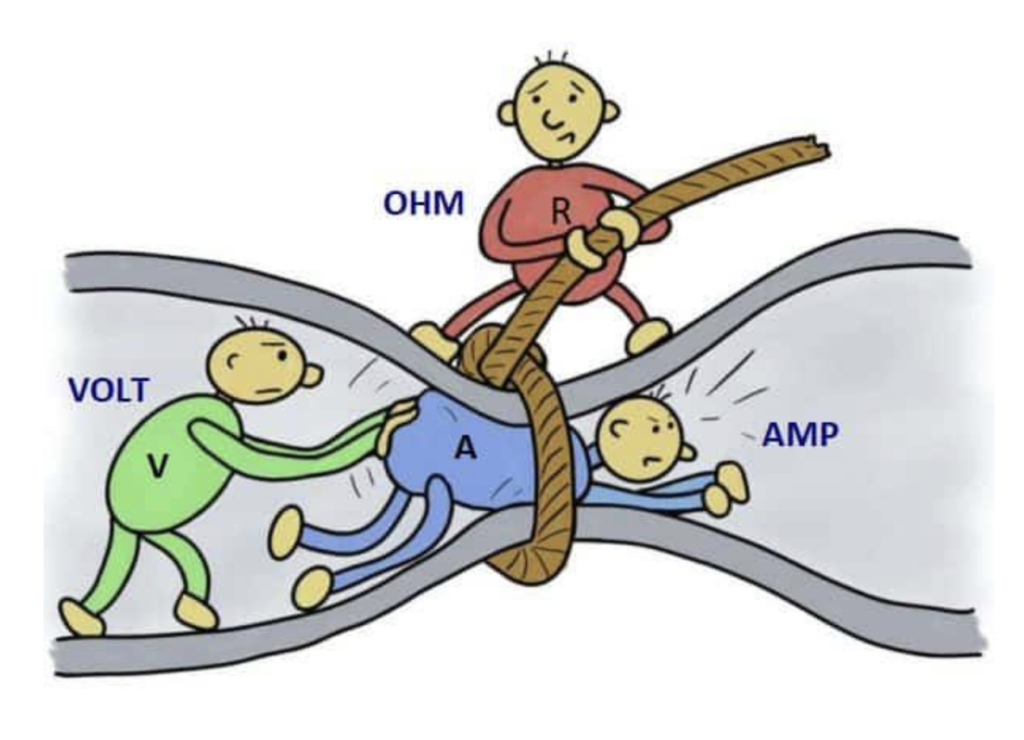
As I’m sure you know, voltage equals electric current divided by the resistance of the conductor.
Thanks to Quentin Stafford-Fraser for spotting it.
One overlooked aspect of the Nvidia crisis
As nailed by Charles Arthur (Whom God Preserve):
Once it turned out that Jensen Huang had not one, not two, but three affairs his goose was truly cooked. Imagine though how amazingly effective Nvidia could be if its chief executive isn’t having to buy three sets of flowers and scented candles every day.
This Blog is also available as an email three days a week. If you think that might suit you better, why not subscribe? One email on Mondays, Wednesdays and Fridays delivered to your inbox at 5am UK time. It’s free, and you can always unsubscribe if you conclude your inbox is full enough already!