
Wizard stuff

King’s Cross, yesterday. The Harry Potter industry continues to thrive. It must be one of Britain’s biggest cultural exports.
Quote of the Day
”Potentially, TV can transform the Presidency into a monarchic dynasty. A merely elective Presidency scarcely affords the depth of dedication and commitment demanded by the TV form. Even teachers on TV seem to be endowed by the student audiences with a charismatic or mystic character that much exceeds the feelings developed in the classroom or lecture hall.”
- Marshall McLuhan in Understanding Media. Prescient, eh?
Musical alternative to the morning’s radio news
Abdullah Ibrahim | Soweto
Keeps me going, sometimes.
Long Read of the Day
The Nobel Prize is not an exact science
Lovely essay by Tim Harford (Gift article)
Visitors to the Nobel Prize Museum in Stockholm will see celebrations both of the life and achievements of Alfred Nobel, and the life and achievements of a thousand laureates — scientists, writers, politicians and even a few economists. Their personal effects, too: books, clothes and even a pair of skis are on display.
I was a visitor myself this year. What I failed to detect among the exhibits was much sign of self-doubt. The museum never quite claims that the Nobel Prize is a secular benediction, awarded by infallible institutions, raising its recipients to the level of intellectual saints, but the vibes are in that direction.
That is a shame. Leave aside those prizes for literature that somehow never were awarded to Virginia Woolf or Leo Tolstoy. (Even at the time, the omission of Tolstoy was something of a scandal.) Forget the small matter of the Peace Prize for Henry Kissinger and Lê Đức Thọ.
Don’t fret too much about the prize for economics, which offers its own diversions. It has repeatedly been split between people who disagree with each other on the central question of the prize. Gunnar Myrdal and Friedrich Hayek shared the prize in 1974; Myrdal was a champion of the Swedish welfare state, while Hayek warned that central planning was the road to serfdom. Robert Shiller and Eugene Fama were among the winners in 2013, Shiller for his demonstrations that stock markets are not efficient, and Fama for his demonstrations that they are. (I exaggerate . . . but not much.)
Read on. My only complaint is that he omits to mention Rosalind Franklin or Jocelyn Bell Burnell. I love Harford’s essays, which often come from left field — about things one should have thought about or questions one should have asked — but didn’t.
Books, etc.
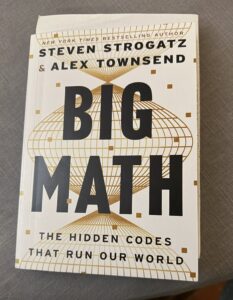
This just arrived. It’s a brave attempt by a pair of Cornell mathematicians to persuade a maths-phobic public that they’re living in a worlds underpinned by mathematics. I’ll be reviewing it for the Observer and am looking forward to the challenge.
My commonplace booklet
One of the reasons I love writing for the Observer (which I’ve done for more than 30 years) is that it was the newspaper that employed Kenneth Tynan as its theatre critic. I’ve long admired his writing, and envied its apparent flowing ease. (His review of Waiting for Godot is a masterpiece that I still re-read from time to time, rather as Somerset Maugham used to read Candide before embarking on a novel, to cleanse his literary palate, as it were.)
But it turned out that all that apparent ease and fluency was a myth. I learn from James Wolcott’s LRB review of Tynan’s diaries that
the Observer reviews didn’t ripple from his fingertips like pearly notes, despite appearances. It’s a consolation to any writer who has envied and marvelled at the epigrammatic ease of his reviews to discover that he had to lash himself to the mast to meet a deadline, pulling all-nighters fuelled by cans of soup or corned beef hash, bottles of hock and packs of cigarettes (‘When I opened the door of his study the smoke, as if from a nuclear blast, shot out to engulf me’), emerging like Dracula from his crypt when he was done. ‘He woke me when he was finished to give me his copy and at that moment he always looked very strange; rather insane.’ The skating charm of his writing required deeper reservoirs of mental-physical stamina and willpower than anyone other than Dundy knew; to hit near-perfection week after week, he was borrowing against the future.
So maybe the adage that “nothing that is read with pleasure is written without pain” is spot on. Given that I’ve written 50 columns a year every year since 1987, people often ask me if I like writing. My reply: “I like having written”.
This Blog is also available as an email three days a week. If you think that might suit you better, why not subscribe? One email on Mondays, Wednesdays and Fridays delivered to your inbox at 5am UK time. It’s free, and you can always unsubscribe if you conclude your inbox is full enough already!