
Figures on a beach

You have to squint to see the people. I love the limitless skies and huge beaches of North Norfolk. This is Brancaster.
Quote of the Day
“America has a choice. We can have great wealth in the hands of a few, or we can have a democracy. But we cannot have both.”
- Justice Louis Brandeis
Musical alternative to the morning’s radio news
John Field | Piano Concerto No. 2 in A-Flat Major, H. 31: II. |Poco adagio
Long Read of the Day
Susan Sontag’s Playground of Ideas
Regular readers will know that I am a great fan of notebooks — and will therefore understand why I alighted on this essay by Jillian Hess, who has been reading Susan Sontag’s notebooks in the UCLA’s archives. Sontag was a compulsive note-taker and left 100 notebooks to her son, David Rieff; on her deathbed she told him that they were “the most important thing” she had bequeathed to him. In the piece there are lots of photographs of pages from the notebooks. I particularly liked the list she made of the writers she needed to deal with in her book Against Interpretation.
Hope you enjoy this as much as I did.
Books, etc.
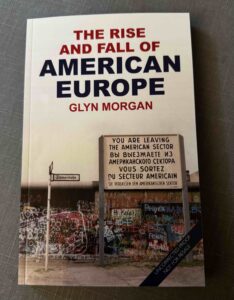
This arrived the other day. (Publishers often send me unsolicited proof copies of forthcoming titles.)
As it happens, it looks interesting and timely, because the future and identity of ‘Europe’ have suddenly become more questionable than any of us supposed until Trump and J.D Vance articulated their contemptuous view of the continent.
Glyn Morgan is an historian who points out that the Europe my generation grew up in was essentially a creation of the post-war American state. From 1946 onwards, the U.S. Administration pushed reluctant Europeans to create a federation of democratic states. In doing so, they gave birth to what Morgan called an ‘American Europe’ — a new political order protected by the U.S. military and buoyed by transatlantic trade.
In the introductory chapter, he gives an interesting example of how this worked.
In 1946, the French government were desperate to secure the forgiveness of their war debts and to secure a loan. They were ultimately successful, but the US government drove a hard bargain, including forcing the French to open their movie theatres to foreign films (essentially US films). As part of the deal, French films were only allowed to be shown for four weeks out of thirteen. It’s not clear whether such a deal counts as an act of an imperial power, an act of accepting an invitation, or an ordinary financial transaction between stronger and weaker parties. Nonetheless, this ‘money for movies’ deal provided the French government with ample warning that they would be playing a subordinate role in the new American Europe.
It also, incidentally, led de Gaulle to decide that France needed its own nuclear deterrent.
My commonplace booklet
Bombing as entertainment
Fintan O’Toole has a great column in the Irish Times (behind a paywall) about the war between Trump and Iran. He opens the piece with the previous experiment in bombing countries into oblivion — the allied offensive in Germany during WW2 — and the sobering findings of J.K. Galbraith’s retrospective analysis of that campaign: “as bombing intensified, war production increased.” Galbraith determined that by September 1944, when the US and British bombing campaign reached its peak, German production of military aircraft was “nearly twice what it was before the raids”.
But at least in WW2 the carpet bombing had an ostensible purpose, even if it turned out to be cruel and misguided. The difference between then and now, O’Toole writes,
is that there is no real pretence of purpose and no real effort at justification. This ostentatious insouciance is novel. When Trump announced that he might bomb Iran’s oil facilities on Kharg Island “a few more times just for fun”, a new note was being sounded in human history – the open relishing of annihilation as entertainment.
Entertainment doesn’t have to work. There will be no need to send today’s equivalent of Galbraith to Iran to figure out how effective all this violence has been. Who bothers to ask how effective a giant fireworks display was? It made a big bang, created an exciting spectacle and cost a fortune. It showed off our wealth and power and was fun while it lasted. We bombed our little hearts out.
Feedback
- The photograph of the Gibbs Building in Monday’s edition sparked some memories, and a lovely email from Bill Lubenow, the distinguished historian of British intellectual life.
The Popper/Wittginstein confrontation took place in H1 in rooms occupied by Richard Braithwaite (a member of the Moral Sciences Club and an Apostle where the Apostles met frequently) and Christopher Morris. The poker was Braithwaite’s. It is remarkable to think about how much knowledge (understanding and generalized) is local and intimate. It reminds me of the “Circus” which did so much help form [Keynes’s] ideas for the General Theory.
Bill wrote the definitive book on the Cambridge Apostles.
- Thanks to Aoife Midgley for pointing out that the correct spelling for ‘bright’ in Irish is Geal, rather than Gael. A portion of humble pie has been duly consumed.
This Blog is also available as an email three days a week. If you think that might suit you better, why not subscribe? One email on Mondays, Wednesdays and Fridays delivered to your inbox at 5am UK time. It’s free, and you can always unsubscribe if you conclude your inbox is full enough already!