
On the road…
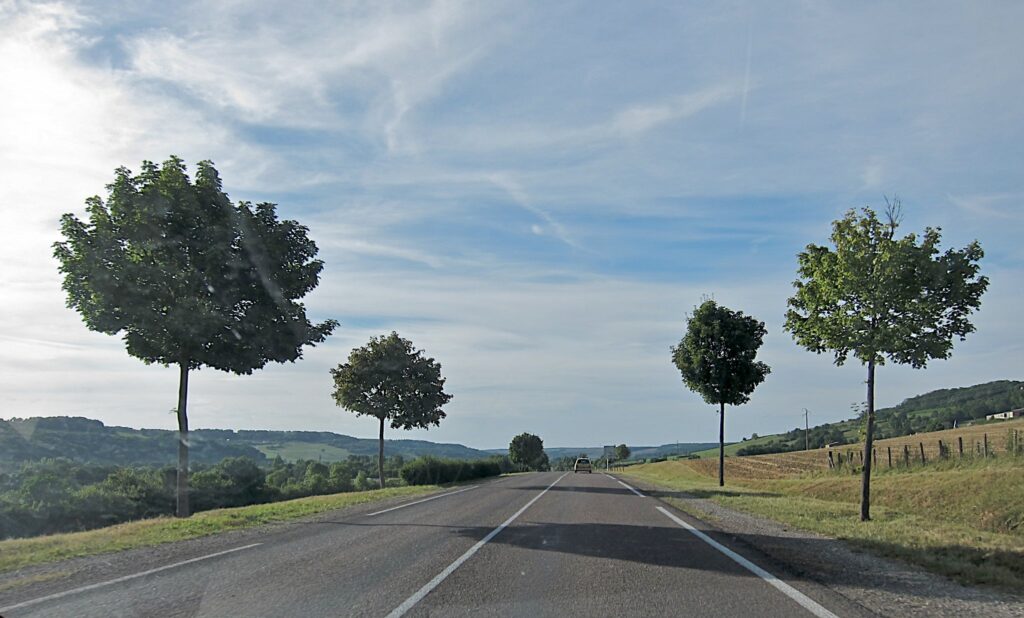
… in Burgundy, September 2012.
Quote of the Day
“Courage is the only virtue you can’t fake”.
- Nassim Nicholas Taleb
Musical alternative to the morning’s radio news
Pentangle | Goodbye Pork Pie Hat
Long Read of the Day
America has identified its greatest enemy: Western Europe
I can’t understand why European states continually fail to understand the implications of J.D. Vance’s speech to the Munich Security Conference. Which is why Henry Farrell’s latest essay on what the US National Security Strategy has become under Trump was so welcome. In it he distills what he learned from a recent closed-door, high-level conference he attended in Switzerland. And it’s salutary stuff.
Sample:
It has been clear for some while that the Trump administration has a … novel … understanding of America’s relationship with Europe. But it has not always been as clear as it ought be to European officials. These officials have often vacillated in response to previously unthinkable demands, sometimes making concessions, sometimes looking to preserve a little autonomy. Brief shocks (such as J.D. Vance’s speech at Munich) have not been sufficient to galvanize long term coherence.
[…]
The National Security Strategy declares that Europe is not just in economic decline, but faced with the prospect of “civilizational erasure.” The “European Union and other transnational bodies” are undermining “political liberty and sovereignty.” Europe is riddled with “censorship of free speech and suppression of political opposition.” It is led by “unstable minority governments, many of which trample on basic principles of democracy to suppress opposition.” Most fundamentally, Europe is being turned into a zone of “strife” by migration policies, so that it will be “unrecognizable” in two decades. Certain NATO members will become “majority non-European”and no longer reliable allies. It doesn’t take much sophistication to decipher what terms like “majority non-European” are intended to mean.
However, the NSS says, America “cannot afford to write Europe off.” Instead, it will work to foster what it calls “genuine democracy, freedom of expression and unapologetic celebrations of European nations’ individual nations’ character and history.” America “encourages its political allies in Europe to promote this revival of spirit, and the growing influence of patriotic European parties indeed gives cause for great optimism.” To help all this along, the NSS says that America will undertake actions which include “[c]ultivating resistance to Europe’s current trajectory within European nations” and “[b]uilding up the healthy nations of Central, Eastern, and Southern Europe through commercial ties, weapons sales, political collaboration, and cultural and educational exchanges.”
This is, quite straightforwardly, a program for regime change in Europe, aimed at turning it into an illiberal polity. Accomplishing this transformation would involve undermining existing liberal governments in cahoots with Europe’s own far right, and turning Eastern Europe into an ideological wedge against its Western neighbors…
When Russia invaded Ukraine I remember thinking that the post-war “holiday from history” that we Europeans have enjoyed is over. Not only is the US no longer a potential ally, it’s turning into an adversary. We’re into an entirely new game.
Books, etc.
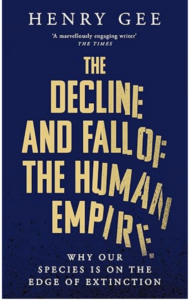
Ever since I first read Yuval Noah Harari’s Sapiens I’ve had the thought that maybe we humans were’t such a good thing for the planet. Henry Gee, a palaeontologist, hammers this message home in his new book. I was first alerted to it by a splendid episode after listening to a Past, Present, Future episode in which he talks to David Runciman. The (only) cheery thought is that we may still have 10,000 years to go before we’re extinct.
My commonplace booklet
From Niall Ferguson, writing about the AI feeding frenzy. He’s reminded of the Dr Suess story in which Sam-I-Am is continually trying to sell ‘Green Eggs and Ham’ to people.
When you come to think of it, there is often someone called Sam trying to sell you something you don’t initially want. In the 1920s, as I learned from Andrew Ross Sorkin’s 1929: Inside the Greatest Crash in Wall Street History and How It Shattered a Nation, it was Sam Crowther’s article, “Everybody Ought to Be Rich” — exhorting housewives to buy stocks with margin credit.
Which reminds me, I need to read the Sorkin book.
Feedback
My use of the Frans Hal’s portrait of a wealthy Dutchman prompted Sheila Hayman (Whom God Preserve) to point me to an interesting commentaryon Dutch still-life painting.
“The skull,” she writes
is actually the least interesting and crudest symbol of it; the link goes into all the details but, crudely, flowers and fruit are often depicted in full bloom/on the point of decay, which is the signifier of mortality and the transience of life; insects on or in them, ’the worm in the bud’ , signify that no physical thing is without its flaw, and only the immortal can attain perfection; and scientific instruments, mirrors, etc signify the vanity and conceit of human ambition.
Everything in one of these elaborate paintings has a meaning, in addition to the technical virtuosity it displays.
The great thing about being a blogger, as I’ve often observed, is that you continually learn stuff from your readers.
This Blog is also available as an email three days a week. If you think that might suit you better, why not subscribe? One email on Mondays, Wednesdays and Fridays delivered to your inbox at 5am UK time. It’s free, and you can always unsubscribe if you conclude your inbox is full enough already!