

Monday 6 April, 2026

Tulip Mania

These amazing multi-coloured tulips which suddenly appeared in our garden a couple of years ago, give one a hint of why the Dutch went mad about the bulbs in the mid-1600s.


Quote of the Day

”The modern conservative is engaged in one of man’s oldest exercises in moral philosophy; that is, the search for a superior moral justification for selfishness.”

  • John Kenneth Galbraith

Musical alternative to the morning’s radio news

J.S.Bach | Wachet auf, ruft uns die Stimme (Sleepers Awake) | Munich University choir.

Link

In the cantata (of which this is just a spectacular part), performed by the Netherlands Bach Society, everything revolves around the parable of the wise and foolish virgins. They wait throughout the night with burning lamps for the arrival of the bridegroom. Five of them have brought along extra oil to keep their lamps burning. The others run out of oil and go off to buy some more. The bridegroom arrives while they are away. Nice to wake up to it on Easter Day!


Long Read of the Day

It’s astonishing to watch from afar how Trump & Co are getting away with what they’re doing. A lot of it has to do with the extraordinary way that Congress has been cowed. But it also has something to do with the fact that cowardice is contagious (as people discovered in 1930s Germany).

This essay by historian Timothy Snyder outlines some of the grim possibilities that faces the American public over the months between now and November.

We are seven months away from the most consequential midterm election in the history of the United States. Meanwhile, we are fighting a war. These are the structural conditions for a coup attempt in which a president tries to nullify elections and take permanent power as a dictator. If we see this, we can stop it, overcome the movement that brought us to this point, and make a turn towards something better.

President Donald Trump and Secretary of State Pete Hegseth are stuck in the logic of escalation, according to which the feeling of defeat today can be reversed by doing the first thing that comes to mind tomorrow. Trump is surrounded by people who are making money from the war; each day of war strengthens a warmongering lobby with personal access to the president. As the war lengthens, the chance that it will be exploited for a coup attempt increases.

Trump tells us that he is chiefly concerned with the permanence of his own comfort and power (think about ballroom and bunker), much of which he will lose when his party is defeated decisively in the midterms. He regularly declares his intention to meddle in the elections. His party backed a bill which would have turned elections into a sham. Trump wants to increase the defense budget by nearly 50% without any review of what the money is for; this is strategic nonsense, and has to be understood as a payoff for the men who, as he imagines, will help him install a dictatorship. Hegseth is meanwhile purging the highest officer ranks of people of principle.

It is up to us to put two and two together: Trump will seek to exploit the war (or the next one) to alter the elections. We bear responsibility for what comes next.


Chart of the Day
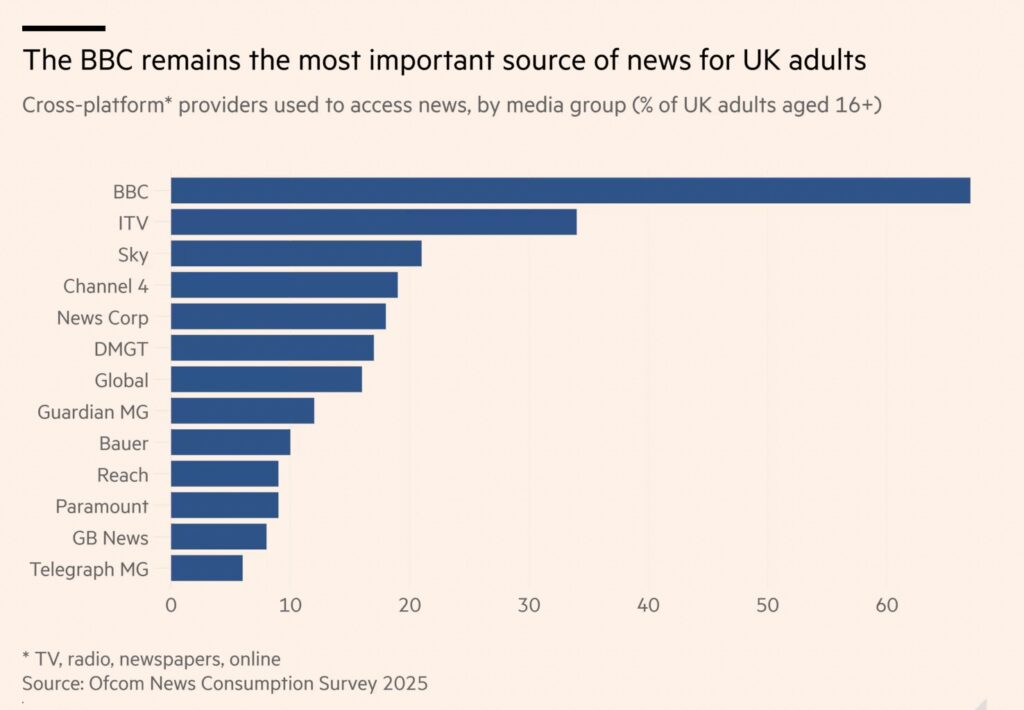
Screenshot

Which explains why it is important that the UK government continues to support the BBC as negotiations about the renewal of its Charter continue.


This Blog is also available as an email three days a week. If you think that might suit you better, why not subscribe? One email on Mondays, Wednesdays and Fridays delivered to your inbox at 5am UK time. It’s free, and you can always unsubscribe if you conclude your inbox is full enough already!


Friday 3 April, 2026

An orchid by any other name…

… is still an Orchid. Seen on a windowsill in College.


Quote of the Day

”Most people would sooner die than think; in fact, they do so.”

  • Bertrand Russell

Musical alternative to the morning’s radio news

Keith Jarrett | My Wild Irish Rose

Link

An unexpected find.


Long Read of the Day

Paul Krugman on Trump’s speech on Wednesday

I really enjoy Krugman’s Substack. It’s interesting to see how leaving the NYT (where he had a widely-read column for years) has energised him. Here’s Thursday’s edition:

I’m not going to do a regular post today — it’s Thursday morning — because I wanted to wait and see what was in the big speech from Donald Trump last night. And I thought I could just do a short video about it.

It turns out that the speech was sort of an anticlimax, although not in a good way. Many people expected Trump to pull the mother of all TACOs, to declare victory and surrender. He did not do that. He declared victory, of course, but he did not actually announce an end to hostilities. On the contrary, he said we’re going to bomb Iran into the Stone Age. So add massive war crimes to your schedule.

There is clearly no strategy here. There’s no endgame. There’s nothing. It’s hard to tell, as always, whether Trump is delusional or just completely unable to admit something that he actually knows.

One of the moments that really struck me in the speech was him declaring that the whole world was extremely impressed by what happened. He said,

“the whole world is watching and they can’t believe the power, strength and brilliance. They just can’t believe what they’re seeing. The world can’t believe what it’s seeing.”

What it’s seeing is that the world’s greatest military power took on a fourth-rate power. Again, as I said the other day, Iran’s military budget is a rounding error in our military budget. And we lost…


Books, etc.

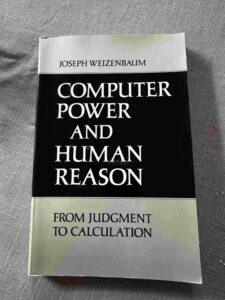
Ever since ChatGPT launched I’ve been thinking about Joe Weizenbaum, the computer scientist who created the world’s first chatbot — ELIZA — in the 1960s. And so I dug out his book (which now seems to be out of print, sadly) to re-read it. It’s as good as I remembered. And it’s fascinating to read it with the 20/20 vision of hindsight. It’s an examination of what computers can and cannot do — and, more interesting in the present context — what they should not be used to do.


My commonplace booklet

The cost of Trump’s war to British households

Interesting numbers from the Financial Times

The International Energy Agency reports that the UK consumed 4.4mn terajoules of oil and gas products in 2024. Convert this into a rough barrels of oil equivalent and you get 720mn barrels of oil. These have gone up about $40 a barrel since the Iran war started leaving UK consumers $29bn worse off.

When converted into sterling, that is hit of about £22bn a year or roughly 0.7 per cent of national income. 


Linkblog

Something I noticed, while drinking from the Internet firehose.

  •  The Beginning of Programming as We’ll Know It

Given all the nonsense that’s being written about “vibe coding”, I thought that this little essay by a real programmer was a delight.

In the wake of AI coding assistants like Claude and Codex, which can seemingly perform the equivalent of a day’s work in a matter of minutes, many of us are wondering if the human role of “computer programmer” is coming to an end. Will the AI bots one day do all the programming for us?

Maybe so, but not yet. At this particular moment, human developers are especially valuable, because of the transitional period we’re living through. Just a few years ago, AI essentially could not program at all. In the future, a given AI instance may “program better” than any single human in history. But for now, real programmers will always win. Why? Because we are uniquely positioned to harness most of the power of AI while augmenting it with human taste, wisdom, and caution, among other qualities that an AI is thus far incapable of possessing…

Worth a read, if you’re interested in this stuff.


Feedback

From Mark Allan on bombing as entertainment…

Re: Fintan O’Toole’s article that you reference, Adam Tooze’s work on the German economy during WWII suggests a more nuanced picture than Galbraith’s older work. Tooze is bilingual in English and German and used German sources to come to very different conclusions, in his book The Wages of Destruction.

The Allied bombing was horrific – but there is a strong argument that it did hasten the end of the war, crucially by enabling the Soviet Union to defeat Germany in the East. See this from the MoD – not an unbiased source but not necessarily wrong.

However, this argument about WWII bombing doesn’t change the fact that current Iran cannot be compared to Nazi Germany. Israel and the USA are clearly conducting an illegal war, and one with very bad consequences for the world as a whole.

I haven’t read Tooze’s book, so I went looking at reviews of it to get a feel for his arguments. James Buchan’s review in the Guardian provides a useful glimpse.

In his long new book, the Cambridge historian Adam Tooze presents the Third Reich as an engine doomed to smash itself to smithereens not, as for Speer, from bureaucratic turf wars and Hitler’s chaotic office habits, but from its own birth defects.

To sum up: Hitler’s Germany was always too hampered by shortages of raw materials, notably crude oil and rubber but also iron ore and coal, animal feed and fertiliser, foreign currency and even labour, to attempt an independent industrial and commercial existence in peace, let alone a campaign of European conquest. For all the ingenuity of cynical opportunists such as Hjalmar Schacht, at the Reichsbank until 1939, and Speer, at Armaments after 1942, Germany passed through a succession of hair-raising financial and resource crises that hampered its armies and helped to bring on the final collapse.


This Blog is also available as an email three days a week. If you think that might suit you better, why not subscribe? One email on Mondays, Wednesdays and Fridays delivered to your inbox at 5am UK time. It’s free, and you can always unsubscribe if you conclude your inbox is full enough already!

Wednesday 1 April, 2026

Figures on a beach

You have to squint to see the people. I love the limitless skies and huge beaches of North Norfolk. This is Brancaster.


Quote of the Day

“America has a choice. We can have great wealth in the hands of a few, or we can have a democracy. But we cannot have both.”

  • Justice Louis Brandeis

Musical alternative to the morning’s radio news

John Field | Piano Concerto No. 2 in A-Flat Major, H. 31: II. |Poco adagio

Link


Long Read of the Day

Susan Sontag’s Playground of Ideas

Regular readers will know that I am a great fan of notebooks — and will therefore understand why I alighted on this essay by Jillian Hess, who has been reading Susan Sontag’s notebooks in the UCLA’s archives. Sontag was a compulsive note-taker and left 100 notebooks to her son, David Rieff; on her deathbed she told him that they were “the most important thing” she had bequeathed to him. In the piece there are lots of photographs of pages from the notebooks. I particularly liked the list she made of the writers she needed to deal with in her book Against Interpretation.

Hope you enjoy this as much as I did.


Books, etc.

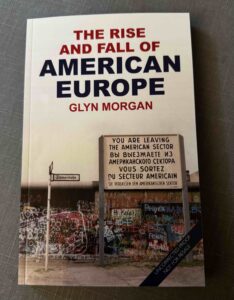
This arrived the other day. (Publishers often send me unsolicited proof copies of forthcoming titles.)

As it happens, it looks interesting and timely, because the future and identity of ‘Europe’ have suddenly become more questionable than any of us supposed until Trump and J.D Vance articulated their contemptuous view of the continent.

Glyn Morgan is an historian who points out that the Europe my generation grew up in was essentially a creation of the post-war American state. From 1946 onwards, the U.S. Administration pushed reluctant Europeans to create a federation of democratic states. In doing so, they gave birth to what Morgan called an ‘American Europe’ — a new political order protected by the U.S. military and buoyed by transatlantic trade.

In the introductory chapter, he gives an interesting example of how this worked.

In 1946, the French government were desperate to secure the forgiveness of their war debts and to secure a loan. They were ultimately successful, but the US government drove a hard bargain, including forcing the French to open their movie theatres to foreign films (essentially US films). As part of the deal, French films were only allowed to be shown for four weeks out of thirteen. It’s not clear whether such a deal counts as an act of an imperial power, an act of accepting an invitation, or an ordinary financial transaction between stronger and weaker parties. Nonetheless, this ‘money for movies’ deal provided the French government with ample warning that they would be playing a subordinate role in the new American Europe.

It also, incidentally, led de Gaulle to decide that France needed its own nuclear deterrent.


My commonplace booklet

Bombing as entertainment

Fintan O’Toole has a great column in the Irish Times (behind a paywall) about the war between Trump and Iran. He opens the piece with the previous experiment in bombing countries into oblivion — the allied offensive in Germany during WW2 — and the sobering findings of J.K. Galbraith’s retrospective analysis of that campaign: “as bombing intensified, war production increased.” Galbraith determined that by September 1944, when the US and British bombing campaign reached its peak, German production of military aircraft was “nearly twice what it was before the raids”.

But at least in WW2 the carpet bombing had an ostensible purpose, even if it turned out to be cruel and misguided. The difference between then and now, O’Toole writes,

is that there is no real pretence of purpose and no real effort at justification. This ostentatious insouciance is novel. When Trump announced that he might bomb Iran’s oil facilities on Kharg Island “a few more times just for fun”, a new note was being sounded in human history – the open relishing of annihilation as entertainment.

Entertainment doesn’t have to work. There will be no need to send today’s equivalent of Galbraith to Iran to figure out how effective all this violence has been. Who bothers to ask how effective a giant fireworks display was? It made a big bang, created an exciting spectacle and cost a fortune. It showed off our wealth and power and was fun while it lasted. We bombed our little hearts out.


Feedback

  • The photograph of the Gibbs Building in Monday’s edition sparked some memories, and a lovely email from Bill Lubenow, the distinguished historian of British intellectual life.

The Popper/Wittginstein confrontation took place in H1 in rooms occupied by Richard Braithwaite (a member of the Moral Sciences Club and an Apostle where the Apostles met frequently) and Christopher Morris. The poker was Braithwaite’s. It is remarkable to think about how much knowledge (understanding and generalized) is local and intimate. It reminds me of the “Circus” which did so much help form [Keynes’s] ideas for the General Theory.

Bill wrote the definitive book on the Cambridge Apostles.

  • Thanks to Aoife Midgley for pointing out that the correct spelling for ‘bright’ in Irish is Geal, rather than Gael. A portion of humble pie has been duly consumed.

This Blog is also available as an email three days a week. If you think that might suit you better, why not subscribe? One email on Mondays, Wednesdays and Fridays delivered to your inbox at 5am UK time. It’s free, and you can always unsubscribe if you conclude your inbox is full enough already!