
The House

From Will Blackburn in Sydney. One of the rewards of an early morning run!
Quote of the Day
”Narrative is strategy in story form.”
- Mark Laity, former head of strategic communications at NATO.
Musical alternative to the morning’s radio news
Randy Newman, Linda Ronstadt & Ry Cooder | Rider In The Rain
Long Read of the Day
How Jeffrey Epstein Became a Public Intellectual
Interesting insights from Ted Gioia
Elon Musk is now the wealthiest person in the world—and he’s making proclamations every day. He even bought his own social media platform, and posts his opinions constantly. He’s the reverse of Howard Hughes. You can’t escape him. And unless he flies off to Mars, you never will.
It’s not just Musk. There are dozens of billionaires who aspire to public intellectual status. Bill Gates serves up book reviews. Peter Thiel gives a lecture series. Tom Steyer makes speeches and offers himself as a candidate for President.
We have come a long, long way from the working class intellectuals and soapbox pundits of yore. Everything now is pay-to-play.
How did this happen? When did the status of public intellectual become something you can buy, like merchandise on the shelf at a Rodeo Drive boutique?
The recent release of the Jeffrey Epstein files gives a clue.
Epstein left NYU without earning a degree, and got dismissed from his teaching gig at Dalton for poor performance. But this didn’t prevent him from getting his own office at Harvard…
Read on…. It’s amazing what money can buy nowadays.
Books, etc.
Screenshot
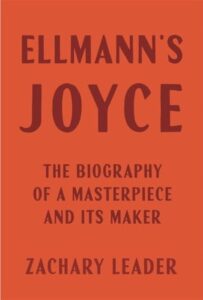
Zachary Leader has written what looks like an interesting book on the making of Richard Ellmann’s canonical biography of James Joyce.
James Woodall, who’s always a welcome guest at the Bloomsday lunch I host every year, has written an interesting review of it in The European Journal of Life Writing.
Over 800 pages, the Oxford University Press James Joyce was the first biography that mattered after a couple in Joyce’s lifetime that hadn’t. When I bought my copy in 1977, it read so smoothly and stylishly that it seemed sculpted by the steadiest of hands under the most unblinking of gazes. It had arrived – in print (in October 1959, one year before I was born) – in the compelling shape of a novel, a saga that might have taken a master, a Henry James for example, perhaps two years of undimmed concentration.
Ellmann’s book was not a shoe-in. Long thought about by its writer in his early thirties, James Joyce took five years: from his first research trip to Dublin in the spring of 1953, to his completion of the typescript in the summer of 1958. That in itself was a remarkable achievement, given the variables in play: the astounding number of people Joyce knew across Europe whom Ellmann had to track down; the volume of letters he found and used (and finally edited); his masterful wooing of the surviving family; and the sometimes tortured secrecy he had to spin to keep rivals at bay. A Joyce cult was brewing, and Ellmann needed to contain it to make the writer his. He did.
Hmmm… Given that I love Ellmann’s biography I might just have to buy Leader’s book.
My commonplace booklet
From Andy Borowitz…
Imagine a hypothetical job applicant. He can’t spell the simplest words, such as “heal” and “tap.” Confused by geography, he thinks there’s an African country called “Nambia.” As for American history, he’s under the impression that Andrew Jackson, who died in 1845, was angry about the Civil War, and that Frederick Douglass, who died in 1895, is still alive.
Given the alarming state of his knowledge, you might wonder what job he could get. Unfortunately, he’s not hypothetical, and the job he got, in 2016, was president of the United States.
I had similar thoughts when watching his Press Conference on the SCOTUS decision.
This Blog is also available as an email three days a week. If you think that might suit you better, why not subscribe? One email on Mondays, Wednesdays and Fridays delivered to your inbox at 5am UK time. It’s free, and you can always unsubscribe if you conclude your inbox is full enough already!