
It’s 2.45am and the TV networks are now predicting that Labour will be returned to power with a majority of 82 (having earlier predicted a majority of 66 on the basis of exit polls). Given the astonishing diversity of the results in most of the key marginal seats declared so far, and the contradictory nature of many of the outcomes, I’m sceptical of any overall prediction. What we’re seeing, I suspect, are the non-linear effects of a three-party contest in a system which has hitherto been accustomed to two-party politics. Anyway, I’m off to bed. We’ll know in the morning.
Category Archives: Politics
There is no real alternative, alas
For once, I agree with the Economist…
IF BRITAIN’S general election were simply a referendum on Tony Blair and the Labour government he has led since 1997, then there would be a real possibility that the voters would give him, and Labour, a slap in the face. That would also be The Economist’s instinct, though no doubt for different reasons. But it isn’t a referendum: it is a choice, one about which of the three big national parties offers the most credible and suitable government for Britain’s next four or five years. On that, our answer is the same as the one suggested by the opinion polls: the winner should again be Labour, led by Mr Blair.
Political photoshopping — audio
The glories of privatized medicine
From Paul Krugman’s column in the New York Times…
In 2002, the latest year for which comparable data are available, the United States spent $5,267 on health care for each man, woman and child in the population. Of this, $2,364, or 45 percent, was government spending, mainly on Medicare and Medicaid. Canada spent $2,931 per person, of which $2,048 came from the government. France spent $2,736 per person, of which $2,080 was government spending. Amazing, isn’t it? U.S. health care is so expensive that our government spends more on health care than the governments of other advanced countries, even though the private sector pays a far higher share of the bills than anywhere else.
So the US spends more on health care. Is the population therefore healthier? Er, no.
Most Americans probably don’t know that we have substantially lower life-expectancy and higher infant-mortality figures than other advanced countries.
So why is the supposedly efficient private system so expensive? Answer: it’s hideously bureaucratic.
Above all, a large part of America’s health care spending goes into paperwork. A 2003 study in The New England Journal of Medicine estimated that administrative costs took 31 cents out of every dollar the United States spent on health care, compared with only 17 cents in Canada.
But hang on… isn’t it the state systems that are supposed to be hideously bureaucratic?
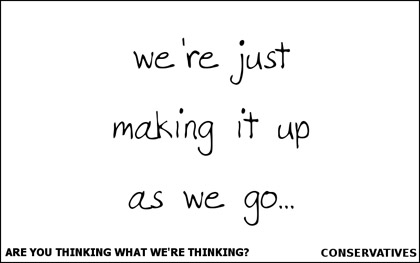
My very own Tory election poster
There’s a lovely site for generating your own “handwritten” Tory poster. Here’s mine.
The Rover fiasco
From Frank Kane’s admirably robust commentary on the disaster.
The number of politicians hand-wringing their way through Longbridge on Friday – including the Prime Minister – almost made you think MG Rover’s collapse was some great natural disaster that had engulfed Birmingham.
But there is nothing ‘natural’ about the Longbridge scandal; it is no act of God. It is an entirely man-made catastrophe, which can be blamed on a relatively small number of individuals. They can and should be made to pay.
He also points out that Patricia Hewitt, the Cabinet Minister ultimately responsible, has to explain
why she wasted another £6.5m of taxpayers’ money last week – apparently acting on orders from the Prime Minister – when the Chinese had told her in writing more than two weeks ago they were not interested in Rover. As one adviser says, ‘Which part of “no” did she not understand?’
On this day…
… in 1961, 1,500 CIA-trained Cuban exiles launched the Bay of Pigs invasion of Cuba in a laughable attempt to overthrow the government of Fidel Castro. In the process, they also taught Jack Kennedy an important lesson about the CIA. 45 years later, the Cuban factor still poisons US politics, especially in Florida, where the next Bush presidential candidate presides as governor.
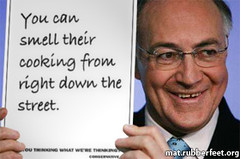
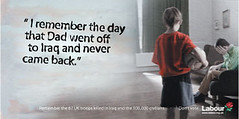
More creative photoshopping
NYT journalism dissected
Aaron Schwartz was asked to speak to the Bay Area Law School Technology Conference about blogging as compared with conventional journalism. Here is the transcript of his extraordinary talk, which was based on a close reading of the way the New York Times covered the presidential election.
What UK politicians would have on their iPods…
… if only they knew how to operate them. Lovely item in today’s Guardian about politicos’ musical tastes. Reminds one that music provides a window into the soul. Could one love someone who loved Wagner?