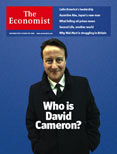
Who indeed?

Who indeed?
Listening to Tony Blair’s valedictory speech I was struck by two thoughts. The first is how good he was at reminding his party about how and why it won office (and, by implication, warning it not to forget that lesson). The second was that, but for his single, colossal misjudgement about Iraq, he would have gone down as one of the great reforming prime ministers in British history.
There were some really good lines in the speech — for example, his crack about Labour’s “core vote” being the people of Britain rather than its traditional “heartlands”. The observation that the only Labour party tradition he abhorred was “failure”. And his frank admission that some of the things that were done by Thatcherism had to be done if Britain were to become a modern country. Nobody who recalls the chaos of the Wilson/Heath/Callaghan years will dispute that.
That said, Blairism wasn’t the continuation of Thatcherism by other means. Listening to his recital of what his administration has done in terms of renewing the country’s public services, schools, hospitals, etc., it was impossible to believe that a Tory government would have done the same. A few weeks ago I met an American who had been a student here in the 1970s and hadn’t been back to the UK since. He was dumbstruck by how much had changed — for the better. And he was right.
So long as it stuck to domestic issues, the speech was terrific. But the moment it moved on to the ‘war’ against terrorism, it lost its way. Just like its author.
Terrific column by Martin Kettle.
Yesterday’s Guardian poll shot an arrow through the heart of the Labour party. It says that Labour is on course to lose the next election. It says that Gordon Brown hasn’t got what it takes to turn things around. It implies that no one else in the Labour party has, either. It crystallises everything anxious Labour activists have been saying to themselves on the eve of the party conference in Manchester – and then it adds some. It is hard to think of a more pivotal political opinion poll in recent times…
It’s a very perceptive piece — and I’m not saying that just because Kettle agrees with me. Here’s how it concludes:
Perceived likability unlocks electability. One of the reasons Blair dominated British politics for so long was that, where personality was concerned, he had it. It is equally clear that one of Cameron’s great strengths is that he has it too. The message of the poll is that the voters have sized Brown up and don’t like what they see. It may be miserably demeaning that modern politics has come to this. But if Brown hasn’t got it, how does he acquire it? And if he can’t acquire it, who else has Labour got?
Answer: nobody.
Way back last December I did some musing about why Gordon Brown would be a liability as Labour leader. I wrote:
Boredom is the elephant in the room of British politics. The electorate is, in the main, entirely uninterested in politics. It complains about the government, of course, but in the main it is hard to stir up electors on ideological or policy grounds. They put up with the Tories, for example, for 18 years, and eventually threw them out not because the party was intellectually and morally bankrupt (as we pointy-headed intellectuals fondly imagine), but basically because people had become tired of seeing all those old faces trotting out the same old story.
Now spool forward four years to 2009. In the Labour corner will be dull, monotonic, dark-suited, Homburg-hatted Brown rabbitting on about the timing of the economic cycle, the importance of means-tested benefits and how he was right about pensions all along. Yawn, zzzzz…. For the Tories, there will be a young, smooth-talking snake-oil salesman named Cameron. Could this be the nightmare scenario that Blair foresees, and is determined to avoid?
Now comes this report of a survey commissioned by the Guardian in advance of next week’s Labour party Conference.
The scale of the challenge facing Gordon Brown as Labour’s likely next leader is revealed today by a Guardian/ICM poll showing that voters believe David Cameron would make a more effective prime minister and that Britain will be better off if Labour loses the next election.
As activists prepare to head to Manchester for the party’s annual conference, beginning on Sunday, the poll suggests voters may be tired of Labour: 70% said they agreed with the phrase it was “time for change”, if there were a general election tomorrow, and only 23% agreed with the phrase “continuity is important, stick with Labour”.
Lovely column by Vanora Bennett on how her grandad was finally cured of his belief that private medicine must be best because you’re paying for it.
And, within 24 hours of excellent treatment, the problem was solved. At lunchtime the next day Grandad was sitting up by his bed, doing the Times crossword and chatting with the nurses, as cheerful as anything. He wasn’t coughing at all. “Dr Wu took me off the medicine and put me on something else,” he said happily. “I haven’t coughed once since she did.”
It was that simple – a bit of intelligent, disinterested medical care from an NHS doctor who wasn’t looking at a fee of thousands of pounds – just a person in need of attention and reassurance. Despite all the cuts that the Royal Free has been suffering, it can still do better for its patients than the smartest of private care…
My colleague, William Keegan, thinks that Tony Blair may be preparing to spring a surprise. He reports that a close associate of the Prime Minister has told friends that he is concerned about his own future because Blair could be gone ‘in a fortnight’.
When people who know the Prime Minister’s mind begin to panic about their future, there must be at least a chance that Blair is thinking of bowing out at the Labour Party conference in Manchester next week. It would be a dramatic thing to do, and, with recordings of Laurence Olivier in John Osborne’s The Entertainer now on general release, he might learn a few extra tricks from that master of final appearances. Suddenly there could even be sympathy for him. It would surely be preferable to dragging out the agony for a further nine months of pregnant expectation. In effect he could be emulating Denis Healey’s apocryphal speechwriter who, according to that formidable ex-Chancellor, once left his minister in the lurch: when the latter turned to page four of his speech, all he found were the words: ‘From now on you’re on your own, you bugger.’
In Blair’s position I should certainly want to leave the stage as fast as possible and let the rest of them sort it out. Recent events in the Labour Party are worthy of Honore de Balzac, specifically the passage in Cousin Bette where we are told: ‘Complaint, long repressed, was on the point of breaking the frail envelope of discretion.
‘Oh, that frail envelope!
Hindsight, as the man said, is the only exact science. I was thinking of that while I watched the two-part TV drama, The Path to 9/11 which was screened by BBC2 on September 10 and 11. It was a gripping production in which Harvey Keitel played John P. O’Neill, the FBI counter-terrorism chief who was on the track of Bin Laden and was, ironically, killed in the attack on the Twin Towers. The film-makers came clean on the fact that the production was a dramatisation of a real-life story, and that it had involved “time compression”, but also claimed that it had been extensively informed by the findings of the 9/11 Commission. The implicit message was: “We have to declare that this is fiction, but really it’s very heavily rooted in fact”.
The Commission’s report revealed that there had been a great deal of scattered knowledge in the US intelligence and law-enforcement communities about the activities of Al-Qaeda in the years running up to 9/11, but that a variety of factors — including inter-Agency rivalry — had prevented all these scattered ‘dots’ from being ‘joined up’. In fact the Report revealed an astonishing number of unjoined dots. The film then took a selection of these dots and wove a compelling narrative from joining them up. It tells a story of a group of dedicated public officials, led by O’Neill, who knew what Bin Laden & Co were up to and wanted to stop them, but were prevented from doing so by a variety of factors — including bureaucratic turf wars, but also (interestingly) the Clinton Administration’s caution and apparently over-zealous adherence to the rules of international law. (There were also hints here and there in the narrative that Clinton’s difficulties with Monica Lewinsky had had an enervating impact on the drive to counter Al-Queda.)
As I watched the story unfold, the hidden message became unmistakeable: the US had been endangered by three factors: inefficient intelligence and law enforcement efforts; respect for national and international law; and a Democratic president. The film was thus, in effect, setting out a justification for everything the Bush regime later implemented.
It doesn’t take a rocket scientist to smell a rat here. As the Washington Post put it:
According to the movie, Osama bin Laden — now the most wanted man in the world and a terrorist whose role in the 9/11 atrocity is not in doubt — was virtually within the grasp of U.S. intelligence operatives twice during the ’90s, after the 1993 attack on the World Trade Center. Islamic extremists left a truck bomb in the center’s underground parking garage — hoping, the film says, that the blast would knock one tower off its base and into the other.
Weak-kneed bureaucrats declined to act upon the opportunities to seize or kill bin Laden, the film also says. But the docudrama doesn’t stop at criticizing generic bureaucrats — which would at least have helped sustain a nonpartisan aura — and aims arts specifically and repeatedly at Albright, Berger, then-CIA chief George Tenet and others in the Clinton administration, most of them made to seem either shortsighted or spineless.
Clinton himself is libeled through abusive editing. A first-class U.S. operative played by Donnie Wahlberg argues the case for getting bin Laden while the al-Qaeda leader is openly in view in some sort of compound in Afghanistan. CIA officials haggle over minor details, such as the budget for the operation. The film’s director, David L. Cunningham, then cuts abruptly to a TV image of Clinton making his infamous “I did not have sexual relations with that woman” remark with regard to Monica Lewinsky. The impression given is that Clinton was spending time on his sex life while terrorists were gaining ground and planning a nightmare.
It would have made as much sense, and perhaps more, to cut instead to stock footage of a smirking Kenneth Starr, the reckless Republican prosecutor largely responsible for distracting not just the president but the entire nation with the scandal…
A little digging was all that was required to show that the film’s subliminal message owed a great deal to its provenance. Here’s Max Blumenthal on the background to the production:
“The Path to 9/11” is produced and promoted by a well-honed propaganda operation consisting of a network of little-known right-wingers working from within Hollywood to counter its supposedly liberal bias. This is the network within the ABC network. Its godfather is far right activist David Horowitz, who has worked for more than a decade to establish a right-wing presence in Hollywood and to discredit mainstream film and TV production. On this project, he is working with a secretive evangelical religious right group founded by The Path to 9/11’s director David Cunningham that proclaims its goal to “transform Hollywood” in line with its messianic vision.
Before The Path to 9/11 entered the production stage, Disney/ABC contracted David Cunningham as the film’s director. Cunningham is no ordinary Hollywood journeyman. He is in fact the son of Loren Cunningham, founder of the right-wing evangelical group Youth With A Mission (YWAM). The young Cunningham helped found an auxiliary of his father’s group called The Film Institute (TFI), which, according to its mission statement, is “dedicated to a Godly transformation and revolution TO and THROUGH the Film and Televisionindustry.” As part of TFI’s long-term strategy, Cunningham helped place interns from Youth With A Mission’s in film industry jobs “so that they can begin to impact and transform Hollywood from the inside out,” according to a YWAM report…
An interesting question — as yet unanswered — is how the BBC came to screen such a farrago of misrepresentation.
Or perhaps a new isolationism? Interesting Pew Research Center report
Five years later, Americans’ views of the impact of the Sept. 11 terrorist attacks have changed little, but opinions about how best to protect against future attacks have shifted substantially. In particular, far more Americans say reducing America’s overseas military presence, rather than expanding it, will have a greater effect in reducing the threat of terrorism.
By a 45% to 32% margin, more Americans believe that the best way to reduce the threat of terrorist attacks on the U.S. is to decrease, not increase, America’s military presence overseas. This is a stark reversal from the public’s position on the first anniversary of the Sept. 11 attacks. In the summer of 2002, before serious public discussion of removing Saddam Hussein from power had begun, nearly half (48%) said that the best way to reduce terrorism was to increase our military involvement overseas, while just 29% said less involvement would make us safer.
Similarly, in 2002 a 58% majority felt that military strikes against nations developing nuclear weapons were a very important way to reduce future terrorism. Today, just 43% express the same level of support for such action…
From today’s Guardian…
John Reid will sanction the forced removal of up to 32 Iraqis today after telling the high court he would ignore any last-minute legal challenge to their deportation. The Guardian has learned that the home secretary has told the high court that today’s specially chartered flight will not be stopped by anything short of an injunction.
Last November, an attempt to deport more than 70 Iraqi Kurds ended with just 20 going home because of a host of last-ditch legal applications. Mr Reid has since decided to take a tougher stance and told the high court today’s flight would go ahead regardless of any legal applications.
Footnote for overseas readers: Dr Reid is the British Minister of the Interior. For some reason, he is called the Home Secretary. It’s a sinister post which turns almost all its occupants into monsters. The only exception I can think of is the late Roy ‘Woy’ Jenkins, an erudite, civilised and liberal man who wound up as Chancellor of Oxford University.
Interesting report in yesterday’s Guardian.
The annual bill for Whitehall consultants advising government departments is running at more than £2.2bn, an investigation by the Guardian reveals today…
One reason for this is that New Labour ideology includes a naive assumption that ‘business’ methods are invariably superior to old-style ‘public-service’ methods. The problem is that nobody in the Labour leadership knows anything about business because they’ve never run one. And (poor saps) they think that consultantcy firms do. The Guardian report claims that one section of the Department of Health is now staffed by almost as many consultants as full-time officials – 180 civil servants and 170 consultants.