
That anti-Clinton YouTube ad (contd.)

You may recall that I liked the YouTube video which mixed the 1984 Apple Macintosh Superbowl ad with Hilary Clinton’s “our conversation” video. Well, Rex Hughes has now pointed me at the next instalment of the story. Read on…

News watchers need to buckle up today as the mainstream media does its whipsaw thing now that the identity of the infamous anti-Hillary Clinton/pro-Barack Obama “Vote Different” video has become publicly known – and that man is now out of a job. The ad, a take-off on Apple’s legendary “1984” spot, had become a YouTube sensation and the guessing game over the author an online parlor game. (Note string of updates below)

For those who haven’t seen it, the anti-Clinton ad, while unflattering, is reasonably clever, not the least bit offensive, and, by modern-day standards, more of a love note than a Swift-boating. … But, as we’re seeing, none of that matters in a practical, political sense.

Phil De Vellis, a political operative at Blue State Digital (the company name tells you what party’s candidates it serves), has been outed as the ad’s designer, and, depending on which account you wish to believe, has resigned or been fired because his employer’s most prominent client is presidential candidate Obama. He claims he did it on his own time and without the knowledge of Blue State Digital or the Obama campaign. You can read more of what De Vellis has to say for himself here on the Huffington Post.

So why all the fuss?

This is high-stakes presidential politics and everybody has a well-defined role to play.

Clinton feigns outrage because that’s her role. She’s been in politics all of her adult life and is no more outraged by that video than her husband was believable when wagging his finger. She does, however, recognize opportunity when it knocks and this video is an opportunity for her to play the victim … and no doubt attempt to inoculate herself against what promise to be truly vicious assaults to come.

Obama feigns outrage because that’s his role. He may be newer to politics, but he’s smart enough to recognize the risks – such as they are – of having his campaign appear to be “attacking” a fellow Democrat. The senator may indeed prefer that his campaign not be associated with such a video, but you can be certain that is a tactical decision and not an intellectually honest assessment of the spot’s message or style.

De Vellis feigns resignation – and says he resigned – because that’s his role. Even if we take him at his word about the project being his and his alone, he knew full well what the consequences would be if he his identity should become public. With free speech comes consequences. He’s no naïf. Weep not for him.

The mainstream media knows its role here, too: Just fan the flames. There isn’t a reporter or pundit on the planet who honestly believes that ad was out of bounds. There isn’t a reporter or pundit on the planet who believes that Clinton or Obama might be genuinely outraged. (There may be a few who believe De Vellis a “victim,” but they haven’t thought it through.) But every reporter and pundit on the planet recognizes good political theater when they see it.

So, what should have happened, you might be asking.

Clinton should have watched the video and shrugged. Obama should have told his people to tell Blue State Digital to get a tighter grip on its employees. De Vellis should have shown reporters his slapped wrist, apologized for causing a client trouble, and gotten on with his career.

But this is presidential politics. Those roles aren’t in the script…

My instincts would be to hire Mr De Vellis. His skills are useful.
A Blogger.com curiosity

From the blog of one of our Wolfson Press Fellows, Lara Pawson…

Well there’s a funny thing. I wrote a blog four days ago, criticising the BBC (and indirectly British foreign policy) for its contradictory approach to Africa, in particular its interest in Zimbabwe compared to Angola. And this afternoon, some time between 3pm in Luanda and 6pm, it disappeared. Yes! It vanished from my site. Is this Blogger falling prey to the heavy hand of British censorship, or just a clumsy oversight on my part? I’d encourage you to respond with your own thoughts: I really haven’t a clue. All I can say is that it is a strange feeling to be living in Angola – which is not known for its press freedom – and to feel like you are being censored from afar, possibly from home. Can a techno please enlighten me on what might have happened to my posting, ‘substantially worse’?

Fortunately, she had saved a copy and was able to re-post the item — which is well worth reading btw. But for one nasty moment, I had a creepy feeling. Angola (from where she is currently reporting) is a dangerous place, but it’s not where Google resides. Was it just a technical glitch? If the BBC had complained about her post, surely Google would have pulled the entire blog, not just the offending post? Hmmm…

Robbing the young

I am lucky enough to own a house which has escalated in value to the point where it is apparently ‘worth’ a lot of money. Big deal! The only way of turning it into ‘real’ money would be to sell it and live in a tent. More importantly, the price escalation which has led to its current valuation is what will make it difficult or impossible for my kids to buy homes of their own. I therefore view house prices with a good deal of dyspeptic cynicism, and refuse to participate in dinner-party conversations on the subject. So good on Peter Wilby, who has written an excellent rant on this very subject, in the process highlighting yet another reason why young people are turned off by newspapers. Excerpt:

Anybody over 50, who has already done most of their retirement saving, has every reason to be gloomy when the Footsie dives. Those under 40, with most of their saving ahead of them, should jump for joy. Their pension schemes will pay less for the assets that are going to finance their old age. So they will get more bang for their bucks. The same, more obviously, applies to house prices.You would not know any of this from reading the papers. Whether it’s house prices or share prices, the press treats a rise as cause for celebration, a fall as an occasion for alarm. We are led to believe that inflation is a thing of the past, a relic of the 1970s and old Labour.

This is nonsense. Inflation is alive and well; it has merely moved from goods and services to assets. In other words, the press presents the world through a middle-aged, middleclass prism. When young people read that house prices have shown “healthy increases”, they must think journalists live in a parallel universe. No wonder they don’t read newspapers or feel any affection for them. If any paper hopes to woo the under-30s in large numbers, whether through new media or old-fashioned print, it will have to get to grips with what Faisal Islam, economics correspondent of Channel 4 News, calls “the great generational robbery”.

In the New Statesman this month, he wrote of how 22-year-olds, through rent payments, are paying off the mortgages of older landlords who benefited from cheaper house prices; of how, when they eventually buy houses, it will represent a transfer of many millions of pounds from young to old; of how, through rising taxation, they are paying their parents’ pensions. Why do we so rarely read of this in the daily and Sunday papers? Why do papers such as the Telegraph and Express fuss so much about inheritance tax which matters to people in their 50s and 60s, whose parents are approaching the end of their lives, not to those in their 20s and 30s? Newspapers think they are trying hard to attract younger readers, with new designs, consumer guides to iPods and long features about pop and film celebrities. It is all window-dressing. In their coverage of politics, social affairs and business, they betray underlying assumptions and attitudes to drugs, sex, money and much else that seem quite alien to the most young readers.

I’ve just read Faisal’s piece, and very good it is too.

Tories discover Open Source

The Shadow Chancellor, George Osborne, has posted a shortened version of a speech to the RSA on IT and government. Excerpt:

I think that our willingness to change needs to match the scale of the technological revolution taking place all around us. Just as companies all over the world are changing the way that they do business, so too must we evolve.

In short, I believe that we need to recast the political settlement for the digital age. We need open source politics…

The Guardian version of the speech attracted 45 comments, the majority of which seemed to miss the point in one way or another. Of the 45, only about four were genuinely thoughtful or illuminating, and perhaps another four were trying to be helpful by adding links or references. It’s a sobering illustration of the problems with online ‘debate’.

In the Blogosphere, though, there was a good deal of intelligent discussion — for example from David Wilcox. There’s something interesting going on here, with the New Tories sidling up to the Google/Web 2.0 gang while New Labour clings to Microsoft and Sir Billg.

Brown vs. Cameron: contd.

Sorry to be a bore about this (er, see here, here and here) but the recent ICM poll for the Guardian confirms my suspicion — that Labour won’t win the next election if they are led by Gordon Brown.

Gordon Brown is failing to persuade the public that he would make a better prime minister than David Cameron, according to a Guardian/ICM poll published today which suggests the Conservatives could win a working majority at the next general election.

Voters give the Tories a clear 13-point lead when asked which party they would back in a likely contest between Mr Brown, Mr Cameron and Sir Menzies Campbell.

The result would give the party 42% of the vote against Labour on 29%, similar to its performance under Michael Foot in 1983. The Liberal Democrats would drop to 17%. The result is the highest that the Conservatives have scored in any ICM poll since July 1992, just after their last general election victory…

The Economist‘s Bagehot column has some interesting reflections on this.

Three quite big and important things appear to be going on. The first is that a sort of positive feedback loop has been established in which the long-standing misgivings about Mr Brown within his own party are now being projected back to it by the voters. Senior Labour figures glumly go through the motions of declaring in public their utter confidence in Mr Brown’s prime-ministerial credentials. He is the most successful chancellor of the exchequer since records began, a political heavyweight of towering intellectual stature and soaring moral purpose. It’s a testimonial just close enough to the truth not to provoke sniggers, but they and we know it’s only half the story. What increasingly worries ministers, and those Labour MPs in southern seats whose majorities hang by a thread, is that, unless he can reveal a different side to his personality, dour, stiff, slightly odd Mr Brown will struggle to reach those aspiring middle-class voters whom Mr Blair could still just about deliver in 2005.

The second big thing is that the mood of the electorate seems to be swinging from apathetic boredom and irritation with the government to a feeling that maybe it’s time for a change. If that is right, Mr Brown, for all his admirable qualities, is the last person on earth who can deliver it. However much Mr Brown and his supporters insist that Labour will look very different when he is prime minister, the fact is that Mr Brown is universally recognised as the joint-architect of the government’s successes and failures. It is hard to see what sort of meaningful fresh start Mr Brown can offer.

That was the argument made last week by Frank Field, an independent-minded Labour MP. Mr Field reminded his colleagues that the Tories were able to win a remarkable fourth successive election partly because Margaret Thatcher’s replacement, Mr Major, emerged from nowhere. Even Mrs Thatcher, who backed Mr Major’s leadership bid, had only the haziest idea what he was really like (and was bitterly disappointed when she found out). But it meant that the Tories were able to claim plausibly that by choosing the obscure, untainted Mr Major they had already given the voters the change they demanded.

Mr Field went on to suggest that if Labour was serious about winning it should thank Mr Brown for his outstanding service and move on to the next generation in the shape of David Miliband, the 41-year-old environment secretary who for some time has been uncomfortably cast in the role of next-leader-but-one. That is where Mr Field’s line of reasoning runs out of steam…

Agreed. Miliband is a nice lad (and he’s driven around in a Prius), but not Premiership material. Labour’s problem is that they have nobody else in Cameron’s generation who has leadership potential. Game over, I suspect.

The madness of King Tony

Perceptive observation by Armando Iannucci.

Am I going mad? I heard that Tony Blair thinks so. Not just me; everyone. You too. He thinks we’re all mad. Someone close to his circle told me recently that the reason Blair seems so resolute, so calm in the face of criticism, is that he thinks the media are just mad. And he confronts unpopularity with the knowledge that we, the public, are turning mad as well. The more we say: ‘He’s going mad’, the more it proves to him that we must be mad. Is that the logic of a madman?

I only mention this because I was struck by the madness of a remark Blair made last week. It was just as the High Court ruled that the government’s recent consultation with the public over what our future energy policy should be wasn’t consultative enough, and that he and his ministers would have to consult us on the policy again.

Asked if this would put on hold his plans to build more nuclear power stations, he said: ‘No. This won’t affect the policy at all. It’ll affect the process of consultation, but not the policy.’

Take a good hard look at that quote again. It’s mad. It’s based either on a belief in the possession of psychic powers so discriminating they can predict the outcome of a consultation before it happens (which is mad) or they’re based on the belief that words have no meaning other than the meaning one chooses to give them and that this meaning can change at any particular moment (which is at least three times as mad as the first example of madness).

A sane person would assume that a consultation about a decision would be part of the process of forming that decision.

He would indeed. Which is why Britain needs a new constitution. At present we have an elected dictatorship which can do what it likes so long as the Prime Minister has a working majority.

Iran here we come

Is the Bush regime getting ready to attack Iran? Paul Rogers thinks it might be. In April.

Timothy Garton-Ash has also been brooding on this.

f we don’t bomb Iran, Iran is quite likely to get the bomb. If Iran gets the bomb, Saudi Arabia, Egypt and others in the Middle East will be tempted to follow. The last barriers to nuclear proliferation, already breached by North Korea, Pakistan, India and Israel, could rapidly break – in the most volatile region in the world. The risk of nuclear war will then be greater than it was in the 1980s, when CND, END and other west European peace movements marched against new US and Soviet missile deployments. The likely scale of the nuclear conflict is much smaller than a superpower nuclear apocalypse, but that in itself makes it more not less probable that an unhinged leader would take the risk.

On the available evidence, the Islamic Republic of Iran is trying to edge towards a technological position from which it could, should it choose, rapidly move towards 90% uranium enrichment and the production of nuclear weapons. The best analysis we have suggests that Ayatollah Khameini, the supreme leader of the revolutionary regime, has not made a decision to go for nuclear weapons, and it would take a number of years to get there even if he had. But Iran has been doing a number of things that are not explicable simply by a desire to have the civilian nuclear energy to which it is entitled under the nuclear non-proliferation treaty.

The real question is therefore how, without the use of force, you can stop Iran going down this path…

Mute but moving

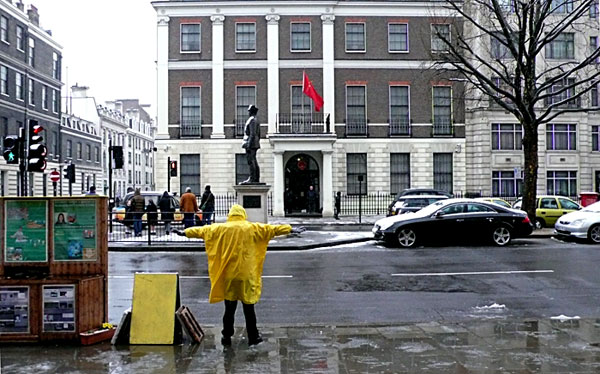
Every day, for as long as I can remember, there’s been a lone Falun Gong demonstrator outside the Chinese Embassy in Portland Place. Here is this morning’s protestor. It’s an impressive, quiet display — all the more so when you see someone sitting motionless in the freezing cold for hours on end. Meanwhile virtually every UK university and FTSE company is sending people to China, touting for business like tarts on the road from Milan airport. And of course Google China (and Yahoo and MSN) block access to search results for ‘Falun Gong’.

Politicians and technology: oil and water

This morning’s Observer column

When New Labour came to power it was terribly gung-ho about IT, which it equated with modernity, and there was a lot of pious vapouring about e-business and making Britain ‘the best place in the world’ in which to do it. Much of this rhetoric was emitted by one Anthony Blair, who spoke about these matters with the sublime ignorance with which teenage boys lecture one another on sexual technique. But then it emerged one day that the Prime Minister had tried to order flowers for Cherie over the internet and had made a hash of it. There was much sniggering in Daily Telegraph circles when this became public. So in best New Labour spin-doctoring style, it was decided to turn the gaffe into an opportunity, and Blair enrolled for an ‘IT for beginners’ course, accompanied by the usual horde of minders and TV crews…