McCain looking for his 9-11 moment? Some cheap, armchair psychologizing…

Watching McCain posturing as the saviour of the US economy this evening I was reminded of this post by David Weinberger.

McCain’s suspending of his campaign is so very odd that I find myself looking for psychological, and not just political, explanations. So, try on this armchair psychoanalysis, keeping in mind that I’m just making this stuff up:

First, assume that McCain is desperate. When Fox puts you at 39%, desperation becomes reality-based thinking. Second — and this is the unpleasant part — imagine that McCain has had the thought that many of us had had: A terrorist attack in October would shake up the entire electoral chessboard, and might well favor the Republicans. (Yeah, yeah, I don’t think it should it, either.)

Now, no one wants a terrorist attack (except, um, the terrorists), including John McCain, of course. But we’re talking psychology here. So, could it be that McCain is reacting to the financial meltdown as if it were a large-scale terrorist attack because deep within him, he’s waiting for the crisis that saves him, the crisis that lets the aging warrior put on his flight suit one more time?

After all, the subtext of his “putting country first” trope isn’t patriotism but heroism. Heroes need crises. McCain’s brand of heroism consists of sacrifice: He gave up 5 years of his life in North Vietnam, and now he’s willing to give up campaigning.

McCain’s political problem is that in this case, his self-sacrifice seems unnecessary and can be taken as panic or cowardice. It seems like sacrifice for sacrifice’s sake. He thus runs the risk of voters turning away from the hero-without-a-cause to the leader who has one.

The politics of unverified threats

Terrific post by Dave Winer.

Flash back to the United Nations on 2/5/03. An impressive almost Presidential Secretary of State, Colin Powell, delivering some chilling news, not coming right out and saying it, but definitely leading you to believe that Saddam has nukes and chemical weapons and stuff even more horrible and is getting ready to use all of it in some unspecified horrible way. It’s the lack of specificity that makes it so chilling.

Consider the whole scenario. Powell can’t tell us what the danger is because that would violate some security that he can’t violate. Well, I did what a lot of Americans did that day, I sucked it up and got behind my government. And they suckered me. And I’ll never forget it. I got fooled, and used, and a lot of people died, in the name of freedom, and it was all a lie.

We all paid a huge price that day, and the bill may be coming due today, because they’re presenting us with the same scenario, this time about the economy. And we’re not going for it. You can see it in the way things flipped around overnight. A lot of people woke up this morning, like I did, and realized — wait I’ve seen this movie before.

Now we have another impressive Almost Presidential secretary, Henry Paulson, who says there’s impending doom, but he can’t say exactly what it is, it’s not security this time, but fear of starting another level of bank runs. Senators and Representatives come out of a Thursday night meeting with the secretary (would they have believed the President) won’t say exactly what he said, but they are stunned. The next day buried in a sea of press about this event is an almost innocuous paragraph in a NYT piece that talks about a flight to safety from the US Treasury money market. OMG. A point made by the secretary to the Congresspeople, a lot of your constituents have their savings in money markets. The Senators think to themselves, Fuck the constituents, that’s where my retirement savings are! (And by the way, mine.)

And who elected Hank Paulson btw? Dave’s point is that

we can’t do it on the terms that Paulson asks for. There has to be some pain and there has to be oversight and checks and balances. There’s no such thing as a law passed by Congress that can’t be judged by the courts. Not in the USA, not under our form of government. And no way is Bush going to get that by us.

So here’s what I propose. The Republican slogan today is Country First. So let’s see the Republicans do a little of that famous Country First stuff.

Bush and Cheney must resign immediately. No immunity, no pardons. Nancy Pelosi will become President, promising not to run for re-election on November 4. Her term will be one of the shortest in US history, just long enough to enact the provisions of the bill being proposed by the Republican administration. If it really is the best thing for the country and not a trick, then the Republicans, being impressed by the seriousness of it, would have to insist that Bush step aside and let the Democrats execute the plan. The entire Bush cabinet stays in office through January 20, but reports, of course to Pelosi. And that includes Paulson.

It’s pretty simple. If they won’t do it, we know they’re bluffing.

Hmmm…. I think we know the answer to that one.

James Miller pointed me to an interesting post by Robert Reich, the Harvard academic who was Bill Clinton’s Secretary of Labor for a while:

The public doesn’t like a blank check. They think this whole bailout idea is nuts. They see fat cats on Wall Street who have raked in zillions for years, now extorting in effect $2,000 to $5,000 from every American family to make up for their own nonfeasance, malfeasance, greed, and just plain stupidity. Wall Street’s request for a blank check comes at the same time most of the public is worried about their jobs and declining wages, and having enough money to pay for gas and food and health insurance, meet their car payments and mortgage payments, and save for their retirement and childrens’ college education. And so the public is asking: Why should Wall Street get bailed out by me when I’m getting screwed?

So if you are a member of Congress, you just might be in a position to demand from Wall Street certain conditions in return for the blank check…

He goes on to set out five conditions. The one I like best is that banking bonuses be based on a five-year rolling average of performance.

Who killed New Labour?

Terrific essay in the Economist.

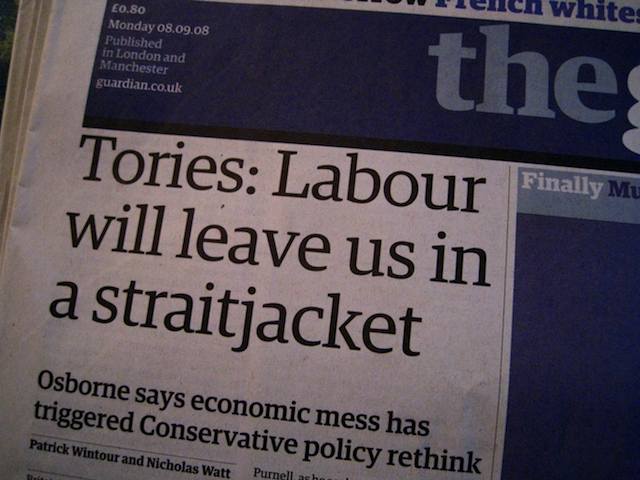
New Labour is dying. It has lost the three vital qualities that kept it alive and vibrant. First, discipline. A shared purpose and scowling party apparatchiks once bound Labour MPs to a party line; now some are calling for Mr Brown to stand down—and he may yet have to, little more than a year after he moved into Number 10. The rumblings about his leadership already constitute a crisis, and a humiliation, for him and his party.

Second, intellectual confidence: the party that once defined the intellectual terrain of politics has been reduced to aping its opponents’ policies. Most important, New Labour has lost the habit of winning.

What has been one of the great election-winning forces in British political history has been routed in a run of parliamentary by-elections and local votes. Its poll ratings are so bad—a survey released on September 18th gave the Conservatives a 28-point lead—that recovery before the next general election, due by June 2010, looks almost impossible. On current form, the resulting defeat may be Labour’s worst since the second world war. In the aftermath of such a rout, some Labour supporters fear, the party may disintegrate, with a revived Old Labour faction, wedded to the ideals of punitive taxation and a monolithic state, reasserting its anachronistic grip…

Best analysis I’ve read.

George Lakoff on Obama’s mistake

George Lakoff is one of the most insightful writers on public discourse that I’ve read. Here’s an interesting post by him on why the Obama campaign has been wrong-footed recently by McCain.

I’ve been getting loads of email asking me to say something to the campaign. So with some hesitation and a great deal of respect, I will simply point out what I see.

Four years ago I wrote a book called, Don’t Think of an Elephant! The title made a basic point: Negating a frame activates that frame. If you activate the other side’s frame, you just help the other side, as Nixon found out when he said, “I am not a crook,” which made people think of him as a crook.

The Obama campaign just put out an ad called “No Maverick”. The basic idea was right. The Maverick Frame is central to the McCain campaign, and as the ad points out, it’s a lie. But negating the Maverick Frame just activates that frame and helps McCain. You have to substitute a different frame that characterizes McCain as he really is. There are various possibilities. Let’s consider one of them. Ninety percent of the time, McCain has been a Yes-Man for Bush. Think in terms of questions at a debate. If the question is, is McCain a maverick?, you are thinking about him as a maverick, even when you are trying to find ways in which he isn’t. McCain wins. If the question is whether McCain is a Yes-Man for Bush, you put McCain on the defensive. People think of him as a Yes-man 90 percent of the time, and try to think cases when he might not have been. This is not rocket science. It’s the first principle of framing.

The “No Maverick” ad also misses an opportunity. It correctly observes that McCain’s campaign is loaded with “lobbyists.” But most of the people the ad is trying to reach don’t know just what a “lobbyist” is. McCain is saying he is fighting against the Washington power structure. A lobbyist is a “member of the Washington power structure.” If you use such a phrase, you can point out that McCain campaign itself is part of the Washington power structure, the old-boy network…

Child abuse at the conventions

From Willem Buiter’s blog

I have now watched a brace of US presidential nominating conventions. This has been a truly mind-numbing and depressing experience – a complete triumph of appearance over substance.

Particularly disturbing has been the willingness (eagerness?) of both the Democratic and the Republican candidates to exploit their minor children in the hope of gaining electoral kudos with the family values crowd. First the Obamas trot out their nine and seven year old daughters (after Michelle Obama had been airbrushed into a tupperware mom). Then the McCains roll out their seventeen year old daughter. Not to be outdone, Sarah Palin bounces onto the stage with her newborn baby in her arms. Even her seventeen year old pregnant daughter was put up for public display, accompanied by the neanderthal earmarked/branded for future son-in-law status.

At least the Obama kids may be too young to suffer lasting psychological damage as a result of their cynical exploitation. Seventeen-year old teenagers may not be as fortunate. Should the social services get involved in what has all the hallmarks of emotional child abuse?

The Palin Effect

Welcome detachment in The Atlantic.

In the last 18 hours, I’ve seen the Palin Effect on two very different groups of Republicans: grassroots delegates and professional operatives. Last night, I wormed right up front to the edge of the stage, where I figured the hardest-core activists would cram in to watch Palin, allowing for easy anthropological observation. They raved and seemed convinced she would put the ticket over the top. (The best line, whooped in my ear by a Kentucky delegate responding to Linda Lingle’s quip about how 250 Delawares could fit inside Alaska: “That’s right, baby, size matters!”)

Everybody at this morning’s panel discussion, on the other hand, thought Palin was great, but not the decisive factor that the activist crowd did. The clear consensus was that McCain needs to focus on independents. “He’s got to message himself to independents tonight,” said Rep. Tom Davis of Virginia. “He has to win independents, period,” said Sara Taylor, former White House political director. “He must be more focused on the center of the electorate than Bush was in ’04, and pull independents and conservative Democrats,” said Terry Nelson, McCain’s former campaign manager. In his own inimitable fashion, Chris Matthews seemed to concur: “If you guys want to be the war party, kiss it!”

Er, I’m not sure I understand that last comment, but I sure hope the Republicans continue to make the same mistake as they made at the convention. Keep preaching to the converted and leave the country to make up its own mind.

And there’s always the ‘Eagleton Scenario’.

Nice column by Gail Collins in which she points out that McCain is actually running for Leader of the Senate:

A visitor from another planet who dropped in on the Republican campaign at this point would very likely assume that the presidential nominee was a guy who had spent his life as a prisoner of war until he was released just in time to pick Sarah Palin for vice president.

“I can’t wait to introduce her to Washington, D.C., and the pork barrelers and the lobbyists,” he said.

Ah, the dreaded pork barrelers.

John McCain is not actually running for president. He’s running for Senate majority leader. All his passion is directed at defects in the legislative process. He’s been a military man or a senator for virtually all of his adult life, and listening to him talk, you get the definite impression that the two great threats of the 21st century are Islamic extremism and the appropriations committee.

Breaking with convention(s)

I thought I was unshockable, but the news that there were 15,000 accredited journalists at the DNC took me aback. It leads one to ask: where’s the value they add? The answer is: nowhere. This was brought home very forcibly when I was able to watch Bill Clinton’s entire speech on YouTube — and then compare it with the little soundbitten excerpts relayed by the mainstream TV channels. Now that I can see this stuff for myself, I don’t need media folks on extravagant per diems to ‘interpret’ it for me.

Jeff Jarvis feels the same and has written a great column on the subject. Sample:

Nothing happens at the conventions. They are carefully staged spin theatre. The only reason for all these journalists to travel to Denver and St Paul is ego. They feel important for being there and their publications feel important for sending them. But their bylines matter little to readers.

We simply don’t need all their coverage of the conventions. Thanks to the internet anyone, anywhere, can read the best coverage of the top few news organisations. On Google News you’ll find thousands of articles devoted to the same stories, most telling us little we didn’t know or couldn’t have guessed. Go to YouTube or network sites and you can watch the speeches yourself.

Footnote: in the 1980s I covered some of the UK Party Conferences and observed, with astonishment, the size of the media contingent. The BBC, for example, usually sent about 120 people. And, in those days, most of the Corporation’s senior executives came down for a day or two to “sniff the air”, as it were (and stay in the most expensive hotels). It was ludicrous even then but conceivably could be justified because it was the only way of transmitting the proceedings to the public. But those days are gone.

Nudge, nudge…

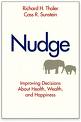
Where do the Cameroonians get their ideas from? One source, apparently, is Nudge: Improving Decisions about Health, Wealth and Happiness by Richard Thaler and Cass Sunstein. This focuses on the foibles and idiosyncrasies of human behaviour and on how, with a little discreet encouragement, we can usually be ushered in the right direction. Writing in the Guardian, James Harkin is not impressed.

Nudge has been put on a list of 38 books which Tory MPs have been given by Dave as their summer reading. I’ve just looked at the list. It’s got some weird things on it — The Rise of Boris Johnson, for example. The only item I’ve read is Ferdinant Mount’s memoir, Cold Cream. Other books are Tom Wheeler’s book on Abraham Lincoln’s use of the telegraph in the Civil War and Philip Bobbitt’s Terror and Consent. And why the Cameroonians should need David Runciman’s Political Hypocrisy is beyond me, given that they are such past masters of the art.

Er, wink, wink.