
Get Carter

Charles Arthur is not impressed by ‘Lord’ Stephen Carter’s Interim ‘Digital Britain’ Report.

I’m still reeling from having to read the word porridge of the interim report on Digital Britain, handed down yesterday by (Lord) Stephen Carter. What a mish-mash of quangos, incomplete thinking, and bars set so low you can walk over them. 2 megabit per second connections for all by 2012? When people in South Korean cities today think things are bad if their speed drops to 30Mbps? A “rights agency” funded by content providers and ISPs (ie, in the end, us) that will come together to dream up a way to “enable technical copyright-support solutions that work for both consumers and content creators”?

I have never, ever heard of a quango writing a piece of code, nor even spotting the best stuff. (Generally, it’s quite the opposite: hello, English NHS record computerisation.) Getting the “right” DRM is an intractable problem. You’ll never reach the end: the only DRM that really works for consumers is none; the only DRM that really works for content producers is either zero or lots. But not all content producers agree with zero DRM. There is no single solution, and the Rights Agency will simply burn up our money failing to find it.

What’s more concerning is the Carter approach to “net neutrality”. That, you’ll recall, is the proposition that a network operator should not discriminate against data packets purely on the basis of where they originate. Thus packets with video or sound should, as they pass over the network, be treated in the same way as other video or sound packets (they tend to get priority over plain old text); data packets should not be held up purely because of where they started.

[…]

Carter, however, suggests that net neutrality is a waste of the chance to squeeze some money from customers. (That’s us – you know, the people funding that Rights Agency above.)

Spot on. Carter’s effort is an embarrassing document, the product of an old-style push-media mentality.
Illinois’s new Governor…

… is Pat Quinn. (Good Irish name, that.) The NYT reports today that

In 1980, one of Mr. Quinn’s petition drives ended the practice that allowed Illinois legislators to collect their entire salaries on the first day in office. Along with his other petitions, like the one that reduced the size of the legislature, he was not earning a lot of friends in state government.

One afternoon in 1976, he visited the Capitol and took a seat in the gallery.

“They said, ‘Up there in the gallery is that Pat Quinn,’ ” he remembered one lawmaker saying. “And they stood up and booed for three minutes. One guy called it a standing boo-vation.”

A few years later, he was elected commissioner of the Cook County Board of Tax Appeals, his first elected office. He has served in a number of other positions, usually gravitating to veterans affairs, environmental and consumer protection issues. He was elected state treasurer in the early 1990s.

Mr. Quinn said he was not sure whether he would run in 2010, when Mr. Blagojevich’s term ends. As it was, he had not decided what to do when his term as lieutenant governor was up.

One thing he will not do, he said, is let his newfound popularity go to his head.

“You want to know my philosophy?” Mr. Quinn said. “One day a peacock. The next day a feather duster.”

I like the sound of this guy.

If Google were a country…

Jeff Jarvis musing in Business Week along the lines of his forthcoming book.

To summarize if not oversimplify their vantage points: Where Gore demands taxes and regulation, the Google team proposes invention and investment. Gore & Co. want to raise the cost of carbon—the cost of polluting—whereas the Google team wants to lower the cost of energy, producing clean electricity for less than the cost of power generated with coal. RE

Still, we see different worldviews at work. "You can't succeed just out of conservation because then you won't have economic development," Google.org head Larry Brilliant said. "Find a way to make electricity—not to cut back on it but to have more of it than you ever dreamed of." More power than you ever dreamed of. Create and manage abundance rather than control scarcity—as ever, that is the Google approach. Whereas Gore talks about what we shouldn't do, Google talks about what we can do. There, we see the contrast between the politician's brain and the engineer's. Google people start with a problem and look for a solution. They identify a need, find an opportunity, and then systemically, logically, and aggressively attack it with innovation.

In power or not, Google and the Internet will have a profound impact on how government is run, on its relationship with us, and on our expectations of it. Now that we have the technological means to open up government and make every action transparent, we must insist on a new ethic of openness. I say we should abolish the Freedom of Information Act so we can turn it inside out. Why should we have to ask for information from our government? The government should have to ask to keep it from us.

Bad Faith Economics

Paul Krugman on some of the Republican arguments against Obama’s stimulus package.

But the obvious cheap shots don’t pose as much danger to the Obama administration’s efforts to get a plan through as arguments and assertions that are equally fraudulent but can seem superficially plausible to those who don’t know their way around economic concepts and numbers. So as a public service, let me try to debunk some of the major antistimulus arguments that have already surfaced. Any time you hear someone reciting one of these arguments, write him or her off as a dishonest flack.

First, there’s the bogus talking point that the Obama plan will cost $275,000 per job created. Why is it bogus? Because it involves taking the cost of a plan that will extend over several years, creating millions of jobs each year, and dividing it by the jobs created in just one of those years.

It’s as if an opponent of the school lunch program were to take an estimate of the cost of that program over the next five years, then divide it by the number of lunches provided in just one of those years, and assert that the program was hugely wasteful, because it cost $13 per lunch. (The actual cost of a free school lunch, by the way, is $2.57.)

The true cost per job of the Obama plan will probably be closer to $100,000 than $275,000 — and the net cost will be as little as $60,000 once you take into account the fact that a stronger economy means higher tax receipts.

Next, write off anyone who asserts that it’s always better to cut taxes than to increase government spending because taxpayers, not bureaucrats, are the best judges of how to spend their money.

Here’s how to think about this argument: it implies that we should shut down the air traffic control system. After all, that system is paid for with fees on air tickets — and surely it would be better to let the flying public keep its money rather than hand it over to government bureaucrats. If that would mean lots of midair collisions, hey, stuff happens.

Holding Bush/Cheney/Rumsfeld accountable

Mark Anderson is asking who should be held to account for all the Iraqi civilians killed since the US invasion.

Using these techniques, IBC reports between 90,400 to 98,700 civilian deaths to date. This conservative floor remains much higher than Bush administration claims of somewhere in the 15K+ region.

When this argument has continued for awhile, it is likely that no single study will prevail, but that the method of counting by randomized, direct survey will be the most accurate method. It is hard to make the argument, outside of scientific circles, that ethics or war crimes tribunals will distinguish between whether there were 100K deaths officially recognized by media and government, or 600K civilians actually killed, or twice that figure.

Who is responsible for these deaths? Why did these people die? For what? Non existent WMDs? Non existent Iraqi Al Qaeda?

Let’s say George Bush’s idea of Pre-emptive War has just killed something like 500k-1MM innocent civilians in Iraq, and that the war itself was a mistake. Or, much more worrisome, along Clarke’s lines, it was not a mistake at all. According to one of Rumsfeld’s top aides, who took notes at a meeting on 9.11, Rumsfeld wanted to go after Saddam “whether or not he was relevant” to the 9.11 attack.

Now what happens? Golf in Dallas? Cheney speechifying in Jackson Hole? Rummy rewriting history?

Now what happens?

And what about our own Revd. Blair’s responsibilities in this matter?

Rules of engagement

The best way of ensuring reasonable behaviour in online commenting spaces is to make people responsible for their words. Anonymity prevents that. Of course sometimes anonymity has benefits — especially in repressive environments; but overall it seems to enable the pollution of unmoderated discussions. Mark Anderon has been pondering the question in relation to his blog, and has come up with some rules.

After a year or more of running this blog without rules, we seemed to have recently crossed the Rubicon: in moving from our internal member conversations to a more open, perhaps wild frontier on the Net, the dialogue has gone from that of mutual respect and intellectual exchange to anonymous insult and emotional attack.

So, as of today I am putting the same rules in place on this blog as we use in our newsletter. They are very simple:

1. All comments must be signed, hopefully with real names. Since we are not naive, there is also:

2. Comments should be about issues, and not personal and / or emotional attacks. Fine to say you don’t agree or like something, but say why.

3. We will allow anonymous (to the public) comments in only one situation: when the poster would suffer career damage from the expression of ideas. In these cases, we will require the poster’s real name be shared with us, and we will post the comments anonymously.

In other words: vigorous debate is encouraged, hate mail is not allowed.

Computing’s religious wars

From this morning’s Observer column.

Umberto Eco once wrote an intriguing essay about the differences between the Apple Macintosh and the PC. ‘The fact is’, he wrote, ‘that the world is divided between users of the Macintosh computer and users of MS-DOS compatible computers. I am firmly of the opinion that the Macintosh is Catholic and that DOS is Protestant. The Macintosh is… cheerful, friendly, conciliatory; it tells the faithful how they must proceed step by step to reach – if not the kingdom of heaven – the moment in which their document is printed. It is catechistic: The essence of revelation is dealt with via simple formulae and sumptuous icons. Everyone has a right to salvation.’

The PC was very different: ‘Protestant, or even Calvinistic, it allows free interpretation of scripture, demands difficult personal decisions, imposes a subtle hermeneutics upon the user, and takes for granted the idea that not all can achieve salvation. To make the system work you need to interpret the program yourself: Far away from the baroque community of revellers, the user is closed within the loneliness of his own inner torment.’

Modern Liberty: the convention

From Henry Porter in yesterday’s Observer.

Look no further than the news of recent days to know why the Convention on Modern Liberty, launched last week in London by Baroness Kennedy, is so critical and is inspiring such support. As co-director, I would naturally talk it up, but many have been struck by the contrast – actually, I would say lunatic hypocrisy – in a government where you have a foreign secretary who, swooning for Obama, called for Britain to champion the rule of law and “uphold our commitments to human rights and civil liberties at home” and a justice secretary who a few hours before had announced measures in the Coroners and Justice Bill (a tricksy little portmanteau if ever there was one) that will bring in secret inquests and legalise a vast exchange of personal data between government departments.

Convention is on February 28, at venues around the country. See the web site for details. You can also follow it on Twitter.

Where you can see the Inauguration

Useful set of links.

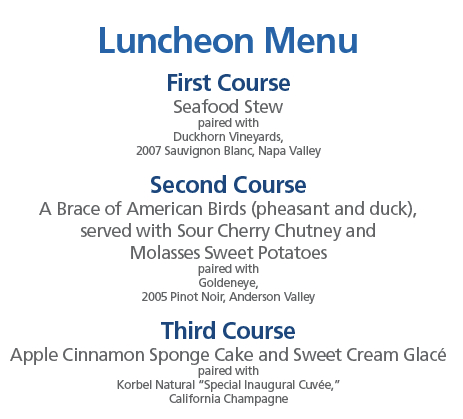
After the president takes the oath of office and delivers his Inaugural address and following the departure ceremony for the outgoing President, he will be escorted to Statuary Hall in the U.S. Capitol for the traditional Inaugural Luncheon. This is the menu:

Er, the first course will be served on replicas of the china from the Lincoln Presidency, which was selected by Mary Todd Lincoln at the beginning of her husband’s term in office. The china features the American bald eagle standing above the U. S. Coat of Arms, surrounded by a wide border of “solferino,” a purple-red hue popular among the fashionable hosts of the day.

How do I know all this? Why I visited the relevant Senate web site.