
Wanted: intellectual firepower

John Nagl has published a very perceptive review of Jonathan Stevenson’s book Thinking Beyond the Unthinkable: Harnessing Doom from the Cold War to the Age of Terror in which he contrasts the feeble resources currently devoted to thinking about countering the Al-Qaeda threat with the resources mustered by the US to ponder nuclear strategy in the Cold War. It’s easy now to ridicule the Dr Strangelove aspects of the doctrine of Mutual Assured Destruction, but the fact is that a great deal of deep thinking went into formulating a strategy for dealing with the threat of nuclear war. (And, btw, it also got us the Internet.)

Nagl’s (and Stevenson’s) point is that nothing comparable is going on in relation to the so-called ‘war’ on terror.

There are thousands of years of history to support the contention that deterrence works against states, and while the ruler of Iraq may have been a very bad man, there is little to suggest that he was anything but a rational political actor. Even if Saddam Hussein had gained control of nuclear weapons, self-preservation would have precluded him from using them, just as it had prevented a succession of Soviet leaders from unleashing this horseman of the apocalypse. Meanwhile, the risk that his proliferation would have been discovered and punished would have deterred him from giving nuclear weapons to sub-state actors, who had no territory at risk. September 11 did not, in fact, change everything, and one of the things that it did not change was the fact that states can be deterred.

Non-state actors, however, cannot be deterred so easily. Stevenson gets to this point about two-thirds of the way through Thinking Beyond the Unthinkable, and this is where the book begins to plow fertile new ground. The process by which Al Qaeda made the decision to attack the World Trade Center and the Pentagon is instructive:

“Al-Qaeda’s shura, or council, sharply debated whether the shock of attacking the World Trade Center and the Pentagon would be worth the probable loss of Afghanistan as a base, and ultimately was persuaded that it was. So the threat of devastating retaliation against territory that had proven so reliable a deterrent during the Cold war was unavailing against al-Qaeda’s most powerful leaders. They seemed to view not only the destruction of September 11 but also the robust U.S. response as a catalyst to a self-perpetuating and intensifying jihad that would somehow realize the group’s violent eschatological vision of an America destroyed. In that light, any feasible punishment administered by the United States was not merely futile but, in fact, inspiring to the jihadists.”

We now face enemies who not only are unconcerned that the fruit of their labors will be the destruction of everything they hold dear, but are absolutely gleeful at the idea. This is a new challenge, and not one which Kahn and Wohlstetter can help us with very much.

Nagl builds on this to say:

The challenge of radical Islam is not something to which the United States devoted much thought as it grew stronger, encouraged by a reaction to globalization and by some of our own foreign policy decisions. In a judgment some readers will likely take personally but is almost certainly true, former RAND President Harry Rowen said that before September 11, “The scholars of Islam available in the West–certainly in the United States–were a pretty sorry lot.” They did not, by and large, see this one coming.

Stevenson proposes creating a Federally Funded Research and Development Corporation, or FFRDC, dedicated to thinking about the Islamic terror threat in the same way that RAND thought about the Soviet nuclear threat. Stevenson suggests the Defense Advanced Research Projects Agency (DARPA) as a model.

Commenting on this, Nagl writes:

It is undeniably a good and long-overdue idea, with likely payoffs hugely exceeding the few hundred million dollars such an organization would cost the taxpayer every year. But beyond the basics, Stevenson is working from the wrong mould. RAND was so influential not least because it was the brains behind an enormously large and powerful set of muscles called the Strategic Air Command, where peace was a profession and war just a hobby; DARPA provides thinking that feeds the mammoth U.S. defense industry. Stevenson’s proposed think tank would need similar need bone and muscle. But unlike the Strategic Air Command or the Department of Defense, the muscle we need today would motivate soft power, rather than hard steel.

If the Bush regime had been really serious about it’s concept of a ‘war’ on terror, then they would have mobilised all the elements of U.S. national power — including the nation’s collective IQ. A moment’s reflection — or even a conversation with Philip Bobbitt — would have told them that they needed to address not just the intellectual dimensions of the problem but also the fundamental inadequacy of an international law of war designed to govern the conduct of war between states rather than the challenge of non-State actors.

A better policy therefore, Nagl argues,

would be an international conference leading to an updated Geneva Accords, focusing on state sponsors of terrorism. It would hold that any state that actively or passively enabled terrorist organizations acting on its soil would share responsibility for the terrorist activity, to include financial liability; states could also be held responsible for control of fissile material produced inside their borders. Because deterrence is a function of both capability to punish and credibility that threats will be fulfilled, an international consensus on state responsibility for terror would be far more useful than threats to attack Islam’s holy cities, without the added negative second-order effect of inspiring additional jihadis to fight us to defend them.

Great stuff.
Taking the long view of the banking crisis

In the last week I’ve been brooding about what lifted the US out of the Great Depression. The (terrifying) answer is: the Second World War. So you might say (I mused) that what we really need now is a bloody good war. Except of course that today’s wars do not require national mobilization (as we saw with the adventure in Iraq); they just require us to spend unconscionable amounts of public money on fancy kit. And then along comes this remarkable, long, thoughtful and persuasive piece by James Galbraith arguing that nobody — including Obama’s team — has the measure of the scale of the crisis yet.

Is there anything today that we might do that can compare with the transformation of World War II? Almost surely, there is not: World War II doubled production in five years.

Today the largest problems we face are energy security and climate change — massive issues because energy underpins everything we do, and because climate change threatens the survival of civilization. And here, obviously, we need a comprehensive national effort. Such a thing, if done right, combining planning and markets, could add 5 or even 10 percent of GDP to net investment. That’s not the scale of wartime mobilization. But it probably could return the country to full employment and keep it there, for years.

Moreover, the work does resemble wartime mobilization in important financial respects. Weatherization, conservation, mass transit, renewable power, and the smart grid are public investments. As with the armaments in World War II, work on them would generate incomes not matched by the new production of consumer goods. If handled carefully — say, with a new program of deferred claims to future purchasing power like war bonds — the incomes earned by dealing with oil security and climate change have the potential to become a foundation of restored financial wealth for the middle class.

This cannot be made to happen over just three years, as we did in 1942-44. But we could manage it over, say, twenty years or a bit longer. What is required are careful, sustained planning, consistent policy, and the recognition now that there are no quick fixes, no easy return to ‘normal,’ no going back to a world run by bankers — and no alternative to taking the long view.

A paradox of the long view is that the time to embrace it is right now. We need to start down that path before disastrous policy errors, including fatal banker bailouts and cuts in Social Security and Medicare, are put into effect. It is therefore especially important that thought and learning move quickly. Does the Geithner team, forged and trained in normal times, have the range and the flexibility required? If not, everything finally will depend, as it did with Roosevelt, on the imagination and character of President Obama.

This is a great piece — very long but worth the time and effort. Here’s another passage that struck me:

The most likely scenario, should the Geithner plan go through, is a combination of looting, fraud, and a renewed speculation in volatile commodity markets such as oil. Ultimately the losses fall on the public anyway, since deposits are largely insured. There is no chance that the banks will simply resume normal long-term lending. To whom would they lend? For what? Against what collateral? And if banks are recapitalized without changing their management, why should we expect them to change the behavior that caused the insolvency in the first place?

The oddest thing about the Geithner program is its failure to act as though the financial crisis is a true crisis — an integrated, long-term economic threat — rather than merely a couple of related but temporary problems, one in banking and the other in jobs. In banking, the dominant metaphor is of plumbing: there is a blockage to be cleared. Take a plunger to the toxic assets, it is said, and credit conditions will return to normal. This, then, will make the recession essentially normal, validating the stimulus package. Solve these two problems, and the crisis will end. That’s the thinking.

But the plumbing metaphor is misleading. Credit is not a flow. It is not something that can be forced downstream by clearing a pipe. Credit is a contract. It requires a borrower as well as a lender, a customer as well as a bank. And the borrower must meet two conditions. One is creditworthiness, meaning a secure income and, usually, a house with equity in it. Asset prices therefore matter. With a chronic oversupply of houses, prices fall, collateral disappears, and even if borrowers are willing they can’t qualify for loans. The other requirement is a willingness to borrow, motivated by what Keynes called the “animal spirits” of entrepreneurial enthusiasm. In a slump, such optimism is scarce. Even if people have collateral, they want the security of cash. And it is precisely because they want cash that they will not deplete their reserves by plunking down a payment on a new car.

The credit flow metaphor implies that people came flocking to the new-car showrooms last November and were turned away because there were no loans to be had. This is not true — what happened was that people stopped coming in. And they stopped coming in because, suddenly, they felt poor.

Strapped and afraid, people want to be in cash.

Obama’s ‘Katrina Moment’?

Further to my earlier musings, it seems to me that the growing public outrage in the US (and elsewhere, including the UK) about the behaviour and mores of the banking sector poses a serious risk to politics-as-usual. Although the analogy is regularly discounted by contemporary sages, I keep thinking of what happened in Germany during the Great Depression, when the perceived incompetence of the political establishment at a time of economic emergency provided fertile ground for the rise of Nazism.

The rising level of popular rage in the US poses a real challenge to the Obama administration. It will take consummate political skill to manage and assuage it. All the evidence we’ve seen so far suggests that (a) the president is the only person in the Administration who possesses those skills, and (b) that many of his key appointees don’t possess them in the smallest measure. A case in point is Larry Summers, who may have a four-digit IQ, but has the political and emotional sensibilities of a dead cat.

Frank Rich made this point in a terrific OpEd piece in the NYT today.

Bob Schieffer of CBS asked Summers the simple question that has haunted the American public since the bailouts began last fall: “Do you know, Dr. Summers, what the banks have done with all of this money that has been funneled to them through these bailouts?” What followed was a monologue of evasion that, translated into English, amounted to: Not really, but you little folk needn’t worry about it.

Yet even as Summers spoke, A.I.G. was belatedly confirming what he would not. It has, in essence, been laundering its $170 billion in taxpayers’ money by paying off its reckless partners in gambling and greed, from Goldman Sachs and Citigroup on Wall Street to Société Générale and Deutsche Bank abroad.

Summers was even more highhanded in addressing the “retention bonuses” handed to the very employees who brokered all those bad bets. After reciting the requisite outrage talking point, he delivered a patronizing lecture to viewers of ABC’s “This Week” on how our “tradition of upholding law” made it impossible to abrogate the bonus agreements. It never occurred to Summers that Americans might know that contracts are renegotiated all the time — most conspicuously of late by the United Automobile Workers, which consented to givebacks as its contribution to the Detroit bailout plan. Nor did he note, for all his supposed reverence for the law, that the A.I.G. unit being rewarded with these bonuses is now under legal investigation by British and American authorities.

Summers is not the only tone-deaf appointee Obama has made. Most of the key figures in his Administration are poster children of the US Ivy League meritocracy — the kind of kids who, in other circumstances, would expect to have had great careers in the investment banks and hedge funds and law firms that presided over the current disaster. They have little empathy with ‘ordinary’ Americans, and know little of routine politics as it’s conducted on the ground. As such, they are walking disaster zones at such a sensitive and tricky time. what Obama needs around him now are not just liberal policy-wonks and rocket scientists, but old-fashioned pols (like the late Tip O’Neill, or even, Goddam it, Lyndon Johnson).

What happened in Germany was that the rage, fear and frustration of ‘ordinary’ people was turned on what they saw as a myopic, impotent and insensitive political establishment which appeared to be unaware of their concerns. In the end, they turned on that establishment — and gave the Nazis their opportunity. Something similar is beginning to happen in the US, and it’s scary. The US may never have produced a Hitler. But it did produce Joe MacCarthy.

Obama names the United States’s CTO

From NYTimes.com

Perhaps not surprisingly, President Obama has formed a close friendship with the District of Columbia’s young, Blackberry-addicted, problem-solving mayor, Adrian Fenty. Now, the president has raided Mr. Fenty’s staff to name a youthful, Indian-born techno-whiz as his first federal chief information officer.

The White House said Thursday that it had selected Vivek Kundra, 34, the chief technology officer for the District, to the federal position, where he will be expected to oversee a push to expand uses of cutting-edge technology. He will have wide powers over federal technology spending, over information sharing between agencies, over greater public access to government information and over questions of security and privacy.

But he will also – as Mr. Obama mentioned twice in the space of a six-line comment distributed by the White House – look for ways to “lower the cost of government operations” through technology.

Mr. Kundra’s background seems to suit him well for both aspects of the job. Born in India, he lived in Tanzania until the age of 11, when he moved to the Maryland suburb of Gaithersburg. One of his first memories there, according to a profile last month in The Washington Post, was of seeing a dog-food commercial on television. “I was shocked,” he said. “I was used to seeing people starve in Africa. It was mind-boggling to me that people could afford to feed their dogs!”

I like the sound of this guy. For example,

In just 19 months with the District, Mr. Kundra has moved to post city contracts on YouTube and to make Twitter use common in his office and others. He hopes to allow drivers to pay parking tickets or renew their driver’s licenses on Facebook.

His office’s Web site offers a “Digital Public Square” with links to information on everything from crime to parking to tourism. It provides a map of free wi-fi hot spots, a public library finder, leaf-collection schedules; even a widget to view live snow-plow progress.

Good Morning Silicon Valley gave some more detail:

In his D.C. job, Kundra attracted attention with his embrace of all things Web 2.0, moving the district’s 38,000 employees off of Microsoft’s Office software and into Google’s cloud-based applications, encouraging the use of social channels like YouTube and Twitter, and turning to crowdsourcing for development of apps of use to taxpayers (or as he calls them, “co-creators”). Based on brief remarks to reporters today, Kundra plans to take the same approach on the federal level, shunning expensive customized systems where possible in favor of off-the-shelf software and services. In Washington, “when I left my place and went to the local coffee shop, I had more computing power in my hands than the average teacher, the average police officer, and the average public works official,” he said. “The reason was because the public sector decided it was so special that there was no way it would adopt consumer technology. … You have Darwinian innovation in the consumer space, and that fundamentally lowered our operating costs.”

Kundra is also intent on giving citizens greater access to the vast reservoirs of data collected by the government on their behalf — a move also gaining momentum in the House — to allow third-parties to mine, analyze and mash up the information in ways not possible now. “There is a lot of data the federal government has and we need to make sure that all the data that is not private, or restricted for national security reasons, can be made public,” he said. Kundra plans a new site, Data.gov, to serve as a repository.

Ambitious aims, given the legendary intransigence of the federal bureaucracy, but a definite signal that the days of business as usual are ending. Says Tod Newcombe at Government Technology: “Kundra’s blend of public- and private-sector experience also bodes well. His ability to think outside the box, combined with his understanding of politics are two highly touted skills that a government CIO needs to move IT projects forward in the federal bureaucracy jungle. Finally, Kundra’s enthusiasm for technology as a powerful enabler and transformer, not just as plumbing to keep static government programs alive, marks a sea change in attitude regarding the business of government in the 21st century. Dare we say a paradigm shift?”

Now just imagine who John McCain would have chosen for the post. Probably the CEO of SCO.
.

Wrecking America

If you’re wondering what motivates the Republicans in Congress who have opposed the Obama stimulus plan tooth and nail, then you aren’t alone. Mark Anderson is not only baffled; he’s furious.

The first inkling that, having literally destroyed America’s domestic and international well-being, the remaining GOP crowd were going to get even worse, came with the stimulus vote. It seems to have started with Rush Limbaugh, an embarrassing dinosaur on AM radio who seems now to be running the party, in lieu of anyone else raising their hand. “I hope he fails!” he shouted to his listeners the day of Obama’s inaguration.

Let’s look at that for a moment. Since then, Rush, a convicted drug addict and no sane person’s idea of a role model, has tried to back off of his statement, whining away that it was a defensive comment after all those bad things other people said about his boy, George Bush. Another lie, in a long series of lies. Why does he even bother? He said it, and he should be a man: stand by your word.

Today’s headline in the WSJ:

GOP Attacks Climate Plan as Too Costly

Let me say this clearly: since Reagan, by uniting the Christian Coalition with old-line Eisenhower Republicans in order to win the election, laid the seeds for the destruction of his own party, nothing really has changed. Bush Jr. forced the Christians to shut up during his opening convention, in return for getting lots of power later, and they went along: the convention did not mention abortion, there was no rancor on the floor, and the nation was split along abortion lines from then on.

Thanks, George.

What do Republicans stand for today? Well, in truth, they don’t have a clue. But some evil mind in their ranks is telling them that, in the midst of the greatest crisis perhaps ever faced by the nation, they should simply oppose whatever Obama and his party suggests.

Really?

Is that all you’ve got?

If that is all you’ve got, then what you are doing should be deemed illegal. You aren’t even trying to offer us a new path; you are just doing what you did for the last eight years: wrecking America.

Liberty on the march

Yesterday saw one of the most hopeful developments in years — the first nationwide meetings of the Convention on Modern Liberty. One of its driving spirits is my Observer colleague Henry Porter. In today’s paper he reflects on the experience and on why he’s putting himself through it.

More than once, I asked myself – why the hell are we doing this? Putting on a convention with more than 150 speakers in eight different cities across the United Kingdom at the same time as maintaining an alliance of about 50 organisations, not all of whom loved one another – or us – with the weaving, ducking and diving that entails can be demanding.

You begin to glimpse the morbid addictions that fill the life of the seasoned political campaigner. You find yourself developing skills of appearing to agree when you don’t, of smiling when irritated, of asking for money without the slightest shame, of reading and sending more emails than is recommended in a lifetime. Your language deteriorates and by degrees you morph into a version of Alastair Campbell, preoccupied by slights, losing friends fast and living off chocolate biscuits.

The best reason for doing it is — as Henry observes — Jack Straw, the most slippery authoritarian in modern British history. He’s currently Secretary of State for Justice, which just goes to show that satire isn’t dead. His most recent coup is the Coroners and Justice Bill, which contains measures that introduce secret inquests and would lift the ban on data sharing between ministries in the Data Protection Act.

Before the Convention (and the death of his son) David Cameron said that:

“When academics look back on Labour’s time in power the erosion of our historic liberties will surely be one of its most defining, and damning, aspects. Things we have long thought were part of the fabric of liberty in this country – such as trial by jury, habeas corpus with strict limits on the time that people can be held without charge, the protection of parliament against intrusion by the executive – have been whittled away.”

Cameron’s right. It’s difficult — as Andrew Marr said on TV this morning — to see the Tories as defenders of civil liberties, but if Cameron commits the party to a comprehensive rolling back of New Labour’s surveillance state then I’ll vote Tory.

En passant: Here’s an interesting web project for the next election. Create a website which asks every single parliamentary candidate whether s/he supports the plan for a National ID Card. Yes or No. And then post the answer on the site.

Here we go… again.

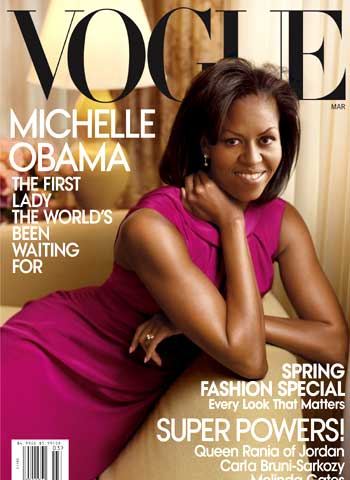
I’m a big Obama fan and am delighted that such a handsome couple have made it to the White House. But there’s something depressing about seeing Mrs Obama draped on the cover of the latest edition of the premier fashion rag. She’s a clever and interesting woman, but the glossy media are going to do their utmost to turn her into a clothes-horse. And it looks as though she’s playing ball. Sigh.

Photo by Leibovitz, naturally. Explains why she’s the only snapper in the world who can afford a private jet.

Steve Ballmer’s Speech to the Democrats

As some readers know (and others have probably guessed) there are lots of things about Microsoft that I dislike. But one thing I’ve always admired about the company is the fact that it’s never had any corporate debt. Bill Gates famously said once that he wanted Microsoft always to be able to run for an entire year without earning a cent in revenues. Until today, however, I didn’t know why he felt so strongly about that. Now, thanks to Mark Anderson, I do. He’s relayed the entire text of a speech Steve Ballmer gave the other day to the Democratic Caucus. Here’s the passage that made me sit up.

When I got to Microsoft and we were this tiny little company, we didn’t have the budget to put people up in hotels, so I lived with Bill. And every time I sat down, in every corner, nook and cranny of couches, tables, I’d find these little yellow pieces of paper with Bill’s writing that had a bunch of people’s names and companies’ names and numbers.

I think of myself as pretty good pattern matching… and I just couldn’t figure out what these numbers were.

So, finally I said to Bill, what is this? He says, Steve, I’m really always worried about whether we’re going to have enough cash to pay people. So, every night I write down everybody who works for us and how much we pay them, and every contract we have and how much it’s worth. I’ve got to count the pennies tightly and that’s why you’re here now.

It’s a great talk, which is essentially about how the US needs to reboot itself. And another interesting thing: he flew to the meeting on the red-eye scheduled flight, not in a corporate jet. A neat contrast to the automobile moguls, eh? And to the Citicorp execs.

The Blond Bombshell

Madeleine Bunting had a thoughtful column in yesterday’s Guardian about the search for political ideas following the implosion of Reaganite deregulated liberalism.

She focusses on Philip Blond, a theology lecturer at the St Martin’s College, Lancaster who in addition to writing a book on Thomas Aquinas is also apparently “giving David Cameron advice on progressive Conservatism”. It was his ideas, she says, “which peppered Cameron’s speech at Davos” and which has, apparently, infuriated Simon Heffer, the infant Tory columnist, who was apparently “apoplectic with fury last week as he lambasted it as terrifying, meaningless, obtuse and infantile”.

Blond may provoke fury and incomprehension on the Tory blogs, but party thinkers such as Oliver Letwin and David Willetts are intrigued. As are the more thoughtful on the Labour backbenches such as Jon Cruddas. Close watchers on the left acknowledge that Blond is opening up ‘potent political territory’ – territory that could go to the Tories but equally could be captured by another, or even a new, party.

The key to understanding Blond’s thinking is that he is reviving a long-neglected tradition of English radical conservatism that goes back to William Cobbett and John Ruskin and which last flourished before the second world war in the thinking of GK Chesterton and Hilaire Belloc. If you are thinking that this kind of stuff can hardly be relevant to our current predicament, think again. From this tradition emerged a passionate attack on both the power of the state and the power of big business. Belloc's argument in The Servile State was that both capitalism and socialism enslaved the masses to their dictates.

Blond picks up these strands of conservative communitarianism and links them to two current critiques. The first is an attack on his own party’s hallowed faith in Thatcherite economics: it’s bust, argues Blond, and led to a form of monopoly capitalism which enriched only a tiny oligarchy. The second is an attack on the managerial technocratic welfare state which has destroyed the mutualism of the working class – and here, he owes much to Ferdinand Mount’s thoughtful Mind the Gap. Third, he attacks liberalism for promoting atomised individualism and moral relativism (which will go down very well with the Daily Mail constituency).

It sounds like a big bag of tricks, and it is; some new, some old, some borrowed, and only some blue.

Bunting goes on to remind her readers that dear old Belloc was an admirer of Mussolini, which brings a useful touch of historical perspective to all this. The lesson of history is that economic turmoil usually brings political and ideological change. The big political question for the industrialised world is whether the new political ideas are civilising or barbaric. Watching Gordon Brown & Co (and Brian Cowen in Ireland) floundering in the wake of the credit crunch one is struck by the thought: is this what the hapless politicians of the Weimar Republic looked like to their electorate? Incompetent, corrupt and out of date.

Footnote: Just realised that Blond studied at Peterhouse — a famous kindergarten for conservative thinkers.