Henry Louis Gates: Déjà Vu All Over Again

As it happens, Henry Louis ‘Skip’ Gates is a Cambridge man (he did a PhD in English at Clare College), so my ears pricked up when I read about the fracas in which he was arrested for breaking into his own house in a leafy suburb of Cambridge, Mass. It turns out that the story also made Stanley Fish sit up and take notice. After which he wrote a terrific OpEd piece in the NYT.

I’m Skip Gates’s friend, too. That’s probably the only thing I share with President Obama, so when he ended his press conference last Wednesday by answering a question about Gates’s arrest after he was seen trying to get into his own house, my ears perked up.

As the story unfolded in the press and on the Internet, I flashed back 20 years or so to the time when Gates arrived in Durham, N.C., to take up the position I had offered him in my capacity as chairman of the English department of Duke University. One of the first things Gates did was buy the grandest house in town (owned previously by a movie director) and renovate it. During the renovation workers would often take Gates for a servant and ask to be pointed to the house’s owner. The drivers of delivery trucks made the same mistake.

The message was unmistakable: What was a black man doing living in a place like this?

At the university (which in a past not distant at all did not admit African-Americans ), Gates’s reception was in some ways no different. Doubts were expressed in letters written by senior professors about his scholarly credentials, which were vastly superior to those of his detractors. (He was already a recipient of a MacArthur fellowship, the so called “genius award.”) There were wild speculations (again in print) about his salary, which in fact was quite respectable but not inordinate; when a list of the highest-paid members of the Duke faculty was published, he was nowhere on it.

Gates went on to a tenured Chair at Harvard, which is where, presumeably, Obama got to know him. Fish goes on to link the episode (and the arresting policeman’s mindset) to the strange tribe of fanatics — the birthers — who are obsessed with trying to prove that Obama was not born in America but in Kenya, and is therefore ineligible to be president. Professor Gates committed the sin of being HWB (Housed While Black). Obama has committed an even bigger sin in the eyes of birther bigots — he’s not only WHWB but PWB.

This isn’t just a phenomenon in the US btw. I know from anecdotal evidence that one way to receive a lot of unwanted police attention in the UK is to be a black man driving a Porsche or an upmarket BMW.

So where is the alternative government?

Thoughtful Observer column by will Hutton.

The essence of democracy is alternative governments. After 13 years of New Labour, the country is ready for change. But the question it will and must ask is whether David Cameron’s Conservatives are the answer to Britain's problems. To jump from the frying pan into the fire would be stupid. Brown, like the tortured heroes of Shakespearean tragedies, is complex: he has strengths that partly compensate for his all too obvious flaws. One strength is that he is assembling an array of policies that are right. This, along with his astonishing tenacity, makes it so hard for his party to junk him. And here's the rub. The country may find it has the same difficulty.

One of the Conservative party’s problems is that it does not have the intellectual, political and philosophical wind at its back and it has no surefooted sense of what it should do as the economic and social crisis unfolds. Thus Boris Johnson’s London mayoralty in which little positive has been done. As somebody close to him acknowledged admiringly to me, Boris is the classic Tory. It is as important to occupy power, so denying its use to others, as to do anything constructive with it. That may excite Tory camp followers; others may feel that the point of power is to use it.

The size of the prospective budget deficit has given the Tory leadership a new confidence. The Conservatives’ task is to do what comes naturally: to take an axe to public spending and the regulatory arms of government like OfCom or the Financial Services Authority that displease the Tories’ natural constituencies, whether Rupert Murdoch or a stage army of City traders. Yet under Adair Turner, the FSA has begun to get serious about insider trading, investment banker bonuses and the structure of banks’ business models. Just as it gets its act together, it is to be disbanded and its powers handed to what City minister Paul Myners calls the “bookish” Bank of England, whose record of both spotting asset price bubbles and handling bank crises is dire. Thinking City people concerned about the dominance of speculative finance are shaking their heads in disbelief. Equally, Sky’s competitors and many consumers are no less dismayed that a champion of competition is to be abolished.

Onwards and downwards?

The report of Alan Milburn’s inquiry into social mobility in contemporary Britain is deeply depressing. It charts the extent to which this is an unequal society. As Ian Jack observes.:

Many of its statistics are shocking. Only 7% of the population attended private schools, but 75% of judges, 70% of finance directors, and one in every three MPs went to one. And unto those that hath, etc: among nine out of 12 professions examined, particularly medicine and the law, the proportion of entrants coming from well-off families has been increasing; doctors born in 1970, for example, typically grew up in families with an income nearly two thirds higher than the average. Connection matters. ‘Soft skills’ in interviews matter: how to be confident, how to please. Unpaid internships and work experience schemes, particularly in glamorous professions such as the media, tend to be monopolies of the well-connected. Milburn describes it as “the closed shop society”, with a geographic bias towards London and the south-east.

Jack is as astonished as I am by one finding of the report relating to the mainstream media:

Figures 1F and 1G in the report. The first shows that more than half of “top journalists” were privately educated. The second shows how this proportion has actually increased since the 1980s – alone among eight professional categories, including barristers, judges and vice-chancellors.

As far as this phenomenon is concerned, the decline of the print media looks like a consummation devoutly to be wished. Once the stranglehold of the print and journalistic unions was broken by Murdoch & Co, the closed world of British national newspapers was transformed into an environment tailor-made for shoehorning well-connected Oxbridge kids into cushy roles. With a bit of luck this agreeable system of outdoor relief will wither on the vine: these brats won’t find the online world quite so accommodating to folks whose main qualification is an assumption of entitlement and superiority.

But the wider problem laid bare with scarifying clarity by the Milburn report remains. And nobody — and this includes Milburn — has any real idea what to do about it.

Control, halt, delete

Excellent FT.com piece on the increasing number of countries which are controlling their citizens’ use of the Internet.

The number of such states is in the dozens, researchers say. In Burma and Moldova, governments recently resorted to pulling the plug on mobile phone networks amid unrest magnified by text messages; in Uzbekistan, there is widespread suspicion of internet monitoring but few ways to prove it. That is despite the fact that a lot of the surveillance and security software in the hands of governments across the world comes from western suppliers. In what is by its nature among the most globalised of industries, technology companies are seeing a revenue boost from governmental interest in data mining, search and storage products, though they periodically draw fire from activists for assisting repressive states.

The most gripping evidence of the change at hand has come from Iran. The theocratic regime has been in a protracted struggle over the free flow of information and communication with many of its largely young urban populace since the day after this month’s disputed election.

The piece focusses mainly on Iran and China, but it’s a good general survey.

Obama wakes up to Chinese Net-filtering demands

From today’s NYTimes

The Obama administration lodged a formal protest on Wednesday with the Chinese government over its plan to force all computers sold in China to come with software that blocks access to certain Web sites.

Commerce Secretary Gary Locke and Ron Kirk, the trade representative, sent a letter to officials in two Chinese ministries asking them to rescind a rule about the software that is set to take effect on July 1.

Chinese officials have said that the filtering software, known as Green Dam-Youth Escort, is meant to block pornography and other “unhealthy information.”

In part, the American officials’ complaint framed this as a trade issue, objecting to the burden put on computer makers to install the software with little notice. But it also raised broader questions about whether the software would lead to more censorship of the Internet in China and restrict freedom of expression.

“China is putting companies in an untenable position by requiring them, with virtually no public notice, to pre-install software that appears to have broad-based censorship implications and network security issues,” Mr. Locke said in a news release. The government did not release the text of the letter…

Hmmm… It’s good news that the US government is beginning to take a real interest in this. But I wonder how it will play out.

FOOTNOTE: The research report on Green Dam by Scott Wolchok, Randy Yao, and J. Alex Halderman is here. The Abstract reads:

We have discovered remotely-exploitable vulnerabilities in Green Dam, the censorship software reportedly mandated by the Chinese government. Any web site a Green Dam user visits can take control of the PC.

According to press reports, China will soon require all PCs sold in the country to include Green Dam. This software monitors web sites visited and other activity on the computer and blocks adult content as well as politically sensitive material.

We examined the Green Dam software and found that it contains serious security vulnerabilities due to programming errors. Once Green Dam is installed, any web site the user visits can exploit these problems to take control of the computer. This could allow malicious sites to steal private data, send spam, or enlist the computer in a botnet. In addition, we found vulnerabilities in the way Green Dam processes blacklist updates that could allow the software makers or others to install malicious code during the update process.

We found these problems with less than 12 hours of testing, and we believe they may be only the tip of the iceberg. Green Dam makes frequent use of unsafe and outdated programming practices that likely introduce numerous other vulnerabilities. Correcting these problems will require extensive changes to the software and careful retesting. In the meantime, we recommend that users protect themselves by uninstalling Green Dam immediately.

In other words, this isn’t just about the Chinese government’s repressive Internet policy. It potentially affects every Internet user because Green Dam could make it possible to turn the Chinese Internet into a gigantic botnet.

End the Lobby cartel

One of the most pernicious conspiracies between Westminster politicians and journalists is the ‘lobby’ system. In an interesting article in the Independent, Tom Watson, the former Minister for Digital Engagement, thinks that abolishing the lobby system is one of the first things a new Speaker should do.

Driven by the decreasing space allocated to Parliament in their papers, lobby journalists report only a fraction of Westminster discussions. Where, for example, can you read of recent debates on extreme solar events or addiction to prescription medicines? These and others were not reported because they were not the big story of the day – and all because a cartel of political editors convened over afternoon tea to decide that this was so.

Last month, Sri Lanka was the big story. This month, alas for the Tamils, it wasn’t. So Siobhain McDonagh’s debate on 12 June over the plight of 300,000 Tamil refugees was barely noticed.

The 238 pass-holding lobby journalists do not have an outlet for lesser stories, so they end up, pack-like, having to chase the same one or two stories each day.

Yet it is a stark reality of life in the internet age that parliamentary reporting no longer has to be constrained by column inches. The new Speaker should log on to see what is possible. See, for example, Ispystrangers.org. There you will read of discussions as wide-ranging as NHS provision in Cornwall and job losses on a missile range in South Uist.

The problems for the lobby are also compounded by absurdly out-of-date “you must wear a tie in the gallery” rules.

David Miliband has called for an end to unattributable briefings. He’s right. In the internet age there is no such thing as a secret. Over the next few months I will argue for a technologically enabled democracy, from e-petitions to digitally encoding each clause and amendment to every Bill. This will further open up Parliament.

Crack open the lobby cartel. Let in a new generation of online commentators. Share access to lobby briefings with a more diverse group of reporters. Rip up the lobby rules and put all briefings on the record. Do this, and a new Speaker can genuinely be part of a new era of accountability.

Can’t see this idea appealing to the Lobby hacks. After all, it would mean that they would have to do some real reporting, and wear out some real shoe-leather.

Police face prosecution for obstructing photographers

Hooray! At last some sense of proportion. This from Press Gazette.

Lord Carlile QC, who reviews anti-terror legislation, said officers who use force or threats against photographers to make them delete images could face prosecution themselves.

Section 58A of the Counter-Terrorism Act, which came into force in February, bans photographers from taking pictures of the police if the photographs could be useful to terrorists.

Lord Carlile said this was a "high bar" and should not be used to interfere with day-to-day photography of officers which is "as legitimate as before".

One photographer wrote to him to complain about being forced to delete an image from his camera of an officer on traffic duty.

In his annual review of anti-terror laws, Lord Carlile said: “It should be emphasised that photography of the police by the media or amateurs remains as legitimate as before, unless the photograph is likely to be of use to a terrorist. This is a high bar.

“It is inexcusable for police officers ever to use this provision to interfere with the rights of individuals to take photographs.

“The police must adjust to the undoubted fact that the scrutiny of them by members of the public is at least proportional to any increase in police powers – given the ubiquity of photograph and video-enabled mobile phones.

“Police officers who use force or threaten force in this context run the real risk of being prosecuted themselves for one or more of several possible criminal and disciplinary offences.”

About time.

Sunlight, not PDF, is the best disinfectant

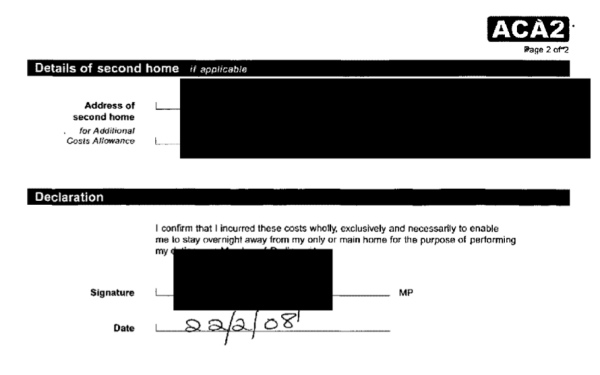
So Parliament has finally published the data on MPs’ allowances. Except, of course, that it hasn’t, really. Here’s an example: a part of the ‘return’ for Margaret Moran, the MP for Luton South:

Note that there’s no way of determining where her second home is. It’s the same story as one wades through her ‘receipts’. For example:

The more I look at this stuff, the more I appreciate how much old-style journalistic digging the Telegraph did. Knowing the address of Moran’s second home was just the starting point. So to denounce the Telegraph revelations as mere ‘cheque-book journalism’ is spectacularly to miss the point.

Oddly enough, this is also a case where networked journalism would have worked — if the data had been out there in non-censored form then we could have crowd-sourced the investigation of individual MPs.

UPDATE: The Guardian is already crowdsourcing the job. I’ve just spent a happy hour poring through the expenses returns of Ben Wallace, the Tory MP for Lancaster and Wyre. Wonder why he spends so much money on (a) IT services and (b) ‘executive’ cars.

Sugaring the pill(ock)

One of the strangest things about Gordon Brown is the gulf between his fantasies about having a ‘vision’ and his pathetic appetite for gimmicks. The latest is his appointment of ‘Sir’ Alan Sugar as the government’s ‘Enterprise Czar’. Apart from the ludicrousness of thinking that this one-dimensional celebrity might be able to address anything as complex as industrial policymaking, there is the small matter of the way his acceptance of a post on Brown’s sinking ship compromises the independence of the BBC. So it’s good to see that the Tories are taking up the case.

The Conservatives today launched a concerted attempt to scupper the appointment.

Jeremy Hunt, Shadow Culture, Media and Sport Secretary, said: “Presenting a programme for the BBC and working for the Government on the same issue is totally incompatible with the BBC’s rules on political independence and impartiality. Sir Alan Sugar needs to make a choice between his role in The Apprentice and his role as the Government’s business tsar.

“I have written to Sir Michael Lyons and asked him as a matter of urgency to explain who at the BBC gave guidance to Sir Alan and whether he had informed them that he would be a Labour peer.”

John Whittingdale, chair of the Culture Select committee of MPs, said: “In my view it is not possible for him to continue to present The Apprentice at the same time as he is so closely identified with the Government.

“I had assumed that by accepting the role as Enterprise Czar he would stand down from his role in The Apprentice.

“His show is all about business and enterprise. He will be making recommendations on policy to Government. He is already a political figure – he has made no secret of his admiration for Gordon Brown.

“Either he is an influential figure in Government or this is just window dressing.”

If the BBC Trust dodges this, then some of us licence-fee payers might have to take some online action involving Sir Michael Lyons’s email inbox. After all, according to the Charter, the purpose of the BBC Trust is

“to work on behalf of licence fee payers, ensuring the BBC provides high quality output and good value for all UK citizens, and it protects the independence of the BBC”.

I haven’t yet been able to locate the Chairman’s personal email address, but for starters there’s always trust.enquiries@bbc.co.uk

UPDATE: The Observer reports that:

Government insiders say ministers have been wrangling about who should take responsibility for the feisty businessman and star of The Apprentice. “No one wants to have him,” said one source.

Sugar’s appointment was announced with great fanfare by the prime minister in his cabinet reshuffle, but a spokeswoman from Lord Mandelson’s Department for Business, Innovation and Skills confirmed that he would have no staff and no office there.

“We want him to go out and meet small businesses and report what he’s seeing. He’s not in the government, he’s just an adviser,” she said.