
Lisa Benson’s Christmas cartoon.
Category Archives: Asides

Brendel bows out
Alan Rusbridger, Editor of the Guardian and a keen pianist, made the pilgrimage to the Musikverein in Vienna for Alfred Brendel’s last public performance. He’s written a lovely account of the event.
At 8.13pm on Thursday night, one of the greatest pianists of his, or any, age sat down to play in public for the last time. Alfred Brendel spread his tails behind him, adjusted the stool and, for the final time, beamed his readiness to the conductor.
Two weeks before his 78th birthday, he was ready to bring down the final curtain while still at something like the peak of his powers. To choose such a moment of finality is, for a pianist, a comparatively rare thing. Arthritis gets some in the end; others die in harness; for some, the phone gradually stops ringing. Brendel decided he would rather be in control of the moment. His chosen exit was characteristic. Not for him a last Prospero-style pronouncement – not Beethoven's Op 111 or Schubert's D960, but instead, a youthful Mozart piano concerto, K271 in E flat.
There were demands for encore after encore, as you’d expect. In the end,he played
Liszt’s Au Lac de Wallenstadt. In an irony that would not have escaped him (he has written a poem on the subject), he played to the accompaniment of a ghostly mobile phone ringtone for a few bars.
He had first played Liszt in this hall 51 years ago. These last minutes marked not only the end of his career, but the severing of the thread that links generations of the great instrumentalists.
At the end of all the appplause – perhaps 20 minutes in all – Brendel smiled with what looked like a surge of relief and gestured down into the audience, which included all four of his significant pupils: Kit Armstrong, Imogen Cooper, Paul Lewis and Till Fellner. He seemed to be saying, “That’s me. Now it’s over to you.” And so the baton was passed on to the next generation. For Brendel, the rest is – in public, at least – silence.
Oh to have been there.
Concepts of ‘authority’ in a networked world

Strange paradox about the web: it’s a space in which anyone can become a global publisher, so, in theory you’d expect that blogs would have readerships distributed according to a normal distribution, with most blogs having an ‘average’ number of readers. In practice, of course, it doesn’t work out like that at all — as Clay Shirky observed a long time ago, blog readership follows a Power Law distribution, with a relatively small number of blogs having large readerships, and most blogs (the long tail of the distribution) having tiny audiences.
This fact — which, as I say, has been common knowledge for a long time — has led to occasional outbreaks of (generally clueless) mainstream media speculation about the “death of blogging”. I’ve argued that this is an idiotic misreading of the statistics. The main value of the blogosphere, IMHO, resides in the long tail, not in the small number of super-blogs with huge audiences.
Nevertheless, the tendency to confuse numbers with authority continues to flourish. The latest outbreak concerns Twitter, the ‘micro-blogging’ social networking service. As far as I can see, the firestorm was started by Loic de le Meur* in a blog post arguing that the search facility in Twitter was useless because it didn’t filter results. “What we need”, he wrote,
“is search by authority in Twitter Search. Technorati had nailed it years ago by allowing searches filtered by number of links the blogger had. It would be very easy for Twitter to add an authority line in their search criteria, with the number of followers so that you can search for say, only people who have more than a thousand followers and see what they say. React as fast as you can for criticism from them. It is not a criteria for being smart or not, but clearly a criteria for how fast something can spread.”
This touched a raw nerve, with lots of prominent Twitterers logging vociferous objections.
For example:
Robert Scoble: “Here’s why it’s a stupid idea: everyone is gaming the number of followers. And, even if everyone weren’t, popularity on Twitter isn’t a good way to measure whether a Tweet is any good or not.” [Ok, but it is a good way of determining how loud that message was]
Dave Winer: “I think it’s a bad idea.”
Sarah Lacy: “No one could be this nakedly egotistical and self-serving.” [this one was my personal favorite. Sarah is clearly worked up over this idea.]
Steven Hodson: “some-one like me with next to no followers wouldn’t even rate showing up in search results even if I started to topic being searched for” [no, only if someone turned that filter on in the search]
Sam Harrelson: “I think this is a terrible idea.”
MG Siegler: “this absolutely would ruin one of the most compelling things about Twitter: That it’s completely democratic.”
The fundamental problem here is le Meur’s concept of ‘authority’. What he really means is ‘influence’. And a rather limited kind of influence at that. For example, he cites an interesting experiment that he conducted:
Comments about your brand or yourself coming from @techcrunch with 36000 followers are not equal than someone with 100 followers. Most people use Twitter with a few friends, but when someone who has thousands, if not tens of thousands of followers starts to speak, you have to pay attention.
Brands do pay attention and already start understanding the difference. We made the experiment with Ben Metcalfe. I started complaining that Sprint was not offering the new Blackberry (they still don’t, I want a BB Bold with worldwide unlimited data) on Twitter and minutes later a Sprint representative contacted me and offered me VIP customer service. I loved it. For the experiment, @dotben started also complaining about the same issue (and really would love a Bold too, it was true) but nothing happened for Ben. Why not? Sprint understood that I have nearly 10x the number of followers of Ben so I had to be answered immediately, even with my weird last name no one can pronounce.
This is influence all right. But it’s not authority. It’s the same kind of influence that big newspapers and broadcasters wield. It’s the kind of influence that enables Stephen Fry to destroy the credibility of the BlackBerry Storm in a couple of critical tweets. So we need to unpack the concept of ‘authority’.
One way of doing that is to go back to Steven Lukes’s wonderful book in which he argues that power can take three forms: 1. the ability to force you to do what you don’t want to do; 2. the ability to stop you doing something that you want to do; and 3. the ability to shape the way you think.
In my experience, the last interpretation comes closest to describing the authority of the blogosphere’s long tail. It’s got nothing to do with the number of readers a particular blog has, but everything to do with the intellectual firepower of the blog’s author. That’s why I pay attention to Ed Felten, Tony Hirst, Nick Carr, Bill Thompson, Richard Posner, Dave Winer, Quentin Stafford-Fraser, Martin Weller, Lorcan Dempsey, Larry Lessig, Andrew Brown, Jeff Jarvis, Charles Arthur and a host of others. Their importance to me derives not from the number of readers they have (though some have large audiences) but from the fact that they are original, well-informed, thoughtful people.
Which brings me to Twitter. I find it a valuable service, but think that for for most people one’s Twitter_index (i.e. the ratio of those you follow to those who follow you) ought to hover around 1.0. (As I write, my index is 78/78, i.e. 1.0, but it varies slightly from time to time.) Otherwise one gets into the online celebrity, power-law nonsense that le Meur describes. My tweets are ‘protected’ — that is to say you need my permission to see them, and I only agree to a ‘follower’ request if the person seems to me to be interesting — so my ‘authority’ (in de Meur’s sense) will continue to be minuscle. Since many of the requests come from PR firms or marketers who are clearly eyeing my role as an Observer columnist, that’s just fine by me. I’d prefer to be taken seriously by my 78 ‘followers’ than to have the power to make T-mobile pay attention to the fact that unless they come up soon with the BlackBerry Bold on their network then I shall have to get an iPhone from O2.
Footnote: * Apologies to Loic for mis-spelling his name.
Later: Jeff Jarvis picked up on this and usefully extends it.
Le Meur’s not wrong when he tries to find a way to express and calculate the idea that it’s not the author who holds authority but his or her audience. But his critics are also right when they say that number of followers won’t get him there. I think there is no easy measure, but if it exists it will be found instead in relationships: seeing how an idea spreads (because it is relevant and resonates) and what role people have in that (creating the idea, finding it, spreading it, analyzing it) and what one thinks of those people (when MrTweet.net tells me that John Naughton follows someone, I’ll see more authority in that than, say, whom Robert Scoble follows – no offense, Robert – because Naughton is so highly selective). That is what the totality of the press-sphere will also look like as various players add varying value to add up to a whole (and in 3D, the sphere will look different to each of us, so one-size-fits-all measurements will become even more meaningless).
Jeff also points out that the obsession with metrics that has surfaced again in discussions about the “death of blogging” is a carry-over from an age of mass media:
In mass media, of course, big was better because you had to be big to own the press: Mass mattered. We still measure and value things online according to that scale, even though it is mostly outmoded. Indeed, we now complain about things getting too big – when, as Clay Shirky says, what we’re really complaining about is filter failure. That is why Loic Le Meur suggested filtering Twitterers by their followers; he’s seeking a filter.
The press was the filter. And the press came to believe its own PR and it conflated size with authority: We are big, therefore we have authority; our authority comes from our bigness.
“The last thing we need or want in the web”, he concludes, “is Nielsen ratings”.
Right on!
.
The giddy social whirl
Like me, Andrew Brown doesn’t live in London. Like me, he has found himself having to go to a series of Xmas parties in the Big Smoke. But he has more stamina than me. One night recently, for example, he went to no fewer than three parties — one at the Swedish Embassy, one in the Travellers’ Club in Pall mall and one in a night-club.
And so to the last train back from Liverpool St, caught with a minute to spare: young man in a suit in that stage of drunkenness where all the small muscles of the face have gone, and a kind of long-jawed chimpanzee mask lolls on the neck; a carton of takeway curry with lots of rice splashed all over the floor by the doors to the carriage; the middle-aged man, also in a suit, who pushed past me out of the lavatory had just been copiously sick inside it. In the middle of the carriage, two jolly fat blondes in miniskirts and sombreros who looked up every time I passed them as if expecting conversation … outside, at Audley End, a hard frost and the noise of scraping windscreens carrying across the car park.
Been there, done that, got the tee-shirt. And one wonders afterwards why one does it? I suppose it’s called ‘networking’. Twitter’s easier. And cheaper.
Link.
On this day…
… in 1979, Soviet forces invaded Afghanistan. Big mistake, currently being repeated by US and its allies.
Going, going…
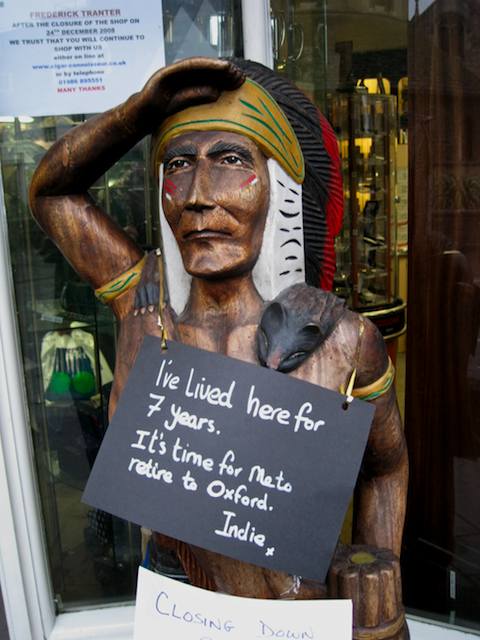
Snapped outside Cambridge’s last remaining cigar shop. End of an era. When I came here as a student there were three specialist tobacconists.
Cookery lesson #153

Carbon sequestration. Or what happens when you put a muffin in the Aga oven and then forget about it.
Happy Christmas!
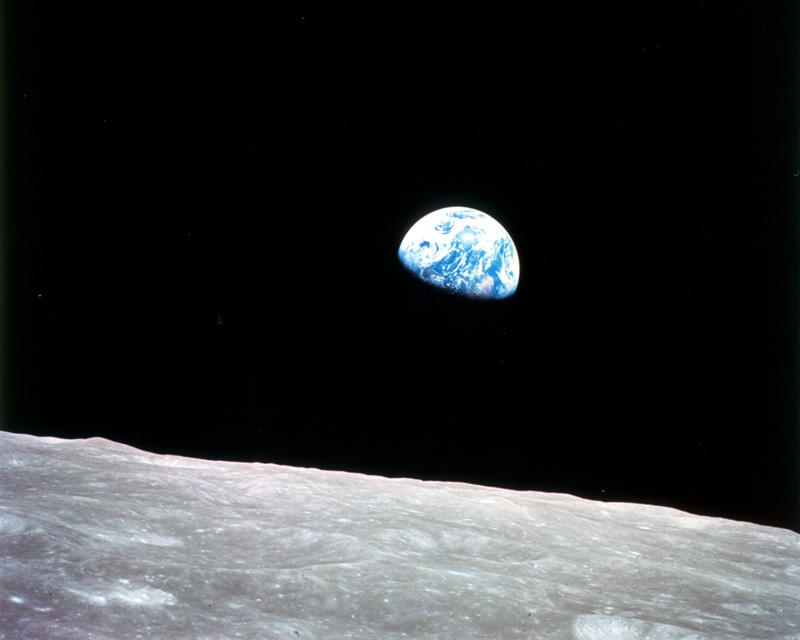
Earthrise at Christmas — taken taken by the Apollo 8 crew in December 1968. Possibly the most influential photograph ever taken. Certainly it changed the way many of us see our home planet. Click on image to see a larger one.
Creating docs within Googlemail
Just discovered (via the Gmail Blog) that if you have keyboard shortcuts enabled (and Gmail.com registered as an exception to the ‘block pop-up windows’ preference) then hitting ‘g’ followed by ‘w’ opens a Google doc. Very useful.
Friedman: Rebooting America
The NYT man reflecting on the squalor of JFK Airport after a spell abroad.
All I could think to myself was: If we’re so smart, why are other people living so much better than us? What has become of our infrastructure, which is so crucial to productivity? Back home, I was greeted by the news that General Motors was being bailed out — that’s the G.M. that Fortune magazine just noted “lost more than $72 billion in the past four years, and yet you can count on one hand the number of executives who have been reassigned or lost their job.”
My fellow Americans, we can’t continue in this mode of “Dumb as we wanna be.” We’ve indulged ourselves for too long with tax cuts that we can’t afford, bailouts of auto companies that have become giant wealth-destruction machines, energy prices that do not encourage investment in 21st-century renewable power systems or efficient cars, public schools with no national standards to prevent illiterates from graduating and immigration policies that have our colleges educating the world’s best scientists and engineers and then, when these foreigners graduate, instead of stapling green cards to their diplomas, we order them to go home and start companies to compete against ours.
To top it off, we’ve fallen into a trend of diverting and rewarding the best of our collective I.Q. to people doing financial engineering rather than real engineering. These rocket scientists and engineers were designing complex financial instruments to make money out of money — rather than designing cars, phones, computers, teaching tools, Internet programs and medical equipment that could improve the lives and productivity of millions.
For all these reasons, our present crisis is not just a financial meltdown crying out for a cash injection. We are in much deeper trouble. In fact, we as a country have become General Motors — as a result of our national drift. Look in the mirror: G.M. is us.
That’s why we don’t just need a bailout. We need a reboot.
There’s an interesting (and ironic) echo here of the famous observation made by a GM executive in a Congressional hearing. According to the Wikipedia entry for General Motors:
In 1953, Charles Erwin Wilson, then GM president, was named by Eisenhower as Secretary of Defense. When he was asked during the hearings before the Senate Armed Services Committee if as secretary of defense he could make a decision adverse to the interests of General Motors, Wilson answered affirmatively but added that he could not conceive of such a situation “because for years I thought what was good for the country was good for General Motors and vice versa”. Later this statement was often misquoted, suggesting that Wilson had said simply, “What’s good for General Motors is good for the country.” At the time, GM was one of the largest employers in the world – only Soviet state industries employed more people. In 1955, General Motors became the first American corporation to pay taxes of over $1 billion.