Xmas time on the Cote d’Azur

This painting, ‘Christmas Time in the South of France 1922’ by John Duncan Fergusson, was the most striking image I took away from a disappointing Royal Academy exhibition, ‘Painting the French Riviera’. As the Guardian’s critic, Jonathan Jones put it, what we got was “a pedantic obsession with the geography of France’s southern coast” in which “artists get rewarded for which bit of it they painted”.
Quote of the Day
”You can turn an aquarium into fish soup, but can you turn fish soup back into an aquarium?”
- Nicholas Colin
This is the question that faces the Democrats in the US as they return to power and have to start clearing up the mess created by Trump.
Musical alternative to the morning’s radio news
Status Quo | Whatever You Want – Glastonbury Festival 28-6 2009
Terrific performance. Must have been great to be there.
Long Read of the Day
John Hersey and the horrors of Hiroshima
This essay by Iain MacGregor on how one journalist’s account of the Hiroshima bombing and its aftermath, told through the eyes of Japanese survivors, forced the world to reckon with the terrifying power of nuclear weapons. It’s the best thing I’ve read in a while, and a reminder of why journalism matters. It’s a long read, but worth it.
Sample:
When the war finally ended and the world staggered into the uneasy light of 1946, John Hersey was exhausted in ways he could barely articulate. He had reported from crumbling cities, frontlines and bombed ruins. He had watched soldiers die with dirt in their teeth, civilians sift through rubble for the remains of homes, and generals rationalise carnage as necessity. But there was one place he had not yet been, one scene of devastation that existed for him only in second-hand cables and official statements: Hiroshima. And in January 1946, the New Yorker’s William Shawn – renowned for his gentle, soft‑spoken character, one that belied an unyielding moral purpose – began quietly imagining a way to get Hersey there.
By the spring, the plan had hardened. Shawn believed the world needed a different kind of account of the atomic bomb, something free of euphemism, abstraction or triumph, unlike that of the Truman administration and the heroes of the now well-known Manhattan Project led by General Leslie Groves and its scientific director Professor J. Robert Oppenheimer. Reports were filtering through of survivors of the bombings at Hiroshima and Nagasaki dying mysteriously from a myriad of cancer-related illnesses. Shawn wanted Hersey to get there and form his own opinion, believing that he would be the perfect person to cover the story. In a Manhattan café, Hersey accepted without fanfare. He understood what the assignment implied: to bear witness to an event that America, in its relief at victory, was already mythologising…
Read on.
Books, etc.
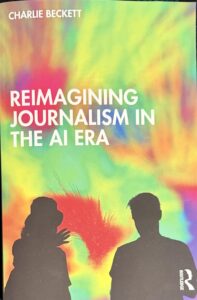
Charlie Beckett is an experienced journalist who made the transition to becoming a professor (so, like me, he “has a foot in both graves”, as my former Editor-in-Chief, Conor Cruise O’Brien, once put it to me). He and I shared a platform at a student event in Cambridge last week, during which he suddenly produced his latest book, like a conjuror pulling a rabbit out of a hat!
What’s immediately interesting about it is that it’s not rooted just in the Anglosphere, as much commentary currently is. And it concludes with five possible scenarios on how things might turn out in the AI/Journalism space. I haven’t had a chance to read it yet, but someone who has — Chris Moran, the Guardian’s Head of Editorial Innovation — has, and this is what he says:
What makes the book essential is not just its range and breadth but its central provocation: that in an age of AI the human element becomes more important, not less. The book’s argument — that curiosity, craft, and connection are precisely the qualities journalism must reclaim — comes at a time when the field needs guidance from grounded research rather than glittering buzzwords.
Amen to that.
My commonplace booklet
The FT’s Will Loyd spent five days attending CHOGM (Commonwealth Heads of Government Meeting) in Antigua and wrote a fabulous piece of sceptical reportage about it under the headline “Is this how the Commonwealth ends?” Here’s his closing para:
The Commonwealth was a ghost ship, set on its course a long time ago by British leaders humbled by the end of their empire and unsure of their future. There was only one point of agreement I found about this vessel, after five days trapped inside its bowels: it had “potential”. It was, in the King’s words, “a unique opportunity”. Confronted by the Commonwealth senescence, observers and true believers alike mistook its infirmity for growing pains. Just give it a few more years. Never say never. The Commonwealth might really matter one day.
I’m afraid I’ve never been able to see the Commonwealth as anything other than “Empire LITE”, which used to irritate some of my friends who really believed in it. Imperial afterglow dies hard.
The Jensen Huang corner
From the *New York Times.
It has been a hard week, even for the thick-skinned.
The news that Jensen Huang, a co-founder of Nvidia, admitted to an affair with a woman whom U.S. intelligence regards as a Chinese spy has shaken not only Silicon Valley and geopolitics. It also has been an earthquake for the leather-jacket-wearing community.
We ask ourselves: Was Mr. Huang an easy mark because of his love of high-fashion, motorcycle-adjacent jackets that say both “I don’t care what people think!” and “Do you like how I look?” Did our — I mean, his — armor make him a target? Is an expensive leather jacket on a middle-aged man the new symbol of a honeypot victim?
Without any authorization whatsoever, because that would go against our rebellious grain, I’m speaking out on behalf of the leather-jacket community. We are washed-up musicians and we are dads just trying to feel something again and we are people who want others to assume that we own a Ducati Panigale. And we are here to defend the leather jacket’s name and honor.
We declare: One man’s fleshly failures should not impugn our second skins. They say not to throw out the baby with the bathwater. Well, similarly, don’t throw out the baby lambskin with the horny human body beneath…
Quite right too. He has besmirched all those middle-aged guys who like to pretend that buying a motorbike gives them charisma.
Errata
Thanks to Quentin, Will Parker and dozens of other justifiably annoyed engineers for me getting Ohm’s Law wrong on Monday. Voltage is equal to Current multiplied by Resistance. V=I x R.
Helpings of humble pie have been ordered.
This Blog is also available as an email three days a week. If you think that might suit you better, why not subscribe? One email on Mondays, Wednesdays and Fridays delivered to your inbox at 5am UK time. It’s free, and you can always unsubscribe if you conclude your inbox is full enough already!