
Who do you think your are?
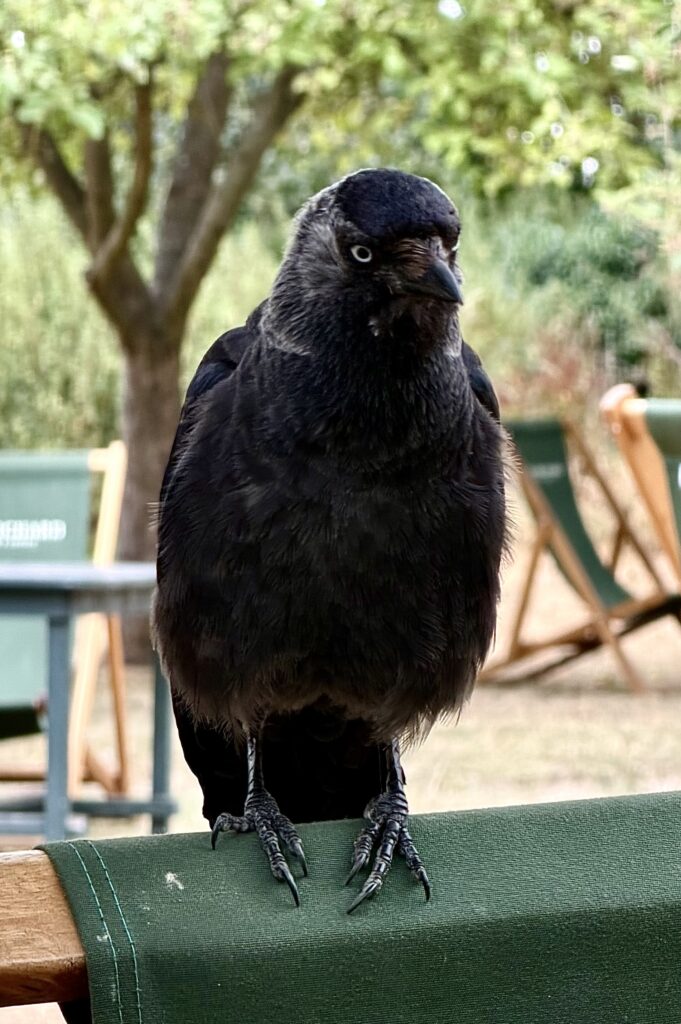
Sitting quietly by myself in the garden of the Orchard in Grantchester yesterday, I was joined by this teenage Jackdaw, who gave me a hard stare. So I stared back and he kindly posed for his portrait.
Quote of the Day
”Let us do something, while we have the chance”.
- Vladimir, in Waiting for Godot.
This could be a good motto for American electors, coming up to the mid-terms.
Musical alternative to the morning’s radio news
Fergus O’Farrell | Something right
Long Read of the Day
Lionel Messi and the Baby in the Bassinet
As I was clearing away all the pieces about the World Cup that I’d collected during the competition I came on this essay by Michael Ignatieff on two great footballers, Lionel Messi of Argentina and Lamine Yamal of Spain, on whether great stars deserve fame and fortune.
When talent of such an extraordinary kind is in play, we enter a magic realm where normal rules and expectations cease to apply. Which is why we watch: we want our side to win, but just as much, we are held in our seats by the possibility of the unexpected, the unplanned, the instant of talent that transforms everything.
Extraordinary talent in any field—football, science, literature, art—always is a reminder to the rest of us that what makes human beings unique is that there are singular individuals among us. In no other species do singular individual members of the species do so much to define who we all are. Their achievements, whether in sport, science or art, set the expectations for everyone who comes after them. Doubtless, the attention and training provided these two young men at La Masia helped mature their talent, but their coaches knew, from the start, that these two had a prodigious natural talent. Their fans worship these talents and believe that they and other supreme sports stars deserve to be paid vast sums to display it.
This attitude towards the incorrigible inequality among individual human beings stands in contrast to the resentment we feel towards other social, economic, gender and racial inequalities. We admire and reward outsized individual talent, while we resent any outsized advantage that arises from birth, wealth, race, class or gender. The unearned privileges of ‘nepo-babies’, children born to fame or fortune, strike us as unjust and awaken resentment and scorn…
It’s an interesting piece which eventually gets to the hard problem that arises when siblings in the same family have greatly different abilities.
But it also reminded me of the way Messi choose to ignore the savage thuggery of his teammates after the final whistle. Instead of taking responsibility and using his status to help moderate their behaviour, he chose to sit sorrowfully on his own on the ground, thereby attracting most of the media attention from what was going on elsewhere. He may be a great footballer, but at that moment he looked like an irresponsible human being.
Books, etc.
Nolan’s Odyssey (contd.)
From Semafor:
Christopher Nolan wants you to see The Odyssey in 70mm, if you can manage to thwart crowds and scalpers to get a ticket — and that’s been a boon for IMAX and its oversized screens. In an earnings call Thursday, CEO Rich Gelfond said the film’s $52 million global opening weekend, sans South Korea, China, and Japan, was the biggest of its kind in the company’s history, with IMAX screens accounting for less than 1% of Odyssey showings but driving 20% of the film’s debut. A “fan frenzy” has pushed theater occupancy rates to “unheard-of” levels, he said, with Odyssey screenings selling out as many as seven or eight weeks into the film’s run and cinephiles packing the seats as early as 7 am.
As young consumers crave IRL experiences, audiences’ overwhelming enthusiasm has even carved out a new market for IMAX merch, Gelfond said: Popcorn buckets in the shape of the company’s famously cumbersome cameras sold out online in minutes.
My commonplace booklet
I’d been watching Searching for Sam, Adrian Dunbar’s fine BBC documentary about Samuel Beckett and was suddenly transported back to Ken Tynan’s unforgettable Observer review of the London premiere of Waiting For Godot. It was published in 1955, when I was a kid growing up in rural Ireland, and so I only discovered it in 1990 when I bought A View of the English Stage, a collection of Tynan’s columns. I can still remember the moment I came on the review, and how I was blown away by it. This, I thought, is what criticism is for: to illuminate a great work of art for those of us who are curious but can’t quite figure it out.
Maybe this excerpt gives an idea of what I mean.
A special virtue attaches to plays which remind the drama of how much it can do without and still exist. By all the known criteria, Samuel Beckett’s Waiting for Godot is a dramatic vacuum. Pity the critic who seeks a chink in its armour, for it is all chink! It has no plot, no climax, no denouement, no beginning, no middle, and no end. Unavoidably, it has a situation, and it might be accused of having suspense, since it deals with the impatience of two tramps waiting beneath a tree for a cryptic Mr. Godot to keep his appointment with them; but the situation is never developed, and a glance at the programme shows that Mr. Godot is never going to arrive. Waiting for Godot, frankly, jettisons everything by which we recognize theatre. It arrives at the customs-house, as it were, with no luggage, no passport, and nothing to declare; yet it gets through, as might a pilgrim from Mars. It does this, I believe, by appealing to a definition of drama much more fundamental than any in the books. A play, it asserts and proves, is basically a means of spending two hours in the dark without being bored.
Its author is an Irishman living in France, a fact which should prepare us for the extra, oddly serious joke he now plays on us. Passing the time in the dark, he suggests, is not only what drama is about, but also what life is about. Existence depends on those metaphysical Micawbers who will go on waiting, against all rational argument, for something which may one day turn up to explain the purpose of living. Twenty years ago, Mr. Odets had us waiting for Lefty, the social messiah; less naively, Mr. Beckett bids us to wait for Godot, the spiritual signpost. His two tramps pass the time of day just as we, the audience, are passing the time of night. Were we not in the theatre, we should, like them, be clowning and quarreling, aimlessly bickering and aimlessly making up – all, as one of them says, ‘to give us the impression that we exist’…
I was the Observer’s TV critic for eight years (and am still writing for the paper) but the thing that most delighted me when I was offered the role was the thought that giants like Tynan had been there before me.
This Blog is also available as an email three days a week. If you think that might suit you better, why not subscribe? One email on Mondays, Wednesdays and Fridays delivered to your inbox at 5am UK time. It’s free, and you can always unsubscribe if you conclude your inbox is full enough already!