
Norman Conquest 2.0

The British Museum in Bloomsbury, seen on a rainy afternoon a while back (when Britain still could make the rains run on time). From today it’s the temporary home of the Bayeux Tapestry which depicts events leading up to the Norman Conquest of England, which I’ve always thought must be the most thorough colonisation in European history. The tapestry will be exhibited from 10 September 2026 to 11 July 2027.
Quote of the Day
”Sex is like money; only too much is enough.”
- John Updike
Musical alternative to the morning’s radio news
Alison Krauss | When You Say Nothing At All
Wonderful!
Long Read of the Day
Chip Off The Old Block
There are two kinds of people in the world — those who have children and those who don’t. The latter group, especially when they congregate online, tend to have very definite ideas about how children should be brought up which, when you think about it, is a bit like Trappist monks having strong opinions on alternatives to the missionary position in intercourse.
The former group know that bringing up children is like perpetually sitting an exam and failing, or at least not getting full marks. I speak with some authority on this question, for I have four kids and although they’re all grown up and fledged I still worry about them. And as I get older is suppose they will worry about me. That’s life.
One public intellectual I had always assumed would not become a parent is Scott Alexander, who is (and has been for years) one of the most interesting bloggers around. I discovered the other day that he has become a parent and looked forward to his reflections on the experience. And lo! — he has begun to write about it here.
It’s lovely. Here’s a sample:
When I was young, my OCD was much more disabling. The worst was my closet door. I had to close it seven times every night before I was satisfied. It’s been decades since I was that bad; my children can’t know anything about it. But lately, my son has taken to obsessively closing the door to the cabinet in his room at night. One evening, after he must have shut it ten or twenty times, I almost yelled at him: “COME ON! YOU KNOW YOU ONLY HAVE TO DO IT SEVEN TIMES!” But maybe he doesn’t know; maybe the genetic transmission isn’t that high-fidelity.
The good news is that all of this gives me a new ally in all my little quarrels with my wife. I’m hypersensitive to being startled when I’m drifting off to sleep; I used to grumble whenever my wife made a tiny amount of noise, and she would grumble about my grumbling, and finally we learned to compromise at some level that worked for both of us. But now it’s great! Whenever my wife makes a tiny amount of noise around bedtime, my son will wake up and scream, and he literally doesn’t know the meaning of the word “compromise”. As a result, everything is much quieter. Except for the screaming.
Or: I get irrationally annoyed if someone leaves a room without closing the door, but it’s fine, it would be weird to bother people about it, it would seem too confrontational to conspicuously get up and close the door, so I just take a deep breath and forget about it. Except that now I don’t have to, because my son immediately gets up from whatever he’s playing with and closes the door for me.
The bad news is that my daughter has inherited all of my wife’s traits, so now it’s 2-2. My room and my son’s room are spotless – my son refuses to sleep if there’s even one toy on the floor. My wife’s and daughter’s room look like a trailer park after a tornado. To my son and my dismay, they both hum wherever they go…
He’s already sitting the exam.
Books, etc.
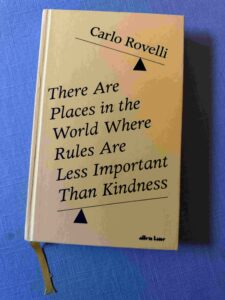
As someone who’s written 50 newspaper columns a year since the mid 1980s, I have a keen interest into other labourers in the same vineyard, partly because a newspaper column is a particular kind of literary artefact — something you sculpt to fit into whatever space your Editors have allocated rather than construct to a blueprint — and it’s interesting to see how others do it.
Umberto Eco, who in addition to being a best-selling novelist and a serious literary scholar also had a charming column in a major Italian newspaper, L’Espresso. I was first alerted it to it by a wonderful column in which he compared the Apple Macintosh with the IBM PC, a metallic box with a text-based screen which ran under the MS-DOS operating system.
“I am firmly of the opinion”, he wrote, in La bustina di Minerva” (“Minerva’s Matchbook”), published on September 30, 1994.
that the Macintosh is Catholic and that DOS is Protestant … It is cheerful, friendly, conciliatory, it tells the faithful how they must proceed step by step to reach – if not the Kingdom of Heaven – the moment in which their document is printed. It is catechistic: the essence of revelation is dealt with via simple formulae and sumptuous icons. Everyone has a right to salvation.
DOS is Protestant, or even Calvinistic. It allows free interpretation of scripture, demands difficult personal decisions, imposes a subtle hermeneutics upon the user, and takes for granted the idea that not all can reach salvation. To make the system work you need to interpret the program yourself: a long way from the baroque community of revelers, the user is closed within the loneliness of his own inner torment.”
Carlo Rovelli is also Italian and cut from the same cloth. In his case he’s a distinguished physicist, but also a someone who writes for newspapers. This little book collects 50 of his essays in a volume that’s a delicious travelling companion.
“An article in a newspaper”, he writes in the preface,
has something in common with a Japanese koan or a European sonnet: limited in size and form, it can transmit little more than one piece of information, a single argument, one reflection, a single emotion. And yet it can speak about everything and anything.
The pieces collected here, which were published in various newspapers over the last decade, speak of poets, scientists and philosophers who have influenced me in some way, of travels, of my generation, of atheism, of black holes, telescopes, psychedelic experience, intellectual surprises … and much else. They are like brief diary entries recording the intellectual adventures of a physicist who is interested in many things and who is searching for new ideas – for a wide but coherent perspective.
It’s a delight.
My commonplace booklet
Worship me at the office altar: Why narcissistic leaders resist remote work
This is a long academic article that caught my eye. It’s on Open Access, which means that anyone can read or download it. It caught my eye because I’ve been puzzled about why some organisations are still so hostile to allowing employees to work from home.
The title gives the game away. The basic findings of the research are that (i) narcissistic leaders (executives, middle managers, supervisors) tend to resist remote work; and (ii) that their resistance stems from the fact that remote working interferes with their need for power and status.
As far as I know, there is no cure for narcissism, even when the sufferer is President of a powerful country.
This Blog is also available as an email three days a week. If you think that might suit you better, why not subscribe? One email on Mondays, Wednesdays and Fridays delivered to your inbox at 5am UK time. It’s free, and you can always unsubscribe if you conclude your inbox is full enough already!