
Street scene, London
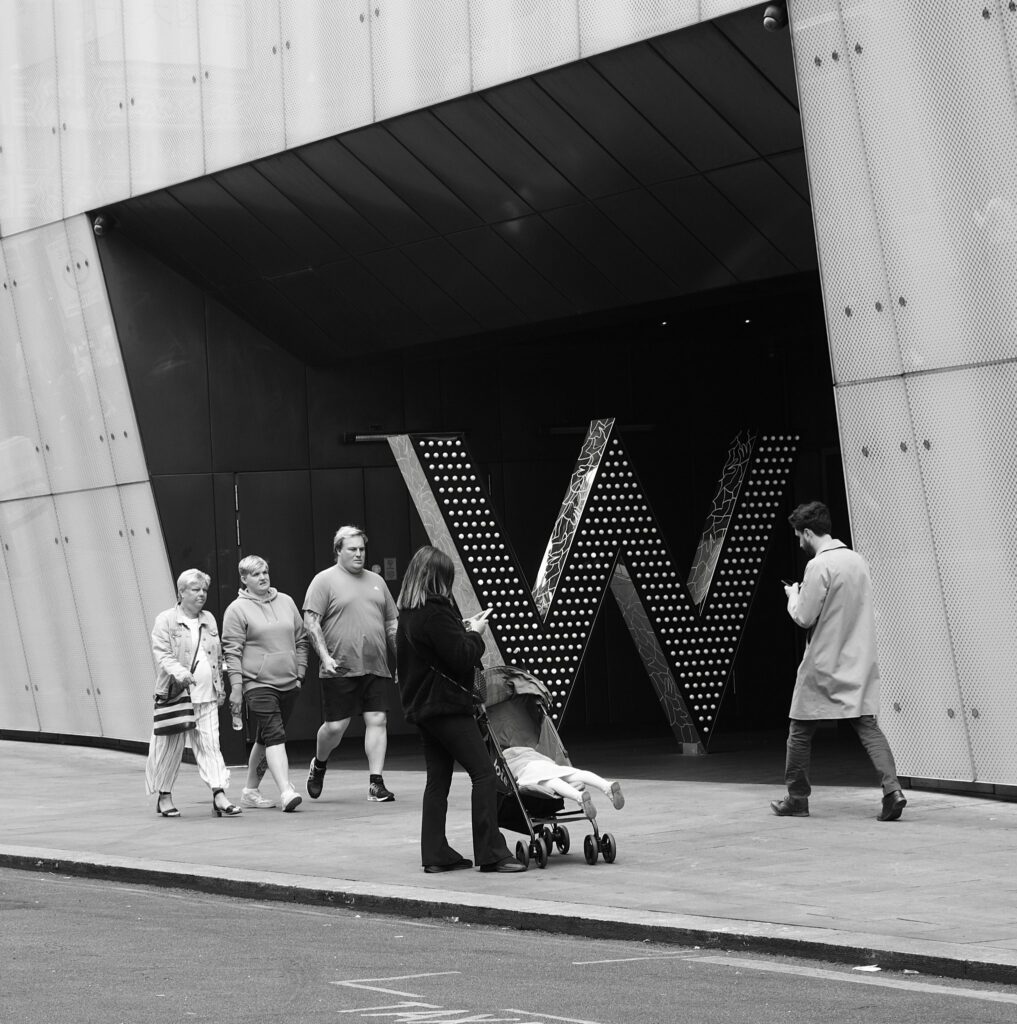
Snatched in true Cartier-Bresson style. And in B&W too.
Quotes of the Day
The American republic celebrated its so-called 250th birthday on Saturday.
Here are two excerpts from speeches marking the occasion.
First, Trump, speaking in Dakota near Mount Rushmore.
Our American ancestors did not shed their blood at Concord and Trenton, Gettysburg and Shiloh, Midway and Normandy, just so that a band of thieves, radicals, and lunatics could come in and loot and pillage our nation. Our heroes died to win, build, and to save, and to build truly a great country, the greatest country ever in the world.
So, on the eve of this 250th anniversary of American heritage, we resolve and swear for all to hear that the citizens of the United States of America will vanquish communism quickly. Don’t let them take too much of your time. You know they’re wasting your time, don’t you?
But we’re not going to let them take too long or too much of our time as they play their games and send them into exile. We will send them quickly away and we will continue to build our country bigger and better and stronger than ever before. America will never be a communist country.
We can only lose the midterms if we allow ourselves to lose the midterms if we are foolish, stupid, and unwise. But if we terminate the filibuster as we should do and immediately vote for the Save America Act, then we will not lose an election for 100 years.
We do that. We’re not going to lose an election for 100 years. The Communist Party is made up of illegal immigrants, criminals, and everybody that doesn’t want to work. Communism is a loser. It always was, and it is right now.
Then Zohran Mamdani, Mayor of New York.
”We see a city of contradictions within a nation of contradictions. We see the wealthiest country in the history of the world — one where children go to sleep hungry while the world’s first trillionaire hungers for more. We see monopolies that dominate every industry and oligarchs who buy elections. We see masked agents terrorizing our streets, eating food cooked by our undocumented neighbors before spiriting them away in unmarked vans. We see a nation whose immense wealth has been built by those with calloused, dirt-streaked hands — those who toil on factory floors and chisel into stone — and we see a nation that has allowed so much of that wealth to be held instead in the soft hands of a precious few.”
Interestingly, as Francis Fukuyama pointed out in the FT, the United States was not created until final ratification of the Constitution, which did not happen until 1789.
The Constitution that gave birth to the country 13 years later made no mention of either human equality or of democracy. It provided for a complex separation of powers that would guard against a centralised state with tyrannical authority.
So what Trump was celebrating was the more or less complete breakdown of that ‘separation’ of powers that has happened on his watch.
Musical alternative to the morning’s radio news
Abdullah Ibrahim | Whoza Mtwana
Long Read of the Day
The Anguish of Choice
Long but fascinating Aeon Essay by Skye C. Cleary on one of the most remarkable public lectures of the 20th century — Jean-Paul Sartre’s talk on “Existentialism is a Humanism”.
On 29 October 1945, the philosopher Jean-Paul Sartre emerged alone from the Paris Métro. He was about to deliver a lecture titled ‘L’existentialisme est un humanisme’ (‘Existentialism Is a Humanism’) at the Club Maintenant. No one had any idea it was going to become one of the most famous lectures of the 20th century. As Sartre walked towards the venue, he saw a huge crowd of people gathered outside. He wondered if Communists were protesting him and whether he should go home. He pushed ahead – really only because he’d made a professional commitment.
While the crowd parted for celebrities, no one knew what Sartre looked like. He didn’t tell anyone who he was, and as he slowly nudged his way towards the front, he was jostled about by brutal scrimmages for seats. The room was overheated and overcrowded. Fifteen people collapsed. An hour late, Sartre climbed to the stage to defend existential philosophy against his critics and argue that existentialism is a humanism. He had no notes, his hands remained in his pockets, but he was well prepared. He said what he came to say and then left.
The hosts of Sartre’s lecture, Jacques Calmy and Marc Beigbeder, had a modest budget. They bought simple ads in newspapers. Their wives posted fliers in Latin Quarter bookstores. Calmy worried: ‘With a title like that! Existentialism!’ Just two months earlier, Sartre had publicly stated: ‘My philosophy is a philosophy of existence; I don’t even know what Existentialism is.’ (Still, Simone de Beauvoir writes in her autobiography: ‘In the end, we took the epithet that everyone used for us [existentialism] and used it for our own purposes.’) Along with recent accusations that Sartre’s novel Nausea (1938) was anti-humanist, they hoped the title might at least be a ‘paradoxical provocation’.
The morning after the lecture, Sartre met with Beigbeder at Sartre’s unofficial office, the Café de Flore. Beigbeder apologised for the chaos, and explained that, between advertising, space rental and the damage to club – including 30 broken chairs and a destroyed box office, meaning that they were unable to sell tickets – they were having trouble coming up with the payment they’d promised Sartre. Sartre had read the morning papers over coffee and croissants and interrupted: ‘As for my fee, forget it! Besides, it looks like we were a success!’
One headline read ‘Too Many Attend Sartre Lecture. Heat, Fainting Spells, Police. Lawrence of Arabia an Existentialist’. The papers reported ‘elbow fights’, ‘nonexistential angst’ and ‘a No Exit situation’ where the mob feared ‘dying of suffocation’. Critics accused Sartre of being ‘too scholarly’, but he was charismatic. His ‘cool’, his ‘courage’, his ‘grit’ and the force of his presence were striking.
By the autumn of 1945, the atrocities of the Second World War had been exposed: the gas chambers, the camps, the friend betrayals, and the avalanches of banal evils. Beauvoir, Sartre’s lifelong partner, wrote that people ‘had discovered History in its most terrible form.’ Sartre was popular because, according to Beauvoir, ‘there existed, at least at first glance, a remarkable agreement between what he was offering the public and what the public wanted.’ In post-liberation Paris, people realised they needed to reconstruct both their buildings and their moral foundations…
If, like me, you were once fascinated by Sartre but found him hard going, then this piece is a delight.
My commonplace booklet
In recent years I’ve got out of the habit of flying, partly because of a dislike of airport security theatre and general hassle. But last week I had to fly to and from Ireland for a funeral. On both flights I had a window seat and so fell into meditating on what I could see from that vantage point.
Which of course mainly consisted of clouds, which have always been an interest of mine because I’m a keen photographer who is constantly on the lookout for interesting cloudscapes. But I also had to do some thinking about them when I was preparing a lecture on “The Materiality of AI” for the Royal Geographical Society back in February. It turns out that the idea of the cloud (as in ‘cloud computing’) does a lot of heavy lifting in obscuring the weight of the industry’s footprint on the planet.
When you think about it the cloud — a soft fluffy object — is a brilliant metaphor for concealing the hard reality of a technology that is powered by submarine cables and data centres.
But in actual fact a real cloud is something that does exactly the opposite: it makes a physical reality — water vapour — visible.
This was brought forcibly brought home to me on both of last week’s flights. As the aircraft began its descent to its destination it had to break through dense banks of cloud. And as it hit them it perceptively shuddered: heavy object going fast meets physical resistance.
So I did some digging. It seems that an inch of rainfall falling on an acre of ground deposits 3,630 cubic feet of water on the surface. That’s about 103 metric tonnes, or the weight of two fully loaded articulated trucks. When you think about it in those terms, delightful fluffy clouds pack quite a punch
This Blog is also available as an email three days a week. If you think that might suit you better, why not subscribe? One email on Mondays, Wednesdays and Fridays delivered to your inbox at 5am UK time. It’s free, and you can always unsubscribe if you conclude your inbox is full enough already!